Why Emulsions Separate Over Time: What It Means for Your Skincare and Makeup
You open a moisturiser and find a layer of oil on top, or shake a foundation that has settled into a thick paste at the bottom and a clear liquid above. Is the product ruined, or is this just what happens to creams over time?
Part of our guide to makeup how-to. Start with: What Can You Use to Make Your Makeup Stay On All Day? 9 Products and Tricks
Most creams, lotions and liquid foundations are emulsions: tiny droplets of oil dispersed in water, or water dispersed in oil, held together by emulsifiers. Emulsions are never permanently stable. Over time, droplets rise or sink, clump together and merge, and eventually the oil and water can split into separate layers. Heat, cold, freezing, light, air, age and contamination all speed this up. Some separation is expected, such as pigment settling in a foundation that says shake well or a bi-phase remover designed to sit in two layers. But a cream that has split, changed smell or colour, or become grainy or watery has usually broken down and should be replaced.
Knowing the difference between normal settling and a broken emulsion helps you avoid throwing away good products and, more importantly, avoid using ones that have gone off.
The FDA notes that cosmetics can deteriorate over time and that storage conditions such as heat and exposure to air can shorten their useful life, which is exactly what drives emulsion breakdown.
This guide explains how emulsions work, why they separate, which types of separation are normal and how to store products so they last.
Shopping these picks?
Amazon Prime members get fast, free shipping on eligible items, plus Prime Video, Amazon Music and member deals. New members can start with a free trial.
Start a free Prime trialAged 18 to 24? Prime for Young Adults comes with a longer free trial and a lower price after it.
Affiliate link: we may earn a commission at no extra cost to you.
Recommended Stable Creams, Bases and Bi-Phase Products




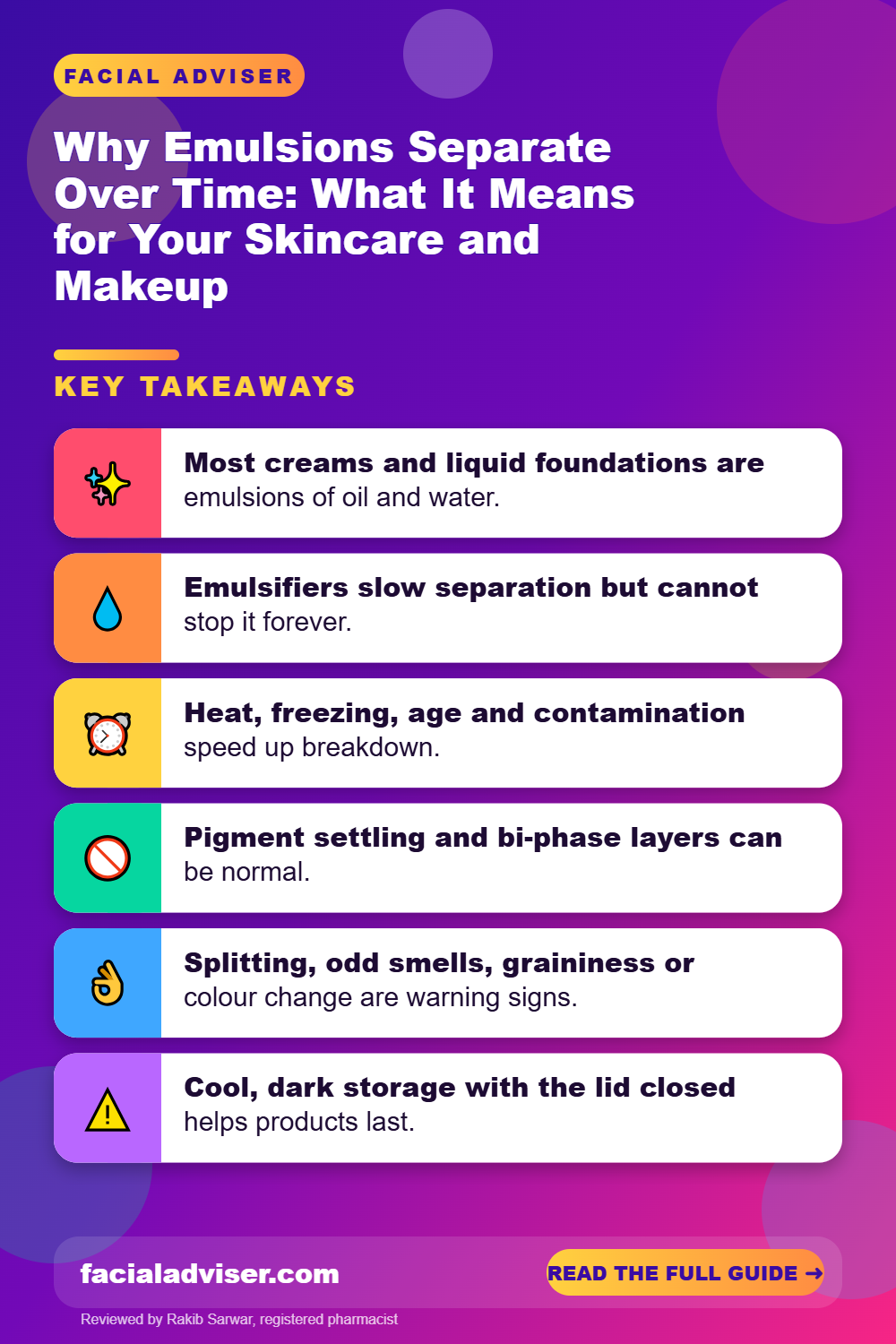
At a Glance
- Most creams and liquid foundations are emulsions of oil and water.
- Emulsifiers slow separation but cannot stop it forever.
- Heat, freezing, age and contamination speed up breakdown.
- Pigment settling and bi-phase layers can be normal.
- Splitting, odd smells, graininess or colour change are warning signs.
- Cool, dark storage with the lid closed helps products last.
- When in doubt, throw it out.
Contents
- What an Emulsion Is
- Why Emulsions Separate
- What Speeds Up Separation
- When Separation Is Normal
- How to Check a Separated Product and Decide Whether to Keep It
- Signs a Product Has Gone Bad
- Separation and Preservatives
- How to Store Emulsions So They Last
- Dos and Don’ts
- Honest Limits
- When to See a Doctor
- Common Questions
- The Bottom Line
What an Emulsion Is
Oil and water do not mix on their own. Stir them together and they soon separate again because oil droplets are attracted to each other and repelled by water. An emulsion is a mixture where one liquid is broken into tiny droplets and spread through the other.
Emulsifiers make this possible. They are molecules with one end that likes water and one end that likes oil. They sit at the surface of each droplet, forming a protective layer that stops droplets from merging. Thickeners such as gums, polymers and waxes make the surrounding liquid more viscous, which slows the droplets down.
| Type | Structure | Feel | Typical products |
|---|---|---|---|
| Oil-in-water | Oil droplets in water | Light, fresh, absorbs quickly | Lotions, most moisturisers, many foundations |
| Water-in-oil | Water droplets in oil | Richer, more water-resistant | Night creams, barrier creams, some long-wear bases |
| Water-in-silicone | Water droplets in silicone | Silky, smooth, long-wearing | Many primers and long-wear foundations |
| Bi-phase (not emulsified) | Separate oil and water layers | Shaken just before use | Waterproof makeup removers, some serums |
Our guide on silicone versus water-based cosmetics explains how the base of a product affects how it feels and layers.
Why Emulsions Separate
Emulsions are thermodynamically unstable, which means that given enough time they will always try to return to separate layers. Formulators use emulsifiers and thickeners to slow the process down so a product stays stable for its expected life, but several processes still happen gradually.
- Creaming and sedimentation: lighter oil droplets drift up and heavier particles such as pigments sink down. This is often reversible with shaking.
- Flocculation: droplets cluster together loosely without merging. The texture may look uneven.
- Coalescence: droplets merge into bigger drops. This is usually permanent and leads to visible oil.
- Phase separation: the emulsion fully splits into oil and water layers.
Once droplets start merging, the process speeds up because bigger droplets move and merge faster. That is why a product can seem fine for months and then change quite quickly.
Droplet size matters too. Formulas with very small, evenly sized droplets, created by high-shear mixing during manufacturing, are usually more stable than those with larger, uneven droplets. This is one reason why two creams with similar ingredients can have very different shelf lives.
Separation is a physical change. It does not automatically mean a product is contaminated, but a broken emulsion often goes hand in hand with a weakened preservative system and changes in how the product performs.
What Speeds Up Separation
| Trigger | What it does | How to avoid it |
|---|---|---|
| Heat | Thins the formula and speeds droplet movement | Keep away from radiators, cars and sunny windows |
| Freezing and thawing | Ice crystals break the emulsifier layer | Do not leave products in freezing cars or luggage holds |
| Repeated temperature swings | Stresses the structure | Store at steady room temperature |
| Air and light | Oxidise oils and some emulsifiers | Close lids tightly; choose opaque or pump packaging |
| Contamination | Microbes can break down ingredients | Use clean hands or a spatula; do not add water |
| Age | Gradual droplet merging | Use within the period after opening |
Steamy bathrooms combine several of these: warmth, humidity and temperature swings. Moving creams and foundations to a bedroom drawer or cupboard often helps them last longer. The same applies to products kept on a sunny windowsill or dressing table, where daily warming and cooling can stress the formula without you noticing.
Stability testing is how brands predict and prevent these problems before a product is sold. Our guide on the importance of stability testing explains how formulas are checked for heat, cold and time.
When Separation Is Normal
Not every layer or change means a product has gone bad.
- Shake-well foundations and sunscreens: pigments and mineral filters are heavy and settle over time. If shaking restores a smooth, even texture, the product is usually fine.
- Bi-phase removers and serums: these are designed to sit in two layers and must be shaken just before use.
- A thin film of liquid on a new cream: a small amount of syneresis, where a little liquid seeps out of a gel, can happen in some gel creams and usually stirs back in.
- Natural oil and butter products: balms and butters can develop a slightly grainy texture if they melt and resolidify. This is a texture change rather than spoilage, though it can feel less pleasant.
Brand-new products can also show slight settling if they have been sitting in a warehouse or shop for some time. A quick shake usually solves it. The key question is whether the product returns to its original look, smell and feel after a gentle shake or stir, and whether it still performs as it should.
How to Check a Separated Product and Decide Whether to Keep It
Check the label
See whether it says shake well or is designed as a bi-phase product.
Shake or stir gently
Use a clean spatula for jars; shake bottles for 10 to 20 seconds.
Look at the texture
It should look smooth and even, not grainy, curdled or watery.
Smell it
Any sour, rancid, musty or unusual smell is a sign to discard it.
Check the colour
Darkening, yellowing or spots suggest oxidation or contamination.
Check the date
Compare with the period-after-opening symbol and when you opened it.
Patch test if unsure
If it passes all checks but you are still unsure, try a small area first, or replace it.
Write the date you opened a product on the base with a marker. It makes it much easier to judge whether separation is a sign of age.
Signs a Product Has Gone Bad
Separation that does not reverse, especially combined with other changes, usually means the product has broken down.
- Oil pooling on top that will not mix back in.
- A curdled, lumpy, grainy or watery texture.
- A sour, rancid or unusual smell.
- Colour change, dark spots or visible mould.
- Stinging or irritation that did not happen before.
- Foundation that looks patchy or streaky despite shaking.
Do not use a product with mould, a sour smell or visible contamination, especially around the eyes. Using contaminated cosmetics can cause skin or eye infections.
The FDA’s guidance on shelf life and expiration dating of cosmetics explains that products can deteriorate before their expected shelf life if stored improperly, and that eye products in particular should be replaced regularly.
Separation and Preservatives
Water-based emulsions need preservatives to stop bacteria, yeast and mould from growing. When an emulsion breaks down, preservatives can become unevenly distributed, with some areas less protected than others.
Contamination can also cause separation. Microbes can break down emulsifiers and thickeners, which is one reason a contaminated product often looks, smells and feels different all at once.
Our guide to which cosmetic preservatives are mild explains how products are protected and why preservative-free water-based products carry a higher risk.
How to Store Emulsions So They Last
Store creams, lotions and foundations at steady room temperature, away from heat, direct sunlight and steamy bathrooms. Close lids and caps tightly after every use.
Use a clean spatula for jars rather than dipping fingers in, and never add water to thin a product. Pump and airless packaging protect products better than open jars.
Shake-well products benefit from being stored upright and shaken for a few seconds before each use, rather than only when you notice settling. Regular gentle mixing keeps pigments evenly spread so each application matches the last.
When travelling, keep products in your carry-on rather than in a car boot or checked luggage that may get very hot or cold. If a product has frozen, let it return to room temperature slowly and check it carefully before using.
Refrigeration is not usually necessary and can cause some emulsions to thicken, crystallise or separate. Follow the label; only store products in the fridge if the brand recommends it.
Dos and Don’ts
Worth Doing
- Shake products labelled shake well
- Store at steady room temperature
- Use a clean spatula for jars
- Write the opening date on products
- Replace anything that smells or looks wrong
Skip It
- Keep creams in a hot car or steamy bathroom
- Let products freeze
- Add water to thin a product
- Use separated eye products
- Keep using a product that now stings
Honest Limits
It is not always possible to tell by looking whether a product is contaminated. A product can look normal and still carry microbes, and a product with minor settling can be perfectly safe.
Some natural or preservative-light formulas have shorter lives and may separate sooner, so their labels and use-by guidance matter more.
If you are ever unsure, the safest choice is to replace the product, especially for anything used around the eyes or on broken skin. Buying smaller sizes of products you use slowly, such as eye creams and specialist treatments, also means you are more likely to finish them before they start to break down.
When to See a Doctor
- You develop redness, swelling or a rash after using a product.
- Your eyes become red, painful or produce discharge after using eye makeup.
- A skin reaction spreads or does not settle after stopping the product.
- You notice pus-filled bumps or signs of infection.
This article is for general information and does not replace professional medical advice. See a doctor if you suspect a skin or eye infection.
Common Questions
Why do emulsions separate over time?
Oil and water droplets gradually drift, clump and merge despite emulsifiers.
Is it normal for foundation to separate?
Pigment settling is often normal; shake it and check the texture.
Is separated moisturiser safe to use?
If it will not mix back in or smells or looks different, replace it.
What makes emulsions break down faster?
Heat, freezing, temperature swings, air, light, contamination and age.
What is a bi-phase product?
A product designed to sit in two layers and be shaken before use.
Should I keep creams in the fridge?
Only if the label recommends it; cold can thicken or split some emulsions.
Can I stir a separated cream back together?
If it returns to its original texture and smell, it may be fine.
Does separation mean bacteria are present?
Not always, but contamination can cause or accompany separation.
How long do creams last after opening?
Check the period-after-opening symbol, often 6 to 12 months.
Why does my balm feel grainy?
It may have melted and resolidified, forming small crystals.
The Bottom Line
Emulsions separate over time because oil and water droplets gradually drift, clump and merge. Heat, freezing, air, light, contamination and age all speed this up.
Some settling is normal and fixes with a shake, but splitting that will not reverse, odd smells, colour changes or irritation mean it is time to replace the product. Store emulsions at steady room temperature with lids closed to help them last.

Written by
Registered pharmacist and founder of Facial Adviser. Rakib's pharmacy training covers how skincare actives work and interact; a later course in cosmetology turned that into a focus on facial treatments and skincare products. He plans, researches and edits every guide on the site and checks health claims against sources such as the American Academy of Dermatology, the FDA and the NIH. He is not a dermatologist; see the Editorial Policy and Medical Disclaimer.
About · Editorial policy · How we choose products · Medical disclaimer · Contact
Keep reading: Making makeup last
- What Can You Use to Make Your Makeup Stay On All Day? 9 Products and Tricks
- How to Keep Makeup From Melting and Bleeding in the Heat
- How to Avoid Product Pilling: Why Skincare and Makeup Ball Up
- Makeup Hacks for an Oily T-Zone: Stay Matte Without Looking Flat
- Makeup on Textured Skin: How to Get a Smoother-Looking Finish
- Makeup Tips for Dry, Flaky Skin: How to Stop Foundation Clinging to Flakes
- Best Way to Use Makeup Remover: Micellar Water, Balms, Oils and Eye Removers
- How to Properly Put On Face Makeup: The Right Order, Step by Step