Microneedling Without Serum: Is It Risky?
Is microneedling without serum actually less effective, or is that just marketing from kits that bundle a specific product with the device?
Part of our guide to facial treatments. Start with: Microneedling Facial: Real Results, Explained
Published split-face trials have found that different serums, including plain saline used as a placebo control, produce statistically similar results after microneedling — the needle injury itself, not the serum, drives most of the treatment’s collagen-remodeling effect. That finding flips the usual marketing question on its head.
The real safety issue isn’t skipping a serum at all. It’s applying the wrong one, since freshly made microchannels bypass the skin’s normal protective filtering.
This guide covers what the research actually shows about serum choice, why one controlled safety study found real irritation from a common active applied right after treatment, and what’s genuinely recommended instead.
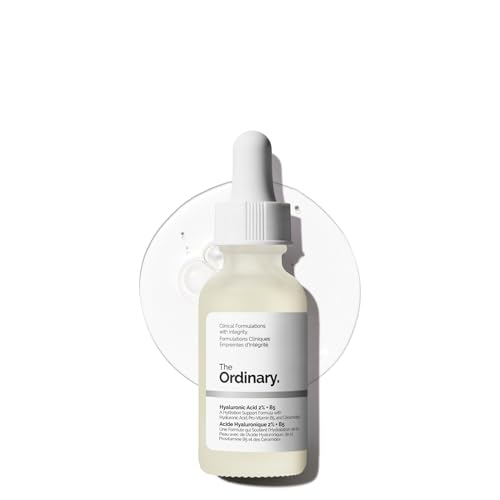
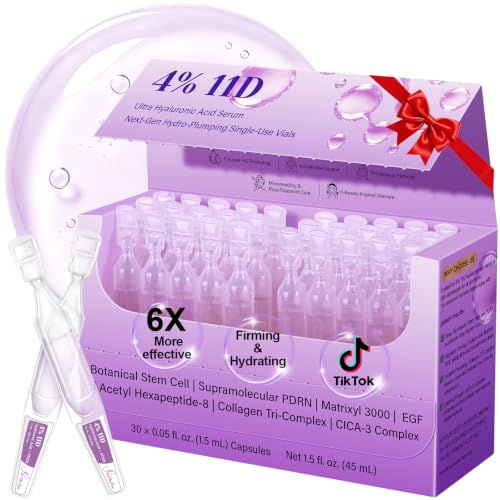
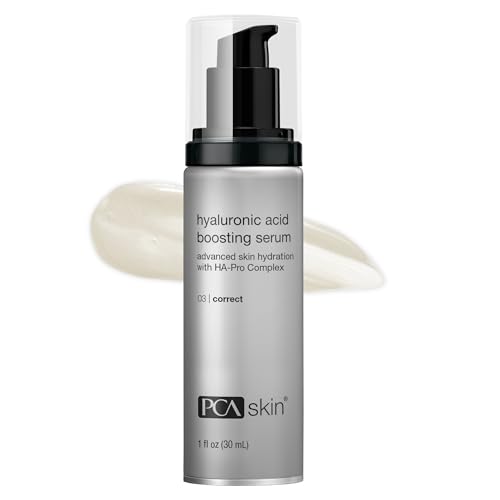
Recommended Post-Microneedling Hyaluronic Acid Serums
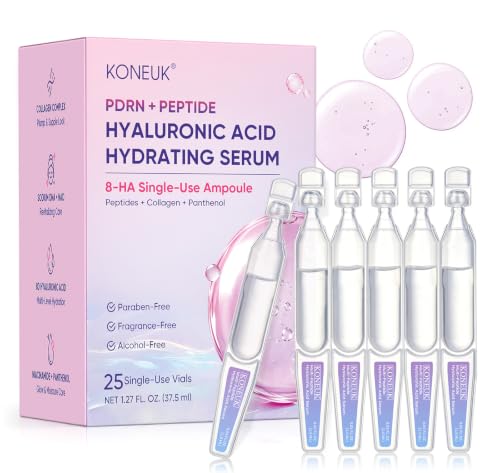
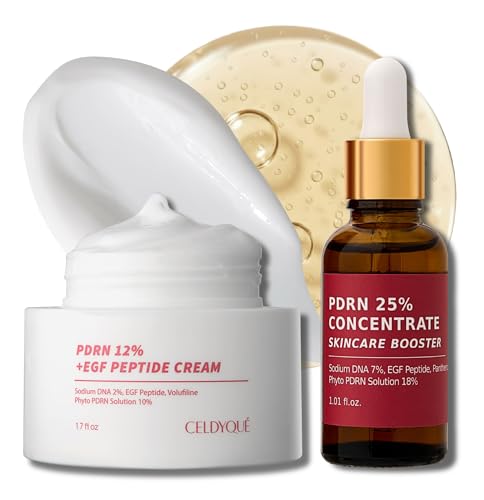
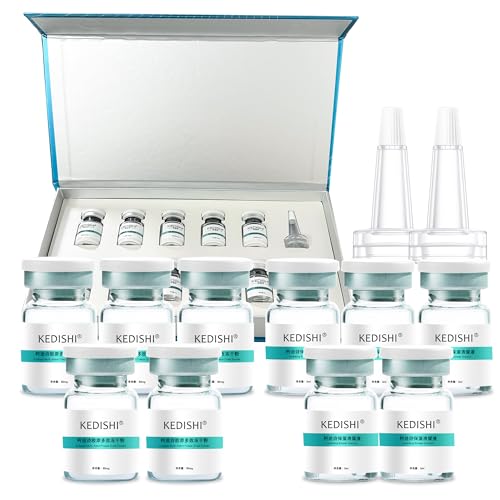
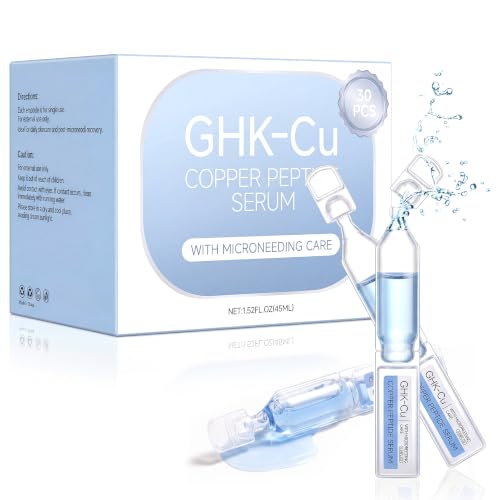
What Microneedling Actually Does to Your Skin
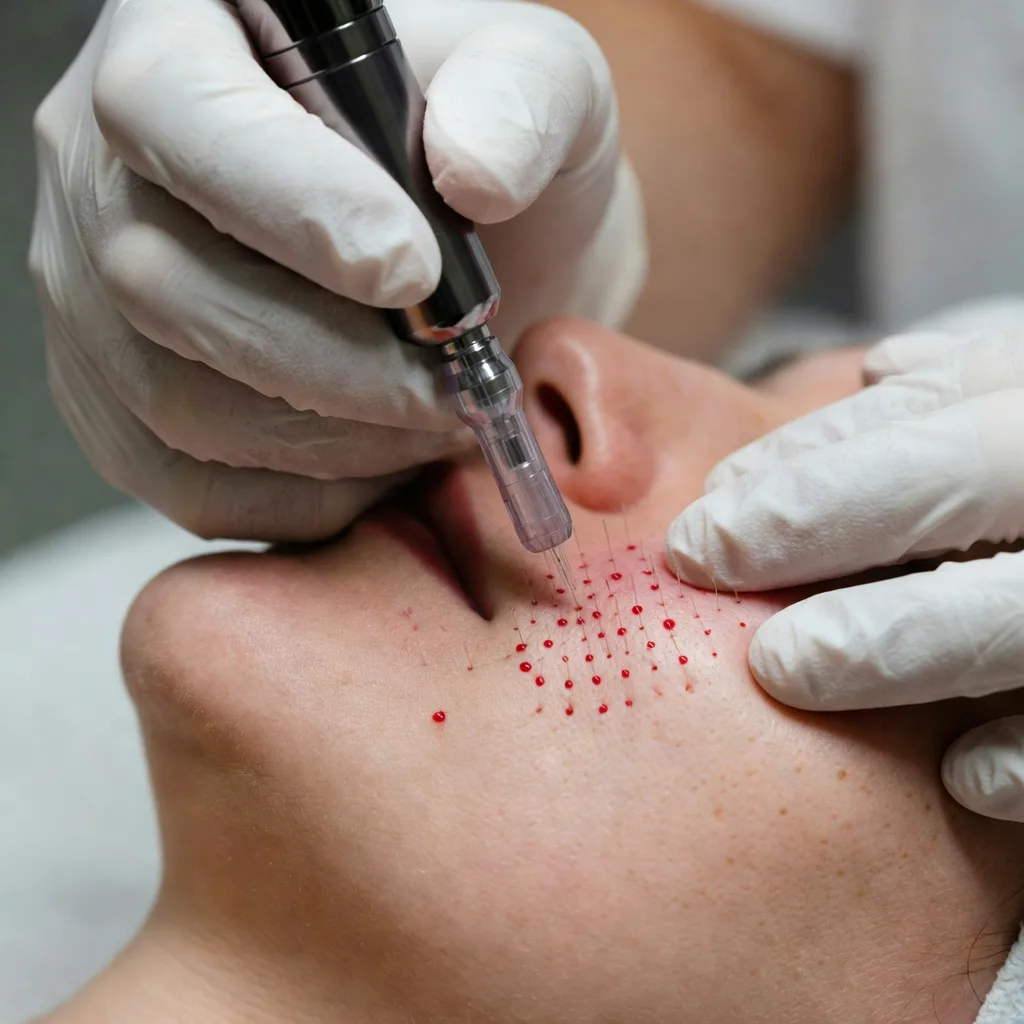
Microneedling, formally called percutaneous collagen induction, works by pressing dozens to hundreds of fine needles into the skin to create thousands of tiny, temporary channels through the outer skin barrier and into the upper dermis. That controlled injury, not any topical you apply afterward, is what triggers the actual biological response: platelets release growth factors (PDGF, TGF-beta, FGF), fibroblasts activate, and the skin lays down new collagen, first the more disorganized type III collagen, gradually remodeling into stronger type I collagen over the following weeks.
Shopping these picks?
Amazon Prime members get fast, free shipping on eligible items, plus Prime Video, Amazon Music and member deals. New members can start with a free trial.
Start a free Prime trialAged 18 to 24? Prime for Young Adults comes with a longer free trial and a lower price after it.
Affiliate link: we may earn a commission at no extra cost to you.
Marketing for at-home microneedling kits and spa menus often implies that a specific “activating” serum is what makes the treatment work. That gets the mechanism backwards. This guide covers what the actual research says about serum choice, why the real safety question is about which products to avoid rather than which one to buy, and what’s genuinely recommended immediately after a session.
The Short Version
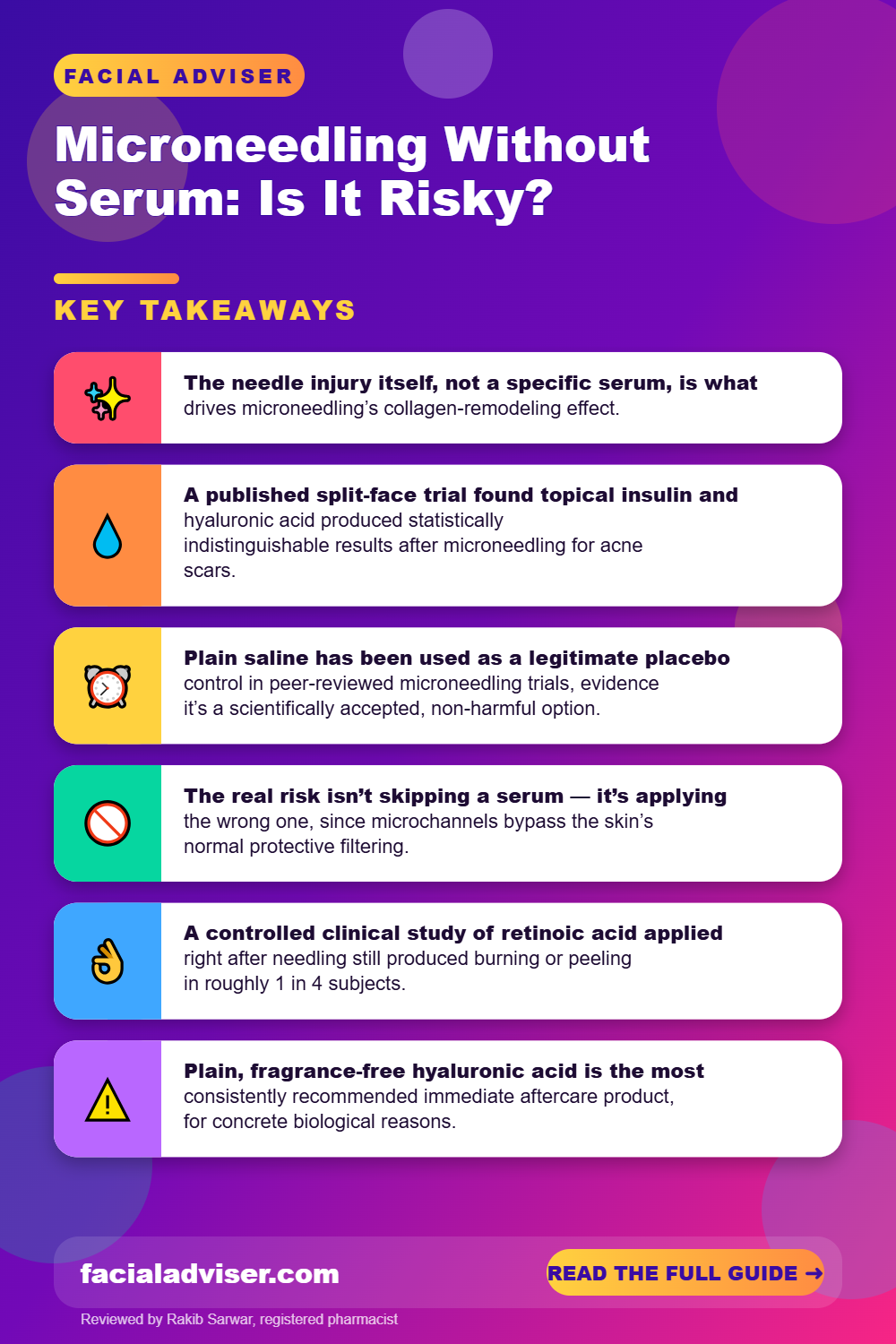
- The needle injury itself, not a specific serum, is what drives microneedling’s collagen-remodeling effect.
- A published split-face trial found topical insulin and hyaluronic acid produced statistically indistinguishable results after microneedling for acne scars.
- Plain saline has been used as a legitimate placebo control in peer-reviewed microneedling trials, evidence it’s a scientifically accepted, non-harmful option.
- The real risk isn’t skipping a serum — it’s applying the wrong one, since microchannels bypass the skin’s normal protective filtering.
- A controlled clinical study of retinoic acid applied right after needling still produced burning or peeling in roughly 1 in 4 subjects.
- Plain, fragrance-free hyaluronic acid is the most consistently recommended immediate aftercare product, for concrete biological reasons.
What This Guide Covers
- What Microneedling Actually Does to Your Skin
- Does the Serum Actually Matter? What Two Real Trials Found
- The Real Danger Isn’t Skipping Serum — It’s Using the Wrong One
- What’s Actually Recommended Immediately After Needling
- Serum-Free vs. Serum-Added: Side by Side
- A Safer At-Home Routine, Serum or Not
- Who This Guidance Applies To
- When to Skip Microneedling Altogether
- When to See a Dermatologist Instead
- No Lab Test for This — A Practical Substitute
- Where the Evidence Runs Out
- Frequently Asked Questions
Does the Serum Actually Matter? What Two Real Trials Found
A 2024 split-face study published in Dermatology Practical & Conceptual compared microneedling with topical insulin against microneedling with non-cross-linked hyaluronic acid for atrophic post-acne scars in 30 patients over six sessions. The insulin side improved 49.18% on average; the hyaluronic acid side improved 47.72%. The difference was not statistically significant. Two genuinely different active ingredients, applied under the same needling protocol, produced results close enough to be a statistical coin flip.
A separate split-face trial published in Dermatologic Surgery went further, comparing injectable platelet-rich fibrin plus microneedling against microneedling plus plain normal saline as the explicit placebo control. That a major dermatologic-surgery journal accepted plain saline as a legitimate, ethical placebo arm for a microneedling study is itself informative — researchers don’t use a control condition they consider unsafe or scientifically meaningless. Other split-face comparisons of PRP against vitamin C serum for acne scarring have found both improve outcomes versus baseline, with head-to-head differences between the two actives often small and non-significant — our dedicated guide to microneedling with PRP covers that specific combination’s evidence and real infection-risk history in more depth.
The Real Danger Isn’t Skipping Serum — It’s Using the Wrong One
The genuinely underused safety point in this whole conversation is about direction, not presence or absence. Because microneedling’s channels temporarily bypass the stratum corneum’s normal filtering, whatever touches the skin during or right after treatment reaches living tissue with far less resistance than it would on intact skin.
A study in Surgical and Cosmetic Dermatology tested exactly this scenario directly: researchers applied 3% and 5% retinoic acid immediately after 1.5mm needling in 12 volunteers, under a controlled, dermatologist-designed protocol with a two-hour dwell time. Two of the twelve developed mild burning at 48 to 72 hours, and one developed intense peeling and redness at 72 hours. No lasting complications occurred, but this was a formally studied, professionally administered protocol — not a consumer applying a leave-on retinoid or exfoliating acid at home immediately after a derma-roller session, where concentration, dwell time, and technique are far less controlled.
| Topical applied right after needling | What actually happens |
|---|---|
| Plain saline or water | Used as a legitimate placebo in published trials; no added risk, no added benefit beyond hydration |
| Fragrance-free hyaluronic acid | Standard clinical recommendation; hydrating, non-irritating, supports wound healing |
| Retinoic acid / retinoids | Studied directly; produced burning or peeling in about 1 in 4 subjects even under controlled conditions |
| Fragranced or alcohol-based products | Not studied for this use; plausible risk of stinging, contact irritation, or chemical burn |
What’s Actually Recommended Immediately After Needling
Aesthetic-dermatology consensus consistently lands on plain, fragrance-free hyaluronic acid or a bland barrier-repair moisturizer as the standard immediate post-treatment topical, and the reasoning is specific rather than arbitrary. Hyaluronic acid is a naturally occurring skin component, meaning it’s biocompatible and carries an extremely low irritancy profile. It’s a humectant, not an exfoliant or a comedolytic agent, so it hydrates without introducing exfoliating activity onto skin that has no barrier left to protect it. Non-cross-linked, low-molecular-weight formulations made for post-procedure use also tend to be preservative-minimal, which matters when the product is sitting directly in open channels rather than on intact skin.
Moist wound healing — keeping the treated area hydrated rather than letting it dry out and crust — is separately associated with faster re-epithelialization and reduced scarring risk in general wound-care literature, which is the practical reason plain hydration outperforms an “active” ingredient in the first 24 to 48 hours after treatment.
Do
- Apply plain, fragrance-free hyaluronic acid or a bland moisturizer immediately after
- Wait at least 24 hours before reintroducing any active ingredient
- Use a clean, sterile device and clean hands
Don’t
- Apply a retinoid, AHA, or BHA right after a session
- Use fragranced toners, essential oils, or alcohol-based products on freshly needled skin
- Assume a specific branded serum is required for the treatment to work
Serum-Free vs. Serum-Added: Side by Side
Framed as a direct comparison, here’s how the evidence actually stacks up between doing microneedling with nothing but a neutral hydrator versus adding an active serum:
| Approach | What the evidence shows | Best-supported use case |
|---|---|---|
| Microneedling + plain saline/water | Accepted placebo-control condition in published RCTs; safe, low-irritation baseline | Sensitive skin, first-time users, uncertain product compatibility |
| Microneedling + hyaluronic acid | Statistically similar outcomes to insulin serum in a direct 2024 trial; strong safety profile | Standard aftercare recommendation across most protocols |
| Microneedling + PRP or vitamin C | Improves outcomes versus baseline in scar trials, but not clearly better than simpler alternatives head-to-head | Acne scarring specifically, under professional supervision |
| Microneedling + retinoid or AHA | Studied directly; measurable irritation rate even under controlled clinical conditions | Not generally recommended immediately post-treatment |
A Safer At-Home Routine, Serum or Not
Cleanse thoroughly
Wash your face and hands with a gentle, non-irritating cleanser and let skin fully dry before starting.Sterilize your device
Use a device with intact, undamaged needles, and disinfect according to the manufacturer’s instructions before every session.Needle in light, even passes
Apply light, consistent pressure across the treatment area rather than pressing hard in any one spot.Apply a neutral hydrator immediately after
Plain hyaluronic acid or a fragrance-free moisturizer is the safest immediate choice, not a leave-on active.Wait before reintroducing actives
Give your skin at least 24 hours, longer if you notice redness or sensitivity, before using retinoids, acids, or vitamin C serums again.Protect from sun exposure
Freshly treated skin is more UV-sensitive; use mineral sunscreen and avoid direct sun for several days.
Who This Guidance Applies To
This mostly matters for people doing at-home microneedling with a derma-roller or short-needle pen, and for anyone booking a professional session who’s being upsold on a specific “activating” serum as essential to results. If you already have a dermatologist-recommended protocol that includes a particular active for a specific condition, like PRP for acne scarring, that protocol was chosen for a documented reason and is a different situation than routine at-home maintenance needling.
When to Skip Microneedling Altogether
Active acne breakouts, open wounds, cold sores, eczema or psoriasis flares in the treatment area, recent sunburn, and known keloid-scarring tendency are all standard reasons to avoid microneedling regardless of what topical you’re considering pairing with it. Isotretinoin use within the past six months is also a widely cited caution, since it affects skin healing.
When to See a Dermatologist Instead
See a professional rather than continuing at home if you notice spreading redness, pus, fever, or increasing pain in the days after a session — these can signal infection rather than normal, expected post-treatment sensitivity. Persistent hyperpigmentation, unusual scarring, or a reaction that doesn’t improve within a week also warrants a professional look rather than self-treatment.
No Lab Test for This — A Practical Substitute
There’s no at-home diagnostic test that tells you whether your skin barrier can handle a given topical after needling. The practical substitute clinicians actually use is a patch test on intact skin days before your session, plus starting with the mildest possible aftercare (plain hydration) and only introducing one new active at a time afterward, watching for at least 24 to 48 hours before adding anything else.
Where the Evidence Runs Out
Most of the serum-comparison research described above focused specifically on acne scarring, not general at-home maintenance microneedling for texture or fine lines, so it’s an honest limitation to note that the “serum barely matters” finding is best supported in that narrower context. No large trial has directly tested a broad range of consumer serums against each other for general microneedling outcomes, and the retinoic-acid safety study used a small sample of 12 volunteers under tightly controlled clinical conditions rather than typical at-home use.
Frequently Asked Questions
Do you need a special serum for microneedling to work?
No — published research shows the needle injury itself drives the main collagen-remodeling effect, and plain saline has been used as a legitimate placebo control in clinical trials.
Is it safe to microneedle without serum?
Yes, using plain water, saline, or a neutral hydrator is a scientifically accepted, low-risk approach.
What should you put on your face after microneedling?
Plain, fragrance-free hyaluronic acid or a bland barrier-repair moisturizer is the most consistently recommended immediate aftercare product.
Can microneedling with the wrong serum hurt you?
Yes — a controlled study found retinoic acid applied right after needling caused burning or peeling in roughly 1 in 4 subjects, even under professional supervision.
Why do microneedling kits come with a specific serum?
Largely for marketing and bundled-sales reasons; the evidence doesn’t show a specific proprietary serum is required for the treatment to work.
Can you use vitamin C serum after microneedling?
Wait at least 24 hours, since fresh microchannels can make even generally well-tolerated actives more irritating than usual.
Is PRP better than hyaluronic acid for microneedling?
Split-face trials for acne scarring show both improve outcomes versus baseline, with head-to-head differences often small and non-significant.
What happens if you apply retinol right after microneedling?
A dedicated safety study found this caused measurable burning or peeling in a meaningful minority of subjects, even at a controlled concentration and dwell time.
How long should you wait to use actives after microneedling?
At least 24 hours is the general guidance, longer if your skin shows redness or sensitivity.
Does skipping serum reduce microneedling’s results?
Available comparative evidence doesn’t show a meaningful reduction in outcomes when a neutral hydrator is used instead of an active serum.

Written by
Registered pharmacist and founder of Facial Adviser. Rakib's pharmacy training covers how skincare actives work and interact; a later course in cosmetology turned that into a focus on facial treatments and skincare products. He plans, researches and edits every guide on the site and checks health claims against sources such as the American Academy of Dermatology, the FDA and the NIH. He is not a dermatologist; see the Editorial Policy and Medical Disclaimer.
About · Editorial policy · How we choose products · Medical disclaimer · Contact
Keep reading: Microneedling, PRP and lasers
- Microneedling Facial: Real Results, Explained
- Dr. Pen Ultima A6S and A6: Features, Safety and Who Should Use It
- Does Needle Count Matter for Microneedling?
- Carbon Peel Laser Benefits: What the Evidence Shows
- Rezenerate Facial vs Microneedling: Differences, Results and Which to Choose
- Vampire Facial vs CO2 Laser: Results, Downtime, Risks and Which to Choose
- What Is the Best Anti-Aging Facial Treatment? Options Compared by Goal
- What Is a Spa Facial?