Does Talc Cause Breakouts? What the Evidence Says About Talc in Makeup
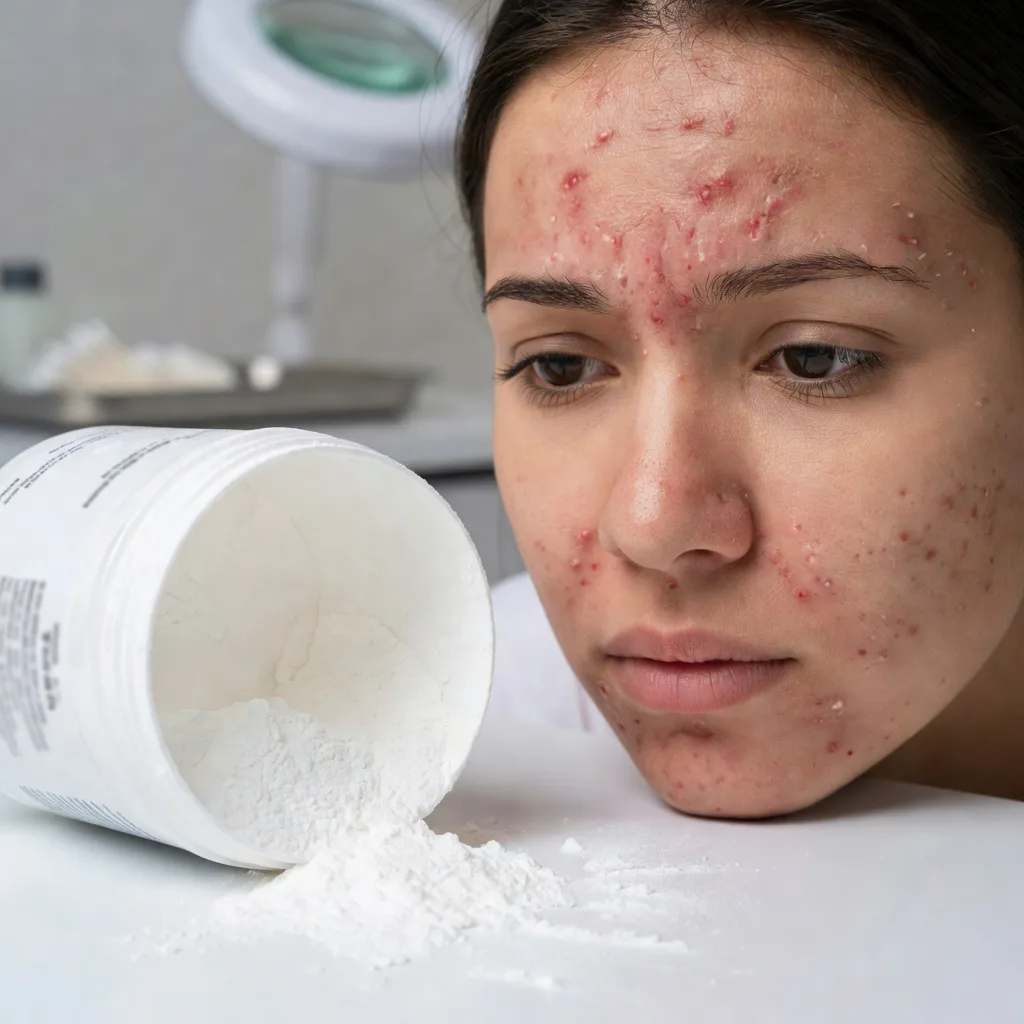
Talc is one of the most common ingredients in face powders, blushes, eyeshadows and setting powders. It is also one of the most debated. If you break out after wearing powder, it is natural to wonder whether talc is the culprit.
Part of our guide to cosmetic science. Start with: How to Read a Cosmetic Ingredient List: A Beginner Guide
Talc itself is not considered strongly pore-clogging. It is a soft mineral that absorbs oil, reduces shine and helps powders spread smoothly, and it is widely used in products labelled non-comedogenic. When breakouts follow powder use, the more likely causes are other ingredients in the formula such as rich oils or waxes, heavy layering that mixes with sweat and sebum, dirty brushes and sponges, sleeping in makeup, or acne that would have happened anyway. Some people with very sensitive or acne-prone skin still prefer talc-free powders, which is a reasonable choice, but switching away from talc alone rarely clears acne.
Talc safety questions usually centre on something else: the possibility of asbestos contamination in poorly sourced talc and the inhalation of loose powder. Those are real topics, but they are separate from whether talc causes pimples.
The FDA maintains a page on talc in cosmetics that describes its testing of talc-containing products for asbestos and the regulatory work around it.
This guide explains what talc does in makeup, what the evidence says about breakouts, how to tell whether your powder is the problem and when a talc-free option makes sense.
Shopping these picks?
Amazon Prime members get fast, free shipping on eligible items, plus Prime Video, Amazon Music and member deals. New members can start with a free trial.
Start a free Prime trialAged 18 to 24? Prime for Young Adults comes with a longer free trial and a lower price after it.
Affiliate link: we may earn a commission at no extra cost to you.
Recommended Powders and Breakout-Friendly Helpers


At a Glance
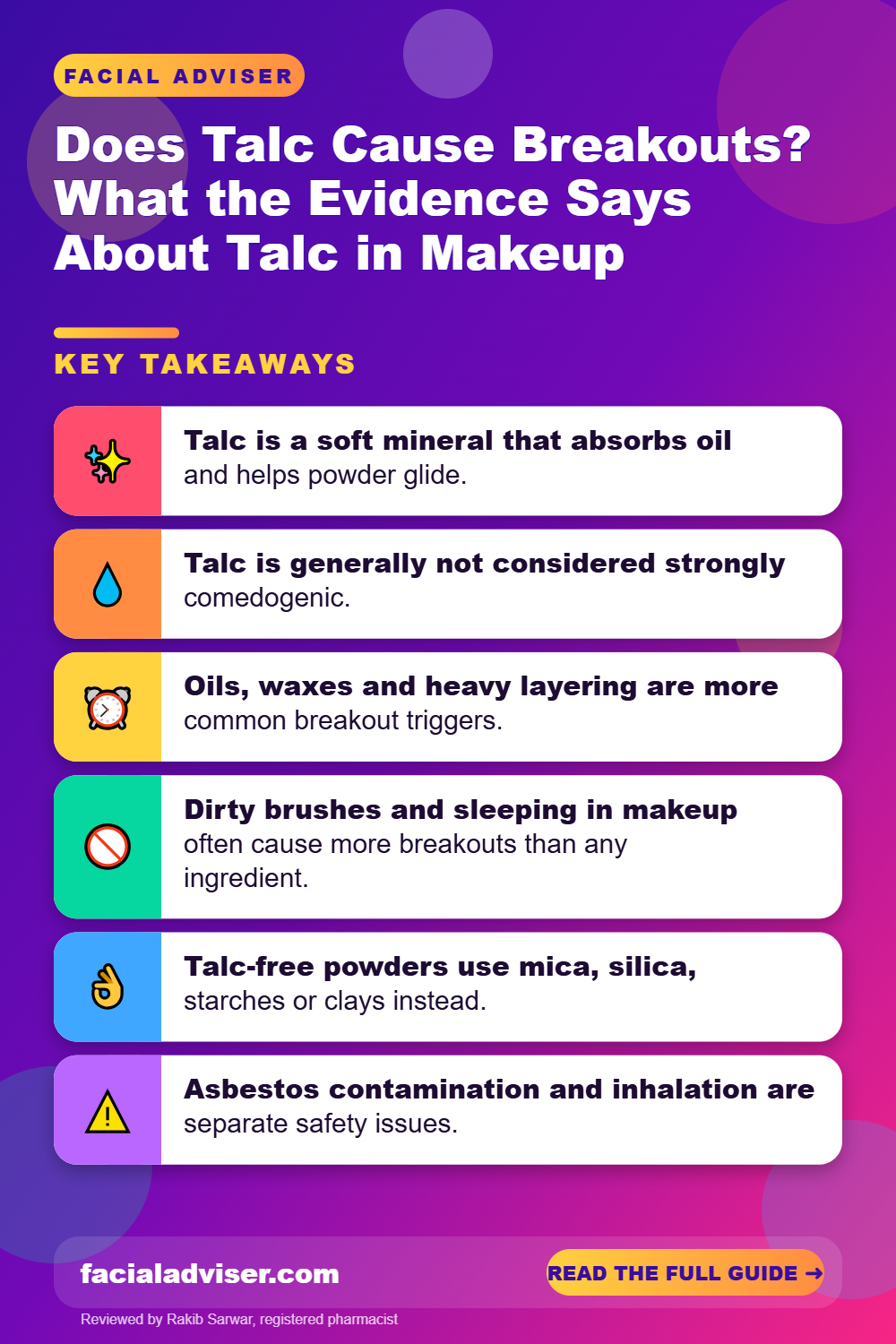
- Talc is a soft mineral that absorbs oil and helps powder glide.
- Talc is generally not considered strongly comedogenic.
- Oils, waxes and heavy layering are more common breakout triggers.
- Dirty brushes and sleeping in makeup often cause more breakouts than any ingredient.
- Talc-free powders use mica, silica, starches or clays instead.
- Asbestos contamination and inhalation are separate safety issues.
- Test one change at a time to find your real trigger.
Contents
- What Talc Does in Makeup
- Does Talc Clog Pores? What the Evidence Says
- More Likely Causes of Breakouts From Powder
- How to Work Out Whether Your Powder Is Causing Breakouts
- Talc-Free Powders: Are They Better for Acne?
- Other Talc Safety Questions
- How to Wear Powder Without Clogging Pores
- Talc in Different Types of Makeup
- Dos and Don’ts
- Honest Limits
- When to See a Dermatologist
- Common Questions
- Summing Up
What Talc Does in Makeup
Talc is a naturally occurring mineral made mostly of magnesium, silicon and oxygen. It is mined, purified and milled into a fine, soft powder. Our guide on where makeup ingredients come from covers how minerals like talc and mica end up in cosmetics.
In makeup, talc does several jobs. It absorbs some oil, gives a soft matte finish, helps pressed powders hold together, makes products glide on smoothly and acts as a filler that lets pigments spread evenly. That is why it appears in so many powders, blushes and eyeshadows.
| Role | What it does | Where you find it |
|---|---|---|
| Oil absorber | Takes up some sebum to reduce shine | Setting and finishing powders |
| Slip agent | Makes powder glide and blend easily | Eyeshadows, blushes, bronzers |
| Filler | Dilutes pigment for even colour | Most pressed powders |
| Binder support | Helps pressed powder hold its shape | Compacts and palettes |
| Texture softener | Gives a silky, soft-focus feel | Finishing powders |
Talc is not the same as asbestos. Both are minerals and can form near each other in the ground, which is why cosmetic-grade talc needs to come from carefully selected and tested sources.
Does Talc Clog Pores? What the Evidence Says
Comedogenicity ratings for cosmetic ingredients come mainly from older rabbit ear tests and a small number of human studies. In these ratings talc is generally listed as having low pore-clogging potential. The same scales also show that how an ingredient behaves depends heavily on its concentration and the rest of the formula.
There is little direct evidence that talc causes acne in people. Dermatologists more often point to oily or waxy ingredients, heavy occlusive layers and poor makeup hygiene as the practical triggers.
Talc is also a very small, inert particle that sits on the surface of skin rather than dissolving into pores. On oily skin, however, a thick layer of any powder can mix with sebum and sweat to form a paste-like film, which may contribute to congestion in some people.
The honest summary is that talc is unlikely to be the main cause of breakouts for most people, but individual reactions vary and some acne-prone people notice their skin does better with lighter, simpler powders.
More Likely Causes of Breakouts From Powder
| Possible cause | Why it matters | What to try |
|---|---|---|
| Rich oils or waxes in the formula | Some emollients are more likely to clog pores | Check the ingredient list; choose oil-free formulas |
| Heavy layering | Thick powder over foundation mixes with oil and sweat | Use a thin layer only where you get shiny |
| Dirty brushes and sponges | Oil, dead skin and bacteria build up | Wash tools weekly |
| Sleeping in makeup | Products sit on skin overnight | Cleanse every evening |
| Fragrance or irritants | Irritation can look like breakouts | Choose fragrance-free products |
| Hormones, stress or skincare changes | Acne often has several causes | Keep a simple routine and track changes |
Many people notice breakouts along the jawline or cheeks after starting a new powder and blame the powder, when the real change was a new foundation underneath, a new brush or a stressful week. Looking at everything that changed around the same time gives a clearer picture.
How to Work Out Whether Your Powder Is Causing Breakouts
Note when breakouts appeared
Check whether they started within a few weeks of adding a new powder or other product.
Clean your tools
Wash brushes and sponges and see whether breakouts settle over two weeks.
Pause the powder
Stop using that powder for three to four weeks while keeping everything else the same.
Watch the pattern
If breakouts clear and return when you restart, the product may be a trigger for you.
Read the ingredient list
Look for heavy oils, waxes or fragrance rather than focusing on talc alone.
Try a lighter or talc-free option
Use a thin layer, applied only where needed, and watch your skin for another few weeks.
Change one product at a time. If you swap your powder, foundation and cleanser in the same week, you will not know which change made the difference.
Talc-Free Powders: Are They Better for Acne?
Talc-free powders usually rely on mica, silica, corn or rice starch, kaolin clay or boron nitride instead. Mineral foundations are often talc-free and based on mica, zinc oxide and titanium dioxide.
These alternatives can be good options, but they are not automatically better for acne-prone skin. Starches can feel heavy on some people, and some mineral powders contain bismuth oxychloride, which can itch or irritate sensitive skin.
If you prefer talc-free products, choose one with a short ingredient list, no added fragrance and a finely milled texture. Apply a thin layer with a clean brush rather than packing it on.
The AAD’s acne skin care tips recommend choosing makeup labelled non-comedogenic or oil-free and removing makeup before bed, which matter more than whether a powder contains talc.
Other Talc Safety Questions
Asbestos contamination. Talc and asbestos can form in the same geological deposits, so poorly sourced talc could be contaminated. The FDA’s page on talc in cosmetics describes its sampling and testing of talc-containing cosmetics and its work on testing methods. Reputable brands source and test cosmetic-grade talc. Inhalation. Loose powders can release fine particles into the air. Applying powder gently, tapping off excess and avoiding large clouds of powder near the nose and mouth is sensible for everyone, and especially for young children and people with lung conditions. Other health debates. Questions about genital talc use and ovarian cancer are separate from facial makeup and breakouts and are beyond the scope of this article.Do not use loose talc-based body powders on babies or young children, and keep all loose powders away from the face of anyone with asthma or breathing difficulties.
How to Wear Powder Without Clogging Pores
- Apply powder in a thin layer only where you get shiny.
- Use a clean, fluffy brush or a freshly washed puff.
- Blot oil with blotting papers instead of adding more powder through the day.
- Remove makeup every night with a gentle cleanser.
- Wash brushes weekly and replace sponges regularly.
- Pair powder with an oil-free foundation if you are acne-prone.
Our guide on why foundation separates by midday explains how to reduce the need for repeated touch-ups, which also means less powder building up on the skin.
If you use an acne treatment such as benzoyl peroxide or a retinoid, apply it at night or let it dry fully before makeup in the morning so powder does not pill or trap it.
Talc in Different Types of Makeup
Setting and finishing powders. These are applied over the largest area of the face, so if powder is a trigger for you, this is where you are most likely to notice it. A translucent powder used in a light layer on the T-zone is usually enough for oily skin. Blush and bronzer. These sit on the cheeks, a common breakout area. If you notice spots only where you apply blush, try washing the brush more often before blaming the formula, since blush brushes are often cleaned less than foundation tools. Eyeshadow. Talc-based eyeshadows rarely cause acne because the eyelids have few oil glands that form pimples. Irritation or itching on the lids is more likely to be a reaction to a pigment, fragrance or preservative. Pressed powder foundation. Because it is used as a base, it covers the whole face. Applying it with a clean puff or brush and removing it thoroughly at night matters more than whether it contains talc. Liquid foundation. Many liquid foundations contain no talc at all, yet still cause breakouts for some people because of oils, silicones or fragrance. This is a good reminder that the ingredient list as a whole, not one ingredient, decides how a product suits you.Dos and Don’ts
Worth Doing
- Use a thin layer of powder
- Clean brushes weekly
- Choose oil-free, fragrance-free formulas
- Remove makeup every night
- Test one product change at a time
Skip It
- Assume talc is the only cause of acne
- Pack powder over oily skin all day
- Sleep in makeup
- Share brushes or puffs
- Create clouds of loose powder near the face
Honest Limits
Comedogenicity scales are imperfect. They were largely developed with animal models and concentrated ingredients, and they do not always predict how a finished product behaves on human skin.
Individual reactions vary. A powder that works perfectly for one person can seem to cause breakouts in another, often because of their skin type, other products or hormones rather than one ingredient.
Acne has many causes, including genetics, hormones, bacteria and inflammation. Changing your powder may help if it is a trigger for you, but it will not clear acne caused by other factors. For many people, a consistent acne treatment routine makes a far bigger difference than any change of powder.
When to See a Dermatologist
- You have painful, deep or cystic breakouts.
- Breakouts leave dark marks or scars.
- Acne has not improved after two to three months of over-the-counter treatment.
- You get itching, redness or a rash after using makeup.
This article is for general information and does not replace professional medical advice. See a dermatologist for persistent acne or skin reactions.
Common Questions
Does talc cause breakouts?
Talc is generally not considered strongly pore-clogging, so it is rarely the main cause.
Is talc comedogenic?
It is usually rated as having low pore-clogging potential.
Why do I break out after using powder?
Common causes include heavy layering, oils in the formula, dirty brushes and sleeping in makeup.
Are talc-free powders better for acne?
Not necessarily. They can help some people, but the whole formula matters more.
What replaces talc in talc-free powder?
Mica, silica, starches, clays or boron nitride.
Is talc the same as asbestos?
No. They are different minerals that can form in the same deposits.
Is talc safe in makeup?
Cosmetic-grade talc from reputable brands is widely used; the FDA tests talc cosmetics for asbestos.
Should I avoid loose powder?
Loose powder is fine for most people; apply gently to avoid breathing it in.
How often should I wash powder brushes?
About once a week, or more often if you are acne-prone.
How long should I pause a product to test it?
About three to four weeks, changing nothing else.
Summing Up
Talc is a soft mineral that helps powder absorb oil and glide smoothly, and it is generally not considered strongly pore-clogging. Breakouts after using powder are more often linked to heavy layering, oily formulas, dirty tools or skipped cleansing.
If you suspect your powder, clean your tools, pause the product for a few weeks and change one thing at a time. A thin layer of a simple, fragrance-free powder, talc or talc-free, suits most acne-prone skin.

Written by
Registered pharmacist and founder of Facial Adviser. Rakib's pharmacy training covers how skincare actives work and interact; a later course in cosmetology turned that into a focus on facial treatments and skincare products. He plans, researches and edits every guide on the site and checks health claims against sources such as the American Academy of Dermatology, the FDA and the NIH. He is not a dermatologist; see the Editorial Policy and Medical Disclaimer.
About · Editorial policy · How we choose products · Medical disclaimer · Contact
Keep reading: How cosmetics are made
- How to Read a Cosmetic Ingredient List: A Beginner Guide
- What Is Hypoallergenic Makeup? What the Label Really Means
- What Are Emollients? Examples, How They Work and How to Choose
- What Is a Clean-Label Cosmetic? What Clean Beauty Really Means
- Silicone vs Water-Based Cosmetics: How to Tell Them Apart and Pair Them
- How Mica Creates Shimmer in Makeup: The Science of Sparkle