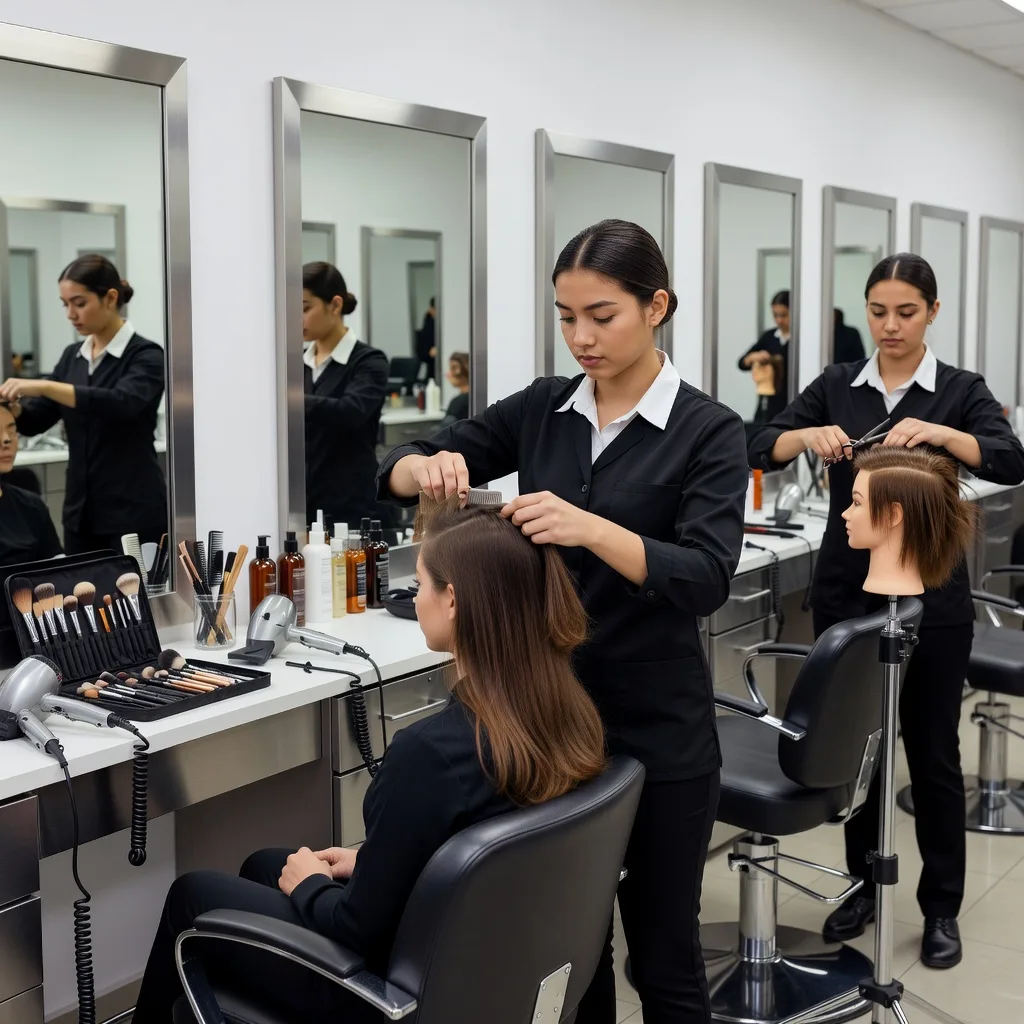
What Is Cosmetology School? The Real Answer
Cosmetology school covers a lot more ground than people often expect, and understanding its real scope matters if you’re deciding between it and a narrower path like esthetics.
Part of our guide to makeup how-to. Start with: How to Get Started as a Freelance Makeup Artist: Training, Kit and Clients
Cosmetology licenses cover hair, skin, and nails together, with California requiring 1,000 training hours versus 600 for an esthetician license in the same state, and national requirements ranging as high as roughly 2,100 hours in some states. Completing the required hours is only part of the process, since licensing also requires passing both a written and a hands-on practical state board exam.
Program length and cost both scale directly with a state’s required hours, and specific figures vary enough that they’re worth confirming directly with your own state’s board.
This guide covers what cosmetology training actually includes, how it differs from esthetician-specific training, and the real path from enrollment to a license.
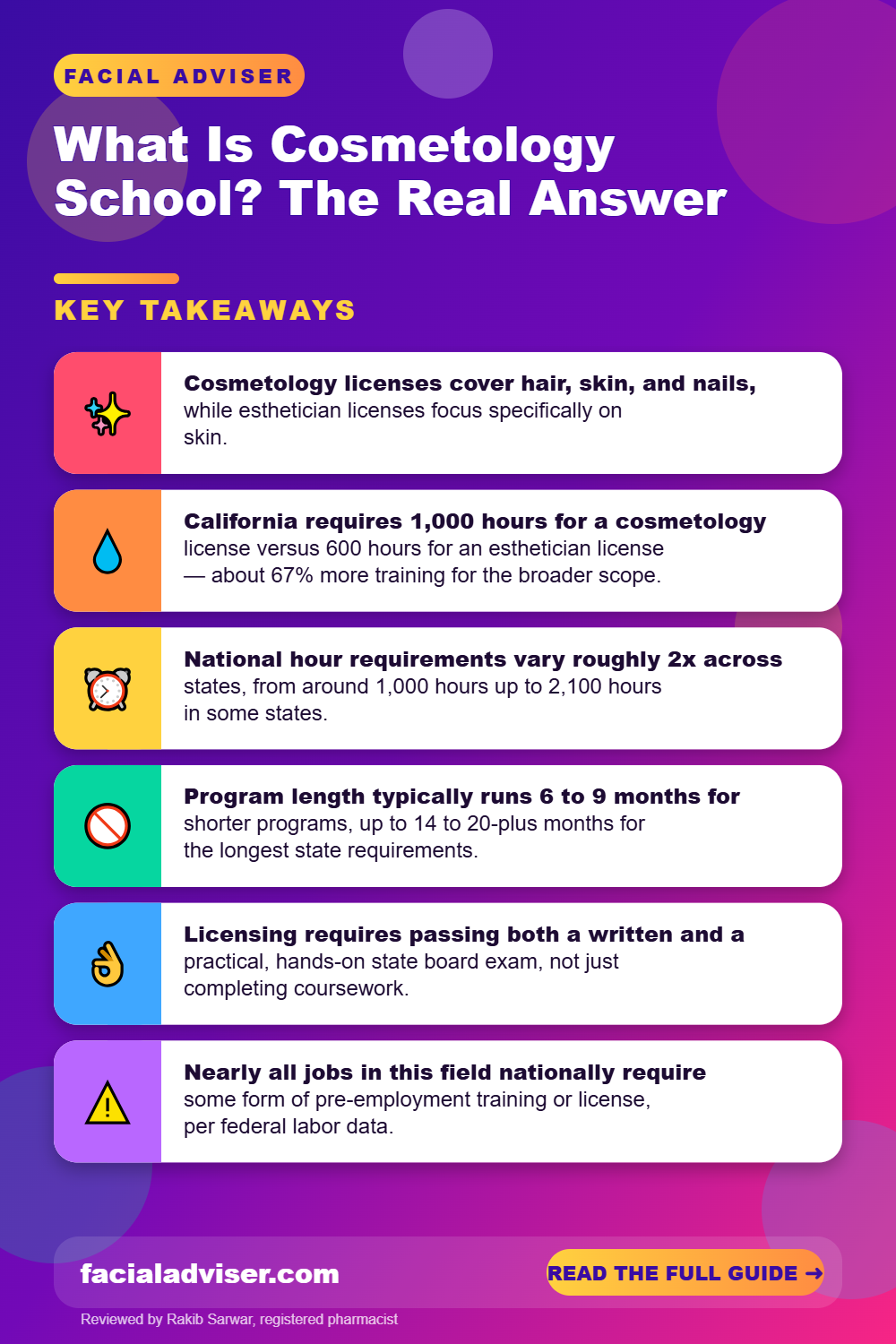
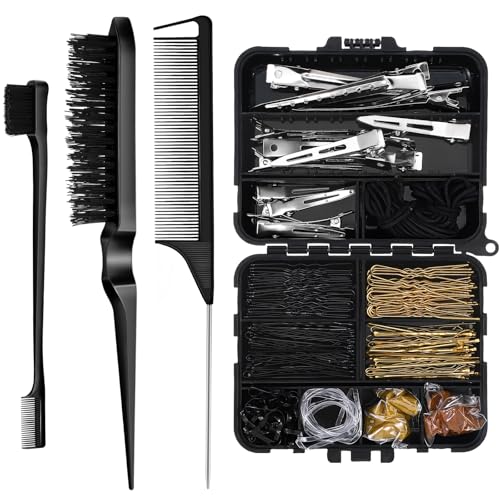
Recommended Professional Kits for Cosmetology Students
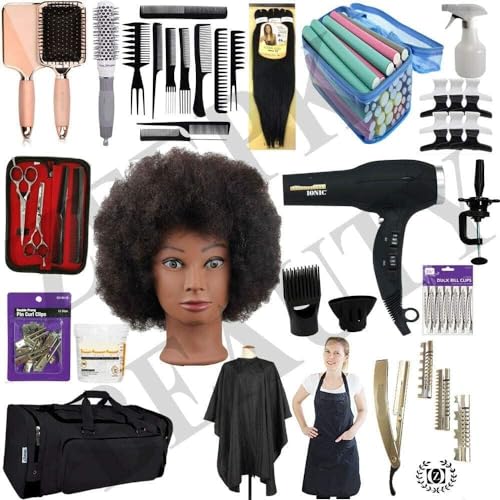


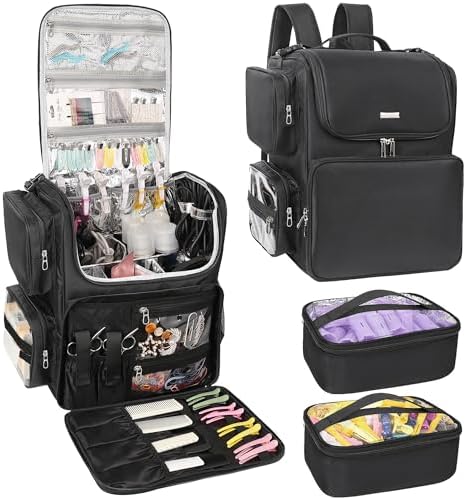

What Cosmetology School Actually Covers
Cosmetology is a broader license than most people assume, and that breadth is the whole point of the program. Unlike esthetics, which focuses specifically on skin, cosmetology training covers hair cutting, coloring, and chemical services, alongside nail care and manicure/pedicure technique, in addition to skin and facial basics. That full-service scope is the actual practical reason cosmetology programs run longer and require more training hours than esthetics-only programs — students are learning three distinct service categories, not one.
Shopping these picks?
Amazon Prime members get fast, free shipping on eligible items, plus Prime Video, Amazon Music and member deals. New members can start with a free trial.
Start a free Prime trialAged 18 to 24? Prime for Young Adults comes with a longer free trial and a lower price after it.
Affiliate link: we may earn a commission at no extra cost to you.
If you’re comparing cosmetology school to esthetician training specifically because you’re interested in skin and facials, the key thing to understand upfront is that cosmetology’s skin-specific curriculum is proportionally smaller than a dedicated esthetics program’s, since cosmetology hours are split across hair, skin, and nails. Our separate guide on what a facialist actually is covers the esthetician license and its skin-specific training in more depth; this guide focuses on cosmetology as the broader credential.
Key Facts
- Cosmetology licenses cover hair, skin, and nails, while esthetician licenses focus specifically on skin.
- California requires 1,000 hours for a cosmetology license versus 600 hours for an esthetician license — about 67% more training for the broader scope.
- National hour requirements vary roughly 2x across states, from around 1,000 hours up to 2,100 hours in some states.
- Program length typically runs 6 to 9 months for shorter programs, up to 14 to 20-plus months for the longest state requirements.
- Licensing requires passing both a written and a practical, hands-on state board exam, not just completing coursework.
- Nearly all jobs in this field nationally require some form of pre-employment training or license, per federal labor data.
Guide Outline
- What Cosmetology School Actually Covers
- Hours and Licensing Requirements by State
- Cosmetology vs. Esthetician Training
- Program Length and Cost
- The Job Market and Licensing Exam
- The Path From Enrollment to Licensed Cosmetologist
- Who Cosmetology School Actually Suits
- When a Cosmetology License Isn’t the Right Credential
- When Your Concern Needs a Medical Provider Instead
- There’s No Shortcut — Check Your State Board Directly
- Where the General Guidance Runs Out
- Frequently Asked Questions
Hours and Licensing Requirements by State
Required training hours vary significantly by state, and the gap is large enough to matter if you’re choosing where to train. California’s Board of Barbering and Cosmetology sets cosmetologist training at 1,000 hours, compared to 600 hours for an esthetician license in the same state — about 67% more training for the broader scope. New York sets a similarly demanding standard, also requiring 1,000 hours for a cosmetology license. At the higher end, several states, including Iowa, Nebraska, Oregon, and South Dakota, require around 2,100 hours — roughly double California and New York’s requirement for the same license type.
| State (example) | Cosmetology license hours | Esthetician license hours (same state) |
|---|---|---|
| California | 1,000 | 600 |
| New York | 1,000 | Varies, lower than cosmetology |
| Higher-requirement states (e.g. Iowa, Oregon) | ~2,100 | Lower, state-specific |
Cosmetology vs. Esthetician Training
The practical difference comes down to scope. An esthetician license is specifically about skin: facials, extractions, waxing, peels within a legal scope, and skin-focused product knowledge. A cosmetology license adds hair cutting, coloring, and chemical services, plus nail care and manicure/pedicure technique, on top of a general skin and facial foundation. That’s a genuinely different professional path, not simply a “bigger version” of esthetics — a working cosmetologist is trained to serve a much broader range of client needs in one license, while an esthetician goes deeper on skin specifically within a narrower scope.
| License type | Core focus | Typical training hours (varies by state) |
|---|---|---|
| Esthetician | Skin and facials only | ~250-1,000 hours depending on state |
| Cosmetologist | Hair, skin, and nails | ~1,000-2,100 hours depending on state |
Program Length and Cost
Program length and cost both scale directly with a state’s required hours. Programs under roughly 1,200 hours typically run 6 to 9 months full-time, while programs in states requiring 1,800 or more hours can take 14 to 20-plus months to complete. Tuition estimates follow a similarly wide range, from roughly $5,000 to $12,000 at the lower end up to $15,000 to $25,000 or more at the higher end, with community colleges generally costing less than private beauty academies. Programs accredited by bodies like NACCAS may make students eligible for federal financial aid, which is worth checking directly with any specific school under consideration, since it isn’t universal.
The Job Market and Licensing Exam
Federal labor data gives useful context on how the field actually treats training requirements. Per the U.S. Bureau of Labor Statistics’ Occupational Requirements Survey data on hairdressers, hairstylists, and cosmetologists, pre-employment training through a license or certificate was required for essentially all workers nationally in this field. Just over half of jobs, 55.3 percent, required 6 months to a year of combined education, training, and experience, while another 24.3 percent required more than 1 to 2 years. A majority of jobs, 58.3 percent, also required at least a high school diploma as a baseline.
Completing a program isn’t the final step either way — licensing requires passing both a written exam and a practical, hands-on state board exam, confirmed directly by both California’s and New York’s licensing boards. Many states participate in reciprocity or interstate testing arrangements coordinated through bodies like the National Interstate Council of State Boards of Cosmetology, though exact reciprocity rules vary meaningfully by state pair and should be verified directly if you’re planning to work across state lines.
The Path From Enrollment to Licensed Cosmetologist
Choose an accredited program
Confirm accreditation (such as NACCAS) and check whether it makes you eligible for financial aid if needed.Complete your state’s required training hours
This varies significantly by state, so confirm the exact number directly with your state’s cosmetology board before enrolling.Pass the written state board exam
This tests theoretical knowledge across hair, skin, nails, and safety/sanitation practices.Pass the practical, hands-on state board exam
This demonstrates actual technique competency before a license is issued.
Who Cosmetology School Actually Suits
Cosmetology school is the right path for anyone who wants a single, broad license covering hair, skin, and nail services, or who isn’t yet certain which specialty they want to focus on and would rather train broadly first. If your interest is specifically and only in skin and facials, a dedicated esthetician program is typically shorter and more directly focused on that goal, and covers that path’s own state-by-state hour variation in more detail.
Do
- Confirm your specific state’s exact hour requirement directly with its cosmetology board
- Check program accreditation before enrolling
- Choose cosmetology specifically if you want hair, skin, and nail training in one license
Don’t
- Assume every state requires the same number of hours
- Trust an aggregator site’s exact hour figure without checking the state board directly
- Choose cosmetology over esthetics if skin and facials are your only real interest
When a Cosmetology License Isn’t the Right Credential
If your specific goal is providing advanced skin treatments — chemical peels beyond a state’s cosmetology scope, or clinical-grade procedures — a cosmetology license alone typically isn’t sufficient, since those services often fall under separate esthetics or medical licensing depending on the state and treatment. Someone focused entirely on skin outcomes is usually better served training and licensing specifically as an esthetician, or working under a dermatologist or medical provider, rather than pursuing the broader cosmetology path.
When Your Concern Needs a Medical Provider Instead
A cosmetology license, like an esthetician license, is a cosmetic and personal-care credential, not a medical one. Any diagnosed skin condition, persistent acne that over-the-counter and salon-level products aren’t controlling, or a concern that might need a prescription-strength treatment should go to a board-certified dermatologist or physician, not a cosmetologist or esthetician, regardless of how experienced that professional is within their own scope of practice.
There’s No Shortcut — Check Your State Board Directly
There’s no valid at-home test or shortcut for this topic, and pretending otherwise would be dishonest. Because hour requirements, program length, and licensing rules vary so significantly by state, the only reliable way to get an accurate answer for your specific situation is to check your state’s cosmetology board website directly, rather than relying on any single aggregator figure, including some of the general ranges cited in this guide.
Where the General Guidance Runs Out
Be precise about what’s reliably established here versus what varies too much to state as a single fact: the core distinction between cosmetology’s broader hair/skin/nails scope and esthetics’ skin-specific focus is consistent nationally, and the general pattern of longer programs and more hours for cosmetology holds broadly. But exact hour requirements, program costs, and reciprocity rules between states vary enough, and change often enough, that any specific number in this guide should be treated as a general reference point, confirmed directly against your own state’s board before making an enrollment decision.
Frequently Asked Questions
What’s the difference between cosmetology and esthetician school?
Cosmetology covers hair, skin, and nails; esthetician training focuses specifically on skin and facials.
How many hours does cosmetology school require?
It varies by state, typically ranging from around 1,000 hours up to roughly 2,100 hours in some states.
How long does cosmetology school take to complete?
Roughly 6 to 9 months for shorter programs, up to 14 to 20-plus months in states with the highest hour requirements.
Do I need to pass an exam after finishing the program?
Yes — licensing requires passing both a written exam and a practical, hands-on state board exam.
Is cosmetology school worth it if I only want to do facials?
Usually not the most efficient path — a dedicated esthetician program is typically shorter and more focused specifically on skin.
How much does cosmetology school typically cost?
Estimates range roughly from $5,000 to $12,000 at the lower end up to $15,000 to $25,000 or more, depending on program length and type.
Can a cosmetologist perform advanced skin treatments?
Often not without additional licensing — advanced procedures typically fall under separate esthetics or medical scopes depending on the state.
Is a cosmetology license the same in every state?
No — required hours and specific rules vary meaningfully by state, so always confirm directly with your state’s board.
Can cosmetologists work across state lines?
Sometimes, through reciprocity arrangements, but exact rules vary by state pair and should be verified directly.
Should I see a dermatologist instead of a cosmetologist for a skin concern?
Yes, for any diagnosed condition or concern that over-the-counter or salon-level products aren’t resolving.

Written by
Registered pharmacist and founder of Facial Adviser. Rakib's pharmacy training covers how skincare actives work and interact; a later course in cosmetology turned that into a focus on facial treatments and skincare products. He plans, researches and edits every guide on the site and checks health claims against sources such as the American Academy of Dermatology, the FDA and the NIH. He is not a dermatologist; see the Editorial Policy and Medical Disclaimer.
About · Editorial policy · How we choose products · Medical disclaimer · Contact
Keep reading: Makeup artists and careers
- How to Get Started as a Freelance Makeup Artist: Training, Kit and Clients
- Makeup Artist vs Beautician: The Real Difference
- Are You Supposed to Tip Makeup Artists? Salon, Freelance and Bridal Etiquette
- Why Do Makeup Artists Charge More for Brides? What the Bridal Rate Covers
- Advantages of Being a Makeup Artist: Honest Pros, Cons and Career Reality
- What is the Meaning of Makeup in a Dream?
- How to Find the Right Shade of Makeup: Undertone, Depth and Testing
- How to Choose the Right Eye Makeup Color for Your Eyes and Skin