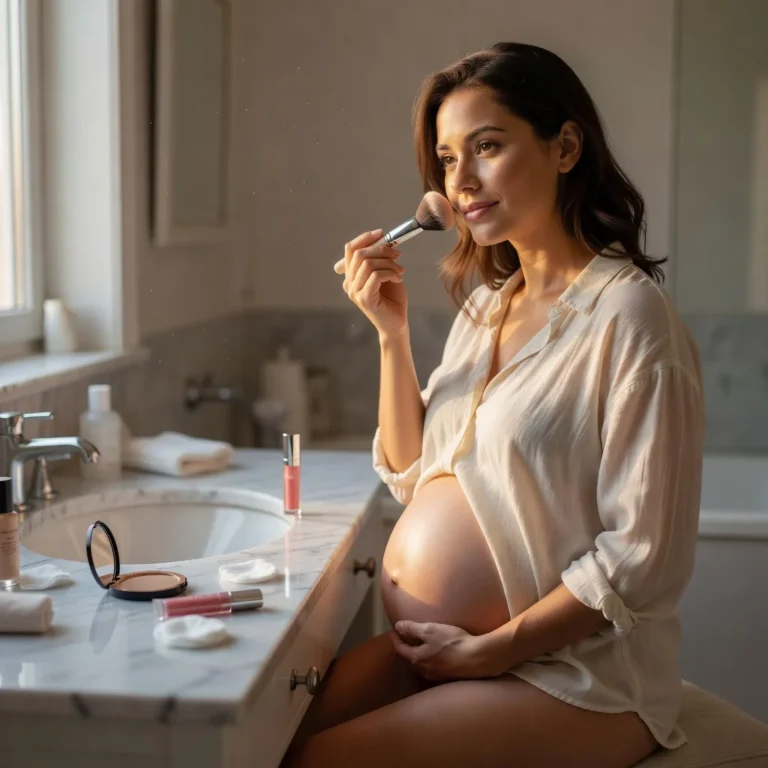
Makeup Artist vs Beautician: The Real Difference
Beauty-industry job titles get used loosely enough that it’s worth asking directly: in a real makeup artist vs beautician comparison, is one actually a broader credential than the other?
Part of our guide to makeup how-to. Start with: How to Get Started as a Freelance Makeup Artist: Training, Kit and Clients
In nearly every US state, “beautician” isn’t a separate license at all — it’s a colloquial synonym for a licensed cosmetologist, whose training covers hair, basic skin care, and often nails. Makeup artistry, by contrast, is the narrowest specialization of the three, and whether it requires any license at all varies genuinely state by state. New Jersey is a documented exception, with an actual distinct “beauty culture” license separate from its cosmetologist license.
A real data point worth reading carefully rather than at face value: government wage data shows a far higher median for makeup artists than for licensed skincare specialists, but that figure comes from an occupational code built around film and TV work, not the broader freelance bridal and editorial market most makeup artists actually work in.
This guide walks through the real scope-of-practice differences by license type, the honest state-by-state licensing variation for makeup artistry specifically, and what the earnings data can and can’t tell you.
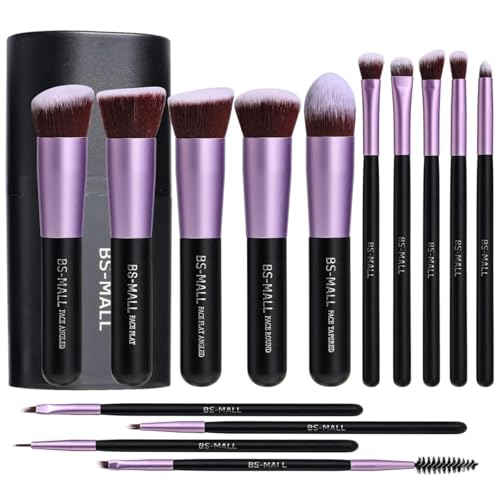
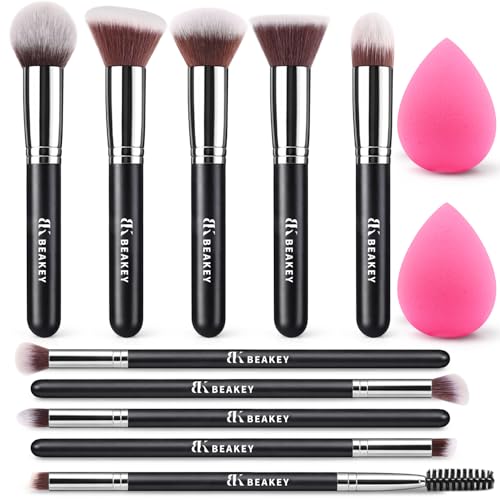
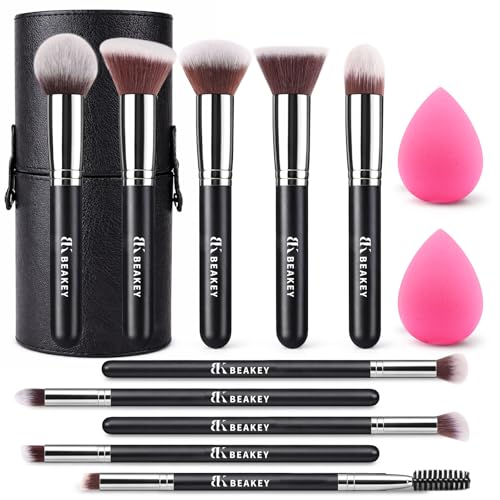
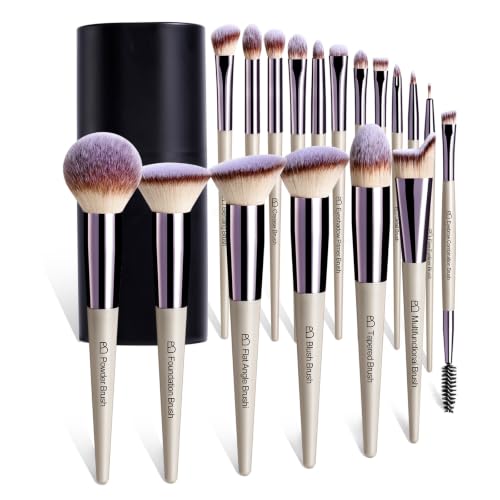
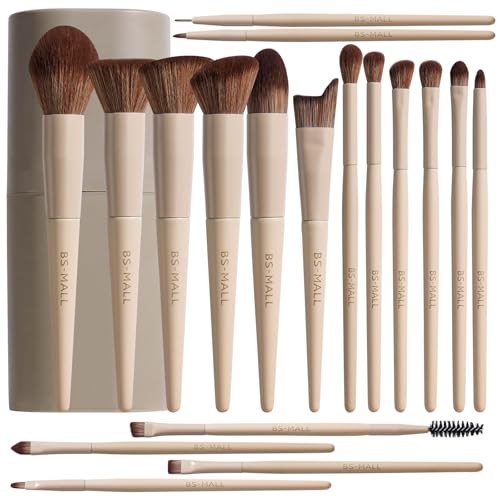
Recommended Professional-Grade Makeup Artistry Tools


Key Takeaways
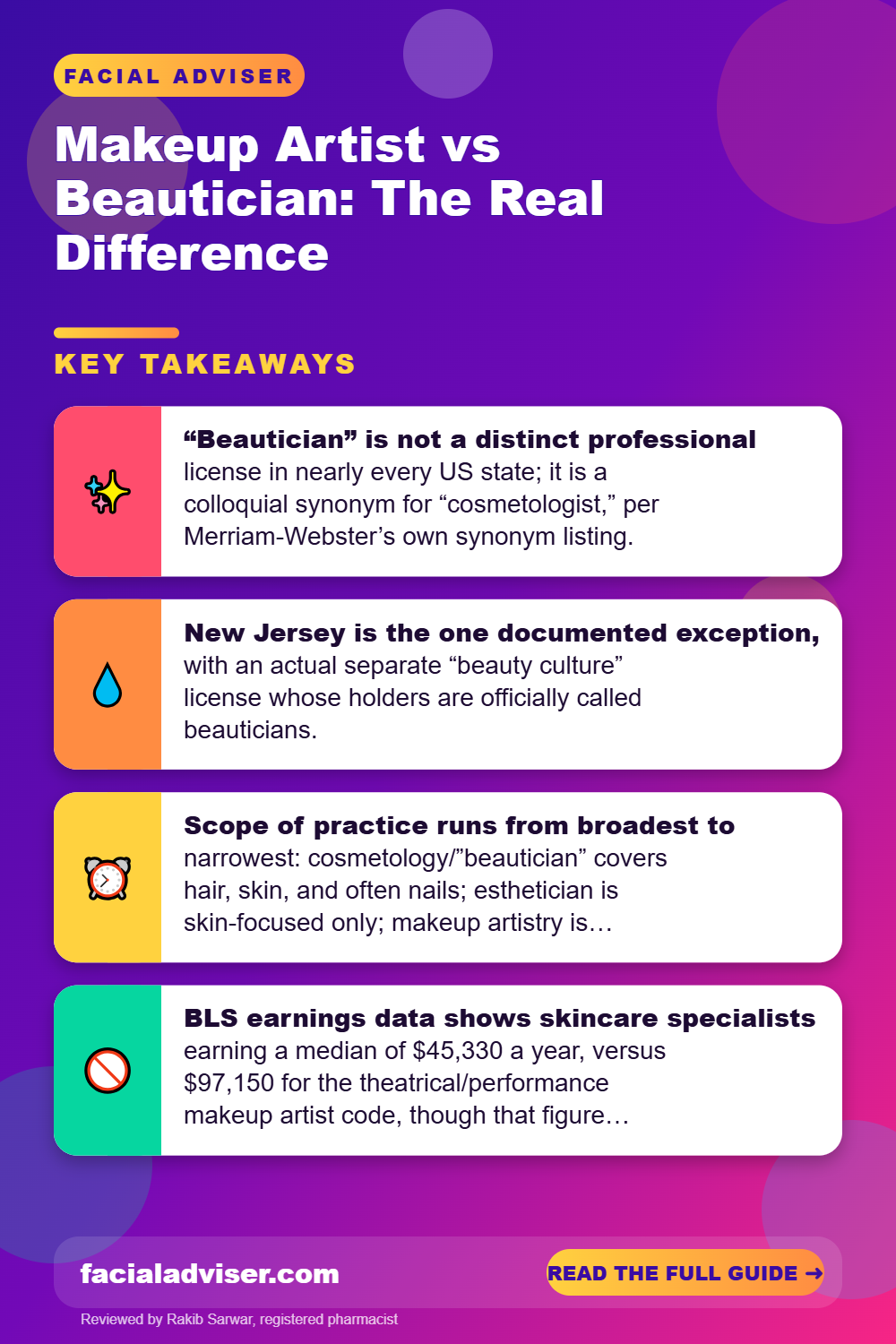
- “Beautician” is not a distinct professional license in nearly every US state; it is a colloquial synonym for “cosmetologist,” per Merriam-Webster’s own synonym listing.
- New Jersey is the one documented exception, with an actual separate “beauty culture” license whose holders are officially called beauticians.
- Scope of practice runs from broadest to narrowest: cosmetology/”beautician” covers hair, skin, and often nails; esthetician is skin-focused only; makeup artistry is narrowest, and whether it needs any license at all is a state-by-state patchwork.
- BLS earnings data shows skincare specialists earning a median of $45,330 a year, versus $97,150 for the theatrical/performance makeup artist code, though that figure carries a huge percentile spread and misses the broader freelance market.
Section Guide
- Correcting the Premise: “Beautician” Is Not a License
- Where the Word Actually Comes From
- New Jersey’s Real Exception
- When “Beautician” Work Happens Without Any License
- The Real Scope-of-Practice Ladder
- Comparing Scope of Practice by License Type
- Does a Makeup Artist Need a License? It Depends Where You Live
- What Skincare Specialists Actually Earn
- What Makeup Artists Actually Earn
- Earnings Side by Side, Percentile Spread Included
- Why the $97,150 Figure Is Misleading on Its Own
- How to Figure Out Which Professional You Actually Need
- Do and Don’t
- Frequently Asked Questions
- The Bottom Line
Correcting the Premise: “Beautician” Is Not a License
Most articles comparing a makeup artist to a beautician treat both words as if they name equally distinct professional categories, each with its own scope. That framing is wrong for one half of the comparison. In nearly every US state, there is no separate “beautician” license. The credential behind the word is a state cosmetology license, and some professionals who hold it simply describe themselves informally as beauticians. Getting this right changes the actual question worth asking: not “what’s the difference between a beautician and a makeup artist,” but what a cosmetology license actually authorizes versus what a makeup artist is licensed to do.
Shopping these picks?
Amazon Prime members get fast, free shipping on eligible items, plus Prime Video, Amazon Music and member deals. New members can start with a free trial.
Start a free Prime trialAged 18 to 24? Prime for Young Adults comes with a longer free trial and a lower price after it.
Affiliate link: we may earn a commission at no extra cost to you.
Where the Word Actually Comes From
According to a licensing explainer from BeautySchoolsDirectory, “beautician” and “cosmetologist” usually mean the same thing in ordinary usage, and Merriam-Webster lists cosmetologist as a synonym for beautician. That confirms the word is not a regulatory term; it is a plain-language stand-in for a title with a formal legal definition. Calling someone a beautician tells you they likely do hair, skin, and possibly nail services under a state license, but nothing more. The actual scope comes entirely from the cosmetology license behind the title.
New Jersey’s Real Exception
New Jersey is the one documented state that breaks this pattern. It offers a distinct “beauty culture” license, separate from its cosmetologist-hairstylist category, and holders are officially termed beauticians in state language. That makes New Jersey the rare case where “beautician” names an actual, separately regulated credential with its own scope, not just shorthand for cosmetologist. For every other state, this is the exception that proves the rule: only one state has formalized a distinct beautician license.
When “Beautician” Work Happens Without Any License
There is a second, narrower wrinkle worth naming. Some beauty-adjacent work happens without any state license, in limited contexts: an unpaid duty in a hospital or nursing home, or a retail cosmetics counter demonstration. This is not “professional practice” in the licensed sense this article covers, and it varies by state. It is mentioned to avoid overstating that every instance of beauty work requires licensure; the comparison below is about paid, standalone services, which is what most readers actually mean.
The Real Scope-of-Practice Ladder
Once “beautician” is understood as informal language for “cosmetologist,” the real comparison becomes a three-tier scope-of-practice ladder. A state cosmetology license, the credential behind “beautician,” typically authorizes the widest range of services: hair cutting, coloring, chemical treatments, basic skincare and facials, and in many states nails, a generalist license by design. An esthetician license sits below that: narrower and skin-focused, covering facials and skin treatments and sometimes waxing or laser, but not hair cutting or chemical treatments. Makeup artistry is the narrowest specialization, and the one where licensing gets genuinely inconsistent state to state.
Comparing Scope of Practice by License Type
Set side by side, the three tiers of the ladder look like this.
| License type | Typical scope | Common informal name |
|---|---|---|
| Cosmetology license | Broadest: hair cutting/coloring/chemical treatments, basic skincare/facials, often nails | Beautician (in nearly all states, a synonym for this license) |
| Esthetician license | Narrower: facials and skin treatments, sometimes waxing/laser depending on state, no hair-cutting or chemical hair services | Esthetician, skincare specialist |
| Makeup artistry | Narrowest specialization; whether it requires its own license at all is a genuine state-by-state patchwork | Makeup artist |
Does a Makeup Artist Need a License? It Depends Where You Live
This is the part where a confident, single national answer would be dishonest. A state-by-state breakdown from a makeup training school found roughly two dozen states generally not requiring a specific license for freelance makeup, including California, New York, Texas, and Florida, though several still require licensure inside a licensed salon or spa. A similarly sized group, including Colorado, Illinois, Massachusetts, and Pennsylvania, generally requires an esthetician or cosmetology license for paid makeup work at all. Montana and New Jersey require licensing except for film or television makeup work. There is no single US answer; it is a 50-state patchwork, and this breakdown comes from a training-school source rather than a primary legal one, so treat it as directional rather than definitive.
What Skincare Specialists Actually Earn
Real wage data from the BLS Occupational Outlook Handbook puts skincare specialists, the category covering estheticians, at a median pay of $21.79 an hour, or about $45,330 a year. Employment is projected to grow 9 percent from 2025 to 2035, faster than average, with roughly 14,200 annual openings. Entering the field requires a state-approved cosmetology or esthetician program plus a licensing exam, required in every state except Connecticut.
What Makeup Artists Actually Earn
The comparable BLS/O*NET figure for makeup artists comes from occupation code 39-5091.00, “Makeup Artists, Theatrical and Performance,” and that title matters for what comes next. The 2025 data shows a median annual wage of $97,150, or $46.71 an hour, more than double the skincare-specialist median. But the more honest number is the spread underneath: the 10th percentile sits at just $23,360, while the 90th percentile reaches $167,470, roughly a seven-fold gap within this single code.
Earnings Side by Side, Percentile Spread Included
Presented together, the median figures alone would suggest makeup artistry is straightforwardly the better-paid field. The percentile spread tells a more complicated story.
| Metric | Skincare specialists / estheticians | Makeup artists, theatrical and performance (BLS code 39-5091.00) |
|---|---|---|
| Median annual wage | $45,330 | $97,150 |
| Median hourly wage | $21.79 | $46.71 |
| 10th percentile (annual) | Not broken out this widely in the same source | $23,360 |
| 90th percentile (annual) | Not broken out this widely in the same source | $167,470 |
| Projected growth | 9% (2025-2035), faster than average | Not separately broken out for this narrow code |
Why the $97,150 Figure Is Misleading on Its Own
The occupation code behind that median is itself a clue to a real limitation. BLS does not maintain a separate code for a freelance beauty makeup artist working weddings or editorial shoots; the only dedicated code is the entertainment-industry one, capturing film and television work. The enormous percentile spread partly reflects a mix of highly paid film and celebrity artists alongside much lower-earning freelance workers, but it also means the broader freelance bridal market, the segment most readers likely have in mind, is not captured at all. Presenting $97,150 as “typical” would be genuinely misleading; it is a real median for a narrower category, not the profession as most people encounter it.
How to Figure Out Which Professional You Actually Need
Identify what service you actually want
Hair services, general skincare, and pure makeup application draw on different training, so start with the specific service rather than the job title someone uses.
Ask directly what license they hold
Since “beautician” is not a formal credential in most states, ask whether the person holds a cosmetology license, an esthetician license, or works under a state’s makeup-specific rules.
Check your state’s specific licensing rules
Because the makeup-artist licensing picture is a real patchwork, verify with your own state’s board rather than assuming a rule from another state applies.
Match the license to the service, not the price
A lower price for a service that legally requires a license in your state is a red flag worth asking about, not a bargain.
Consider the context of the work
A film job may fall under a different licensing exception, per Montana and New Jersey’s carve-outs, than the same person doing bridal makeup in the same state.
Weigh scope against specialization
A cosmetologist offers the broadest service range; an esthetician offers deeper skin expertise; a makeup artist offers the narrowest but often most specialized skill.
Do and Don’t
Do
- Ask which specific license, cosmetology, esthetician, or a makeup permit, the person actually holds.
- Check your own state’s board rather than trusting a blanket claim about licensing requirements.
- Treat the BLS makeup-artist figure as specific to theatrical/performance work, not the whole freelance market.
Don’t
- Don’t assume “beautician” refers to a distinct license; it is just informal language for cosmetologist.
- Don’t assume a state’s makeup-artist licensing rule applies everywhere else.
- Don’t quote the $97,150 median as “typical” without the percentile spread and data-limitation caveat.
Frequently Asked Questions
Is a beautician different from a cosmetologist?
In nearly every state, no; “beautician” is a colloquial synonym for cosmetologist, with New Jersey’s distinct “beauty culture” license as the one documented exception.
What does a cosmetology license actually let someone do?
It authorizes the broadest scope of the three tiers here: hair cutting, coloring, and chemical treatments, basic skincare and facials, and in many states nail services.
How is an esthetician different from a cosmetologist?
An esthetician license is narrower and skin-focused, covering facials and skin treatments and sometimes waxing or laser services, but not hair cutting or chemical treatments.
Does a makeup artist need a license?
It depends on the state; roughly two dozen states generally do not require one for freelance makeup work, while a similarly sized group requires an esthetician or cosmetology license.
Do California and New York require a makeup artist license?
Generally not for freelance or on-location work, but both still require licensure if the work happens inside a licensed salon or spa.
How much do estheticians actually earn?
BLS data puts the median at $21.79 an hour, about $45,330 a year, with employment projected to grow 9 percent from 2025 to 2035.
How much do makeup artists actually earn?
The BLS code for theatrical and performance makeup artists shows a median of $97,150 a year, but the 10th percentile is just $23,360 and the 90th reaches $167,470.
Is $97,150 a realistic salary to expect as a makeup artist?
Not necessarily; that figure comes from a code specific to theatrical work, and it does not cleanly capture the broader freelance bridal and editorial market.
Is New Jersey’s beauty culture license the same as a cosmetology license?
No, it is a separate category from New Jersey’s cosmetologist-hairstylist license, and its holders are officially termed beauticians under that state’s rules.
Can someone do beauty-related work without any license at all?
In limited contexts, such as an unpaid duty in a hospital or a retail cosmetics counter demonstration, some work happens without a license, but this is not standalone professional practice.
The Bottom Line
The real question inside “what’s the difference between a makeup artist and a beautician” is not two parallel professions; it is a scope-of-practice ladder running from the broadest license, cosmetology, informally called beautician, down through the narrower esthetician license, to the narrowest specialization, makeup artistry, where whether any license is required depends entirely on which state you are in.
The earnings picture follows the same pattern. A skincare specialist’s median wage is well documented; a theatrical makeup artist’s median looks far more impressive until the percentile spread and narrow code behind it are accounted for. The honest answer to “which pays better” is the same in both cases: it depends on specifics a title alone will not tell you.

Written by
Registered pharmacist and founder of Facial Adviser. Rakib's pharmacy training covers how skincare actives work and interact; a later course in cosmetology turned that into a focus on facial treatments and skincare products. He plans, researches and edits every guide on the site and checks health claims against sources such as the American Academy of Dermatology, the FDA and the NIH. He is not a dermatologist; see the Editorial Policy and Medical Disclaimer.
About · Editorial policy · How we choose products · Medical disclaimer · Contact
Keep reading: Makeup artists and careers
- Are You Supposed to Tip Makeup Artists? Salon, Freelance and Bridal Etiquette
- Why Do Makeup Artists Charge More for Brides? What the Bridal Rate Covers
- Advantages of Being a Makeup Artist: Honest Pros, Cons and Career Reality
- What is the Meaning of Makeup in a Dream?
- How to Get Started as a Freelance Makeup Artist: Training, Kit and Clients
- How to Choose Lipstick Shade: Undertone, Skin Tone and Testing Tips
- How to Find the Right Shade of Makeup: Undertone, Depth and Testing