
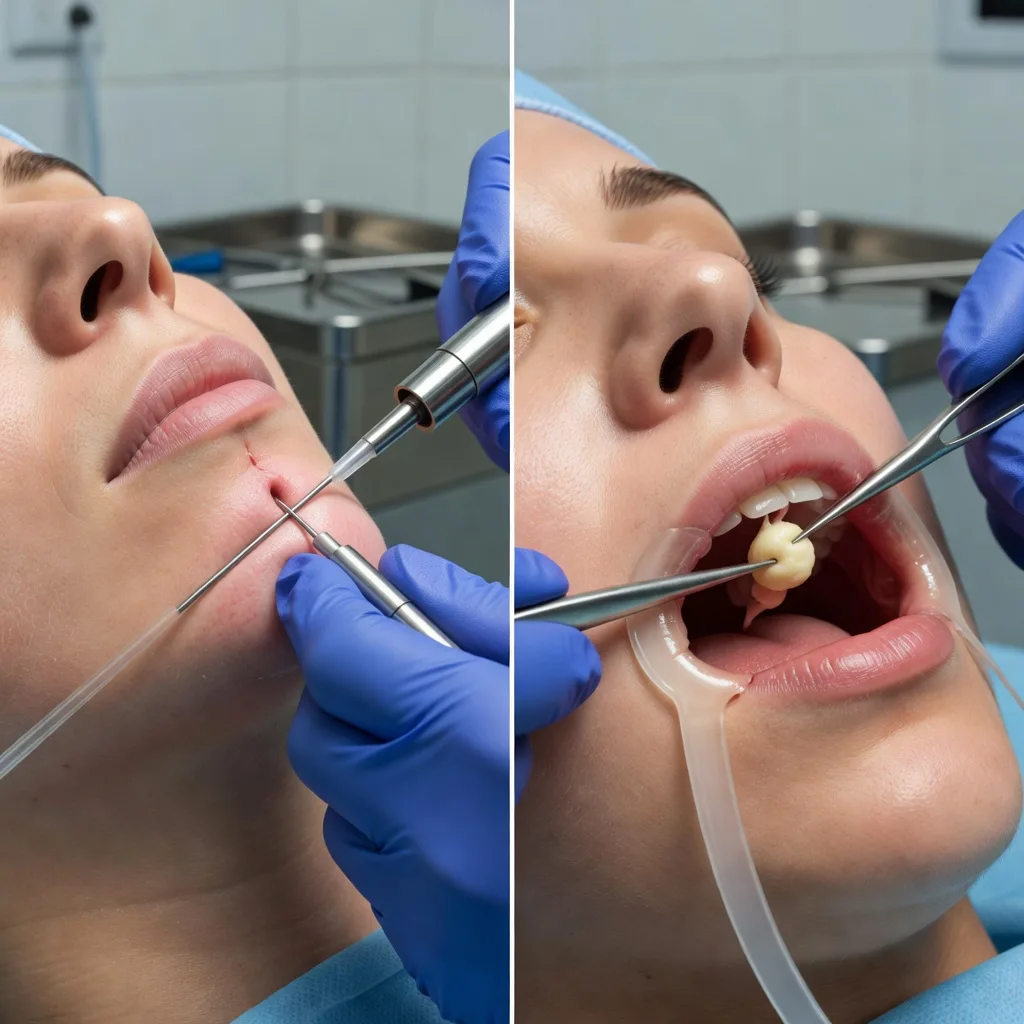
Facial Liposuction vs Buccal Fat Removal: Differences, Risks and Recovery
Facial liposuction and buccal fat removal are both surgical ways to reduce fat in the face, and both have grown in popularity as people look for a slimmer, more defined facial shape. Because they are often mentioned together on social media, many people assume they are interchangeable. In fact they target different fat, in different places, through different techniques.
Part of our guide to facial treatments. Start with: What Is the Best Anti-Aging Facial Treatment? Options Compared by Goal
Facial liposuction uses a thin tube called a cannula to suction fat from just under the skin, most often under the chin, along the jawline or in the jowls. Buccal fat removal is a different operation in which a surgeon removes part of the buccal fat pad, a deep pocket of fat in the cheek, usually through a small cut inside the mouth. Liposuction mainly defines the lower face and neck, while buccal fat removal slims the mid-cheek area. Buccal fat removal is permanent and can make the face look hollow with age, so careful patient selection matters. Both are surgery with real risks and require a qualified surgeon.
Put simply, liposuction reshapes the jaw and neck, while buccal fat removal changes the fullness of the cheeks from the inside.
A 2025 systematic review and meta-analysis in the Journal of Cranio-Maxillofacial Surgery pooled 308 patients who had buccal fat pad removal and found that about a quarter experienced some complication, most often swelling, restricted mouth opening and pain, while facial nerve problems were rare.
This guide explains how each procedure works, who is a good candidate, what recovery looks like, the risks and how to choose the right option and surgeon.
Shopping these picks?
Amazon Prime members get fast, free shipping on eligible items, plus Prime Video, Amazon Music and member deals. New members can start with a free trial.
Start a free Prime trialAged 18 to 24? Prime for Young Adults comes with a longer free trial and a lower price after it.
Affiliate link: we may earn a commission at no extra cost to you.
Recommended Recovery Essentials After Facial Surgery



Quick Answer
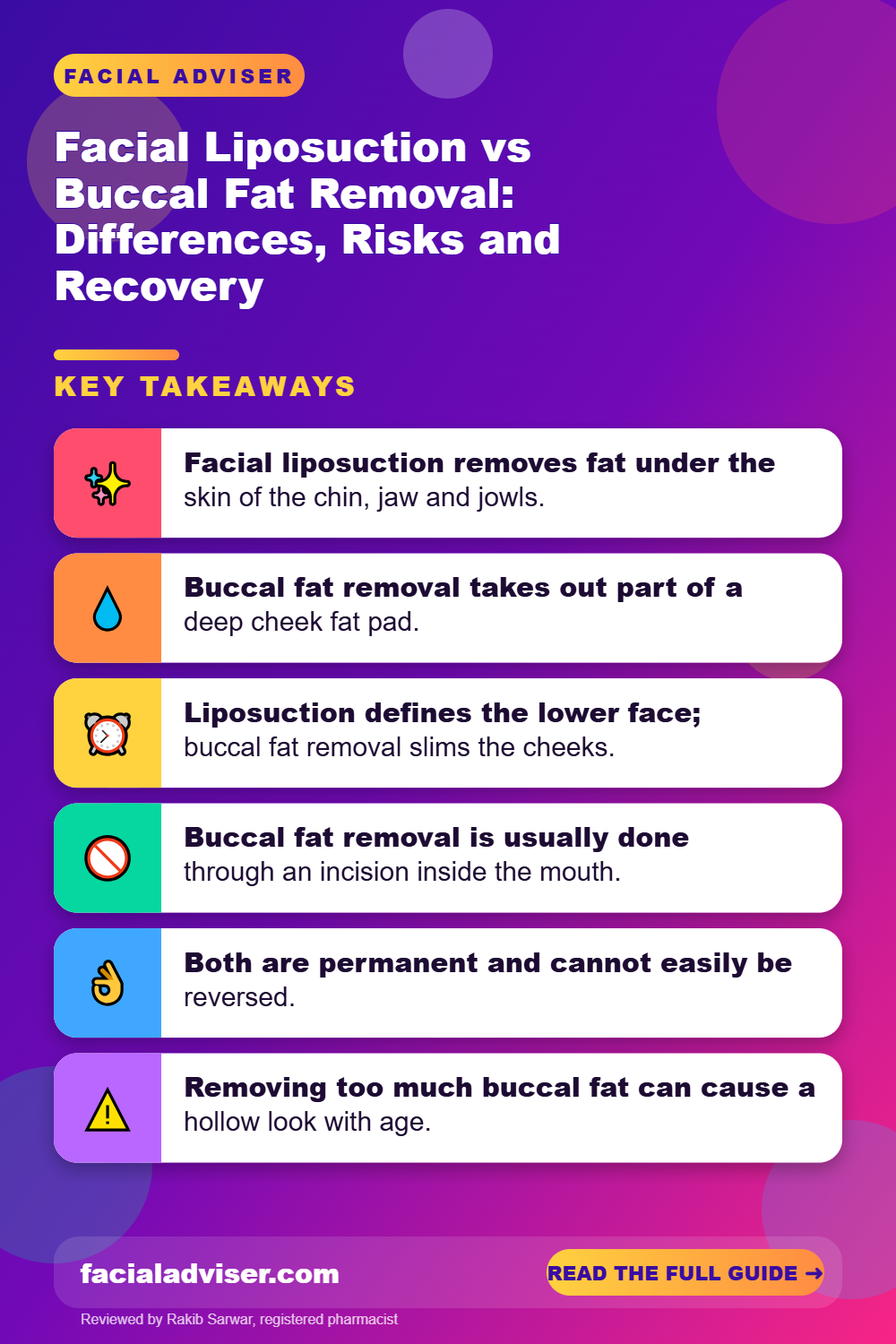
- Facial liposuction removes fat under the skin of the chin, jaw and jowls.
- Buccal fat removal takes out part of a deep cheek fat pad.
- Liposuction defines the lower face; buccal fat removal slims the cheeks.
- Buccal fat removal is usually done through an incision inside the mouth.
- Both are permanent and cannot easily be reversed.
- Removing too much buccal fat can cause a hollow look with age.
- Choose a board-certified plastic or facial plastic surgeon.
Jump to a Section
- Facial Liposuction vs Buccal Fat Removal at a Glance
- How Facial Liposuction Works
- How Buccal Fat Removal Works
- Who Is a Good Candidate?
- Risks and Complications
- How to Decide Between Facial Liposuction and Buccal Fat Removal
- Recovery and Aftercare
- Non-Surgical Alternatives
- Dos and Don’ts
- Honest Limits
- When to See a Doctor
- Your Questions, Answered
- Summing Up
Facial Liposuction vs Buccal Fat Removal at a Glance
This table summarises the main differences between the two procedures.
| Feature | Facial liposuction | Buccal fat removal |
|---|---|---|
| Fat targeted | Fat just under the skin | Deep buccal fat pad in the cheek |
| Main areas | Under the chin, jawline, jowls | Mid-cheek hollow below the cheekbone |
| Technique | Small skin incisions and a suction cannula | Incision inside the mouth; fat gently removed |
| Typical anaesthesia | Local, sometimes with sedation | Local, sometimes with sedation or general |
| Visible scars | Tiny, often hidden under the chin or behind ears | None on the skin |
| Swelling | Weeks, with final shape over months | Weeks, with final shape over months |
| Main long-term concern | Irregularities or loose skin | Hollow or gaunt appearance with aging |
Because these procedures address different fat compartments, some people are candidates for one, some for both and many for neither. The right choice depends on where the fullness actually sits, which a surgeon assesses in person.
How Facial Liposuction Works
Facial liposuction is most commonly performed under the chin and along the jawline to reduce a double chin and sharpen the angle between the jaw and neck. After numbing the area, the surgeon makes one or more tiny incisions and uses a thin cannula to loosen and suction out fat from the layer just beneath the skin.
Good results depend on skin that can contract after the fat is removed. People with good skin elasticity and localised fat tend to see the clearest improvement. If the skin is loose or the neck muscles are prominent, liposuction alone may not give the desired result, and a neck lift may be discussed instead.
Facial fat is not the only cause of a full lower face. Genetics, jaw and chin structure, skin laxity and weight changes all play a role, so liposuction is not always the right answer.
The American Academy of Dermatology explains what liposuction can and cannot do, including why it is not a weight-loss treatment. If you are hoping exercise alone might help instead, our guide on whether face exercises work for a double chin looks at the evidence.
How Buccal Fat Removal Works
The buccal fat pad is a deep, rounded pocket of fat that sits in the cheek between the facial muscles. Its size varies from person to person, and a larger pad can give the face a round, full-cheeked look even in people who are otherwise slim.
In buccal fat removal, the surgeon makes a small incision inside the mouth, on the inner cheek, gently teases out a portion of the fat pad and removes it, then closes the incision with dissolvable stitches. There are no skin scars. The goal is a subtle hollow beneath the cheekbones and a more contoured mid-face.
- Only part of the pad is usually removed, to reduce the risk of later hollowing.
- The procedure is often done under local anaesthetic, sometimes with sedation.
- It is sometimes combined with other procedures, such as chin or neck liposuction.
- The fat does not grow back, so the change is considered permanent.
A systematic review and meta-analysis in the Journal of Cranio-Maxillofacial Surgery, available on PubMed, included 12 studies and 308 patients. About 25 percent had some form of complication; the most common were swelling, trismus (difficulty opening the mouth) and pain, with facial nerve paralysis reported in under 1 percent of cases. The authors concluded that removal can be considered safe with a detailed understanding of the anatomy.
Who Is a Good Candidate?
Suitability depends on where the fullness is, your age, skin quality and long-term goals.
| Situation | Facial liposuction | Buccal fat removal |
|---|---|---|
| Double chin with good skin elasticity | Often suitable | Not relevant |
| Round, full mid-cheeks at a healthy weight | Not relevant | May be suitable |
| Loose or sagging skin | Often not enough on its own | Not suitable; may worsen hollowing |
| Naturally thin face | Rarely needed | Usually not advised |
| Fullness mainly from weight | Weight stabilisation first | Weight stabilisation first |
Age matters, particularly for buccal fat removal. Facial fat naturally decreases over time, so removing cheek fat when young can look sculpted at first but leave the face looking gaunt or older years later. Many surgeons are cautious about buccal fat removal in people with slim faces for this reason.
Psychological readiness matters too. Trends on social media can make a particular face shape seem desirable, but preferences change and these procedures are permanent. A good surgeon will ask why you want the change, whether you have considered non-surgical options and how you would feel if the result were subtler than expected. Taking time between consultation and surgery gives you space to be sure the decision is your own and not driven by a passing trend.
Risks and Complications
Both procedures are generally considered safe in experienced hands, but they are surgery and carry real risks.
- Common to both: swelling, bruising, pain, numbness and infection.
- Facial liposuction: contour irregularities, lumps or dents, loose skin and, rarely, nerve injury affecting the lower lip.
- Buccal fat removal: restricted mouth opening, asymmetry, hematoma and, rarely, injury to facial nerve branches or the salivary duct.
- Long term: over-removal of buccal fat can create a hollow, older-looking face.
Only have these procedures with a board-certified plastic or facial plastic surgeon operating in an accredited facility. Seek urgent care if you have rapidly increasing swelling, difficulty breathing or swallowing, fever, pus or facial weakness after surgery.
Tell your surgeon about any bleeding disorders, blood-thinning medications or supplements, smoking and medical conditions. Smoking in particular slows healing and increases complications, and most surgeons ask patients to stop well before surgery.
How to Decide Between Facial Liposuction and Buccal Fat Removal
Identify where the fullness is
Under the chin and jaw suggests liposuction; mid-cheek roundness may suggest buccal fat removal.
Stabilise your weight
Aim for a stable weight first, as weight changes affect facial fat.
Consider long-term aging
Ask how the face is likely to look in 10 to 20 years, especially after buccal fat removal.
Consult a qualified surgeon
Choose a board-certified plastic or facial plastic surgeon with relevant experience.
Review photos and options
Ask to see results in people with a similar face shape and discuss non-surgical alternatives.
Discuss risks in detail
Make sure you understand complications, recovery and what happens if you are unhappy.
Plan your recovery
Arrange time off, help at home and follow-up visits.
Bring photos of yourself from a few years ago as well as today. They help the surgeon see how your face has changed and whether the fullness is structural, fat-related or skin-related.
Our guide on facial specialists, estheticians and dermatologists explains who is qualified to perform different types of facial treatments.
Recovery and Aftercare
Recovery is broadly similar in length for both procedures, though the details differ.
- Liposuction: a compression garment around the chin and neck is often worn for days to weeks as directed.
- Buccal fat removal: a soft diet for several days and careful mouth hygiene to protect the internal incision.
- Both: cold compresses early on, sleeping with the head elevated and avoiding strenuous exercise for a period.
- Both: attend all follow-up visits and report worsening pain or swelling promptly.
Most swelling settles over the first few weeks, but the final shape can take several months to appear. Your surgeon may advise rinsing with an alcohol-free mouthwash and using a soft toothbrush after buccal fat removal, and keeping small liposuction incisions clean and protected from the sun. Always follow your own surgeon’s instructions over general advice.
Non-Surgical Alternatives
Surgery is not the only option for a fuller face, and some alternatives carry less risk.
For a double chin, an injectable containing deoxycholic acid is approved by the FDA to reduce fat under the chin, and non-invasive fat-reduction devices are also used. These usually need several sessions and give more gradual results. The FDA has also warned consumers about fat-dissolving injections that are not FDA approved, which can cause serious harm.
For a rounder mid-face, some people find that contouring makeup or botulinum toxin for enlarged jaw muscles changes their face shape more than cheek fat removal would. Our guide on facial fillers versus Botox explains how these injectables work.
Dos and Don’ts
Worth Doing
- Choose a board-certified surgeon
- Reach a stable weight first
- Ask about long-term aging effects
- Follow aftercare instructions closely
- Protect incisions from the sun
Skip It
- Base decisions on social media trends
- Remove buccal fat if your face is already thin
- Smoke before or after surgery
- Ignore worsening swelling or fever
- Use unapproved fat-dissolving injections
Honest Limits
Evidence on buccal fat removal comes mostly from relatively small studies, and long-term outcomes over decades are not well documented. Facial liposuction is well established, but results depend heavily on skin quality and the surgeon’s technique.
Neither procedure tightens significantly loose skin or changes bone structure, and neither replaces a healthy lifestyle and stable weight. Because both are permanent, taking time to consider long-term effects and getting more than one professional opinion is sensible.
When to See a Doctor
- Swelling suddenly increases or one side becomes much larger than the other.
- You develop fever, pus, spreading redness or severe pain.
- You have difficulty opening your mouth that is getting worse rather than better.
- You notice weakness or drooping of part of the face or lips.
This article is for general information and does not replace professional medical advice. Consult a board-certified plastic or facial plastic surgeon before considering any cosmetic surgery.
Your Questions, Answered
What is the difference between facial liposuction and buccal fat removal?
Liposuction suctions fat under the skin; buccal fat removal takes out part of a deep cheek fat pad.
Which is better for a double chin?
Facial liposuction, as buccal fat removal does not treat the chin or neck.
Is buccal fat removal permanent?
Yes, the removed fat does not grow back.
Does buccal fat removal leave scars?
No visible scars, as the incision is inside the mouth.
Can buccal fat removal make you look older?
It can cause hollowing with age, especially if too much is removed.
How long is recovery?
Most swelling settles in a few weeks; final results take months.
What are the common side effects?
Swelling, bruising, pain and, after buccal fat removal, temporary difficulty opening the mouth.
Can both procedures be done together?
Sometimes, if a surgeon agrees you are a good candidate for both.
Are there non-surgical options?
Yes, including FDA-approved injections for fat under the chin.
Who should perform these procedures?
A board-certified plastic or facial plastic surgeon.
Summing Up
Facial liposuction removes fat under the skin of the chin, jaw and jowls, while buccal fat removal takes out part of a deep cheek fat pad through the mouth. They treat different areas and suit different face shapes.
Think carefully about long-term aging, reach a stable weight, get assessed by a board-certified surgeon and follow aftercare closely to give yourself the best, safest result.

Written by
Registered pharmacist and founder of Facial Adviser. Rakib's pharmacy training covers how skincare actives work and interact; a later course in cosmetology turned that into a focus on facial treatments and skincare products. He plans, researches and edits every guide on the site and checks health claims against sources such as the American Academy of Dermatology, the FDA and the NIH. He is not a dermatologist; see the Editorial Policy and Medical Disclaimer.
About · Editorial policy · How we choose products · Medical disclaimer · Contact
Keep reading: Anti-aging facials and treatments
- What Is the Best Anti-Aging Facial Treatment? Options Compared by Goal
- Facial Fillers vs Botox: Which Treats Your Lines, and What Each Can Go Wrong
- What Are the Benefits of Anti-Wrinkle Injections? Results, Risks and Options
- What Should I Use on My Face for Anti-Aging? The 5 Products That Matter
- What Does an Anti-Aging Facial Consist Of? Steps, Types and What to Expect
- Can Anti-Aging Creams Age You? Irritation, Sun Sensitivity and Fixes
- Is Hydrafacial a Gimmick? What Evidence Shows
- Ultimate Guide Microdermabrasion: What to Know





One Comment