Laser Facial vs Microneedling: Results, Downtime, and Skin Tone Safety
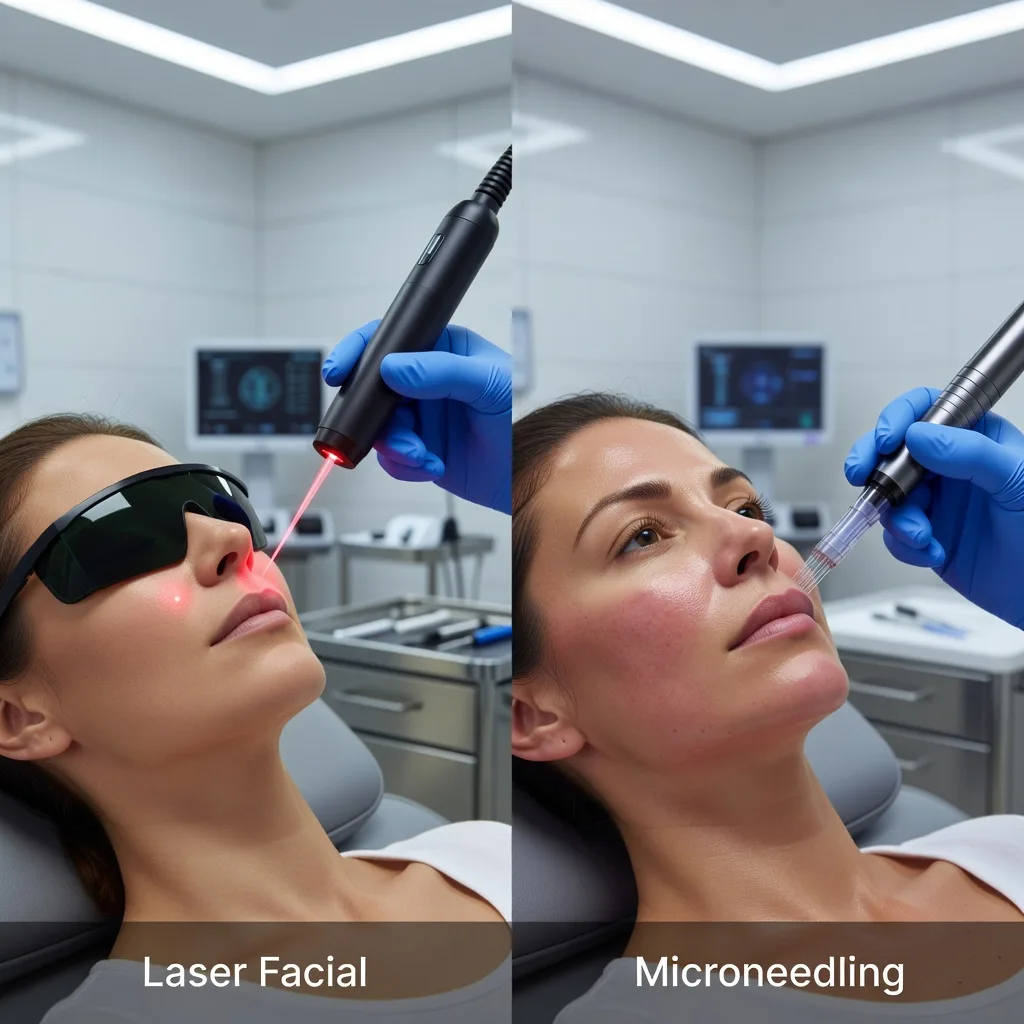
Both treatments work on the same basic idea: create controlled injury in the skin so it rebuilds with fresh collagen. Microneedling does it with rows of fine needles. A laser facial does it with light energy. The goal of smoother, firmer, more even skin is similar, but the route there is different.
Part of our guide to facial treatments. Start with: Microneedling Facial: Real Results, Explained
For acne scars, the two can deliver surprisingly similar results. The biggest differences are in downtime, pigmentation risk, and what else they can treat. Lasers can also target brown spots and redness in ways needles cannot, while microneedling is generally gentler on darker skin tones.
A 2016 randomized trial published in Dermatologic Surgery compared a non-ablative fractional laser with microneedling for acne scars. After three monthly sessions, both groups improved to a similar degree, but post-inflammatory hyperpigmentation appeared in about 14 percent of laser patients and none of the microneedling patients.
Laser facial is also a loose term. It can mean anything from a gentle light treatment with almost no downtime to an ablative resurfacing laser that takes a week or more to heal. Knowing exactly which laser is being offered matters as much as choosing between laser and needles.
This guide explains how each works, compares results and recovery side by side, walks you through a short self-check to see which fits your skin, and covers the red flags that mean you should see a dermatologist first.
Shopping these picks?
Amazon Prime members get fast, free shipping on eligible items, plus Prime Video, Amazon Music and member deals. New members can start with a free trial.
Start a free Prime trialAged 18 to 24? Prime for Young Adults comes with a longer free trial and a lower price after it.
Affiliate link: we may earn a commission at no extra cost to you.
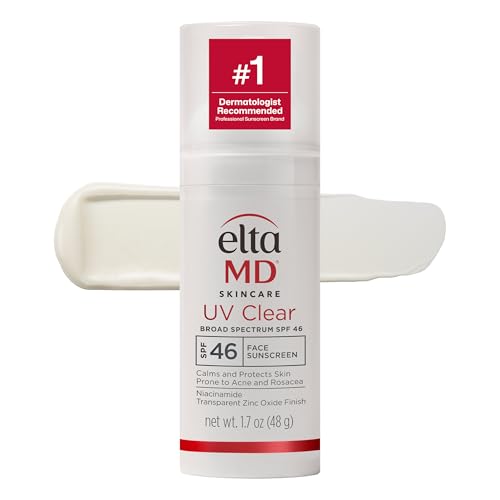
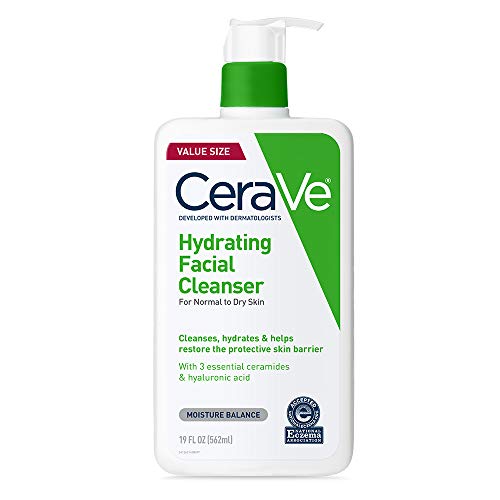
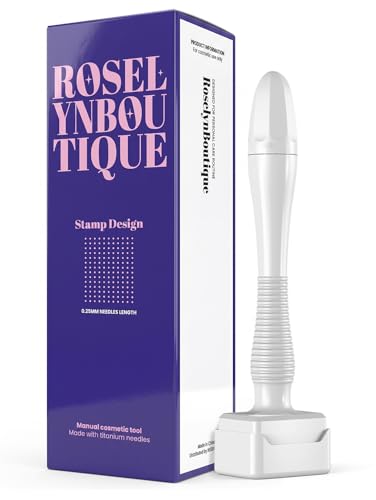
Recommended At-Home Microneedling and Light Therapy Tools


Quick Answer
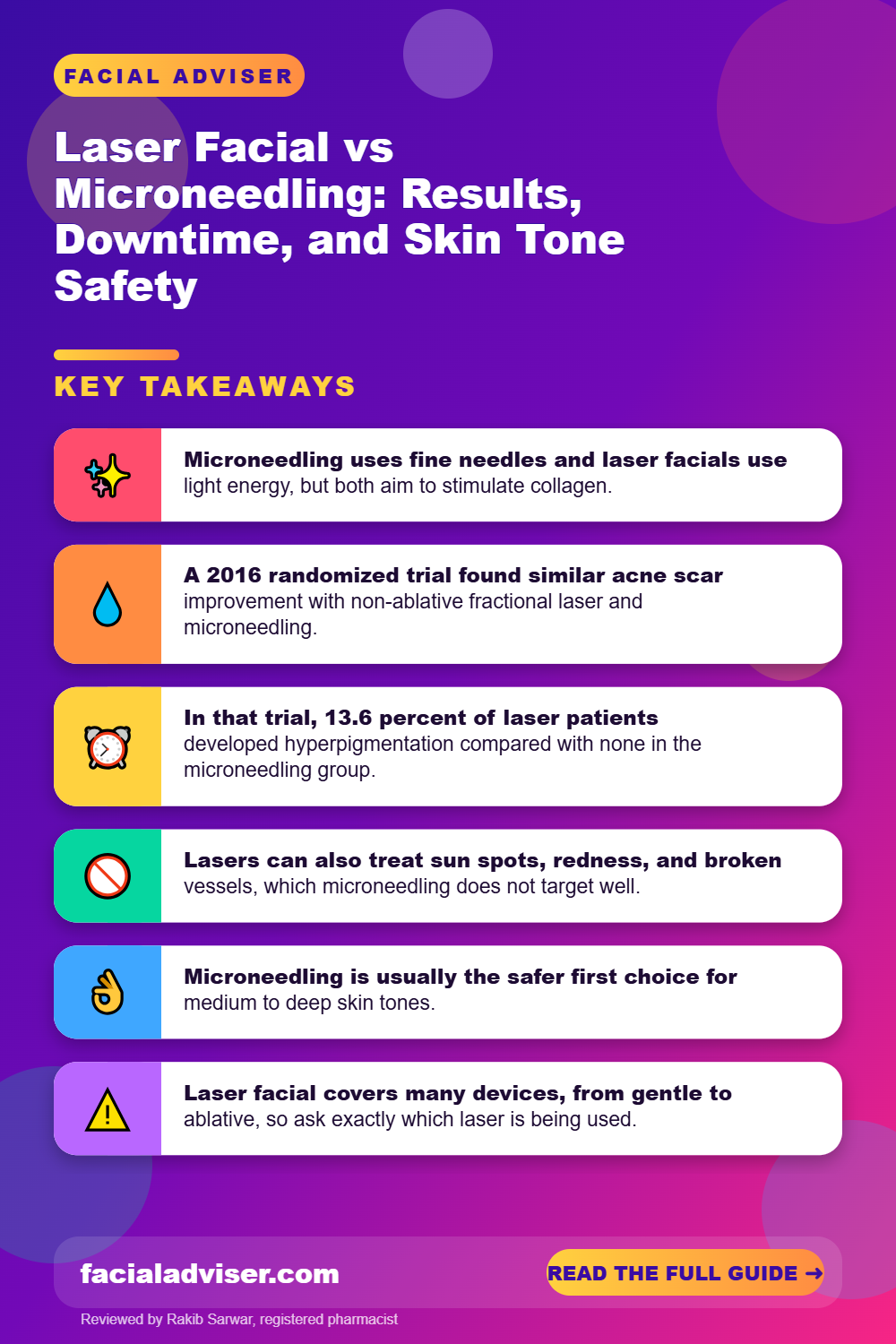
- Microneedling uses fine needles and laser facials use light energy, but both aim to stimulate collagen.
- A 2016 randomized trial found similar acne scar improvement with non-ablative fractional laser and microneedling.
- In that trial, 13.6 percent of laser patients developed hyperpigmentation compared with none in the microneedling group.
- Lasers can also treat sun spots, redness, and broken vessels, which microneedling does not target well.
- Microneedling is usually the safer first choice for medium to deep skin tones.
- Laser facial covers many devices, from gentle to ablative, so ask exactly which laser is being used.
- Daily sunscreen is essential after either treatment to protect results and prevent dark marks.
Jump to a Section
- How Each Treatment Works
- Laser Facial vs Microneedling Compared
- What the Research Shows
- A Quick Self-Check Before Your Consultation
- Skin Tone Matters More Than Most Clinics Admit
- Matching the Treatment to Your Concern
- Recovery and Aftercare
- What Neither Treatment Can Fix
- When to See a Dermatologist First
- Questions People Ask
- Where This Leaves You
How Each Treatment Works
Microneedling
Microneedling, also called collagen induction therapy, uses a pen-like device with tiny needles that create thousands of microscopic channels in the skin. The skin responds by starting a wound-healing process that includes new collagen and elastin. Treatments are usually done in a series, about four weeks apart.
Laser facials
Laser facials use focused light that heats or removes targeted parts of the skin. Non-ablative fractional lasers heat tiny columns of tissue below the surface while leaving the top layer intact, which shortens downtime. Ablative lasers, such as fractional CO2, remove thin columns of skin and deliver stronger results with more recovery time. Other devices, such as IPL, target pigment and redness rather than texture.
If you are also considering radiofrequency microneedling, which adds heat to the needles, our comparison of RF microneedling vs laser covers that option.
Laser Facial vs Microneedling Compared
| Feature | Laser facial (non-ablative fractional) | Microneedling |
|---|---|---|
| How it works | Light energy heats tiny columns of skin | Needles create micro-channels |
| Best for | Texture, scars, sun damage, pigment | Texture, acne scars, fine lines, pores |
| Treats brown spots and redness | Yes, depending on device | Not directly |
| Typical downtime | 2 to 5 days of redness and swelling | 1 to 3 days of redness |
| Pigmentation risk in darker skin | Higher | Lower |
| Usual sessions | 3 to 5, about a month apart | 3 to 6, about a month apart |
| Who performs it | Dermatologist or trained laser provider | Dermatologist, nurse, or trained esthetician |
Both are usually done under topical numbing cream, and both feel like prickling or heat rather than sharp pain for most people.
What the Research Shows
The clearest head-to-head evidence comes from a randomized clinical trial by Cachafeiro and colleagues, published in Dermatologic Surgery in 2016. It included 42 people with atrophic acne scars who received three monthly treatments with either a 1,340 nm non-ablative fractional erbium laser or microneedling.
Both groups showed meaningful improvement on a standard scar grading scale, and patients rated their results similarly, at around 7.6 out of 10 for microneedling and 8 out of 10 for laser. Pain scores were comparable. The difference was in side effects: laser patients had longer-lasting redness after each session, and 13.6 percent developed post-inflammatory hyperpigmentation, while none in the microneedling group did.
The authors concluded that the two methods gave comparable results, but microneedling had a better complication profile. The study was small and focused only on acne scars, so it does not tell us much about pigmentation, sun damage, or wrinkles, where lasers may have an advantage.
Ablative lasers are a different category. Fractional CO2 and erbium resurfacing can produce stronger results for deep wrinkles and scars, with significantly longer downtime and higher risk. They are not usually what spas mean by a laser facial.
A Quick Self-Check Before Your Consultation
This five-step check helps you work out which treatment is worth discussing first. It will not replace a professional assessment, but it will make your consultation more focused.
Name your main concern
Write down whether your top issue is texture and scarring, brown spots and uneven tone, redness and visible vessels, or fine lines.
Check your skin tone history
Think about how your skin reacts to cuts, spots, or burns. If small injuries often leave dark marks that take weeks to fade, you are more prone to hyperpigmentation.
Look at your calendar
Count how many days you can spend with visible redness. One to three days suits microneedling; up to five days suits most non-ablative lasers.
Review recent sun exposure
Recent tanning raises the risk of laser complications. If you have been in strong sun in the past month, microneedling or waiting may be safer.
Match the answers
Texture or scars with a history of dark marks points to microneedling. Brown spots or redness with lighter skin that heals evenly points to a laser. Bring these notes to your consultation.
Ask your provider how many people with your skin tone they have treated with the device they recommend, and whether they can show before and after photos of similar skin.
Skin Tone Matters More Than Most Clinics Admit
Darker skin has more active pigment cells, and heat or inflammation can trigger them to produce extra pigment. This is why post-inflammatory hyperpigmentation is the most common complication of laser treatments in medium and deep skin tones.
Microneedling does not rely on heat and does not target pigment, so it is generally considered safer for darker skin. That does not make it risk-free. Aggressive needle depths, poor aftercare, or sun exposure can still cause dark marks.
Some lasers, particularly longer wavelengths and lower settings, can be used safely on darker skin by experienced providers. The key is choosing someone who adjusts the device and settings to your skin rather than using a single protocol for everyone.
Matching the Treatment to Your Concern
The simplest way to narrow things down is to look at what you most want to change. Each treatment has concerns where it tends to shine and others where it is only a partial answer.
- Rolling or boxcar acne scars: both work, and the 2016 trial suggests results are similar, so skin tone and downtime usually decide.
- Enlarged-looking pores and rough texture: both can help; microneedling is often the gentler starting point.
- Sun spots and freckling: pigment-targeting lasers or IPL are usually more effective than needles.
- Redness and broken capillaries: vascular lasers and IPL are designed for this, while microneedling can briefly make redness worse.
- Fine lines around the eyes and mouth: both can soften them modestly; deeper lines may need ablative resurfacing or injectables.
- Stretch marks and surgical scars: both are used, often in a series, with gradual improvement.
Many people have more than one concern. In that case, a provider may suggest starting with the treatment that addresses the most bothersome issue with the lowest risk for your skin, then adding the other later once you know how your skin heals.
Recovery and Aftercare
After microneedling, skin usually looks pink to red like a mild sunburn for one to three days, with slight dryness or flaking. After a non-ablative fractional laser, expect redness and swelling for two to five days and a rough, bronzed texture as tiny treated spots flake off.
Try This
- Use a gentle cleanser and a plain, bland moisturizer.
- Apply broad-spectrum SPF 30 or higher every day.
- Keep your hands and phone screen clean.
- Sleep on a clean pillowcase for the first few nights.
- Follow your provider’s written instructions.
Avoid This
- Use retinoids, acids, or scrubs for about a week.
- Sit in the sun, sauna, or hot yoga soon after.
- Pick or peel flaking skin.
- Apply makeup too early.
- Book another resurfacing treatment before skin fully heals.
Results from both treatments build over weeks to months as collagen remodels. Our guide to microneedling before and after shows what the timeline typically looks like.
What Neither Treatment Can Fix
Neither microneedling nor a non-ablative laser can lift sagging skin or replace lost volume. Deep ice pick scars often need other approaches, such as TCA cross, subcision, or surgical excision, sometimes combined with resurfacing.
| Expectation | Reality |
|---|---|
| One session will erase scars | Most people need three or more sessions for visible change |
| Results are instant | Collagen builds gradually over three to six months |
| Laser clears melasma permanently | Melasma often returns and can worsen with heat-based treatments |
| No downtime at all | Expect at least one to several days of redness |
| Home devices match clinic results | Home tools are much weaker and carry their own risks |
If you are unsure how much improvement is realistic, ask your provider to estimate the percentage change they expect rather than using vague terms like dramatic or amazing. Our guide on carbon peel laser benefits covers a lighter laser option for oil and pores.
When to See a Dermatologist First
See a board-certified dermatologist before either treatment if any of the following apply:
- You have active acne, cold sores, eczema, or infection on the face.
- You have taken isotretinoin in the past six to twelve months.
- You have melasma, which can worsen with some lasers.
- You have a history of keloid or raised scars.
- You have a mole or spot that is changing, bleeding, or irregular.
- You are pregnant or have an autoimmune or bleeding disorder.
Seek medical help after treatment if you notice blisters, crusting, spreading redness, pus, severe pain, or fever, which may indicate burn or infection.
Medical disclaimer: This article is for general information and is not a substitute for professional medical advice. Always consult a qualified provider about your skin type and health history before cosmetic treatments.
Questions People Ask
Is laser or microneedling better for acne scars?
A 2016 randomized trial found similar improvement, but microneedling caused fewer side effects, especially dark marks.
Which has less downtime?
Microneedling usually has one to three days of redness, while non-ablative lasers often need two to five days.
Is microneedling safer for dark skin?
Generally, yes. It does not use heat and has a lower risk of hyperpigmentation, though careful technique still matters.
Can a laser facial remove sun spots?
Many lasers and light devices can fade brown spots. Microneedling does not directly target pigment.
How many sessions will I need?
Usually three to six sessions spaced about a month apart, depending on your concern and the device.
Can I combine laser and microneedling?
Some providers do, in separate sessions. Allow full healing between treatments and follow professional advice.
Does microneedling hurt more than laser?
Pain scores were similar in the 2016 trial. Numbing cream is used for both.
When will I see results?
Some glow appears within weeks, but collagen changes take three to six months to show fully.
Can I do microneedling at home instead?
Home rollers use very short needles and give far milder results. Deeper treatments should be done professionally.
Should I avoid the sun after treatment?
Yes. Sun exposure increases the risk of dark marks after both treatments, so use daily sunscreen.
Where This Leaves You
Laser facials and microneedling both stimulate collagen, and for acne scars they can deliver similar improvement. The practical differences are downtime, what else they treat, and pigmentation risk, with lasers better for brown spots and redness and microneedling usually safer for darker skin.
Start with your main concern and your skin’s history with dark marks, ask exactly which device a clinic plans to use, and choose a provider experienced with your skin tone. Whatever you pick, strict sun protection afterward protects both your skin and your results.

Written by
Registered pharmacist and founder of Facial Adviser. Rakib's pharmacy training covers how skincare actives work and interact; a later course in cosmetology turned that into a focus on facial treatments and skincare products. He plans, researches and edits every guide on the site and checks health claims against sources such as the American Academy of Dermatology, the FDA and the NIH. He is not a dermatologist; see the Editorial Policy and Medical Disclaimer.
About · Editorial policy · How we choose products · Medical disclaimer · Contact
Keep reading: Microneedling, PRP and lasers
- Why Can't You Wear Makeup After Microneedling? How Long to Wait
- Best Microneedling Pen for Fine Lines and Wrinkles: Safe Home Buyer's Guide
- Best Laser for Facial Veins: Pulsed Dye, KTP, Nd:YAG and IPL Compared
- Facial Veins on the Nose: How to Reduce Them and What Really Works
- Microneedling Facial: Real Results, Explained
- What Is the Best Anti-Aging Facial Treatment? Options Compared by Goal
- What Is a Spa Facial?