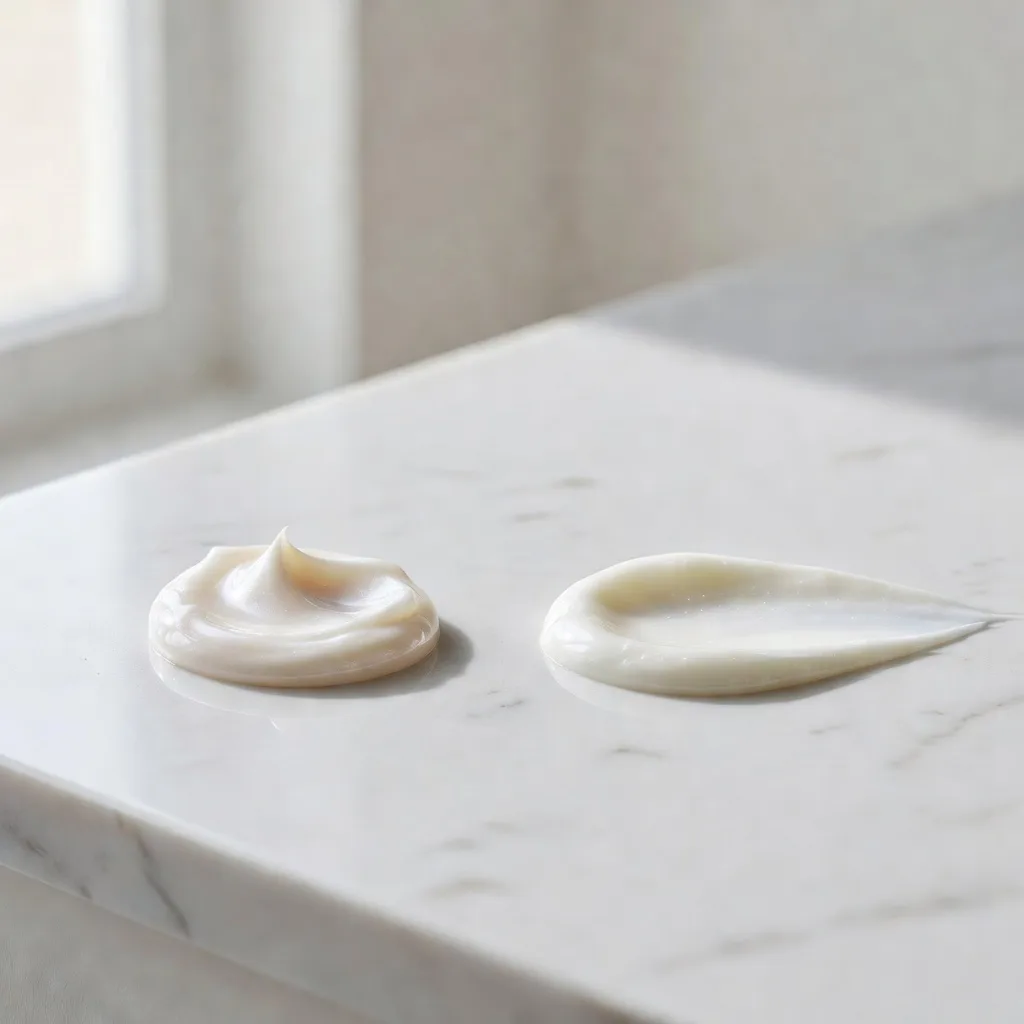
Facial Moisturizer vs Body Lotion: Can You Use Lotion on Your Face?
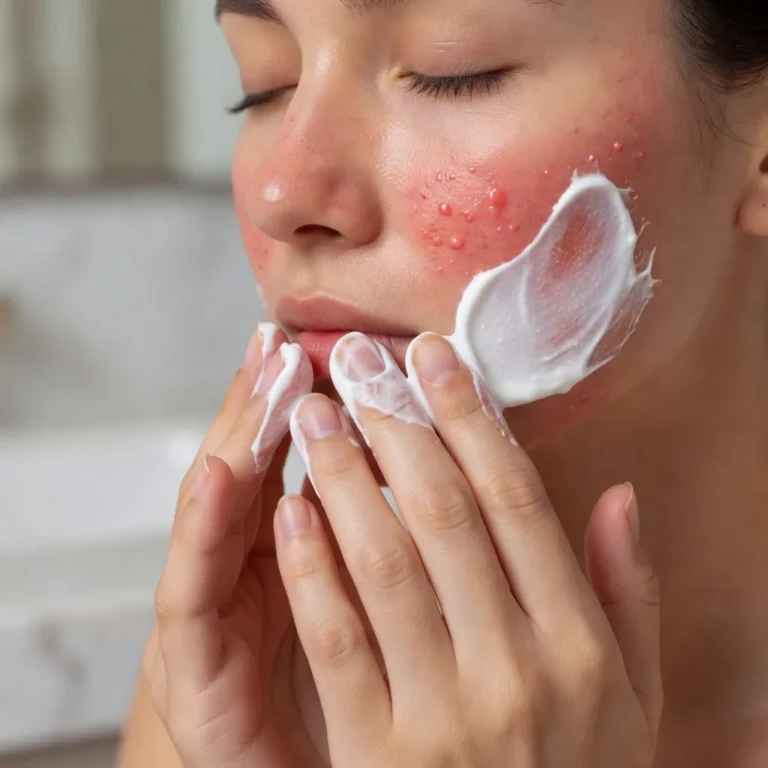
You ran out of face cream, and there is a big bottle of body lotion right there on the shelf. It is all moisturizer, so what is the harm? Sometimes none. Sometimes a week of new breakouts, stinging around the eyes, or a red, itchy patch you cannot explain.
Part of our guide to skincare products. Start with: 10 Best Facial Moisturizers for Dry Skin (2026): Rich, Gentle Creams
The difference between facial moisturizer and body lotion is not the label but the formula. Facial moisturizers are usually lighter, more often fragrance-free, and designed not to clog pores, because facial skin is thinner and packed with more oil glands. Body lotions are often richer, more heavily scented, and built for thicker skin that rarely breaks out.
That matters because fragrance is one of the most common causes of cosmetic skin allergy. In North American Contact Dermatitis Group patch testing from 2019 to 2020, about 13 percent of tested patients reacted to a standard fragrance mix, and people with fragrance allergy were more likely to have dermatitis on the face.
So can you ever use lotion on your face? Yes, if it is fragrance-free, non-comedogenic, and gentle. Plenty of simple creams are made for both face and body. The trouble comes from scented, heavy, or active-packed body products that were never meant for facial skin.
This guide explains why facial skin needs different care, shows you how to check any lotion in about a minute, compares the two side by side, and covers when a reaction means it is time to see a dermatologist.
Shopping these picks?
Amazon Prime members get fast, free shipping on eligible items, plus Prime Video, Amazon Music and member deals. New members can start with a free trial.
Start a free Prime trialAged 18 to 24? Prime for Young Adults comes with a longer free trial and a lower price after it.
Affiliate link: we may earn a commission at no extra cost to you.
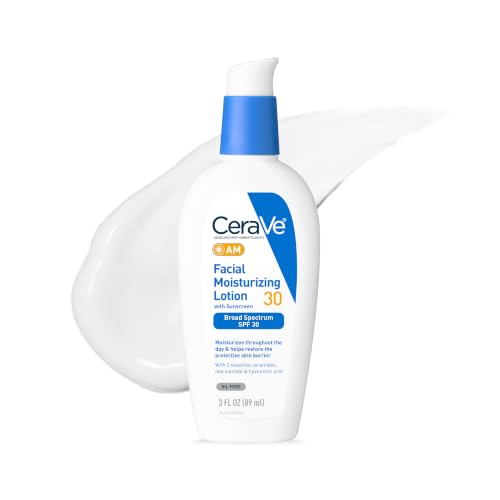
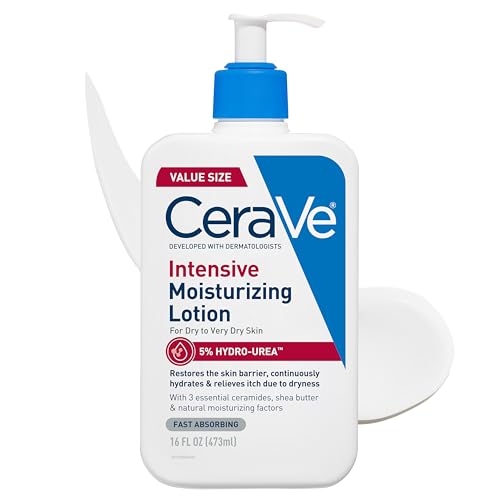
Recommended Face and Body Moisturizers
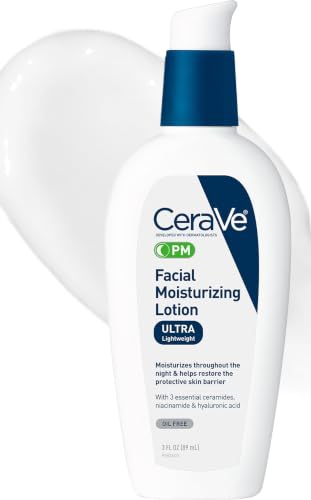
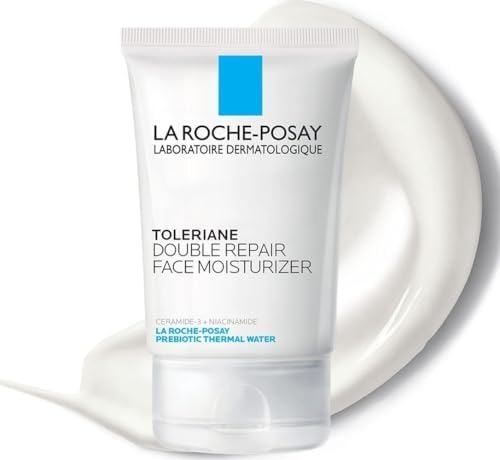

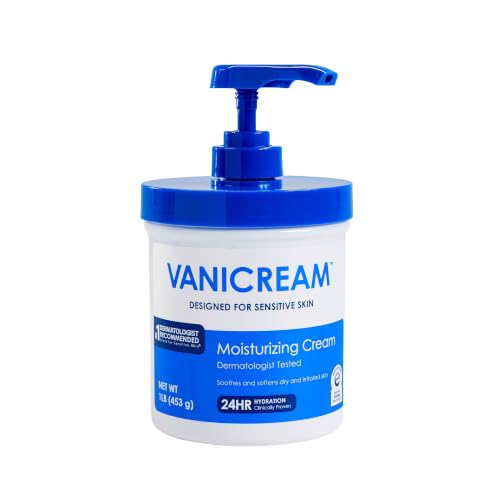

What This Covers
- Why Facial Skin Needs Different Care
- How the Formulas Differ
- Facial Moisturizer vs Body Lotion at a Glance
- The 60-Second Label Check
- Fragrance: The Biggest Reason to Keep Them Separate
- When Using Lotion on Your Face Is Fine, and When It Is Not
- Choosing a Moisturizer for Your Skin Type
- What a Moisturizer Can and Cannot Do
- When a Reaction Needs a Dermatologist
- Your Questions, Answered
- The Takeaway
Quick Answer
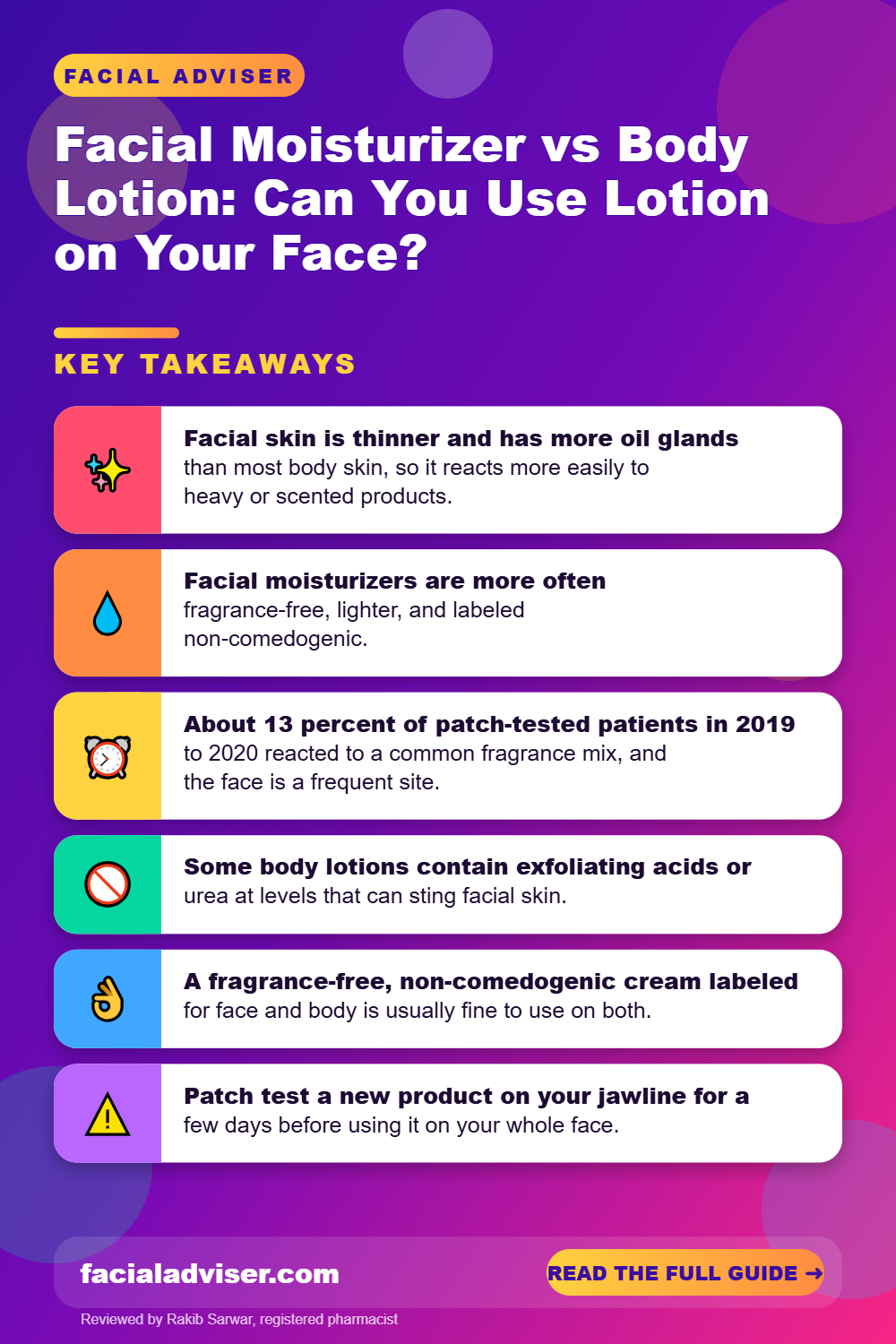
- Facial skin is thinner and has more oil glands than most body skin, so it reacts more easily to heavy or scented products.
- Facial moisturizers are more often fragrance-free, lighter, and labeled non-comedogenic.
- About 13 percent of patch-tested patients in 2019 to 2020 reacted to a common fragrance mix, and the face is a frequent site.
- Some body lotions contain exfoliating acids or urea at levels that can sting facial skin.
- A fragrance-free, non-comedogenic cream labeled for face and body is usually fine to use on both.
- Patch test a new product on your jawline for a few days before using it on your whole face.
- Persistent itching, swelling, or rash after a product needs a dermatologist and possibly patch testing.
Why Facial Skin Needs Different Care
Skin is not the same all over your body. The skin on your face, especially around the eyes, is thinner than on your arms, legs, or back. It also has a high density of sebaceous glands, the glands that produce oil, which is why the face is where most acne happens.
Facial skin is exposed to the sun, wind, and pollution every day, and it is treated with more products than almost any other area. That combination makes it more likely to become irritated, sensitized, or congested when you add a heavy or fragranced product.
Body skin, particularly on the shins, elbows, and heels, tends to be thicker and drier. It often benefits from richer lotions and creams with occlusive ingredients such as petrolatum and shea butter, and sometimes from exfoliating ingredients such as urea or lactic acid.
There are differences within the face too. The forehead, nose, and chin, often called the T-zone, usually produce more oil than the cheeks. The skin around the eyes is the thinnest on the face and has very few oil glands, which is why eye creams tend to be simple and fragrance-free. This variety is another reason a single heavy body product rarely suits the whole face.
How the Formulas Differ
Facial moisturizers are usually designed to absorb quickly, sit comfortably under sunscreen or makeup, and avoid clogging pores. Many include targeted ingredients such as niacinamide, ceramides, hyaluronic acid, or sunscreen filters.
Body lotions are usually made to cover large areas cheaply and pleasantly. They often include fragrance, heavier oils and butters, and sometimes exfoliating acids. None of that is bad on your legs, but it can be too much for your face.
Lotion, cream, gel, and balm describe texture, not where to use them. Gels are the lightest, lotions are thin and spreadable, creams are thicker, and balms and ointments are the richest. Choose texture based on your skin type.
If you are also deciding where serums and oils fit, our guide to facial oil vs serum covers how to layer them with a moisturizer.
Facial Moisturizer vs Body Lotion at a Glance
| Feature | Facial moisturizer | Body lotion |
|---|---|---|
| Typical texture | Light lotion, gel, or cream | Lotion or rich cream |
| Fragrance | Often fragrance-free | Often fragranced |
| Pore-clogging risk | Usually tested as non-comedogenic | Rarely tested for the face |
| Active ingredients | Niacinamide, ceramides, SPF, retinoids | Urea, lactic acid, shea butter |
| Designed for | Thinner, oilier, more sensitive skin | Thicker, drier skin |
| Container size | Small | Large |
| Safe to swap? | Fine on body | Only if gentle and fragrance-free |
The overlap zone is a simple, fragrance-free cream labeled for face and body. These are often recommended by dermatologists for sensitive skin because they are basic and low risk.
The 60-Second Label Check
Before putting any lotion on your face, run through these checks. You only need the bottle and about a minute.
Look for fragrance
Scan the ingredient list for fragrance, parfum, or essential oils such as lavender or citrus. If any are listed, skip it for your face.
Check for non-comedogenic
Look for the words non-comedogenic or will not clog pores on the label. It is not a guarantee, but it means the product was designed with pores in mind.
Scan for strong actives
Watch for urea above about 10 percent, alpha hydroxy acids such as glycolic or lactic acid, or salicylic acid. These can sting facial skin, especially if you already use actives.
Check the first few ingredients
If heavy oils, cocoa butter, or coconut oil appear near the top and you are acne-prone, it may be too rich for your face.
Patch test for three days
Apply a small amount to your jawline or near your ear once a day for three days. If there is no redness, itching, or new bumps, it is likely safe to try on the rest of your face.
If a lotion passes all five checks, using it on your face is usually fine. Many people use one fragrance-free cream for both face and body to keep things simple.
Fragrance: The Biggest Reason to Keep Them Separate
Fragrance is one of the most common triggers of allergic contact dermatitis from cosmetics. In the North American Contact Dermatitis Group patch test results for 2019 to 2020, 12.8 percent of tested patients reacted to fragrance mix I and 7.4 percent reacted to balsam of Peru, a fragrance-related marker.
The same data showed that people sensitive to fragrance or botanicals were more likely to have dermatitis on the face. That fits with what dermatologists see in practice: the face is a common place for fragrance reactions to show up, even when the product was applied elsewhere and transferred by hands or pillows.
Unscented is not the same as fragrance-free. Unscented products can contain masking fragrances that cover other smells. If you have sensitive skin, look for fragrance-free.
When Using Lotion on Your Face Is Fine, and When It Is Not
Good Habits
- Use a fragrance-free face and body cream if your skin is calm.
- Use a richer body cream on very dry facial patches in winter.
- Keep a basic cream as a backup when you run out of face moisturizer.
- Patch test before using any new product on your whole face.
- Apply sunscreen separately if your lotion has no SPF.
Common Mistakes
- Use scented body lotion on your face.
- Use lotions with urea or acids alongside a retinoid.
- Apply heavy body butter if you are prone to acne.
- Use body lotion near your eyes.
- Rely on a body lotion with SPF for facial sun protection unless labeled for face.
For very dry or damaged facial skin, some people use a thin layer of an ointment at night as a final step. Our guide to slugging in skincare covers how to do this without clogging pores.
A good rule of thumb is to think about where the product will end up. Anything you apply to your face also reaches your eyelids, lips, and hairline, and gets transferred to your pillowcase and hands. A body lotion that feels fine on your shins can behave very differently in those more sensitive spots, so it is worth being a little pickier about what goes on your face.
Choosing a Moisturizer for Your Skin Type
The best moisturizer depends more on your skin type than on whether the label says face or body.
- Oily or acne-prone: gel or light lotion, non-comedogenic, fragrance-free.
- Dry: cream with ceramides, glycerin, or hyaluronic acid; a richer night cream can help.
- Combination: light lotion overall, with a richer cream on dry patches.
- Sensitive: short ingredient list, fragrance-free, no essential oils.
- Mature: a moisturizer with SPF in the morning and a richer cream at night.
If you like to layer, lighter water-based products go first and richer creams go last. Our guide to the difference between essence and serum covers where those fit before your moisturizer.
Whatever your type, a moisturizer works best on slightly damp skin, right after cleansing, when it can help hold water in the outer layer.
What a Moisturizer Can and Cannot Do
Moisturizers help the outer layer of skin hold water and repair its barrier. They can make skin feel softer, look smoother, and feel less tight. They do not permanently change skin type, erase wrinkles, or treat acne on their own.
| Claim | Reality |
|---|---|
| Expensive face creams work better | Price does not predict results; ingredients and fit matter more |
| Body lotion always causes breakouts | Only some formulas do; fragrance-free, non-comedogenic ones are often fine |
| Oily skin does not need moisturizer | Oily skin can still be dehydrated, and a light moisturizer helps |
| Anti-aging creams reverse wrinkles | Sunscreen and retinoids have far stronger evidence |
| Natural oils are always gentler | Some plant oils and essential oils can irritate or clog pores |
If your skin still feels dry despite a good moisturizer, look at other parts of your routine, such as harsh cleansers, hot water, or too many exfoliants.
When a Reaction Needs a Dermatologist
A mild tingle that fades in a minute is common. These signs suggest something more is going on:
- Itching, redness, or a rash that lasts more than a day or two.
- Swelling around the eyes or lips.
- Tiny blisters or oozing patches.
- A rash that keeps returning in the same place.
- New bumps or breakouts that persist after stopping a product.
- Any reaction together with trouble breathing or throat tightness, which needs emergency care.
Stop the product and wash the area gently if you notice a reaction. A dermatologist can arrange patch testing to find the specific ingredient causing the problem.
Medical disclaimer: This article is for general information and is not a substitute for professional medical advice. See a healthcare provider about persistent rashes or skin reactions.
Your Questions, Answered
Can I use body lotion on my face?
You can if it is fragrance-free, non-comedogenic, and free of strong acids. Scented or heavy body lotions are more likely to irritate or clog pores.
What is the main difference between face moisturizer and body lotion?
Face moisturizers are usually lighter, more often fragrance-free, and designed not to clog pores. Body lotions are often richer and scented.
Can I use face moisturizer on my body?
Yes. It is safe, just more expensive for large areas.
Why does body lotion make my face break out?
Heavy oils, butters, or fragrance may clog pores or irritate skin, especially if you are acne-prone.
Is unscented the same as fragrance-free?
No. Unscented products can contain masking fragrances. Look for fragrance-free if you have sensitive skin.
Can body lotion with SPF be used on the face?
Only if it is labeled for face use. Many body sunscreens feel heavy and may sting the eyes.
Is Vaseline or ointment okay on the face?
A thin layer at night can help very dry skin, but acne-prone skin may not tolerate it.
Does oily skin need a moisturizer?
Usually yes. A light, non-comedogenic gel or lotion helps without adding greasiness.
How do I patch test a moisturizer?
Apply a small amount to your jawline once a day for three days and watch for redness, itching, or bumps.
What moisturizer is best for sensitive skin?
A fragrance-free product with a short ingredient list, often with ceramides or glycerin.
The Takeaway
Facial moisturizers and body lotions do the same basic job, but they are built for different skin. Facial formulas are usually lighter, fragrance-free, and designed not to clog pores, while body lotions are often richer and scented, which is fine for your legs but risky for your face.
If a lotion is fragrance-free, non-comedogenic, and free of strong acids, it is usually safe to use on your face, and a simple face and body cream can cover both jobs. Patch test anything new, and see a dermatologist if a rash or itch keeps coming back.

Written by
Registered pharmacist and founder of Facial Adviser. Rakib's pharmacy training covers how skincare actives work and interact; a later course in cosmetology turned that into a focus on facial treatments and skincare products. He plans, researches and edits every guide on the site and checks health claims against sources such as the American Academy of Dermatology, the FDA and the NIH. He is not a dermatologist; see the Editorial Policy and Medical Disclaimer.
About · Editorial policy · How we choose products · Medical disclaimer · Contact
Keep reading: Moisturisers and face oils
- 10 Best Facial Moisturizers for Dry Skin (2026): Rich, Gentle Creams
- Day Cream vs Day Lotion for Your Face: Which Texture Does Your Skin Need?
- Skincode Exclusive Cellular Night Refine and Repair Cream: Is It Worth It?
- 10 Best Facial Moisturisers for Oily Skin (2026): Shine-Free Hydration
- 10 Best Facial Moisturisers for Very Dry Skin (2026): Lasting Comfort
- 10 Best Creams for Facial Eczema (2026): Calm, Barrier-First Picks
- 10 Best Face Masks for Every Skin Type (2026): Clay, Gel and Sheet
- What Does a Facial Toner Do? The Real Answer