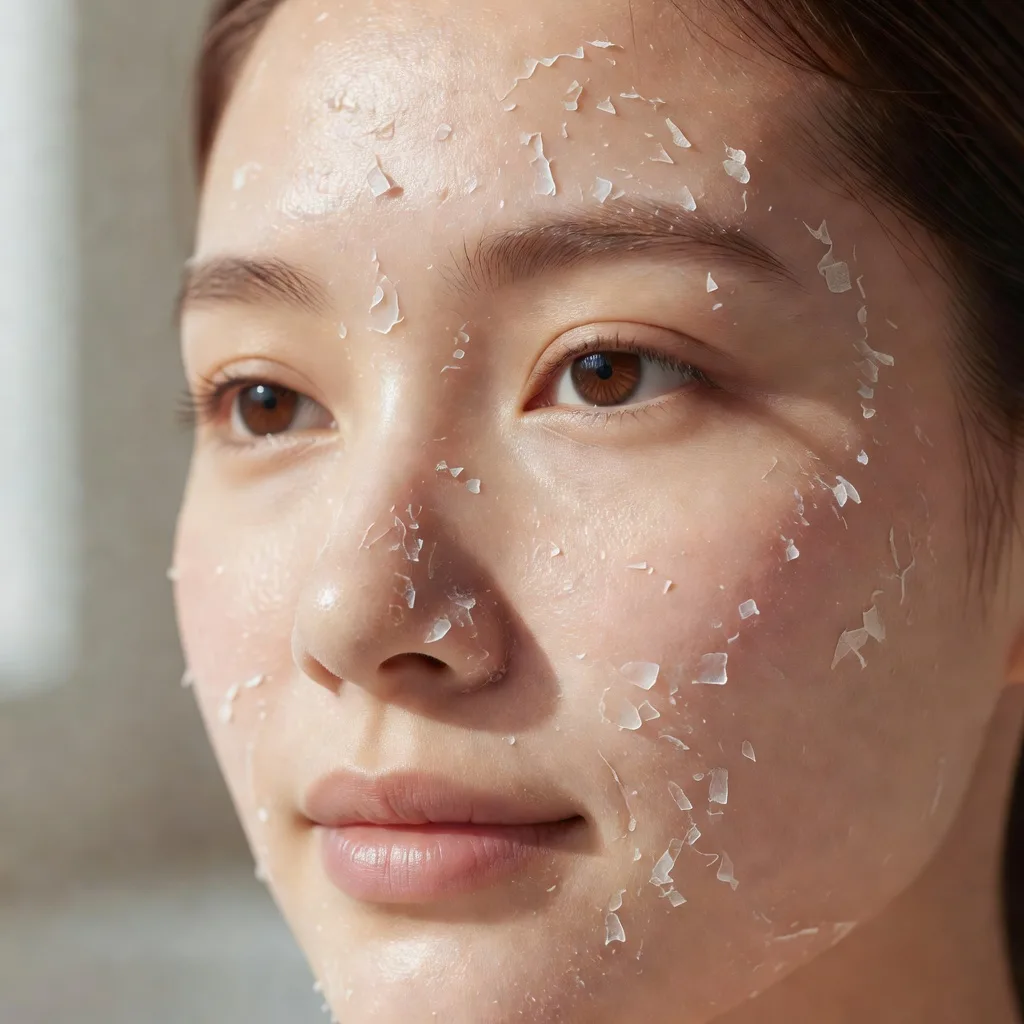
Is Facial Peeling After a New Product Normal? What to Do
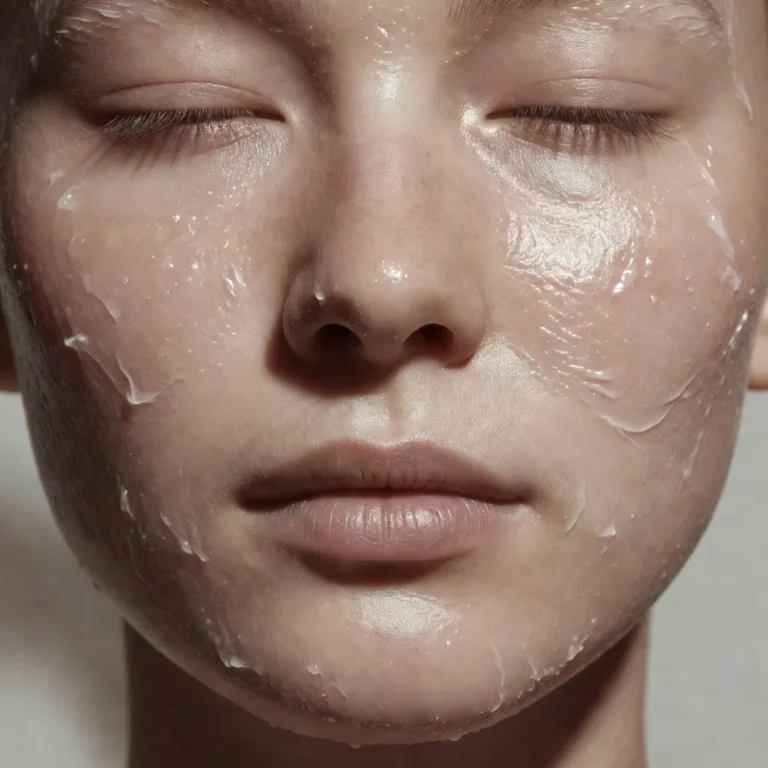
You started a new serum or cream a week ago, and now there are fine flakes around your nose and chin, maybe a tight, dry patch on your cheek. Makeup clings to the flakes and your skin feels slightly raw. The question is whether this means the product is working, or that your skin is telling you to stop.
Part of our guide to facial treatments. Start with: Facial vs Chemical Peel: Differences, Results and Which to Choose
Mild peeling after starting a retinoid, exfoliating acid or benzoyl peroxide is common in the first two to six weeks and usually settles if you cut back how often you use it and moisturise well. Peeling with burning, swelling, itching, hives, blisters or a rash that spreads beyond where you applied the product is not normal; it points to irritation or allergy, and the product should be stopped. Peeling from products that should not exfoliate, such as a plain moisturiser, also needs a closer look.
Some products are designed to speed up how quickly skin cells turn over. Retinoids, alpha and beta hydroxy acids, and benzoyl peroxide all do this to some degree. As the outer layer adjusts, it can shed visibly for a while, a stage sometimes called retinisation. That is a side effect to manage, not proof the product is working better.
Other peeling has nothing to do with active ingredients. It can come from a fragrance or preservative your skin reacts to, from using too many products at once, or from pilling that only looks like peeling. The American Academy of Dermatology recommends testing a new product on a small area twice a day for seven to ten days before using it widely, which catches many of these problems early.
Below you will find how to tell normal adjustment from a reaction, a routine to calm peeling skin, and when to stop a product for good.
Shopping these picks?
Amazon Prime members get fast, free shipping on eligible items, plus Prime Video, Amazon Music and member deals. New members can start with a free trial.
Start a free Prime trialAged 18 to 24? Prime for Young Adults comes with a longer free trial and a lower price after it.
Affiliate link: we may earn a commission at no extra cost to you.
Recommended Products for Peeling, Irritated Skin

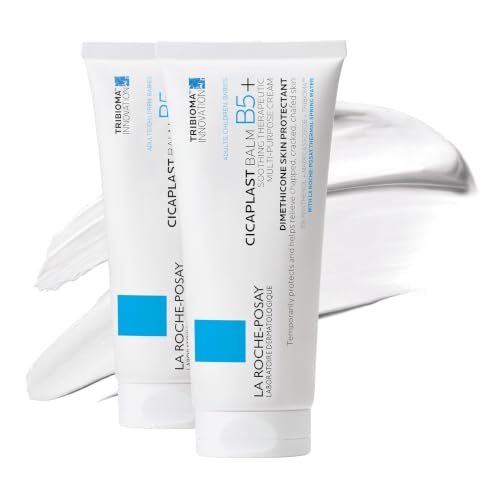
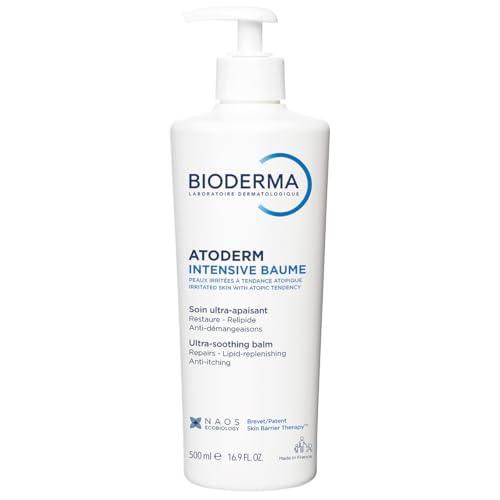
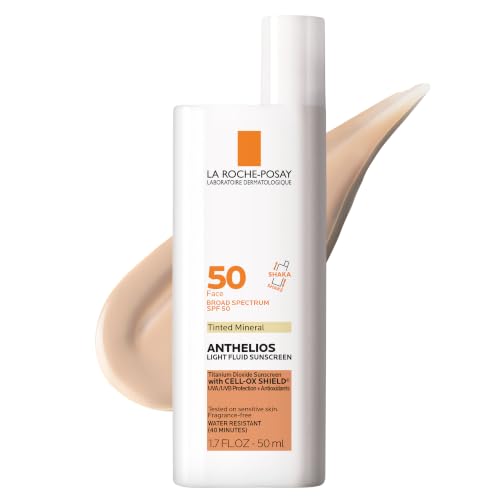


Jump to a Section
- Normal Adjustment or a Reaction?
- Products Most Likely to Cause Peeling
- How to Calm Peeling Skin After a New Product
- What Not to Do With Flaky Skin
- The Retinoid Adjustment Phase
- Is It Peeling or Pilling?
- Patch Testing Before You Commit
- Why Peeling Means the Barrier Needs Help
- A Sample Restart Schedule
- Wearing Makeup Over Flaky Skin
- When Peeling Is Something Else
- When to See a Doctor
- Questions People Ask
- Summing Up
At a Glance
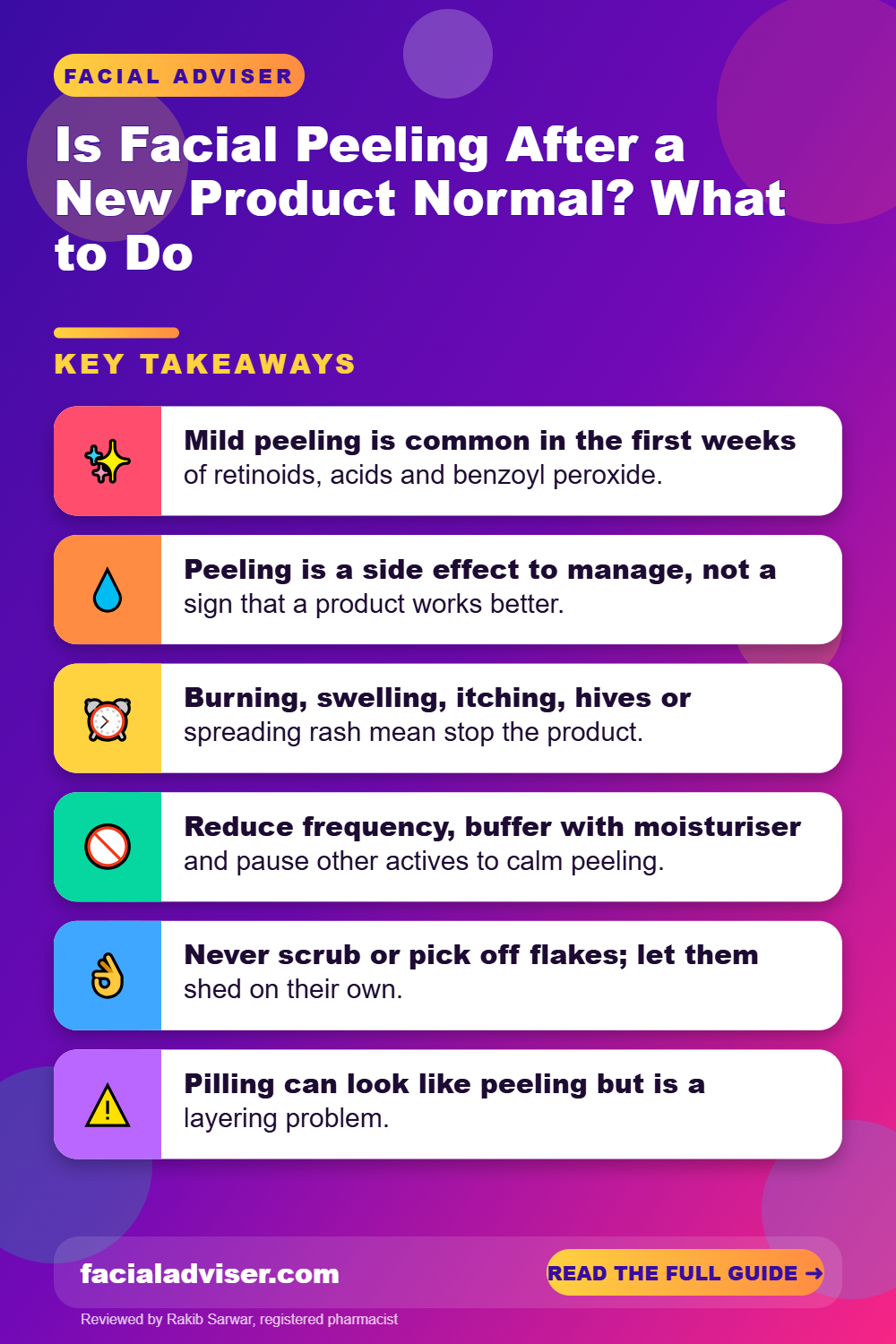
- Mild peeling is common in the first weeks of retinoids, acids and benzoyl peroxide.
- Peeling is a side effect to manage, not a sign that a product works better.
- Burning, swelling, itching, hives or spreading rash mean stop the product.
- Reduce frequency, buffer with moisturiser and pause other actives to calm peeling.
- Never scrub or pick off flakes; let them shed on their own.
- Pilling can look like peeling but is a layering problem.
- Patch testing new products for seven to ten days prevents many reactions.
Normal Adjustment or a Reaction?
| Sign | Likely normal adjustment | Likely irritation or allergy |
|---|---|---|
| Timing | Starts within 1 to 2 weeks of an active | Starts within hours or days of any product |
| Where | Only where the product was applied | Spreads beyond the area, eyelids or neck |
| Feeling | Mild dryness, slight tightness | Burning, stinging that lasts, intense itch |
| Appearance | Fine flakes, mild pinkness | Swelling, hives, blisters, oozing |
| Course | Improves over 2 to 6 weeks | Worsens with continued use |
| Product type | Retinoid, acid, benzoyl peroxide | Any product, often fragranced |
If you are unsure, stop the product for a few days. Normal retinoid-type peeling improves quickly once you pause, while an allergy usually needs more time and may need treatment.
Products Most Likely to Cause Peeling
- Retinoids such as retinol, retinal, adapalene and prescription tretinoin.
- Alpha hydroxy acids such as glycolic, lactic and mandelic acid.
- Beta hydroxy acid (salicylic acid) in toners, serums and cleansers.
- Benzoyl peroxide washes, gels and spot treatments.
- Vitamin C at high strengths, especially L-ascorbic acid at low pH.
- At-home peels and peeling pads.
- Fragranced products and essential oils, which can cause irritation or allergy.
Using several of these at once is the most common reason for peeling. A retinoid at night plus an acid toner and a benzoyl peroxide wash can overwhelm almost anyone’s skin barrier.
Hidden actives are another trap. Some cleansers, toners, moisturisers and even sunscreens contain small amounts of acids or retinol that are easy to miss on the label. If you have added a retinoid and your skin suddenly peels, check every other product in the routine for glycolic, lactic, salicylic or mandelic acid, retinol or retinyl esters, and vitamin C. Removing the doubled-up actives often stops the flaking without giving up the main treatment.
How to Calm Peeling Skin After a New Product
Pause or reduce the active
Use the product every second or third night, or stop for a few days until flaking settles.
Drop other actives
Stop acids, scrubs, vitamin C and benzoyl peroxide while your skin recovers.
Cleanse gently
Use a creamy, non-foaming cleanser with lukewarm water and pat dry.
Moisturise generously
Apply a ceramide-rich cream twice a day, and a thin layer of ointment on very dry spots at night.
Buffer the active
When you restart, apply moisturiser first and the retinoid on top, or mix a pea-sized amount into your moisturiser.
Protect from the sun
Peeling skin burns more easily, so use sunscreen every morning.
Increase slowly
Only raise the frequency once your skin has been comfortable for a week.
Keep retinoids away from the corners of the nose, the mouth and the eyelids. These thin areas peel first and most. A dab of petroleum jelly there before applying helps.
What Not to Do With Flaky Skin
Helps
- Let flakes shed naturally
- Moisturise while skin is still damp
- Use a gentle cleanser
- Wear sunscreen
- Give skin time to adjust
Backfires
- Scrub or peel off flakes
- Add another exfoliant to remove the flakes
- Use hot water or steam
- Start several new products at once
- Push through burning or swelling
Scrubbing away flakes feels satisfying but removes skin that is not ready to shed, leaving raw patches and prolonging the problem.
Stop the product and seek medical advice if you develop swelling of the face, lips or eyes, hives, blisters, or any difficulty breathing. These can be signs of an allergic reaction.
The Retinoid Adjustment Phase
Retinoids are the most common cause of peeling that people are told to expect. In the first few weeks, skin may feel dry, look slightly pink and flake, especially around the nose and mouth. For most people this settles within four to six weeks. Applying the retinoid to completely dry skin, about 20 minutes after washing, can also reduce stinging, since damp skin absorbs it faster and more unevenly.
Starting slowly makes a big difference. Our guide on how to transition to retinol smoothly sets out a gradual 12-week plan that keeps peeling to a minimum.
Stronger is not always better. A lower-strength retinoid used consistently often gives better results than a strong one you can only tolerate once a week.
Is It Peeling or Pilling?
Sometimes what looks like peeling is actually product pilling: tiny rolls of serum, moisturiser or sunscreen that ball up when layered or rubbed. If the flakes come off easily and the skin underneath is smooth and comfortable, pilling is likely.
Use fewer layers, let each one absorb for a minute or two, and pat rather than rub. Our guide to roughness after sunscreen use explains more about layering sunscreen without pilling.
Patch Testing Before You Commit
The AAD recommends applying a new product to a small area, such as the inside of the elbow, twice a day for seven to ten days, and stopping it if redness, itching or swelling appears (AAD).
For products meant to exfoliate, a patch test will not tell you how your whole face will adjust, but it will reveal an allergy. Follow it by starting slowly on the face, two or three times a week.
Why Peeling Means the Barrier Needs Help
The outer layer of skin works like a brick wall, with skin cells as bricks and lipids such as ceramides as the mortar. Exfoliating products loosen that wall on purpose. If they work faster than the skin can rebuild, the result is flaking, tightness and sensitivity. A weakened barrier also lets more of the active ingredient in, which is why a product that felt fine in week one can suddenly sting in week three, even though you have not changed how you use it.
Supporting the barrier with ceramides, glycerin, panthenol and occlusives such as petrolatum gives skin what it needs to rebuild while you continue treatment more gently. Our guide to slugging covers when sealing the skin with an ointment at night helps and when it is better skipped.
A Sample Restart Schedule
Once peeling has settled, bringing the active back in gradually lets skin build tolerance. This is a common pattern for a retinoid; acids can follow a similar plan.
| Weeks | How often | Tips |
|---|---|---|
| 1 to 2 | Twice a week | Apply over moisturiser; skip nights your skin feels tight |
| 3 to 4 | Every third night | Keep other actives paused |
| 5 to 6 | Every other night | Add a richer cream if flaking returns |
| 7 onwards | Nightly if comfortable | Many people stay at every other night long term |
If flaking returns at any stage, drop back to the previous step for another week or two. Moving forward only when your skin feels comfortable is slower on paper but faster in practice, because you avoid repeated setbacks.
Wearing Makeup Over Flaky Skin
Foundation tends to cling to flakes and emphasise them, which can make a mild adjustment phase look much worse than it is. A few changes help while your skin settles.
- Moisturise well and wait five minutes before makeup so flakes soften and lie flat.
- Choose a hydrating or satin foundation rather than a matte, long-wear formula.
- Apply with a damp sponge using gentle pressing motions instead of buffing with a brush.
- Use concealer only where needed, and skip powder on dry areas.
- Remove makeup with a gentle cleansing balm or micellar water rather than wipes.
If an area is raw, stinging or cracked, leave it bare until it heals. Makeup on broken skin can sting and may introduce bacteria.
When Peeling Is Something Else
Not every flaky face is caused by a product. Seborrheic dermatitis causes greasy, yellowish flakes around the nose and brows. Eczema causes itchy, dry patches. Sunburn causes peeling a few days after sun exposure. Cold weather and indoor heating can make skin flake without any new product at all.
Seasonal changes catch many people out. A routine that was perfectly comfortable in summer can start to cause flaking once the heating goes on and the air dries out, simply because the barrier has less moisture to work with. Using the same active less often in winter, or switching to a richer moisturiser, is often all that is needed.
If peeling continues after you have stopped all actives for two weeks, or it follows a particular pattern, the cause is probably not your skincare.
When to See a Doctor
- Swelling, hives, blisters or oozing after using a product.
- Burning or pain that does not ease after washing the product off.
- A rash that spreads to areas where you did not apply the product.
- Peeling that continues after two weeks without any actives.
- You want to keep using a prescription retinoid but cannot tolerate it.
This article is for general information and does not replace professional medical advice. Seek urgent care for facial swelling or difficulty breathing.
Questions People Ask
Is it normal for skin to peel after using retinol?
Yes. Mild peeling is common in the first few weeks and usually settles as skin adjusts.
How long does peeling from a new product last?
Adjustment peeling from retinoids or acids usually eases within two to six weeks.
Does peeling mean the product is working?
No. Peeling is a side effect. Many people get good results with little or no peeling.
Should I stop using a product if my face peels?
Reduce how often you use it and moisturise more. Stop if you have burning, swelling, itching or a spreading rash.
Can I exfoliate to remove the flakes?
No. Scrubbing or using more acids makes irritation worse. Let flakes shed on their own.
What helps peeling skin heal faster?
Gentle cleansing, a ceramide moisturiser, ointment on dry spots at night and pausing other actives.
Can moisturiser cause peeling?
Rarely. If a plain moisturiser causes peeling, you may be reacting to an ingredient such as fragrance.
What is retinisation?
It is the adjustment period when skin gets used to a retinoid, often with dryness and flaking.
How do I know if I am allergic to a skin product?
Itching, swelling, hives or a rash that spreads beyond where you applied it suggest allergy.
Should I wear sunscreen when my face is peeling?
Yes. Peeling skin is more sensitive to the sun, so daily sunscreen is important.
Summing Up
Some peeling after a new retinoid, acid or benzoyl peroxide is common and usually temporary. It is a side effect to manage by using the product less often, supporting the barrier and pausing other actives, not a sign of a stronger result.
Burning, swelling, itching, hives and rashes that spread are different. Stop the product, keep skincare simple and see a doctor if symptoms are severe or do not settle. Patch testing and starting slowly prevent most of these problems in the first place.

Written by
Registered pharmacist and founder of Facial Adviser. Rakib's pharmacy training covers how skincare actives work and interact; a later course in cosmetology turned that into a focus on facial treatments and skincare products. He plans, researches and edits every guide on the site and checks health claims against sources such as the American Academy of Dermatology, the FDA and the NIH. He is not a dermatologist; see the Editorial Policy and Medical Disclaimer.
About · Editorial policy · How we choose products · Medical disclaimer · Contact
Keep reading: Chemical peels and acid facials
- Facial vs Chemical Peel: Differences, Results and Which to Choose
- Grape Peel Treatment: What It Really Does
- Vitalize Peel Treatment: What's Really In It
- Azelaic Acid Facial: What It Treats Best
- Enzyme Peel Facial: How Fruit Enzymes Work, Benefits and Who It Suits
- Lactic Peel Facial: Strengths, Who It Suits, Procedure and Aftercare
- Ultimate Guide Microdermabrasion: What to Know
- What Is the Best Anti-Aging Facial Treatment? Options Compared by Goal