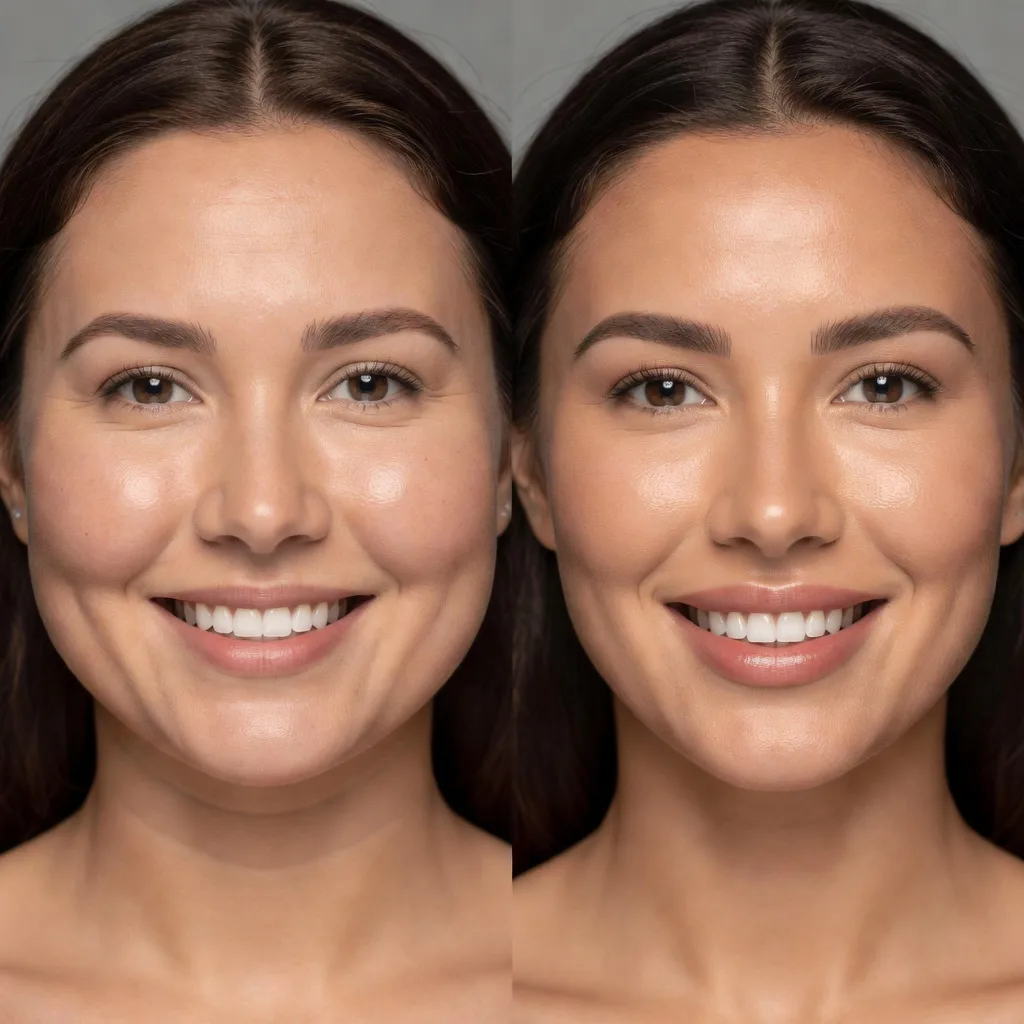
Facial Fat Transfer vs Fillers: Longevity, Predictability, and Who Each Suits
As the face ages, it loses volume. Cheeks flatten, temples hollow, and the area under the eyes can look sunken or tired. Two of the most common ways to restore that volume are injectable dermal fillers and facial fat transfer, also called fat grafting, where fat is taken from another part of your body and injected into the face.
Part of our guide to facial treatments. Start with: What Is the Best Anti-Aging Facial Treatment? Options Compared by Goal
Fillers are quick, predictable, and, in the case of hyaluronic acid fillers, usually reversible, but they wear off. Fat transfer uses your own tissue and can last for years, but how much of it survives is genuinely unpredictable. That trade-off, predictability versus longevity, sits at the center of the decision.
The numbers are striking. A 2024 systematic review of fat grafting to the temples, covering eight studies and 719 patients, found reported fat retention ranging from roughly a third to about two thirds of the injected volume, depending on the study and technique. In practical terms, you cannot know in advance exactly how much of your transferred fat will stay, which is why some people need a second session.
Both approaches carry a rare but serious risk shared by all facial injections: material entering a blood vessel. That makes the injector’s experience crucial regardless of which you choose.
This guide compares how each works, how long results last, the risks, the fit questions that help you decide, and why many surgeons suggest trying a reversible filler before committing to fat.
Shopping these picks?
Amazon Prime members get fast, free shipping on eligible items, plus Prime Video, Amazon Music and member deals. New members can start with a free trial.
Start a free Prime trialAged 18 to 24? Prime for Young Adults comes with a longer free trial and a lower price after it.
Affiliate link: we may earn a commission at no extra cost to you.
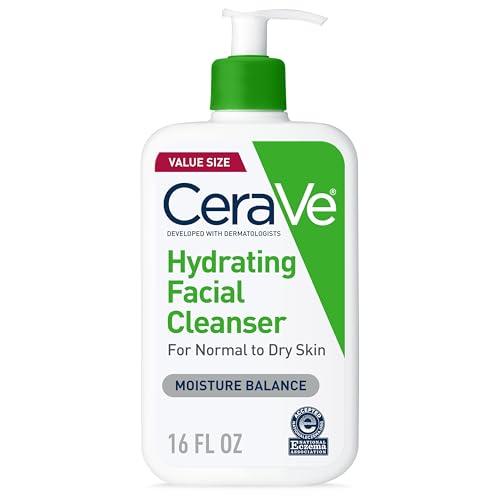
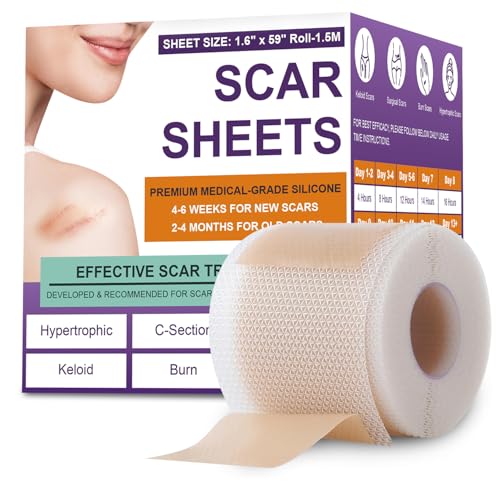
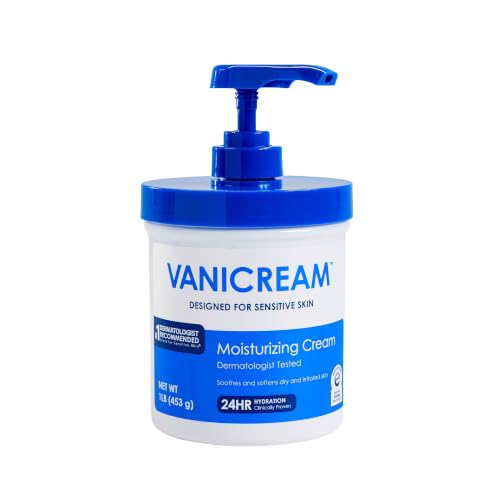
Recommended Skincare for Before and After Facial Volume Treatments



Contents
The Short Version
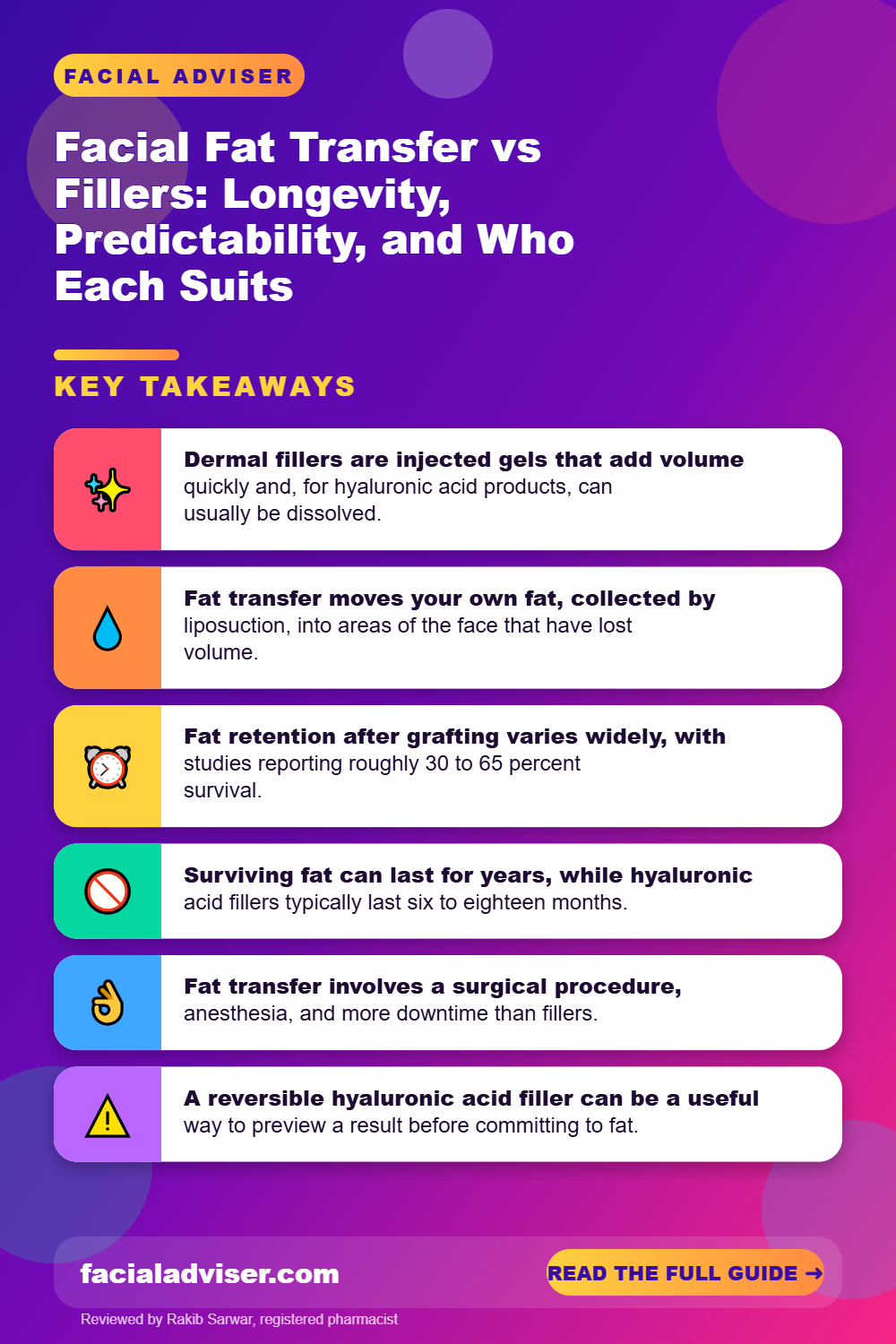
- Dermal fillers are injected gels that add volume quickly and, for hyaluronic acid products, can usually be dissolved.
- Fat transfer moves your own fat, collected by liposuction, into areas of the face that have lost volume.
- Fat retention after grafting varies widely, with studies reporting roughly 30 to 65 percent survival.
- Surviving fat can last for years, while hyaluronic acid fillers typically last six to eighteen months.
- Fat transfer involves a surgical procedure, anesthesia, and more downtime than fillers.
- A reversible hyaluronic acid filler can be a useful way to preview a result before committing to fat.
- Both carry a rare risk of injection into blood vessels, so choose an experienced, qualified practitioner.
How Dermal Fillers Work
Dermal fillers are sterile gels injected under the skin to replace lost volume. Hyaluronic acid fillers are the most common. They attract water, which gives a smooth, natural fullness, and they are gradually broken down by the body. Other types, such as calcium hydroxylapatite and poly-L-lactic acid, also stimulate collagen and tend to last longer, but cannot be dissolved.
Filler appointments are short and usually done with a topical numbing cream or a filler that contains a local anesthetic. Results are visible immediately, with swelling settling over one to two weeks. Longevity depends on the product and area, commonly six months in mobile areas such as the lips and up to a year or more in the cheeks.
The major practical advantage of hyaluronic acid fillers is control. Small amounts can be added gradually, and if a result is uneven or unwanted, an enzyme called hyaluronidase can usually dissolve it. For a broader comparison with muscle-relaxing injections, see our guide to fillers vs Botox.
How Facial Fat Transfer Works
Fat transfer is a surgical procedure. Fat is harvested through small incisions, usually from the abdomen or thighs, using gentle liposuction. It is then processed to separate healthy fat cells from fluid and oil, and injected in tiny amounts into the face with fine cannulas.
The transplanted fat needs a blood supply to survive. Cells that establish a blood supply become a permanent part of the face and age with you. Cells that do not are gradually absorbed over the first few months. That is why surgeons often overfill slightly at first and why the final result is not clear for around three to six months.
The procedure is usually done under local anesthesia with sedation or under general anesthesia, and recovery involves swelling and bruising at both the face and the donor site.
Fat Transfer vs Fillers Side by Side
| Factor | Hyaluronic acid fillers | Facial fat transfer |
|---|---|---|
| Procedure | In-office injections | Surgical procedure with liposuction |
| Anesthesia | Topical or local | Local with sedation or general |
| Downtime | Minimal, swelling for days | Swelling and bruising for 1 to 3 weeks |
| Predictability | High | Variable, part of the fat is reabsorbed |
| How long it lasts | About 6 to 18 months | Surviving fat can last years |
| Reversible? | Usually, with hyaluronidase | No, removal is difficult |
| Allergy risk | Low but possible | Very low, your own tissue |
| Best for | Targeted, smaller volume changes | Larger, multi-area volume loss |
Neither is simply better. The right choice depends on how much volume you need, how you feel about surgery and unpredictability, and whether you prefer maintenance appointments or a longer-lasting result.
The Fit Check: Which Suits You?
Use these questions to work out which option fits your situation before a consultation.
Size up the volume loss
Hold a mirror at waist height and look down into it. Small, targeted hollows point toward filler. Widespread flattening across cheeks, temples, and under-eyes points toward fat.
Check your donor fat
Very lean people may not have enough fat to harvest easily. Ask your surgeon whether you are a suitable candidate.
Weigh surgery versus maintenance
If you prefer to avoid anesthesia and downtime, fillers fit better. If you dislike repeated appointments, fat may appeal.
Decide how much certainty you need
If predictability matters most, filler is easier to control. If you accept that a touch-up may be needed, fat is an option.
Consider a reversible preview
Ask whether a hyaluronic acid filler could show you the effect first, before committing to fat.
The preview approach: many surgeons suggest trying hyaluronic acid filler first, especially for areas such as the temples or cheeks. If you like the look, fat transfer can later provide a longer-lasting version. If not, the filler can be dissolved.
Which Areas Suit Which Option
Some areas of the face lend themselves better to one approach than the other, although practitioners vary in their preferences.
The cheeks and midface are treated well by both. Fillers give precise, predictable lift in a specific spot, while fat can restore broader fullness across the whole cheek area. Temples are a common site for both, and they are where much of the fat retention research has been done.
The under-eye hollow is a delicate area. The skin is thin, and both fillers and fat can create visible lumps, puffiness, or a bluish tint if placed too superficially or in excess. Many experienced injectors use very small amounts here, and some prefer to avoid it in people with puffy lower lids.
Lips are almost always treated with hyaluronic acid filler rather than fat, because they move constantly, fat survival there is poor, and precise shaping matters. Fine lines and small creases are also generally better suited to fillers or skin treatments than to fat, which is better at adding soft volume than filling narrow lines.
For the jawline and chin, fillers designed for structural support are often used. Fat can be used too, but results can be less defined.
How Long Each Really Lasts
Filler longevity is fairly predictable for a given product and area, although metabolism, activity, and injection technique all play a part. Most people need top-ups roughly once or twice a year to maintain results.
Fat is different. Once fat cells survive the first few months, they behave like the rest of your fat. They can last for years, but they also respond to weight changes. Gain weight and grafted areas may fill out further; lose significant weight and they may shrink.
The wide range in retention reported in research reflects differences in technique, the area treated, and individual healing. Our guides on how long facial fat grafting lasts and what fat grafting costs go deeper into both questions.
Risks and Complications
| Risk | Fillers | Fat transfer |
|---|---|---|
| Swelling and bruising | Common, short-lived | Common, can last 1 to 3 weeks |
| Lumps or irregularities | Possible, often dissolvable | Possible, including oil cysts and firm nodules |
| Over or under-correction | Adjustable | May need a further procedure or is hard to reverse |
| Infection | Rare | Rare, at face or donor site |
| Blood vessel injection | Rare but serious | Rare but serious, including fat embolism |
| Anesthesia risks | Minimal | Present with sedation or general anesthesia |
Seek emergency help for severe pain, skin that turns white, gray, or blotchy, or any change in vision after a facial filler or fat injection. Material entering a blood vessel can block blood flow to the skin or eye, and fast treatment matters.
Recovery and Aftercare
Worth Doing
- Follow your practitioner’s written aftercare instructions.
- Use a wrapped cold pack in short sessions for swelling in the first days.
- Sleep with your head slightly elevated after fat transfer.
- Use gentle, fragrance-free skincare while healing.
- Wear sunscreen daily on the face and donor sites.
- Keep follow-up appointments to review the result.
Skip It
- Massage treated areas unless told to.
- Apply ice directly to the skin.
- Exercise hard or drink alcohol in the first days without clearance.
- Start retinoids or exfoliants on treated skin too soon.
- Judge the final result in the first weeks.
- Ignore increasing pain, redness, or fever.
Small liposuction scars at the donor site usually fade well. Silicone gel or sheets are commonly used to support scar healing once wounds have closed, if your surgeon agrees.
What Neither Can Do
Neither fillers nor fat transfer tighten significantly loose or sagging skin. When skin laxity is the main problem, adding volume can make the face look heavy rather than younger, and a lift or energy-based skin tightening may be more appropriate.
Neither improves surface texture, fine lines, or pigmentation on their own. Sunscreen, retinoids, and in-office skin treatments handle those. Claims that fat transfer delivers dramatic skin rejuvenation from stem cells are promising in research but remain less well established than the volume effect itself.
Weight stability matters for fat: because grafted fat behaves like the rest of your body fat, surgeons often recommend being at a stable weight before fat transfer.
Choosing a Practitioner and When to Wait
Consider waiting, or speak with your doctor first, if:
- You are pregnant or breastfeeding.
- You have a bleeding disorder or take blood thinners.
- You have an active skin infection or cold sore in the area.
- You smoke, which can impair fat survival and healing.
- You expect to gain or lose significant weight soon.
- You feel pressured or unsure about changing your appearance.
Choose a board-certified plastic surgeon, facial plastic surgeon, or dermatologist with specific experience in the procedure. Ask to see before-and-after photos of similar cases, how complications are handled, and whether touch-ups are included.
Medical disclaimer: This article is for general information and is not a substitute for a consultation with a qualified medical professional. Surgical and injectable procedures carry real risks and should only be performed by appropriately trained practitioners.
FAQ
What is the difference between fat transfer and fillers?
Fillers are injected gels that add volume temporarily. Fat transfer moves your own fat into the face and can last years if it survives.
Which lasts longer, fat transfer or fillers?
Surviving fat can last for years, while hyaluronic acid fillers usually last about six to eighteen months.
How much fat survives after a fat transfer?
It varies. Studies report retention from roughly 30 to 65 percent, depending on technique and area.
Is fat transfer safer than fillers?
Not necessarily. Fat avoids allergy risk but involves surgery and anesthesia, and both carry rare blood vessel risks.
Can fat transfer be reversed?
Not easily. Unlike hyaluronic acid filler, grafted fat cannot simply be dissolved.
Can fillers be dissolved?
Hyaluronic acid fillers can usually be dissolved with hyaluronidase. Many other types cannot.
How long is recovery after facial fat transfer?
Most swelling and bruising settles in one to three weeks, with the final result clearer after three to six months.
Can I try filler before fat transfer?
Yes. Many surgeons suggest a hyaluronic acid filler first to preview the result before committing to fat.
Does weight change affect fat transfer results?
Yes. Grafted fat behaves like body fat and can grow or shrink with weight changes.
Who is not a good candidate for fat transfer?
Very lean people, smokers, people with unstable weight, and those who want highly predictable results may be better suited to fillers.
Final Word
Fillers and fat transfer both restore facial volume, but they suit different priorities. Hyaluronic acid fillers are quick, adjustable, and usually reversible, yet temporary. Fat transfer uses your own tissue and can last years, but it requires surgery and the amount that survives is genuinely unpredictable.
If you are unsure, a reversible filler is a sensible way to preview the effect. Whichever you choose, pick an experienced, qualified practitioner, plan for aftercare, and know the warning signs that need urgent attention.

Written by
Registered pharmacist and founder of Facial Adviser. Rakib's pharmacy training covers how skincare actives work and interact; a later course in cosmetology turned that into a focus on facial treatments and skincare products. He plans, researches and edits every guide on the site and checks health claims against sources such as the American Academy of Dermatology, the FDA and the NIH. He is not a dermatologist; see the Editorial Policy and Medical Disclaimer.
About · Editorial policy · How we choose products · Medical disclaimer · Contact
Keep reading: Anti-aging facials and treatments
- What Is the Best Anti-Aging Facial Treatment? Options Compared by Goal
- Cryo Facial vs Botox: Which Is Better for Wrinkles and Puffiness?
- Facial Liposuction vs Buccal Fat Removal: Differences, Risks and Recovery
- Facial Fillers vs Botox: Which Treats Your Lines, and What Each Can Go Wrong
- What Are the Benefits of Anti-Wrinkle Injections? Results, Risks and Options
- What Should I Use on My Face for Anti-Aging? The 5 Products That Matter
- What Is a Spa Facial?
- Fruit Facial at Home: Does It Actually Work?