How Often to Do Microdermabrasion
How often to do microdermabrasion isn’t a one-size-fits-all answer, but dermatology does give a real, specific range rather than just “it depends.”
Part of our guide to facial treatments. Start with: Ultimate Guide Microdermabrasion: What to Know
The American Academy of Dermatology states most people can safely repeat treatment about a week later, while a full course for visible results typically runs 5 to 16 sessions, and the skin’s own roughly 26-to-40-day cell turnover cycle is the biological reason treating faster than that doesn’t speed anything up. Professional and at-home devices differ meaningfully in recommended frequency, and overdoing either one has real, documented consequences.
Recent isotretinoin use is a specific, formally flagged risk factor worth checking before scheduling any session.
This guide covers the real cadence guidance, the biology behind it, and how to tell if you’re scheduling sessions faster than your skin can actually handle.
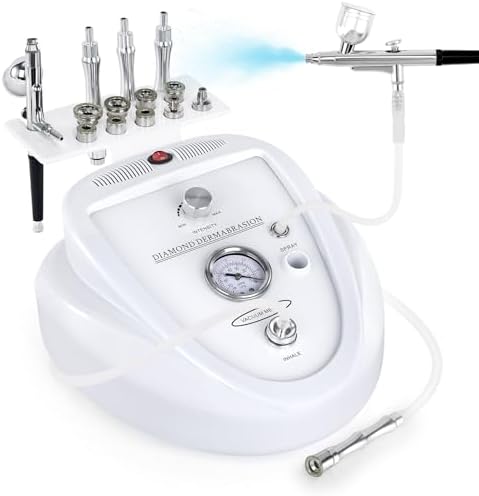
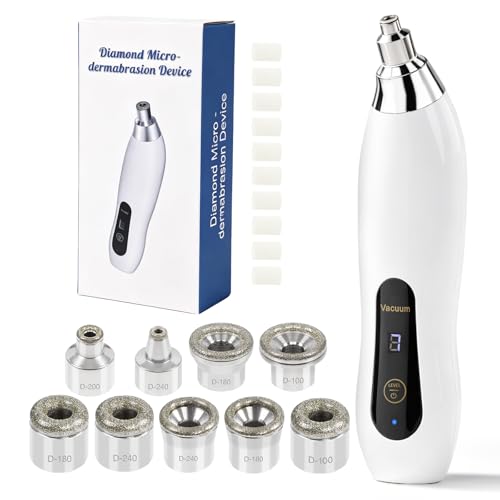
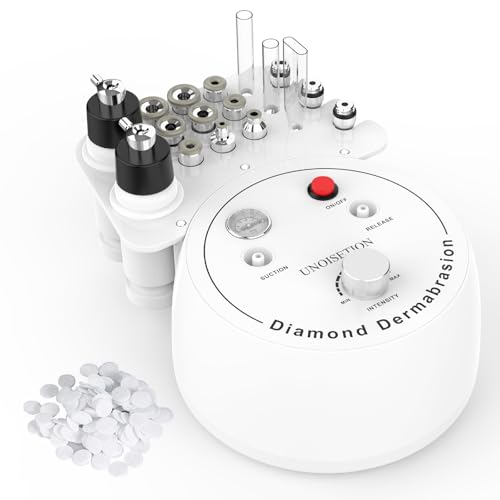
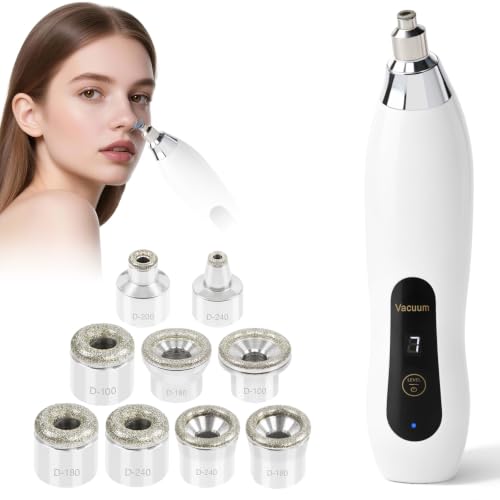
Recommended At-Home Microdermabrasion Devices


What Dermatologists Actually Recommend
The American Academy of Dermatology gives a real, quotable answer to this question rather than a vague “it depends”: “Most people can safely have another treatment a week later. Some patients, however, need several weeks to recover.” For anti-aging goals specifically, dermatologists typically space sessions weekly, every two weeks, or monthly, and a full course of 5 to 16 treatments is usually needed before results become visible. That range is wide on purpose — it depends on your skin’s sensitivity, the treatment’s intensity, and what you’re treating it for, not a single fixed schedule that applies to everyone.
Shopping these picks?
Amazon Prime members get fast, free shipping on eligible items, plus Prime Video, Amazon Music and member deals. New members can start with a free trial.
Start a free Prime trialAged 18 to 24? Prime for Young Adults comes with a longer free trial and a lower price after it.
Affiliate link: we may earn a commission at no extra cost to you.
The short version: weekly is the fastest AAD-supported cadence for professional treatment, but “fastest possible” and “best for your skin” aren’t the same thing. The biology underneath that recommendation — how fast your skin actually generates new, treatable cells — is what sets the real ceiling on how often microdermabrasion can do anything useful.
Quick Hits
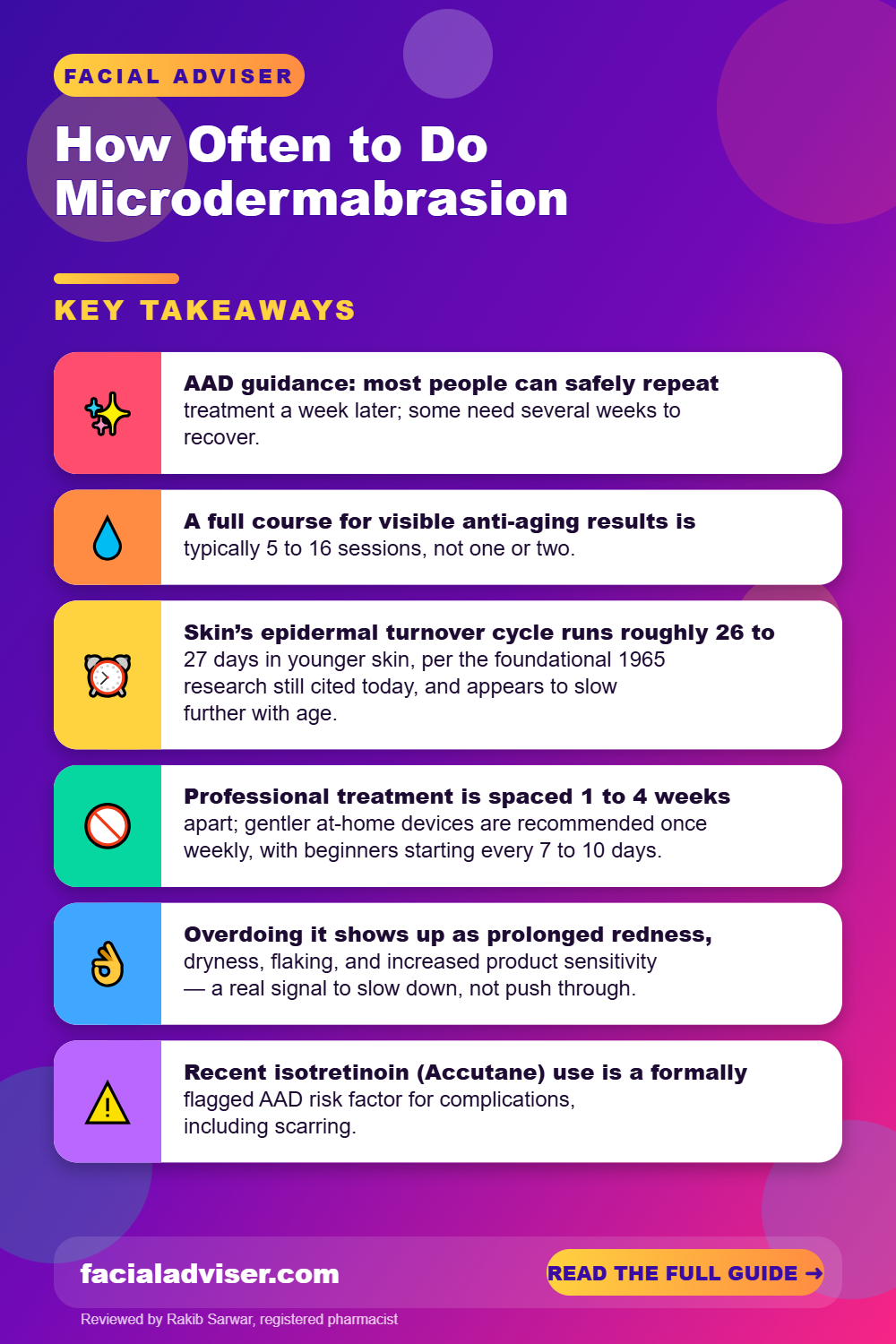
- AAD guidance: most people can safely repeat treatment a week later; some need several weeks to recover.
- A full course for visible anti-aging results is typically 5 to 16 sessions, not one or two.
- Skin’s epidermal turnover cycle runs roughly 26 to 27 days in younger skin, per the foundational 1965 research still cited today, and appears to slow further with age.
- Professional treatment is spaced 1 to 4 weeks apart; gentler at-home devices are recommended once weekly, with beginners starting every 7 to 10 days.
- Overdoing it shows up as prolonged redness, dryness, flaking, and increased product sensitivity — a real signal to slow down, not push through.
- Recent isotretinoin (Accutane) use is a formally flagged AAD risk factor for complications, including scarring.
Page Map
- What Dermatologists Actually Recommend
- The Skin Cycle Behind the Limit
- Professional vs. At-Home Frequency
- What Happens If You Overdo It
- Frequency by Goal
- A Realistic First-Month Schedule
- Who This Cadence Guidance Is For
- Who Should Slow Down or Skip a Session
- When to Check With a Dermatologist First
- The 24-Hour Recovery Check
- Where the Evidence Runs Out
- Frequently Asked Questions
The Skin Cycle Behind the Limit
Microdermabrasion works by mechanically removing the outermost dead skin cells, so how often it makes sense to repeat depends on how fast your skin actually replaces those cells. The foundational data point here, still cited in dermatology today, comes from Weinstein and Van Scott’s 1965 study in the Journal of Investigative Dermatology, which used autoradiography to measure epidermal turnover at roughly 26 to 27 days in young skin — about 13 days for cells to move through the stratum malpighii, plus another 13 to 14 days transiting the stratum corneum. Multiple secondary sources note this cycle appears to slow further with age, often cited as extending toward 40 or more days by mid-adulthood, though that specific age-based extension is less rigorously pinned down than the original 1965 figure and should be read as directionally supported rather than exact.
The practical takeaway: treating faster than your skin actually regenerates doesn’t speed up results, it just re-abrades skin that hasn’t finished renewing from the last session. This is also the mechanism connecting microdermabrasion frequency to other exfoliating treatments on this site — the same roughly 28-to-40-day cycle governs how often deep pore cleansing or any other exfoliation-based routine can meaningfully be repeated.
Professional vs. At-Home Frequency
Professional and at-home microdermabrasion aren’t the same intensity, and their recommended frequencies reflect that directly. In-office treatment, using crystal or diamond-tip devices, is meaningfully more aggressive and is spaced 1 to 4 weeks apart per AAD guidance. At-home devices are gentler by design, and manufacturer guidance — PMD Beauty’s own device instructions are a useful, specific example — recommends once weekly use, with beginners starting even more conservatively at once every 7 to 10 days.
| Setting | Typical intensity | Recommended frequency |
|---|---|---|
| Professional (in-office) | Crystal or diamond-tip, more aggressive | Every 1 to 4 weeks, per AAD |
| At-home device | Gentler by design | Once weekly; beginners every 7-10 days |
What Happens If You Overdo It
Treating too often doesn’t just fail to speed up results — it actively works against them. PMD’s own guidance states plainly that “over-exfoliation can weaken your skin barrier, making it harder to retain moisture and more reactive to products.” That barrier disruption shows up as ongoing dryness, flaking, and a skin surface that reacts more strongly to serums, actives, and even plain moisturizer than it did before. Redness that persists well beyond the normal one-day recovery window AAD describes is a direct signal of this same problem.
Paradoxical hyperpigmentation — darker marks appearing where repeated irritation triggers an overactive pigment response, particularly in darker skin tones — is a mechanistically plausible risk of repeated over-treatment, consistent with how post-inflammatory hyperpigmentation works generally. It’s worth being precise here: no dedicated study has specifically quantified this risk from microdermabrasion overuse frequency alone, so this should be understood as a real, biologically grounded possibility rather than a numbers-backed statistic.
Frequency by Goal
How often makes sense also depends on why you’re doing it in the first place. A single pre-event polish for smoother makeup application is a different use case from a sustained anti-aging course, and treating both the same way either wastes money or risks unnecessary irritation.
| Goal | Realistic frequency | What to expect |
|---|---|---|
| One-off event polish | Single session, several days before the event | Smoother texture and makeup application, no lasting structural change |
| Ongoing texture/tone maintenance | Monthly, matched to the ~28-40 day turnover cycle | Gradual, cumulative smoothing over several months |
| Anti-aging course (professional) | Weekly to every-other-week initially, per AAD | 5 to 16 sessions typically needed before visible change |
A Realistic First-Month Schedule
Start conservatively
Begin with a single session and wait a full week before deciding whether to repeat, even if a device’s instructions technically allow more frequent use.Track your skin’s recovery
Note how many hours or days redness, tightness, or flaking take to fully resolve after each session.Space the next session to your own recovery time
If skin is back to baseline within 24 to 48 hours, your current interval is reasonable; if not, extend it.Reassess after 4 to 6 sessions
Evaluate whether the interval is delivering visible change without lingering irritation, and adjust frequency rather than intensity first.
Who This Cadence Guidance Is For
This guidance applies most directly to people using either professional in-office microdermabrasion or a standard at-home crystal or diamond-tip device for general texture, tone, or mild anti-aging goals. If your actual goal is treating acne or blackheads specifically, frequency isn’t the main question — our separate guide on microdermabrasion for acne and blackheads covers why the treatment itself has real limits there regardless of how often it’s repeated.
Do
- Start with weekly or less-frequent sessions and adjust based on recovery
- Match your schedule to your skin’s own healing time, not a device’s maximum allowed frequency
- Treat a full course as 5+ sessions spaced appropriately, not one dramatic treatment
Don’t
- Use an at-home device daily or every other day expecting faster results
- Push through redness or flaking that hasn’t resolved from the last session
- Ignore recent isotretinoin use when deciding whether or when to treat
Who Should Slow Down or Skip a Session
Anyone with active redness, flaking, or sensitivity still present from a previous session should skip the next scheduled treatment rather than push through on schedule. People who’ve used isotretinoin within the past 6 months should hold off per AAD guidance, and anyone noticing increasing rather than decreasing sensitivity over a series of sessions should extend their interval significantly or pause entirely.
When to Check With a Dermatologist First
See a dermatologist before starting or continuing a microdermabrasion routine if you have active inflammatory acne, a history of keloid scarring, rosacea, or any diagnosed skin condition rather than general texture or tone concerns. Persistent redness, unexpected dark or light patches, or skin that seems to be getting more reactive over a series of treatments rather than less are all reasons to pause and get a professional opinion rather than adjusting frequency yourself.
The 24-Hour Recovery Check
After any microdermabrasion session, check in at the 24-hour mark. AAD describes normal post-treatment skin as pink or red and slightly swollen for about a day. If your skin has returned to its normal look and feel by then, your current interval is a reasonable match for your skin’s recovery rate. If redness, tightness, or flaking is still present at 24 to 48 hours, that’s a direct, biologically grounded signal that you’re scheduling sessions faster than your skin can actually recover from them, and the fix is to extend your interval before your next planned treatment, not to push through it.
Where the Evidence Runs Out
The AAD’s weekly-minimum guidance and the 26-to-27-day turnover-cycle research are both real, citable authorities, but the exact “right” frequency for any individual isn’t something a single study nails down — it genuinely depends on skin sensitivity, device intensity, and treatment goal, which is why the guidance spans a range rather than a single number. The claim that skin turnover specifically slows to “40-plus days” with age is directionally supported by multiple sources but isn’t pinned to a precise number the way the original 1965 figure is. And the paradoxical-hyperpigmentation risk from overuse, while biologically plausible and consistent with general post-inflammatory hyperpigmentation research, hasn’t been specifically quantified for microdermabrasion frequency in a dedicated study.
Frequently Asked Questions
How often can I safely get microdermabrasion?
Per the AAD, most people can safely repeat treatment about a week later, though some need several weeks to recover fully.
How many sessions does it take to see results?
Typically 5 to 16 sessions for visible anti-aging results, according to AAD guidance.
Can I use an at-home microdermabrasion device every day?
No — manufacturer guidance like PMD Beauty’s recommends once weekly, with beginners starting even less often, every 7 to 10 days.
What happens if I do it too often?
Barrier disruption, prolonged redness, dryness, flaking, and increased product sensitivity, per manufacturer and dermatology guidance.
Why can’t I just treat more often to get faster results?
Skin’s own cell turnover cycle, roughly 26 to 40-plus days depending on age, caps how fast new treatable skin is actually generated.
Is professional microdermabrasion done more or less often than at-home?
Professional treatment is typically spaced 1 to 4 weeks apart; at-home devices are gentler and recommended weekly or less often.
Should I space sessions differently for acne versus anti-aging goals?
Anti-aging goals typically use a longer multi-session course; for acne or blackheads specifically, frequency isn’t the limiting factor — the treatment’s reach is.
Is it safe to get microdermabrasion after using Accutane?
Not within 6 months of use — the AAD directly flags this as a higher risk for complications, including scarring.
How do I know if I’m treating too frequently?
If redness, tightness, or flaking from the last session hasn’t resolved within 24 to 48 hours before your next one, you’re outpacing your skin’s recovery.
Does skin turnover really slow down with age?
It appears to, based on multiple sources, though the exact rate of slowing isn’t as precisely established as the original turnover-cycle research.

Written by
Registered pharmacist and founder of Facial Adviser. Rakib's pharmacy training covers how skincare actives work and interact; a later course in cosmetology turned that into a focus on facial treatments and skincare products. He plans, researches and edits every guide on the site and checks health claims against sources such as the American Academy of Dermatology, the FDA and the NIH. He is not a dermatologist; see the Editorial Policy and Medical Disclaimer.
About · Editorial policy · How we choose products · Medical disclaimer · Contact
Keep reading: Microdermabrasion and diamond peel
- Ultimate Guide Microdermabrasion: What to Know
- Microdermabrasion for Acne and Blackheads: Real Answer
- 10 Best Professional Microdermabrasion Machines (2026): Diamond Picks
- Kendal Microdermabrasion Machine: Features, Pros, Cons and Safety
- PMD Personal Microderm: How It Works, Pros, Cons and Who It Suits
- What Is Microdermabrasion Good For? Benefits, Limits and Who It Suits
- Microneedling Facial: Real Results, Explained
- Is Hydrafacial a Gimmick? What Evidence Shows