Before and After Microneedling: What to Expect
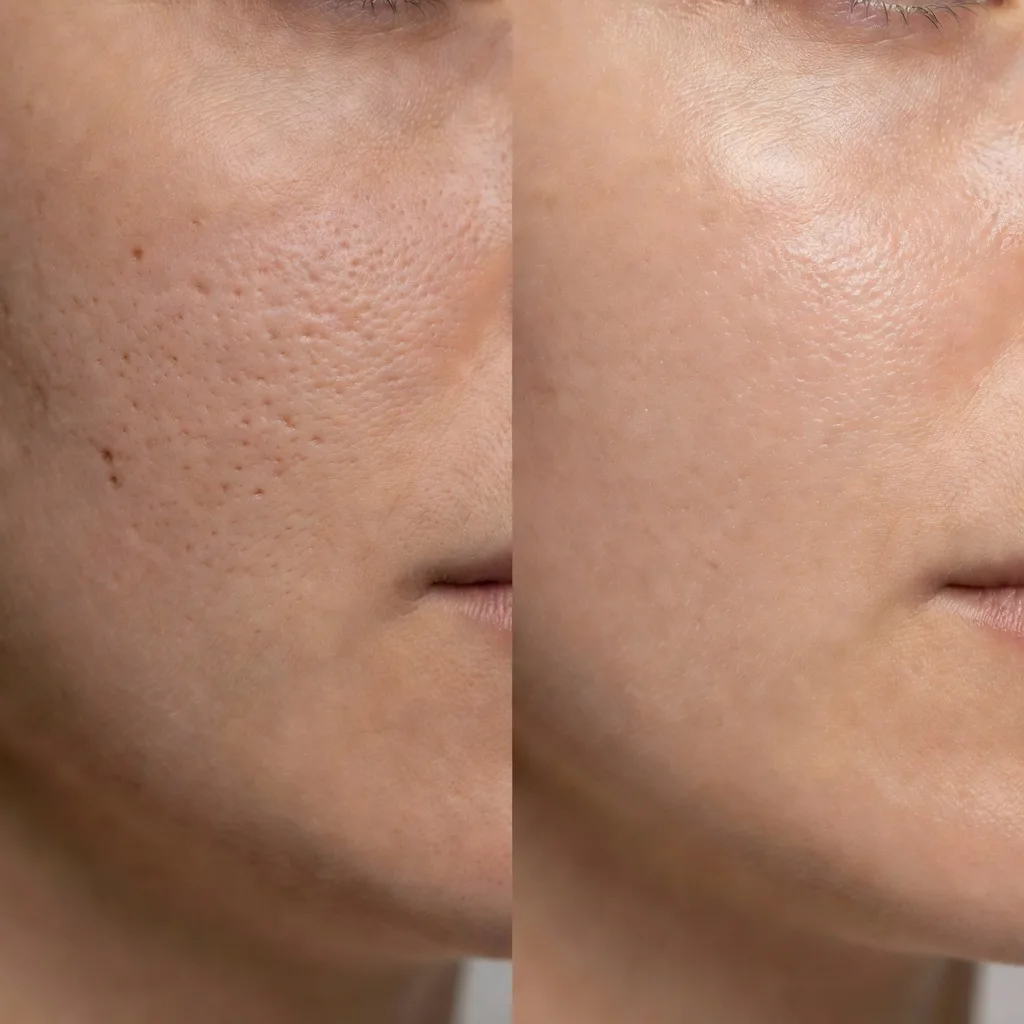
Before and after microneedling comparisons circulate constantly online, but most set unrealistic expectations about how quickly results actually appear.
Part of our guide to facial treatments. Start with: Microneedling Facial: Real Results, Explained
Cleveland Clinic states that redness and swelling typically resolve within about five days, while the actual collagen-driven results take 3 to 6 months to show up, since the remodeling phase of wound healing that produces visible change can continue for up to a year. A real clinical study found statistically significant collagen and elastin changes only after a full six-session course, not after one treatment.
Valid clinical before/after photography requires locked camera settings, lighting, angle, and backdrop, and deviating from any of those can make a normal result look far more dramatic than it actually is.
This guide covers the real recovery and results timeline, and how to track your own progress honestly instead of chasing an unrealistic one.
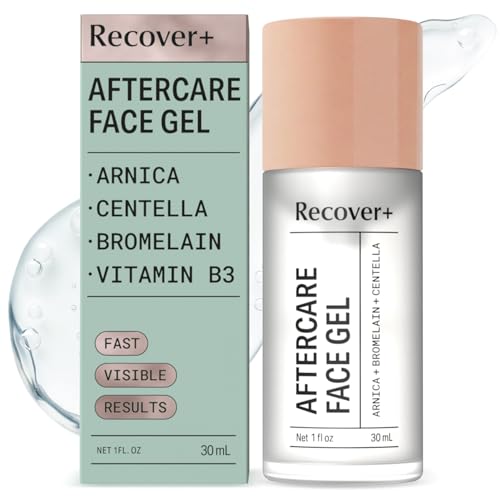
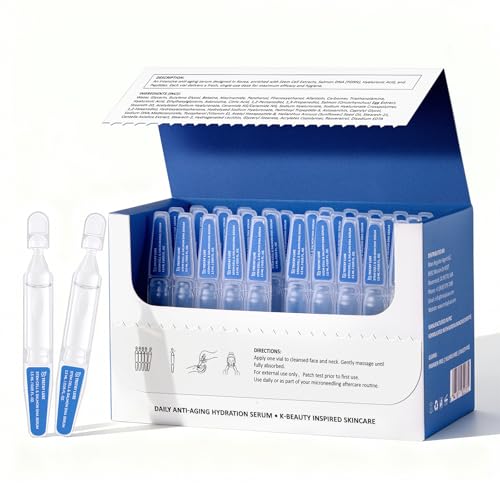
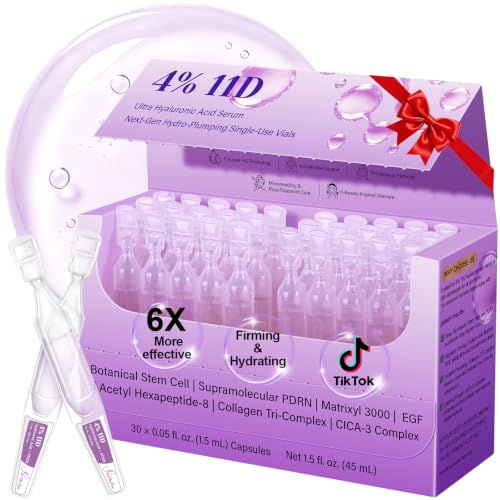
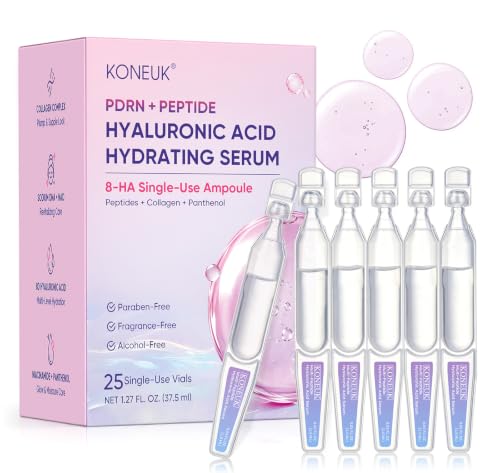
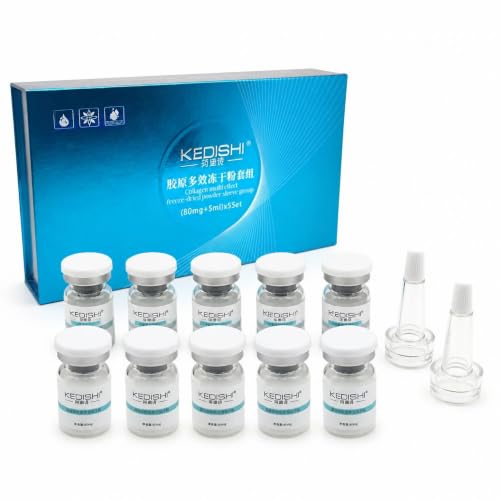
Recommended Aftercare Serums for Post-Microneedling Skin


The Real Recovery and Results Timeline
Cleveland Clinic gives a clear, medically sourced timeline for what actually happens after microneedling, and it’s slower than most before/after marketing implies. Redness and swelling can last up to five days post-treatment, though most people can wear makeup again the next day. Results themselves are not immediate: patients typically wait 3 to 6 months to actually see them, with maintenance treatments recommended annually after finishing an initial series. Sessions are spaced 3 to 8 weeks apart, and multiple sessions are required before any visible outcome shows up.
Shopping these picks?
Amazon Prime members get fast, free shipping on eligible items, plus Prime Video, Amazon Music and member deals. New members can start with a free trial.
Start a free Prime trialAged 18 to 24? Prime for Young Adults comes with a longer free trial and a lower price after it.
Affiliate link: we may earn a commission at no extra cost to you.
That gap — a few days of visible downtime versus months before real results appear — is the single most important thing to understand before comparing your own results, or a set of marketing photos, to what “should” be happening. Nearly every unrealistic expectation about microneedling traces back to collapsing that months-long timeline into a few days.
Snapshot
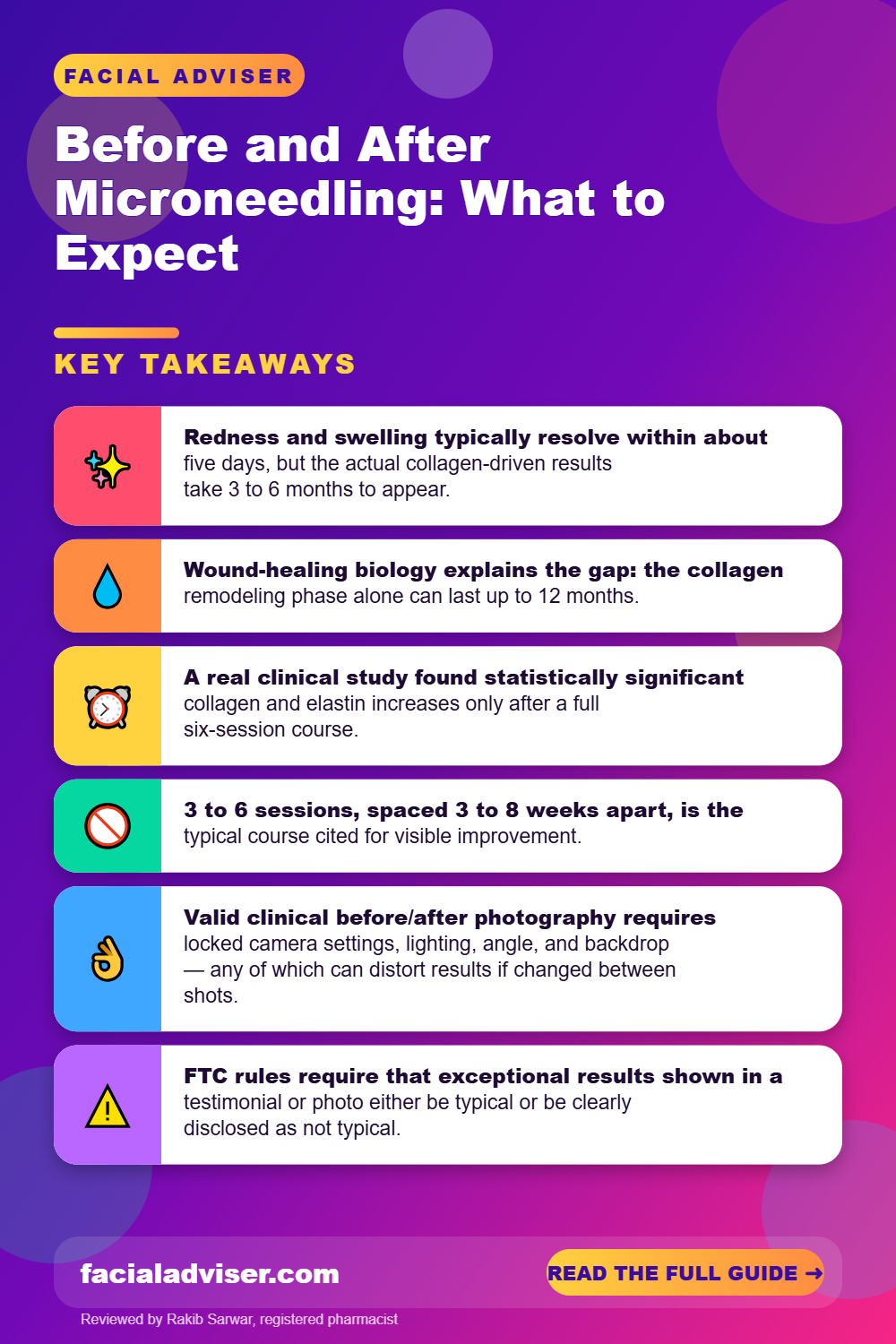
- Redness and swelling typically resolve within about five days, but the actual collagen-driven results take 3 to 6 months to appear.
- Wound-healing biology explains the gap: the collagen remodeling phase alone can last up to 12 months.
- A real clinical study found statistically significant collagen and elastin increases only after a full six-session course.
- 3 to 6 sessions, spaced 3 to 8 weeks apart, is the typical course cited for visible improvement.
- Valid clinical before/after photography requires locked camera settings, lighting, angle, and backdrop — any of which can distort results if changed between shots.
- FTC rules require that exceptional results shown in a testimonial or photo either be typical or be clearly disclosed as not typical.
On This Page
- The Real Recovery and Results Timeline
- Why Results Take Months, Not Days
- How Many Sessions Before Real Change
- What Before/After Photos Can Mislead About
- The Single-Session Trap
- Tracking Your Own Results Honestly
- Who Sees the Most Noticeable Change
- Who Should Modify or Skip Treatment
- When Healing Isn’t Going as Expected
- A Five-Day Healing Check
- Where the Evidence Runs Out
- Frequently Asked Questions
Why Results Take Months, Not Days
The collagen-remodeling timeline isn’t arbitrary — it follows basic, well-documented wound-healing physiology. Per NCBI’s StatPearls reference on wound healing phases, the inflammatory phase lasts several days; the proliferative phase, where fibroblasts begin depositing new collagen, can last several weeks, starting around days 5 to 7; and the remodeling and maturation phase, where that new collagen is actually reorganized and strengthened, starts around week 3 and can continue for up to 12 months. Even at peak tensile strength, reached around 11 to 14 weeks, healing tissue reaches only about 80 percent of its original strength.
This directly explains why a genuine result takes months: the visible redness resolves within days, but the actual structural collagen change that microneedling is meant to produce is still in its earliest phase at that point. Marketing that shows dramatic change “one week later” is, at best, showing something other than the collagen remodeling the treatment is actually designed to produce.
| Phase | Timing | What’s happening |
|---|---|---|
| Inflammatory | First several days | Redness, swelling — visible downtime, no structural change yet |
| Proliferative | Starting ~days 5-7, lasting weeks | Fibroblasts begin depositing new collagen |
| Remodeling/maturation | Starting ~week 3, up to 12 months | New collagen reorganized and strengthened — where real visible change appears |
How Many Sessions Before Real Change
A real clinical study, “Multiple microneedling sessions for minimally invasive facial rejuvenation: an objective assessment,” used six sessions at two-week intervals and took objective measurements at baseline, one month, and three months. It found statistically significant increases in collagen- and elastin-related markers only by the end of that full course — not after a single session. That’s consistent with the broader clinical guidance: 3 to 6 sessions, spaced roughly 3 to 8 weeks apart, is the commonly cited range for visible improvement in scarring or texture, with full results assessed at 3 to 6 months after finishing the course, not after any one treatment.
| Session count | Objective finding |
|---|---|
| Single session | No statistically significant collagen/elastin marker change measured at this point |
| Full six-session course (2-week intervals) | Statistically significant increases in collagen- and elastin-related markers by course end |
What Before/After Photos Can Mislead About
This isn’t just cynicism about marketing — it’s grounded in real clinical-photography standards. Per a detailed guide on photography in dermatology, a genuinely valid before/after comparison requires identical camera settings (aperture, shutter speed, exposure, a locked zoom) and lighting between shots, fixed patient positioning and distance from the camera (clinics often mark this with tape on the floor), and a fixed, non-reflective, consistent-colored backdrop with controlled subject-to-backdrop distance, since even a modest change in that distance changes how shadows render. Deviating from any single one of those — different lighting, a different angle, a different distance, or a different backdrop between the “before” and “after” shot — can make an entirely normal, gradual result look far more dramatic than it actually is.
The Single-Session Trap
There’s a second, commonly missed distortion in how before/after photos get presented: many published pairs actually represent the endpoint of a full multi-session course — all 3 to 6 treatments — but are captioned or implied as the effect of a single session. Given that the clinical evidence above shows meaningful collagen change only becomes measurable after a full course, a single-session “after” photo showing dramatic change should be read skeptically by default.
The FTC’s updated Endorsement Guides, issued in 2023, are directly relevant here: if a testimonial or photo shows exceptional results, the advertiser is required to either demonstrate that’s a typical outcome or clearly disclose that it isn’t, including what the generally expected results of the same regimen actually look like. That’s a real regulatory standard, not just an ethical suggestion, and it’s routinely not followed in casual social-media before/after content.
Tracking Your Own Results Honestly
Take your own “before” photo under consistent, even lighting
Natural window light or a consistent indoor setup works better than mixed or dramatic lighting that can be misread later.Repeat the same angle, distance, and lighting for every follow-up photo
This is the single biggest factor separating a genuine comparison from a misleading one.Expect the first real signal at 4 to 6 weeks, not days
Early photos mainly document downtime resolving, not the treatment’s actual effect.Judge the full course at 3 to 6 months
Compare your true “before” photo to your appearance after finishing your planned session series, not after any single treatment.
Who Sees the Most Noticeable Change
People treating atrophic acne scarring or general textural concerns, who commit to a full multi-session course and wait the full 3-to-6-month window before judging results, tend to see the most consistent, measurable improvement. People expecting a dramatic single-session transformation, based on marketing photos rather than the clinical timeline, are the most likely to feel disappointed even when the treatment is working as designed.
Do
- Plan for a full 3-to-6-session course before judging results
- Take your own consistent, controlled comparison photos
- Wait the full 3-to-6-month window before evaluating the outcome
Don’t
- Expect visible collagen-driven change within days or after one session
- Compare your results to photos with inconsistent lighting, angle, or background
- Assume a dramatic marketing photo represents a single treatment’s typical effect
Who Should Modify or Skip Treatment
Per Cleveland Clinic, active acne, blood disorders, active chemotherapy or radiation treatment, frequent cold sores, a personal tendency toward keloid scarring, and changing moles or skin tags in the treatment area all warrant a provider consultation before proceeding. Eczema or psoriasis flares in the treatment area are also reasons to wait until skin is stable before scheduling a session.
When Healing Isn’t Going as Expected
Normal healing trends toward resolution within about five days, per Cleveland Clinic. If redness, swelling, or pinpoint bleeding worsens rather than improves after day 2 or 3, or if you notice increasing pain, warmth, or pus — signs of infection rather than the normal inflammatory phase of healing — contact your provider rather than assuming it’s part of the expected process.
A Five-Day Healing Check
Track your own healing against the real clinical window: redness and swelling should be trending down, not up, by day 2 or 3, and largely resolved by day 5, per Cleveland Clinic’s own stated timeline. If that pattern holds, you’re healing normally and it’s simply too early to judge the treatment’s actual effect. If it doesn’t — worsening symptoms, new pain, warmth, or discharge — that’s a real signal to contact your provider rather than wait it out, since it suggests something other than ordinary post-procedure inflammation.
Where the Evidence Runs Out
Be precise about what’s established here: the 3-to-6-month results timeline and the wound-healing phase data come from real clinical sources (Cleveland Clinic and NCBI StatPearls), and the six-session objective-measurement study is a genuine, if single, piece of direct evidence for the session-count requirement. What isn’t established is any specific individual’s exact timeline — healing and remodeling speed vary by age, skin type, and treatment intensity, so the ranges given here are reasonable expectations, not guarantees. And no photo, yours or a marketing example, is meaningful evidence of anything unless the camera settings, lighting, angle, and backdrop were genuinely held constant between shots.
Frequently Asked Questions
How long does it take to see microneedling results?
Typically 3 to 6 months, per Cleveland Clinic, even though visible redness and swelling resolve within about five days.
Why do results take so much longer than the visible downtime?
Collagen remodeling, the phase that produces the actual result, starts around week 3 and can continue for up to 12 months.
How many sessions does microneedling usually take?
3 to 6 sessions spaced 3 to 8 weeks apart is the commonly cited range for visible improvement.
Can I see real results after just one session?
Unlikely — a clinical study found statistically significant collagen and elastin changes only after a full six-session course.
Why do some before/after photos look so dramatic?
Often because lighting, angle, or distance changed between the two shots, or because the “after” photo actually represents a full multi-session course, not one treatment.
What does normal healing look like after microneedling?
Redness and swelling for up to five days, trending downward, not upward, over that time.
When should I be concerned about how I’m healing?
If redness, swelling, or bleeding worsens after day 2 or 3, or you notice increasing pain, warmth, or pus.
Are before/after marketing photos regulated at all?
Yes — FTC Endorsement Guides require that exceptional results shown be either typical or clearly disclosed as not typical.
Who should avoid microneedling or delay treatment?
People with active acne, blood disorders, active chemo/radiation, frequent cold sores, keloid tendency, or active eczema/psoriasis flares.
How should I take my own before/after photos?
Under consistent, even lighting, at the same angle and distance every time, to make a genuine comparison possible.

Written by
Registered pharmacist and founder of Facial Adviser. Rakib's pharmacy training covers how skincare actives work and interact; a later course in cosmetology turned that into a focus on facial treatments and skincare products. He plans, researches and edits every guide on the site and checks health claims against sources such as the American Academy of Dermatology, the FDA and the NIH. He is not a dermatologist; see the Editorial Policy and Medical Disclaimer.
About · Editorial policy · How we choose products · Medical disclaimer · Contact
Keep reading: Microneedling, PRP and lasers
- Microneedling Facial: Real Results, Explained
- Will Microneedling Reduce Pore Size?
- Can Microneedling Damage Hair Follicles?
- Can Microneedling Cause Hair Loss? The Real Answer
- Microneedling With Minoxidil: Does It Boost Hair Regrowth and Is It Safe?
- Microneedling Without Serum: Is It Risky?
- Ultimate Guide Microdermabrasion: What to Know
- Facial vs Chemical Peel: Differences, Results and Which to Choose