Facial Harmonization: What It Actually Is
Facial harmonization sounds like a single, specific treatment, but it isn’t one, and that distinction matters before you book a consultation built around the term.
Part of our guide to facial treatments. Start with: What Is the Best Anti-Aging Facial Treatment? Options Compared by Goal
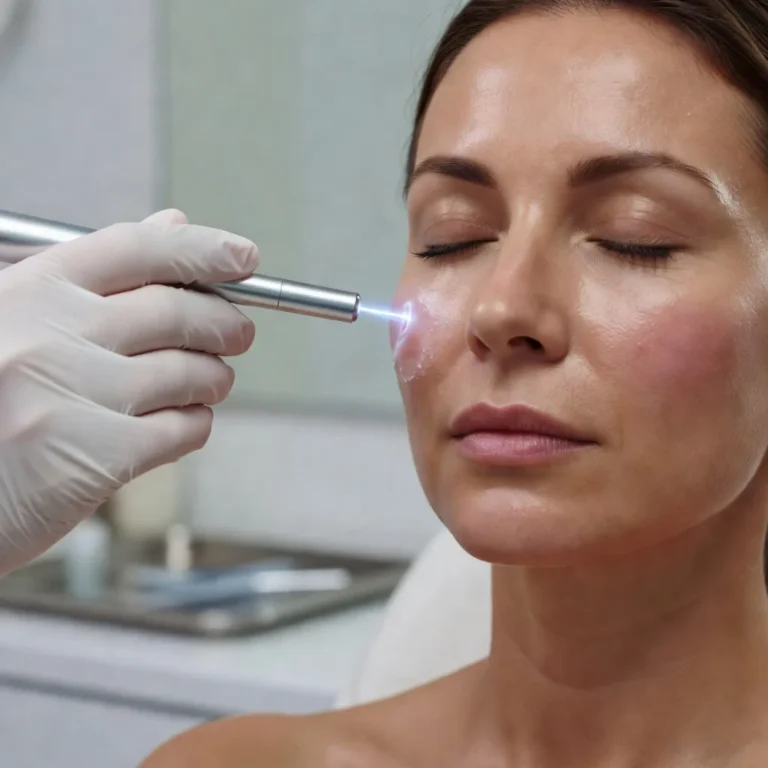
It’s an umbrella label for combining injectables like botulinum toxin and dermal filler, sometimes with threads or energy devices, to balance overall facial proportion — and a surprising share of the academic literature using this exact term exists because of a legal fight over who’s allowed to perform it, not because it names a distinct clinical modality.
The marketing behind this term also frequently leans on the “golden ratio” as a beauty standard, a claim that’s been directly and explicitly refuted in peer-reviewed surgical literature.
This guide covers the real complications data, the proportion frameworks practitioners actually use, and how to vet a provider before committing to a harmonization plan.
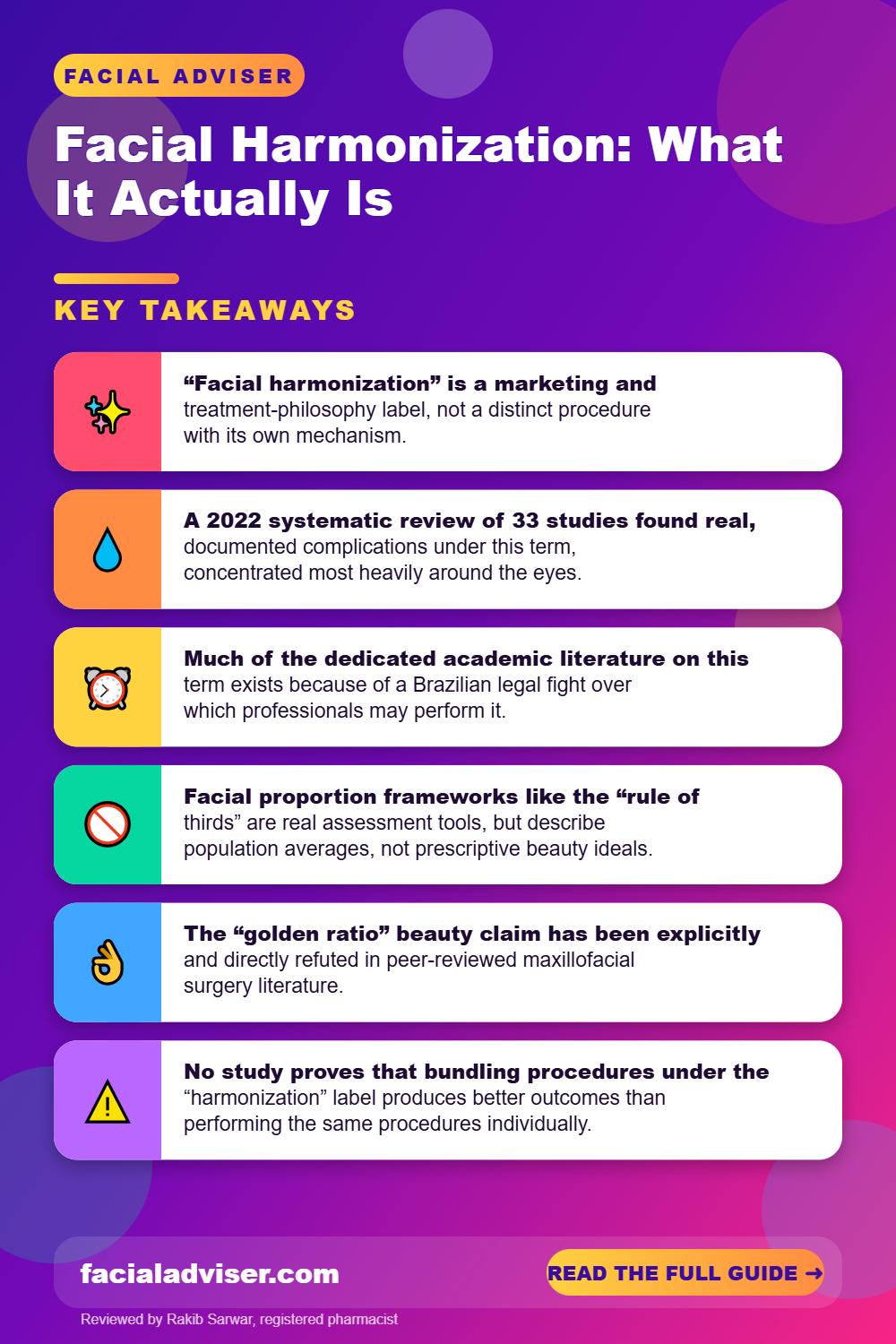
Recommended Hydrating Skincare to Pair With Aesthetic Treatments



What “Facial Harmonization” Actually Means
Facial harmonization sounds like a specific, standardized procedure, but it isn’t one. It’s an umbrella term for a treatment philosophy: combining injectables like botulinum toxin and dermal fillers, sometimes with threads or energy-based devices, to adjust overall facial balance and proportion rather than treating one isolated feature. There’s no single mechanism of action behind “harmonization” itself — every result comes from the same individual procedures already used elsewhere, just planned together with an eye toward the whole face.
Shopping these picks?
Amazon Prime members get fast, free shipping on eligible items, plus Prime Video, Amazon Music and member deals. New members can start with a free trial.
Start a free Prime trialAged 18 to 24? Prime for Young Adults comes with a longer free trial and a lower price after it.
Affiliate link: we may earn a commission at no extra cost to you.
This guide covers what real clinical literature using this term actually shows, a genuinely surprising regulatory story behind why so much of that literature exists, the proportion frameworks practitioners actually reference, and a direct scientific debunking of the “golden ratio” beauty claim this kind of marketing leans on heavily.
Reality Check
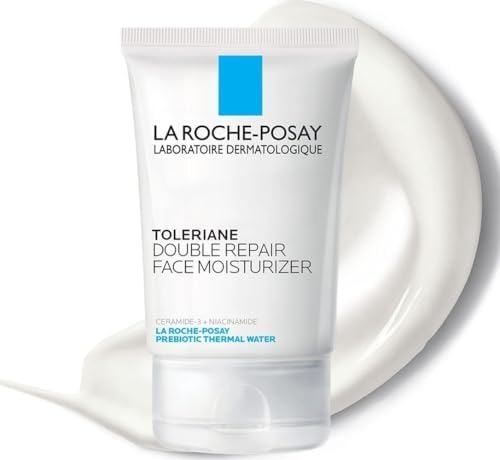
- “Facial harmonization” is a marketing and treatment-philosophy label, not a distinct procedure with its own mechanism.
- A 2022 systematic review of 33 studies found real, documented complications under this term, concentrated most heavily around the eyes.
- Much of the dedicated academic literature on this term exists because of a Brazilian legal fight over which professionals may perform it.
- Facial proportion frameworks like the “rule of thirds” are real assessment tools, but describe population averages, not prescriptive beauty ideals.
- The “golden ratio” beauty claim has been explicitly and directly refuted in peer-reviewed maxillofacial surgery literature.
- No study proves that bundling procedures under the “harmonization” label produces better outcomes than performing the same procedures individually.
Table of Contents
- What “Facial Harmonization” Actually Means
- The Real Literature — and a Surprising Regulatory Story
- What the Complications Data Actually Shows
- The Proportion Frameworks Practitioners Actually Use
- The Golden Ratio Claim, Directly Debunked
- Standalone Procedures vs. “Harmonization” Packages
- How a Harmonization Consultation Usually Works
- Who Actually Considers This
- Who Should Be Cautious
- When to See a Board-Certified Specialist
- Where the Evidence Runs Out
- Frequently Asked Questions
The Real Literature — and a Surprising Regulatory Story
Real, peer-reviewed literature does exist under this exact term, but its origin is more of a legal story than a clinical one. In Brazil, “harmonizacao orofacial” became an official recognized dental specialty in 2019 under a resolution from the country’s Federal Council of Dentistry, which allowed dentists, not just physicians, to legally perform facial filler and botulinum toxin injections. Brazilian medical associations fought this classification for years. As of mid-2026, a federal appeals panel voted to annul that resolution, and the dental council has said it will appeal further.
A meaningful share of the dedicated “facial harmonization” academic literature exists specifically because of this scope-of-practice fight over who is legally allowed to inject, not because the term names a scientifically distinct treatment. That’s worth knowing before treating “harmonization” as if it were a single, evidence-backed modality.
The scope-of-practice fight isn’t unique to Brazil, either. In the United States, dermal fillers and botulinum toxin injections are FDA-regulated as medical devices and prescription biologics, and state medical boards, not a single national standard, determine which licensed professionals (physicians, physician assistants, nurse practitioners, and in some states dentists or nurses under supervision) may legally administer them. A practitioner marketing “facial harmonization” packages in the US is still bound by whatever their individual state’s injectable-scope-of-practice rules say, regardless of what the treatment bundle is branded. This is a genuinely useful, underused screening question for a prospective patient: ask directly what license the injector holds and whether their state permits that license to perform the specific injectables being proposed, rather than assuming a fancy package name implies extra oversight.
What the Complications Data Actually Shows
A 2022 systematic review in a Brazilian plastic surgery journal pooled 33 quality-assessed studies out of more than 3,500 initial references. The most frequently affected area was the eyes and surrounding periocular region, with documented cases including dry eye, double vision, vision loss, drooping eyelid, retinal artery occlusion, and nerve palsy. The nose was next most affected, with cases of tissue death, redness, and numbness, followed by the forehead and glabella area (tissue death, severe pain), the lips (asymmetry, infection, tissue migration), and the lower face (chin tissue death, tongue numbness, nodules). One reported complication onset occurred as late as six years after the original procedure.
| Facial region | Documented complication types |
|---|---|
| Eyes / periocular | Dry eye, diplopia, vision loss, ptosis, retinal artery occlusion, nerve palsy |
| Nose | Tissue necrosis, erythema, numbness |
| Forehead / glabella | Skin necrosis, severe pain |
| Lips | Asymmetry, infection, fibrosis, filler migration |
| Lower face / chin | Tissue necrosis, tongue paresthesia, nodules |
The Proportion Frameworks Practitioners Actually Use
Two real anthropometric tools show up repeatedly in surgical planning: the “rule of thirds,” dividing the face from hairline to chin into three roughly equal vertical sections, and the “rule of fifths,” dividing facial width into five eye-widths. Both trace back to population-level anthropometric research, most notably Leslie Farkas’s norms, and are genuinely useful as descriptive assessment tools — for spotting asymmetry relative to population averages during procedures like orthognathic surgery or rhinoplasty planning. Our guide to how long facial contouring actually lasts covers the real FDA data behind the individual filler types most often used within a harmonization plan, which is worth reading before comparing options. They were never intended as a prescriptive template defining one universal “ideal” face.
It’s also worth noting these frameworks were developed from measurements of specific population samples decades ago, and later cross-cultural anthropometric research has found real variation in what proportions different populations actually average, which is a further reason clinicians treat these ratios as reference points for spotting asymmetry rather than as a fixed universal target every patient should be pushed toward.
The Golden Ratio Claim, Directly Debunked
A 2024 review in Maxillofacial Plastic and Reconstructive Surgery addresses the golden-ratio beauty claim directly and unambiguously: “there is no convincing evidence that the golden ratio is linked to idealized human proportions or facial beauty,” and there is “currently no evidence to support the use of the golden ratio in orthognathic or facial aesthetic/reconstructive surgical planning.” The same review debunks two of the claim’s most repeated supporting stories — that Leonardo da Vinci deliberately used the golden ratio in his proportional drawings, and that the Parthenon was built to it — as unsupported by actual measurement. The authors point to confirmation bias as the likely reason the myth persists: people start with the ratio they want to find and retrofit measurements to match it, rather than measuring first and seeing what ratio actually emerges.
Standalone Procedures vs. “Harmonization” Packages
| Approach | What you’re actually getting | What’s different |
|---|---|---|
| Single-procedure booking (e.g., lip filler alone) | One injectable, one documented goal | Simpler to evaluate outcomes and complications against |
| “Facial harmonization” package | Multiple injectables/procedures planned together across the face | Marketing bundling; same individual techniques, planned holistically |
How a Harmonization Consultation Usually Works
Facial assessment
The practitioner evaluates your features against population-average proportion frameworks and your own stated goals.Treatment planning
A combination of injectables or procedures is proposed, often phased across multiple visits rather than done in one session.Credential and imaging verification
Confirm the practitioner’s medical licensing and ask to see real, unedited before-and-after photos of their own patients.Staged treatment
Procedures are typically spaced out to assess results and swelling resolution before adding more.Follow-up assessment
A final review compares results against the original plan and addresses any touch-ups.
Do
- Confirm your injector’s medical license and specific training in facial anatomy
- Ask which specific procedures are being combined and why
- Get a staged plan rather than everything in one session
Don’t
- Assume “harmonization” is a single standardized, regulated procedure
- Choose a provider based on golden-ratio marketing language alone
- Skip asking about periocular-area risk if injections are planned near the eyes
Who Actually Considers This
People considering facial harmonization are typically already familiar with individual injectable treatments and are looking for a more holistic, planned-out approach across multiple features rather than treating one area in isolation. It’s a reasonable framework for planning, as long as the person understands they’re still receiving standard individual procedures rather than one novel treatment.
Who Should Be Cautious
Anyone with active skin infection in the treatment area, a bleeding disorder, known allergy to the specific filler material, or unrealistic expectations set by golden-ratio-style marketing should pause and get a second, more conservative consultation. Because periocular complications are the most severe and most frequently documented, extra caution and a highly experienced injector matter most for any planned work near the eyes.
When to See a Board-Certified Specialist
Sudden vision changes, severe or worsening pain, skin that turns unusually pale or dusky after an injection, or asymmetric swelling that doesn’t resolve within the expected timeframe are all reasons to seek urgent medical evaluation, since these can signal vascular occlusion, a genuine emergency in filler-based procedures.
Where the Evidence Runs Out
No study directly compares outcomes from a planned “harmonization” package against the same procedures performed individually and separately, so there’s no rigorous evidence that the bundled approach itself produces better results, only that the individual component procedures have their own separately documented evidence bases and risk profiles.
Frequently Asked Questions
What is facial harmonization?
It’s a marketing and treatment-planning term for combining injectables and other procedures to balance overall facial proportion, not a single distinct treatment.
Is facial harmonization a real medical procedure?
The individual procedures used within it are real and studied separately; “harmonization” itself is an umbrella label, not its own distinct modality.
Is the golden ratio real for facial beauty?
No — a 2024 peer-reviewed review states there is no convincing evidence linking the golden ratio to facial beauty or a basis for using it in surgical planning.
What are the risks of facial harmonization?
A 2022 systematic review found documented complications concentrated most heavily around the eyes, including vision changes and vascular occlusion.
Who is allowed to perform facial harmonization?
This varies by country and has been legally contested; in Brazil it became a dental-specialty fight before a court recently annulled the resolution allowing it.
Does facial harmonization use the rule of thirds?
Many practitioners reference proportion frameworks like the rule of thirds or fifths as assessment tools, though these describe population averages, not fixed ideals.
Is facial harmonization better than single treatments?
No study has directly proven that bundling procedures under this label produces better outcomes than the same procedures done individually.
What’s the most serious risk area for facial injectables?
The periocular region, where documented complications include vision loss and retinal artery occlusion.
How do I choose a safe provider for this?
Confirm medical licensing, ask about specific anatomical training, and request real before-and-after examples from their own practice.
Can facial harmonization go wrong?
Yes, like any injectable-based procedure; documented complications range from mild asymmetry to serious vascular events, most concentrated around the eyes.

Written by
Registered pharmacist and founder of Facial Adviser. Rakib's pharmacy training covers how skincare actives work and interact; a later course in cosmetology turned that into a focus on facial treatments and skincare products. He plans, researches and edits every guide on the site and checks health claims against sources such as the American Academy of Dermatology, the FDA and the NIH. He is not a dermatologist; see the Editorial Policy and Medical Disclaimer.
About · Editorial policy · How we choose products · Medical disclaimer · Contact
Keep reading: Anti-aging facials and treatments
- What Is the Best Anti-Aging Facial Treatment? Options Compared by Goal
- Facial Fat Grafting Cost: What You'll Really Pay
- How Long Does Facial Fat Grafting Last?
- Facial Fat Transfer vs Fillers: Longevity, Predictability, and Who Each Suits
- Cryo Facial vs Botox: Which Is Better for Wrinkles and Puffiness?
- Facial Liposuction vs Buccal Fat Removal: Differences, Risks and Recovery
- Fruit Facial at Home: Does It Actually Work?
- Facial Types: A Guide to 11 Popular Facials and How to Choose One