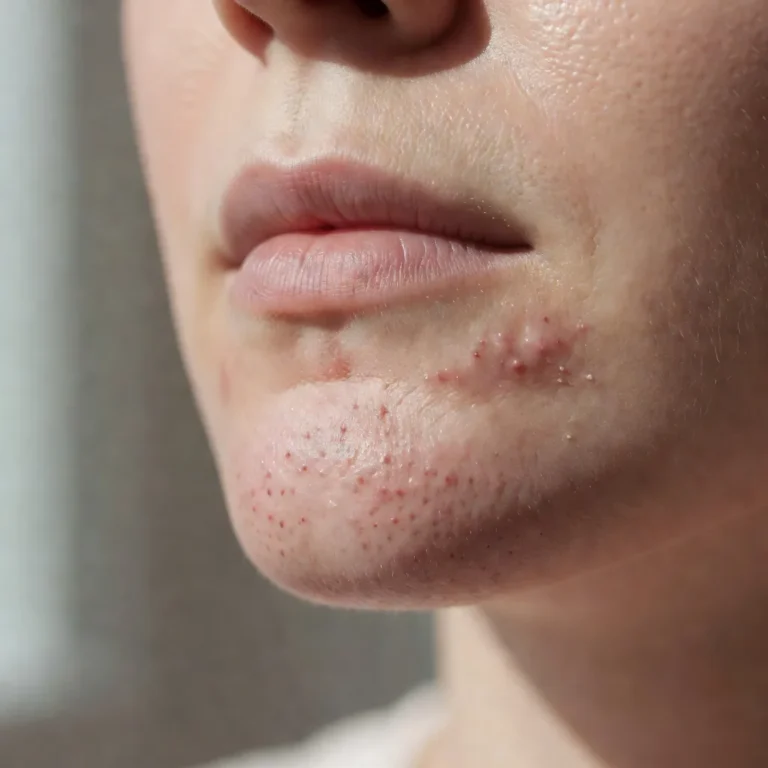

How Long Does Facial Contouring Last?
How long does facial contouring last? It depends entirely on which method you actually mean, since dermal fillers, Kybella, and Ultherapy work through completely different mechanisms with very different timelines.
Part of our guide to makeup how-to. Start with: How to Find the Right Shade of Makeup: Undertone, Depth and Testing
FDA data puts hyaluronic acid fillers at roughly 6 to 12 months, calcium hydroxylapatite around 18 months, and poly-L-lactic acid up to 2 years, while Kybella permanently destroys fat cells rather than adding volume at all. Ultherapy sits in its own category entirely, building results gradually through your own collagen response.
Duration figures here are real population averages from manufacturer and clinical-trial data, genuinely dependent on the specific product, treatment area, and your own metabolism.
This guide walks through the actual FDA and clinical data behind each option, and contrasts all of them against contouring makeup’s purely optical, zero-structural effect.
Recommended Products for Skin Support Alongside Contouring


Key Takeaways
- How long facial contouring lasts depends entirely on which method you mean, hyaluronic acid filler, a longer-lasting filler type, Kybella, or Ultherapy each behave completely differently.
- FDA data puts HA fillers at roughly 6 to 12 months, calcium hydroxylapatite around 18 months, and poly-L-lactic acid up to 2 years.
- Kybella works by destroying fat cells permanently, not by adding volume, so its results don’t fade the way filler does.
- Ultherapy’s collagen-building effect continues improving for about 3 months after treatment, then gradually fades as natural collagen turnover slows.
- Contouring makeup is a purely optical, non-structural effect that lasts only until you wash your face, worth contrasting against the real medical procedures.
- Duration figures are population averages from manufacturer and clinical-trial data, genuinely dependent on the product, treatment area, technique, and your own metabolism.
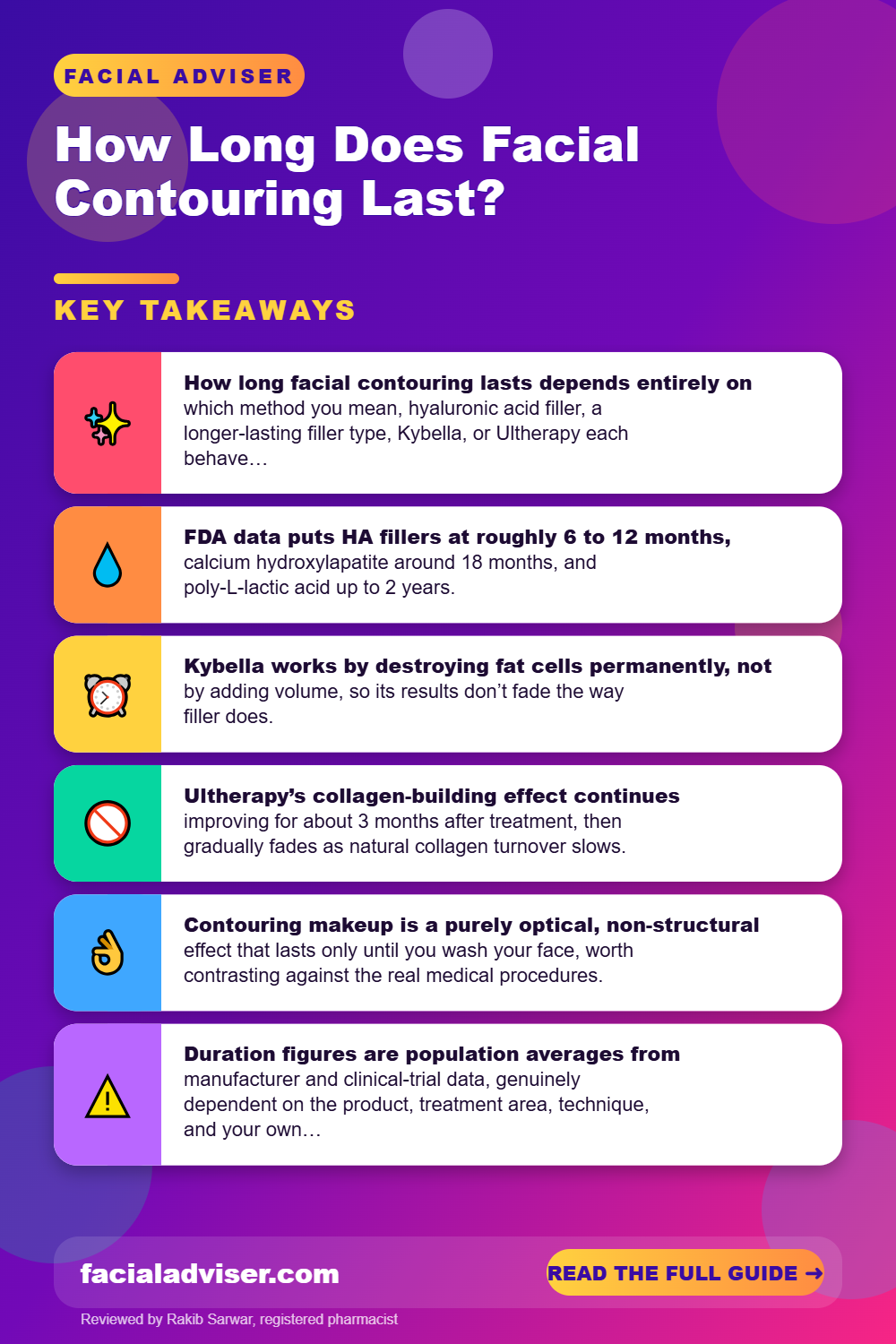
Table of Contents
- How Long Does Facial Contouring Last?
- Dermal Filler Duration by Type
- Kybella: A Different Mechanism Entirely
- Ultherapy: Collagen-Building, Not Filling
- Comparing Every Contouring Method
- Checking What You’re Actually Looking At
- What Actually Shortens or Extends Duration
- Where Contouring Makeup Actually Fits
- Do This, Not That
- How to Plan a Contouring Timeline
- When to See a Provider
- Frequently Asked Questions
- The Bottom Line
How Long Does Facial Contouring Last?
Facial contouring covers several genuinely different procedures, dermal fillers, Kybella, and Ultherapy among them, and how long results last depends entirely on which one you mean. The FDA’s own aesthetic-devices data gives specific duration ranges for each filler category, and Kybella and Ultherapy work through mechanisms so different from filler that comparing their “duration” side by side needs real context, not just a single number.
Shopping these picks?
Amazon Prime members get fast, free shipping on eligible items, plus Prime Video, Amazon Music and member deals. New members can start with a free trial.
Start a free Prime trialAged 18 to 24? Prime for Young Adults comes with a longer free trial and a lower price after it.
Affiliate link: we may earn a commission at no extra cost to you.
This guide walks through the actual FDA and clinical-trial data behind each method, so you can compare real options honestly rather than treating “facial contouring” as one uniform treatment with one uniform timeline.
Dermal Filler Duration by Type
The FDA’s approved dermal fillers page breaks these down by material, and duration varies meaningfully by category. Hyaluronic acid fillers, the most common type, typically last around 6 to 12 months, varying by specific product and injection area. Calcium hydroxylapatite (Radiesse) lasts roughly 18 months. Poly-L-lactic acid (Sculptra) works differently still, it stimulates your own collagen production gradually rather than adding immediate volume, with results building over time and lasting up to 2 years.
Polymethyl methacrylate (Bellafill) is non-absorbable and considered effectively permanent, since the material itself isn’t broken down by the body the way HA or CaHA fillers are. This range, from under a year to permanent, is exactly why “how long does filler last” needs a follow-up question about which filler.
Kybella: A Different Mechanism Entirely
Note: Kybella (deoxycholic acid) isn’t a filler at all, it’s a cytolytic drug that physically destroys fat cell membranes in the treated area. Destroyed fat cells don’t regenerate, which is why its results are described as permanent for those specific cells, even though new fat can still accumulate elsewhere with weight gain.
Per its FDA label, Kybella is indicated specifically for submental fat, the area under the chin, not other facial areas. Dosing involves up to 50 injections of 0.2 milliliters each, up to 10 milliliters total per session, with sessions spaced at least a month apart, up to 6 sessions total. In the pivotal trials, 66 to 70 percent of patients achieved at least a 1-grade improvement versus 18 to 22 percent on placebo, and MRI-confirmed fat volume reduction of at least 10 percent was seen in 43 percent of patients versus 5 percent on placebo.
Warning: Kybella’s real documented risks include marginal mandibular nerve injury causing an asymmetric smile, difficulty swallowing, bruising in 72 percent of patients, and injection-site ulceration, necrosis, or infection. It’s contraindicated with active infection at the injection site, and vascular injury is a real risk if injected incorrectly.
Ultherapy: Collagen-Building, Not Filling
Ultherapy uses microfocused ultrasound, FDA-cleared in 2009 for a non-invasive eyebrow lift, later expanded to neck lift and chest lines. It works by heating deep tissue layers to stimulate new collagen production, meaning results actually continue improving for up to about 3 months after treatment as that collagen remodels.
Unlike a filler, there’s no fixed expiration date built into the treatment, since it doesn’t add material, it stimulates your body’s own collagen response. Results gradually fade as your body’s natural collagen production tapers with ongoing aging, and while the FDA clearance itself doesn’t specify a duration figure, patients commonly report effects lasting around a year before considering a repeat session.
Comparing Every Contouring Method
| Method | Typical duration | Mechanism |
|---|---|---|
| Hyaluronic acid filler | 6-12 months | Adds volume directly, reversible with hyaluronidase |
| Calcium hydroxylapatite (Radiesse) | ~18 months | Volume plus some collagen stimulation |
| Poly-L-lactic acid (Sculptra) | Up to 2 years | Gradual collagen stimulation, not immediate volume |
| PMMA (Bellafill) | Permanent | Permanent volume plus collagen stimulation |
| Kybella | Permanent, for treated fat cells | Destroys fat cells, doesn’t add volume |
| Ultherapy | Builds over ~3 months, commonly ~1 year | Collagen stimulation via heat, no added volume |
| Contouring makeup | Hours, until washed off | Purely optical shading, zero structural effect |
Checking What You’re Actually Looking At
Before booking any procedure, it’s worth pinning down which category actually matches what you want. If you want added volume in a specific area, cheeks or lips for example, that’s filler territory. If your goal is reducing submental fat specifically, that’s Kybella’s actual indication, not other facial areas. If you want gradual skin tightening without added volume, that’s closer to what Ultherapy targets. Confusing these categories is the most common reason patients feel disappointed by results that were, mechanistically, never designed to do what they expected.
What Actually Shortens or Extends Duration
The duration ranges cited for any of these treatments are population averages drawn from manufacturer data and clinical trials, not personal guarantees, and several genuinely variable factors explain why two people can get the same filler injected by the same provider and see meaningfully different longevity. Treatment area matters significantly: areas with more constant muscle movement, like the lips or the area around the mouth, tend to metabolize filler faster than a comparatively still area like the cheekbone.
Your own metabolic rate plays a real role too, since HA fillers are broken down by an enzyme called hyaluronidase that your body produces naturally, and people vary in how quickly they do this. Physical activity level, sun exposure, and even how the product was injected, depth and technique both affect how evenly and how long it holds up, all contribute to the real-world range you’ll see reported by different patients using the exact same product.
Where Contouring Makeup Actually Fits
It’s worth stating plainly why contouring makeup sits in a completely different category from every procedure above: it works by using lighter and darker shades to create the visual illusion of shadow and highlight, tricking the eye into perceiving more or less structure than is physically present. There’s no tissue-level change happening at all, which is exactly why it needs to be reapplied every single day and disappears completely the moment you wash your face.
That’s not a criticism of contouring makeup, it’s a genuinely useful, zero-risk, fully reversible tool for anyone who wants a temporary look without any procedure at all. The contrast is simply worth being explicit about: if a video or product description uses the phrase “facial contouring” without specifying whether it means makeup or a medical procedure, that ambiguity is doing a lot of quiet work, and it’s worth asking which one is actually being described before assuming either the price or the duration involved.
Do This, Not That
Do
- Ask specifically which filler material is being used and its expected duration range
- Understand Kybella targets submental fat specifically, not general facial contouring
- Expect Ultherapy results to continue improving for up to 3 months post-treatment
- Treat duration figures as averages, not guarantees, since metabolism and technique vary
- Ask about reversibility, HA fillers can be dissolved, most other options cannot
Don’t
- Assume all “facial contouring” procedures last the same amount of time
- Expect Kybella to add volume anywhere, it removes fat, it doesn’t fill
- Confuse contouring makeup’s optical effect with any of these structural procedures
- Skip asking about real risks like nerve injury or vascular complications
- Assume a longer-lasting filler is automatically the better choice for your goals
How to Plan a Contouring Timeline
Identify your actual goal
Added volume, fat reduction, and skin tightening are three different goals requiring three different procedures.
Match the goal to the mechanism
Filler adds volume, Kybella destroys submental fat, Ultherapy stimulates collagen without adding material.
Ask your provider for the specific product and its duration range
“Filler” alone doesn’t tell you much, the specific material determines the real timeline.
Tip: Request the product name and FDA clearance information directly, a reputable provider will have this readily available.
Plan touch-up timing around the expected fade
HA fillers may need touch-ups closer to the 6-month mark, longer-lasting options less frequently.
Review real risks specific to your chosen method
Each procedure carries its own distinct risk profile worth understanding before booking.
When to See a Provider
Consult a board-certified dermatologist, plastic surgeon, or facial plastic surgeon before any of these procedures, and specifically ask which product or device they use and its FDA clearance status. If you’re comparing contouring against a non-invasive skin-tightening alternative, our Thermage treatment guide covers another FDA-cleared radiofrequency option, and if body-area procedures are also part of your plan, our body sculpting comparison covers similar duration and mechanism questions for non-facial areas.
Frequently Asked Questions
How long does facial contouring last?
It depends entirely on the method, ranging from 6 months for HA filler to permanent for PMMA filler or Kybella’s fat-cell destruction.
How long do hyaluronic acid fillers last?
Typically 6 to 12 months, varying by specific product and injection area.
Is Kybella permanent?
Yes, for the fat cells it destroys, though new fat can still accumulate elsewhere with weight gain.
How long does Ultherapy last?
Results build for about 3 months post-treatment and commonly last around a year before fading.
What is the longest-lasting facial filler?
PMMA (Bellafill) is non-absorbable and considered effectively permanent.
Can Kybella be used anywhere on the face?
No, its FDA indication is specifically for submental fat under the chin, not other facial areas.
What are the real risks of Kybella?
Marginal mandibular nerve injury, bruising, dysphagia, and injection-site ulceration or infection are documented risks.
Is Ultherapy the same as filler?
No, it stimulates your own collagen through heat rather than adding volume the way filler does.
Does contouring makeup have any lasting effect?
No, it’s a purely optical shading effect that lasts only until you wash your face.
Can hyaluronic acid filler be reversed?
Yes, it can be dissolved with hyaluronidase, unlike most other filler materials.
The Bottom Line
Facial contouring duration isn’t one number, it genuinely depends on the method. FDA data puts HA fillers at 6 to 12 months, calcium hydroxylapatite around 18 months, and poly-L-lactic acid up to 2 years, while PMMA filler and Kybella’s fat-cell destruction are effectively permanent for the material or cells involved.
Ultherapy sits in its own category, building collagen gradually over about 3 months and commonly lasting around a year. Match your actual goal, added volume, fat reduction, or skin tightening, to the mechanism that actually delivers it, and ask your provider for the specific product and its real FDA clearance data before booking.

Written by
Registered pharmacist and founder of Facial Adviser. Rakib's pharmacy training covers how skincare actives work and interact; a later course in cosmetology turned that into a focus on facial treatments and skincare products. He plans, researches and edits every guide on the site and checks health claims against sources such as the American Academy of Dermatology, the FDA and the NIH. He is not a dermatologist; see the Editorial Policy and Medical Disclaimer.
About · Editorial policy · How we choose products · Medical disclaimer · Contact
Keep reading: Foundation, BB cream and base
- How to Find the Right Shade of Makeup: Undertone, Depth and Testing
- Is BB Cream the Same as Foundation?
- What to Do When Makeup Oxidizes
- How to Find the Right Shade of Makeup for Your Skin
- Why Your Makeup Looks Cakey and How to Fix It
- What Is the Purpose of Makeup Foundation? What It Does and Does Not Do
- How to Choose the Right Eye Makeup Color for Your Eyes and Skin
- What Can You Use to Make Your Makeup Stay On All Day? 9 Products and Tricks