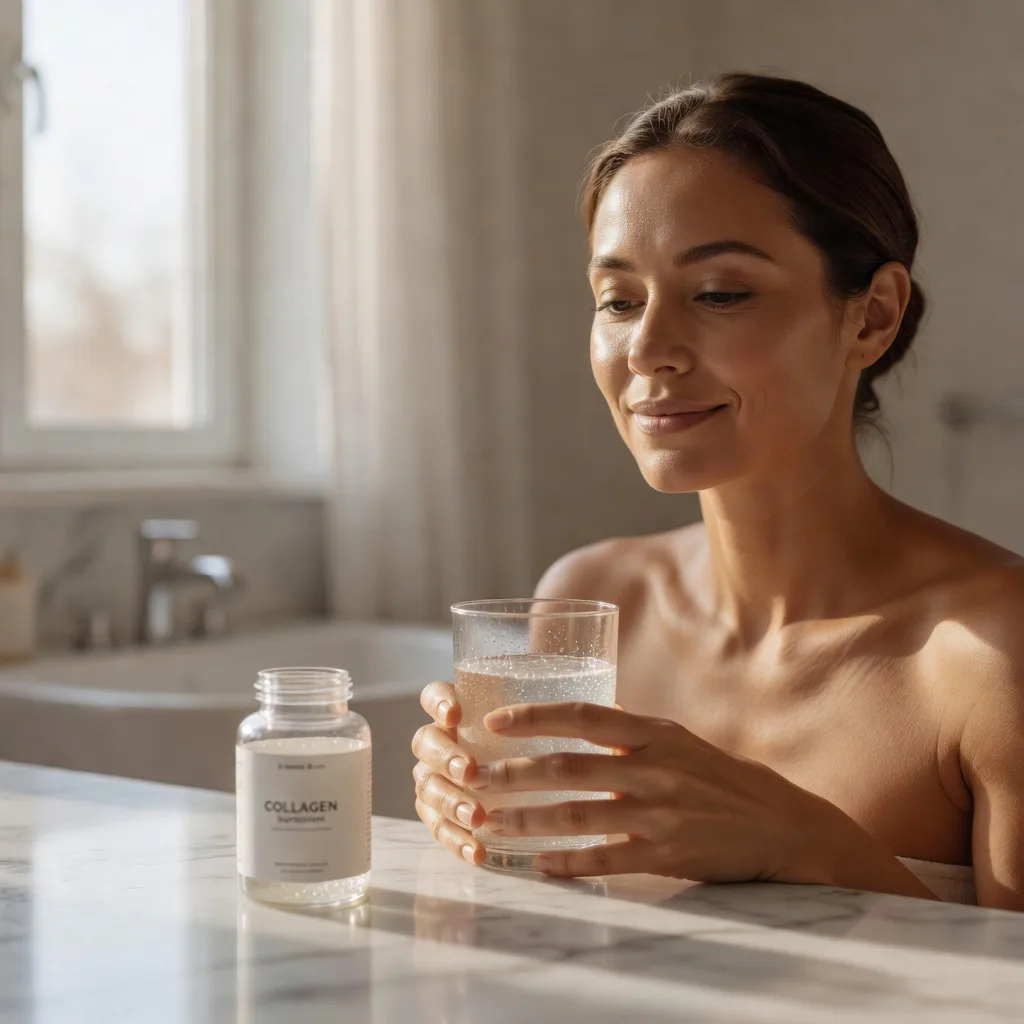
Does Drinking Collagen Help Your Skin?
Does drinking collagen help your skin, or is the newest research telling a different story than the marketing?
Part of our guide to skincare products. Start with: 10 Best Facial Serums for Aging Skin (2026): Picks by Concern
The most rigorous meta-analysis available, published in 2025 and covering 23 trials and 1,474 participants, found no significant effect on hydration, elasticity, or wrinkles once the analysis was restricted to high-quality, independently funded studies. Positive results in the broader literature cluster heavily in industry-funded trials.
No published study has ever compared a liquid collagen drink against a capsule or powder for any skin outcome, and absorption science gives no reason to expect one format to outperform another.
This guide walks through what the evidence actually shows, why funding source matters so much here, and what ingredients have stronger backing if hydration and visible aging are your real goal.
Recommended Hydrating Skincare With Stronger Evidence



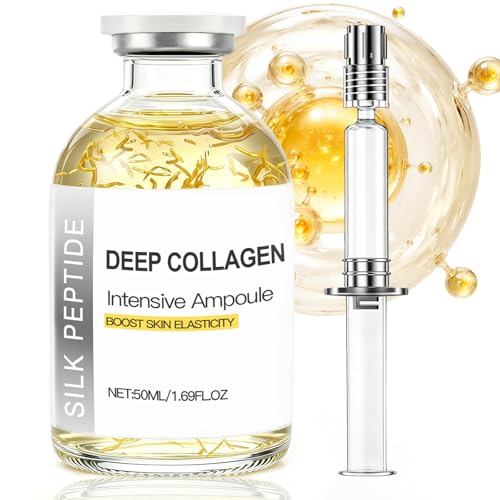

What You Need to Know
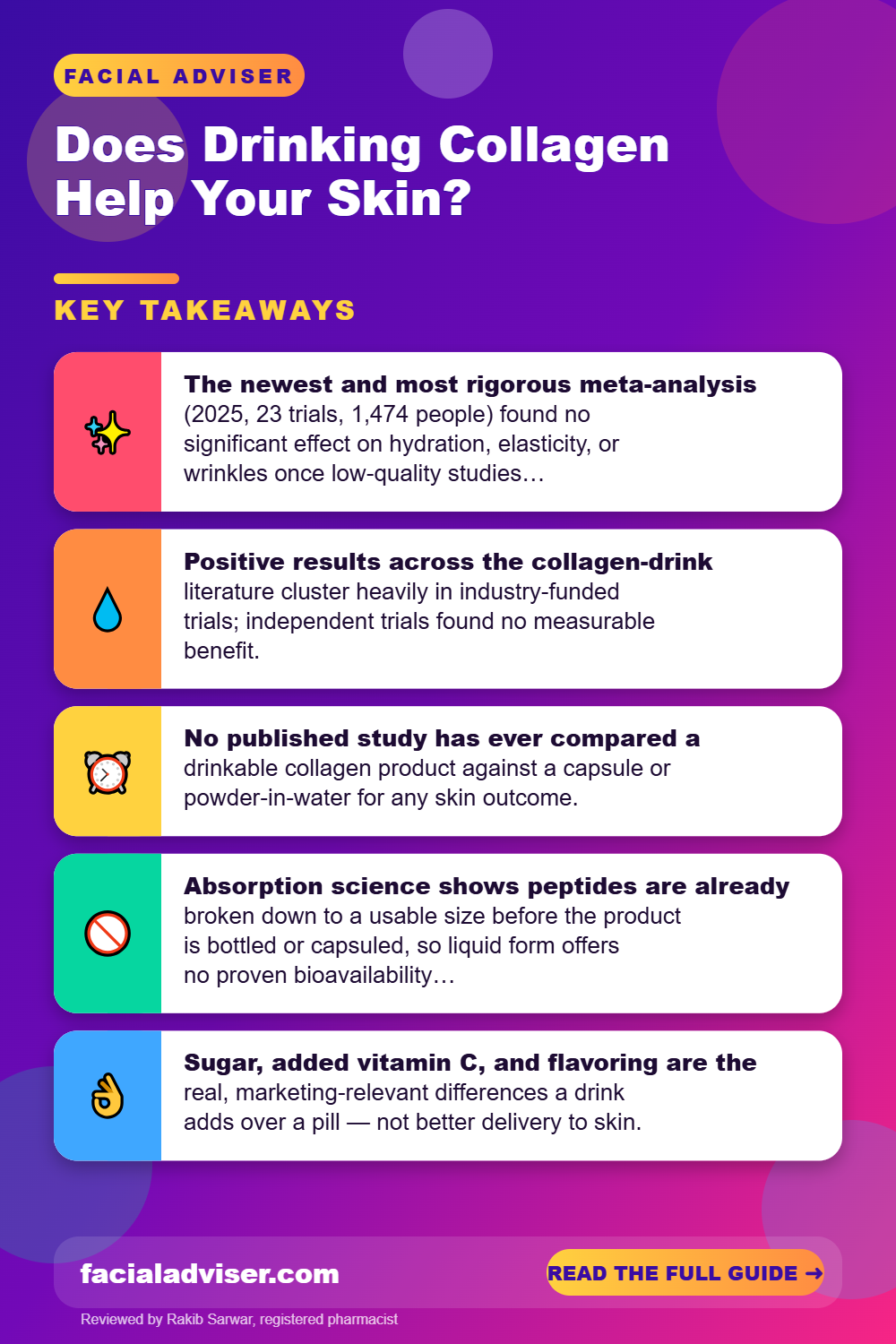
- The newest and most rigorous meta-analysis (2025, 23 trials, 1,474 people) found no significant effect on hydration, elasticity, or wrinkles once low-quality studies were excluded.
- Positive results across the collagen-drink literature cluster heavily in industry-funded trials; independent trials found no measurable benefit.
- No published study has ever compared a drinkable collagen product against a capsule or powder-in-water for any skin outcome.
- Absorption science shows peptides are already broken down to a usable size before the product is bottled or capsuled, so liquid form offers no proven bioavailability edge.
- Sugar, added vitamin C, and flavoring are the real, marketing-relevant differences a drink adds over a pill — not better delivery to skin.
Quick Navigation
- What “Drinking Collagen” Actually Means
- How Oral Collagen Is Supposed to Reach Your Skin
- The Early, More Optimistic Trials
- The 2025 Reanalysis That Changes the Picture
- Why Funding Source Matters Here
- Comparison: Drink vs. Capsule vs. Powder
- What the Absorption Data Actually Shows
- Collagen Format Comparison
- Do This, Not That
- Steps for Evaluating Any Collagen Product
- Ingredients With Stronger Skin Evidence
- Safety and Who Should Be Cautious
- When to Loop In a Dermatologist
- What This Article Can’t Tell You
- Frequently Asked Questions
What “Drinking Collagen” Actually Means
“Drinking collagen” refers to liquid collagen supplements — pre-mixed shots, powders dissolved into water or juice, or collagen-infused beverages — that contain hydrolyzed collagen peptides, the same broken-down protein fragments used in collagen capsules and powders. The collagen itself is almost always sourced from bovine hide, fish scale/skin, porcine, or occasionally chicken cartilage, then enzymatically hydrolyzed into short peptide chains small enough to survive digestion and enter the bloodstream. The marketing distinction is the delivery format; the biological material inside is functionally the same raw ingredient used across the entire oral-collagen category, whether it ends up in a capsule, a powder tub, or a bottled drink.
Shopping these picks?
Amazon Prime members get fast, free shipping on eligible items, plus Prime Video, Amazon Music and member deals. New members can start with a free trial.
Start a free Prime trialAged 18 to 24? Prime for Young Adults comes with a longer free trial and a lower price after it.
Affiliate link: we may earn a commission at no extra cost to you.
How Oral Collagen Is Supposed to Reach Your Skin
The proposed mechanism runs through digestion, absorption, and a signaling effect on skin cells. Hydrolyzed collagen peptides are broken down further by digestive enzymes, and some peptide fragments — particularly proline-hydroxyproline and glycine-proline-hydroxyproline sequences — are absorbed intact into the bloodstream rather than being fully reduced to individual amino acids. The theory, supported by some pharmacokinetic research, is that these specific peptide fragments act as signaling molecules that reach the dermis and stimulate fibroblasts to produce more of the body’s own collagen and hyaluronic acid, rather than the ingested collagen being directly incorporated into skin tissue. This is a real, published hypothesis, not an invented mechanism, but it explains a plausible pathway rather than proving the pathway produces a visible skin outcome in a bottle of any specific product.
The Early, More Optimistic Trials
A 2019 systematic review pooling 11 randomized, placebo-controlled trials and 805 participants found that collagen hydrolysate, taken at 2.5 to 10 grams per day for 8 to 24 weeks, helped with xerosis (dry skin), visible skin aging, and cellulite appearance, while collagen tripeptide at 3 grams per day for 4 to 12 weeks improved elasticity and hydration measurements. The review’s authors described the supplements as safe and concluded they increase skin elasticity, hydration, and dermal collagen density, while explicitly calling for more research on optimal dosing. A larger 2023 meta-analysis expanded on this, pooling 26 randomized controlled trials and 1,721 participants, and found statistically significant improvements in both hydration (p<0.00001) and elasticity (p<0.00001) compared with placebo. Dosages across the pooled trials varied enormously, from 0.6 grams to 12 grams per day, over periods of 2 to 12 weeks, and the collagen sources were a mix of fish, porcine, bovine, chicken, and several trials that didn’t report their source at all. The 2023 review’s own authors flagged bias risks across the included studies and called for larger, more consistent trials before treating the pooled effect as settled.
The 2025 Reanalysis That Changes the Picture
The most methodologically rigorous and most recent analysis on this question, published in the American Journal of Medicine in 2025, pooled 23 randomized controlled trials covering 1,474 participants and did something the earlier reviews hadn’t: it stratified the results by study quality and by funding source. When the analysis was restricted to high-quality studies only, there was no significant effect on hydration, elasticity, or wrinkles at all. Low-quality studies showed a significant improvement only in elasticity, and nowhere else. When the same trials were split by funding source, industry-funded trials reported positive effects across hydration, elasticity, and wrinkles, while independently funded trials showed no measurable benefit on any of those outcomes. The authors’ stated conclusion was direct: there is currently no clinical evidence to support the use of collagen supplements to prevent or treat skin aging. This is a genuinely different conclusion from the two earlier reviews, and it’s the newest, most methodologically careful analysis available on the exact question this article is answering.
Why Funding Source Matters Here
A companion piece published alongside the 2025 reanalysis specifically examined the relationship between commercial sponsorship and methodological quality in collagen trials, and industry groups publicly disputed the findings in trade coverage shortly after publication. That dispute is worth noting honestly — it shows the finding was contentious enough to draw a public response — but the underlying pattern it’s built on (positive results clustering in sponsor-funded, generally lower-quality trials, and largely disappearing in independent, higher-quality ones) is a well-established phenomenon across many areas of nutrition and supplement research, not something unique to collagen. A category with billions of dollars in annual sales riding on small, short trials is exactly the kind of research environment where funding-related bias is worth flagging directly to a reader rather than glossing over.
Comparison: Drink vs. Capsule vs. Powder
This is the specific question this article set out to answer, and the honest answer is that no published trial has ever compared a liquid collagen drink against a capsule or powder-in-water for any skin outcome. That’s a real gap in the literature, not an oversight in this research. Without a head-to-head trial, any claim that drinking collagen “absorbs faster” or “works better” than a capsule is not something the evidence currently supports one way or the other — it’s an assumption, and it should be labeled as one rather than repeated as fact.
What the Absorption Data Actually Shows
A 2024 randomized, double-blind crossover trial gave six healthy adults single 10-gram doses of hydrolyzed collagen dissolved in water and tracked the resulting plasma peptide levels over time. Peak plasma concentration of the tracked peptides occurred 100 to 130 minutes after ingestion, and 36 to 47 percent of the circulating hydroxyproline remained peptide-bound rather than being broken down all the way to free amino acids — evidence that at least some collagen peptides are absorbed intact via specific peptide transporters, supporting the signaling-molecule theory described earlier. The genuinely useful finding for this specific question is that collagen products of different average molecular weight produced highly comparable peptide and amino acid concentrations in the blood. In plain terms, the hydrolysis that determines how absorbable a collagen product is happens at the manufacturing stage, long before the product reaches a bottle, capsule, or powder tub. Whether the finished product you buy is liquid or solid doesn’t change that upstream processing step.
The one physically real difference between formats is trivial by comparison: a gelatin capsule takes roughly 30 to 45 minutes to disintegrate before its contents even reach solution in the stomach, versus a drink that’s already in solution the moment it’s swallowed. Set against a multi-hour absorption and circulation window, that head start doesn’t translate into a meaningfully different total amount of collagen peptide reaching the bloodstream by the end of the process.
Collagen Format Comparison
| Format | What’s actually different | What isn’t different |
|---|---|---|
| Liquid drink/shot | Immediate solution; often contains added sugar, flavoring, and vitamin C | Peptide molecular weight and absorbability — set during manufacturing, not by final format |
| Capsule | ~30-45 min disintegration time before dissolving | Total peptides reaching bloodstream over the full absorption window |
| Powder in water | User controls dose and can mix into food/drinks | Same underlying hydrolyzed collagen source as capsules or drinks from the same manufacturer |
Second Comparison: What the Trial Evidence Actually Supports by Product Type
| Product claim | Evidence level | Honest read |
|---|---|---|
| “Improves hydration and elasticity” | Mixed — positive in older pooled reviews, null in the newest high-quality-only analysis | Plausible in some studies, not confirmed once quality/funding are controlled for |
| “Reduces wrinkles” | Weakest of the three outcomes tested | No significant effect in high-quality trials |
| “Drinking it works better than pills” | No trials exist comparing formats | Unsupported claim, not evaluated by any published study |
Do This, Not That
Do
- Look for the actual grams of hydrolyzed collagen per serving, not just “contains collagen” on the label
- Pair any collagen supplement with daily sunscreen, since UV-driven collagen breakdown outweighs what any oral supplement can offset
- Treat a positive personal experience as anecdotal, since skin also naturally responds to increased water/vitamin intake alongside collagen drinks
Don’t
- Assume a drink absorbs “faster” or “better” than a capsule — no trial has tested that specific comparison
- Expect a measurable wrinkle change based on the highest-quality trial evidence available
- Ignore added sugar content in flavored collagen drinks marketed as a skin-health product
Steps for Evaluating Any Collagen Product
Check the peptide dose
Look for a specific gram amount (most trial doses ranged 2.5 to 12 grams daily) rather than a vague “collagen blend” listing.Identify the source
Marine (fish), bovine, or porcine collagen all appeared across the trials reviewed here; no source showed a clearly superior effect in the pooled data.Check added sugar and calories
Flavored drinks in particular can carry meaningful added sugar that a plain capsule or unflavored powder avoids.Set a realistic timeline
Trials that found any effect used at least 8 to 12 weeks of daily use; a single drink or a few days of use isn’t comparable to any tested protocol.Track objectively if possible
Standardized photos in consistent lighting, taken monthly, are more reliable than day-to-day subjective impressions of hydration or elasticity.
Ingredients With Stronger Skin Evidence
For readers specifically chasing hydration and visible skin-aging improvement, several topical ingredients have deeper, more consistent trial support than oral collagen currently does: topical retinoids have decades of randomized trial data behind them for fine lines and collagen-related skin changes, niacinamide has repeated double-blind evidence for barrier support and sebum regulation, and topical vitamin C has controlled trial data (albeit with real formulation and stability challenges) for antioxidant and mild brightening effects. None of these require betting on an oral supplement category whose best current evidence just concluded there’s no clinical support for treating skin aging.
Safety and Who Should Be Cautious
Hydrolyzed collagen supplements are generally described as safe across the reviewed trials, with mild gastrointestinal upset being the most commonly reported side effect. People with fish, shellfish, or specific animal-protein allergies should check the collagen source carefully, since marine and bovine/porcine collagen carry genuinely different allergen profiles. As with any dietary supplement in the United States, collagen drinks are not FDA-reviewed for efficacy before being sold, so label health claims reflect the manufacturer’s own marketing rather than independent regulatory verification.
When to Loop In a Dermatologist
A dermatologist visit is worth considering if you’re pursuing collagen supplementation specifically to address visible skin laxity, deep wrinkles, or aging concerns, since a professional can point you toward treatments with a stronger independent evidence base — topical retinoids, in-office resurfacing, or other options matched to your specific skin type and goals — rather than relying on a supplement category whose newest, most rigorous analysis found no clinical benefit once study quality and funding bias were accounted for. This is also worth raising if you have any known food allergies relevant to the collagen’s animal source, or if you’re taking other supplements and want to check for redundancy or interaction.
What This Article Can’t Tell You
Frequently Asked Questions
Does drinking collagen actually help your skin?
The most rigorous and recent meta-analysis (2025, 23 trials, 1,474 participants) found no significant effect on hydration, elasticity, or wrinkles once the analysis was restricted to high-quality studies, and noted that positive results clustered in industry-funded trials. Earlier, less-stratified reviews found modest pooled benefits, so the honest answer depends heavily on which quality tier of evidence you weigh most.
Is drinking collagen better absorbed than taking a pill?
No published trial has compared the two formats directly. Absorption research shows the molecular weight and breakdown of the collagen peptides is set during manufacturing, not by whether the final product is liquid or solid, so there’s no established mechanism for a liquid to absorb meaningfully better.
How long does it take to see results from drinking collagen?
Trials that reported any measurable effect used consistent daily dosing for at least 8 to 12 weeks. Shorter use isn’t comparable to any protocol that’s actually been studied.
What’s the difference between marine and bovine collagen drinks?
Both appeared across the pooled trials reviewed here with no clear superiority shown for either source in skin outcomes. The practical differences are allergen profile (fish vs. mammalian) and, for some people, dietary or religious preference.
Can collagen drinks cause side effects?
Mild gastrointestinal upset is the most commonly reported side effect across trials. People with fish or specific meat allergies should check the collagen source before use.
Are collagen supplements regulated by the FDA?
As dietary supplements, they are not reviewed by the FDA for efficacy before being sold, unlike prescription drugs. Manufacturer claims on packaging reflect marketing, not independent verification.
Why do some studies show collagen works and others don’t?
The newest, most rigorous 2025 analysis found the positive effect was concentrated in lower-quality and industry-funded trials, and disappeared when the analysis was restricted to high-quality, independently funded studies.
Does the added sugar in flavored collagen drinks matter?
It can, both for general diet quality and because there’s no evidence the sugar contributes any skin benefit — it’s a formulation and flavor choice, not a functional ingredient tied to the collagen’s proposed mechanism.
What skin ingredients have stronger evidence than oral collagen?
Topical retinoids, niacinamide, and topical vitamin C all have deeper and more consistent randomized trial support for hydration, barrier support, and visible skin-aging outcomes than the current oral-collagen literature provides.
Should I stop taking collagen drinks based on this research?
That’s a personal decision. The evidence doesn’t show harm from moderate use, only that the newest, most rigorous analysis found no clinical benefit for skin aging once study quality and funding were controlled for. If you’ve noticed a genuine personal benefit, that’s not disproven by population-level trial data, but it’s also not confirmed by it.

Written by
Registered pharmacist and founder of Facial Adviser. Rakib's pharmacy training covers how skincare actives work and interact; a later course in cosmetology turned that into a focus on facial treatments and skincare products. He plans, researches and edits every guide on the site and checks health claims against sources such as the American Academy of Dermatology, the FDA and the NIH. He is not a dermatologist; see the Editorial Policy and Medical Disclaimer.
About · Editorial policy · How we choose products · Medical disclaimer · Contact
Keep reading: Serums and actives
- At What Age Should You Start Using Anti-Aging Serum? A Decade-by-Decade Guide
- 10 Best Serums for Mature Skin to Reduce Wrinkles (2026): Top Picks
- 10 Best Facial Serums for Aging Skin (2026): Picks by Concern
- Skinimalism Guide: How to Build a Simple Minimal Skincare Routine
- Snow Mushroom Benefits for Glowing Skin: Tremella vs Hyaluronic Acid
- 10 Best Face Masks for Every Skin Type (2026): Clay, Gel and Sheet
- What Does a Facial Toner Do? The Real Answer