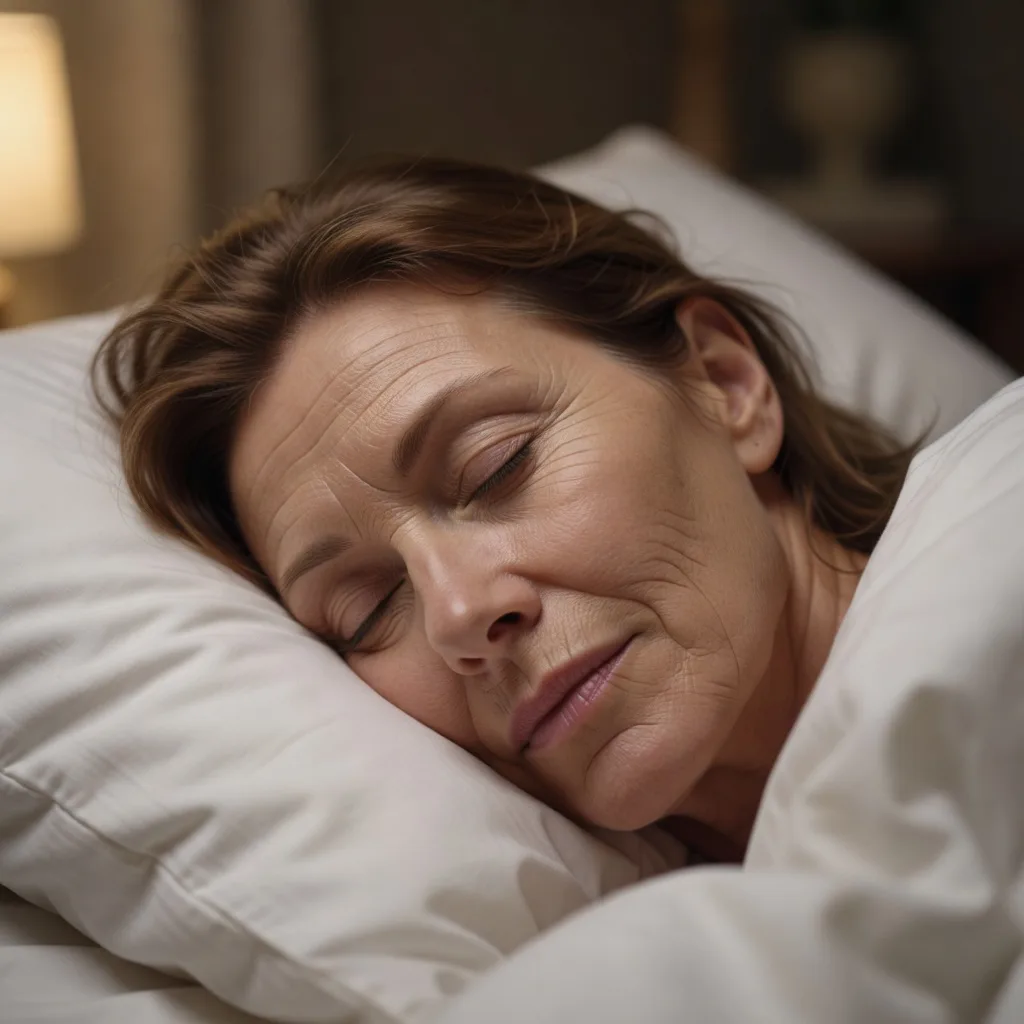
Can Your Sleep Position Cause Wrinkles? What the Research Shows
You wake up with a crease running from the corner of your eye down your cheek, or a diagonal line across your forehead that was not there last night. By lunchtime it has gone. Years later, some of those lines stop leaving.
Part of our guide to lifestyle and skin. Start with: How Diet Impacts the Skin Microbiome: What the Science Actually Shows
Yes, sleep position can contribute to wrinkles. When you sleep on your side or stomach, your face is compressed and pulled against the pillow for hours, creating creases that are separate from the lines caused by facial expressions. In younger skin these marks fade within hours, but as skin loses elasticity with age, repeated creasing in the same spots can become permanent. Back sleeping avoids most of this compression.
This is not just a beauty-industry theory. A 2016 review in the Aesthetic Surgery Journal described sleep wrinkles as a distinct type of facial line, driven by mechanical forces rather than muscle movement, and noted that they tend to run in different directions from expression lines.
That said, sleep position is one factor among many. Sun exposure, genetics, smoking and simple ageing play much bigger roles in how your face changes over time, and very few people can control their sleeping position all night.
Here we explain how sleep lines form, how to tell them from other wrinkles, which positions matter, what pillows and pillowcases can and cannot do, and where your effort is best spent if you want smoother skin in the long run.
Shopping these picks?
Amazon Prime members get fast, free shipping on eligible items, plus Prime Video, Amazon Music and member deals. New members can start with a free trial.
Start a free Prime trialAged 18 to 24? Prime for Young Adults comes with a longer free trial and a lower price after it.
Affiliate link: we may earn a commission at no extra cost to you.
Recommended Products to Help Reduce Sleep Creases
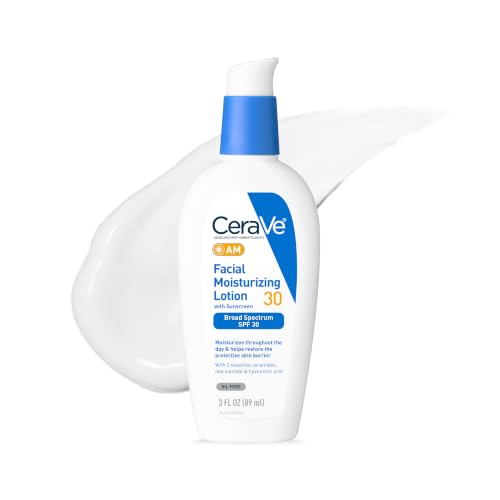
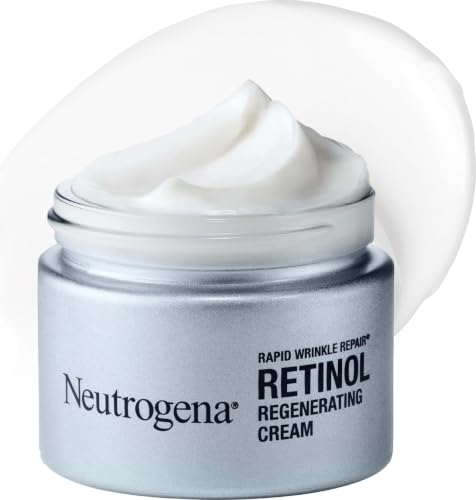


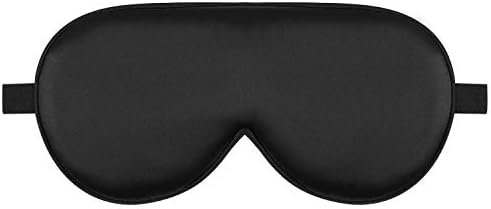
In Brief
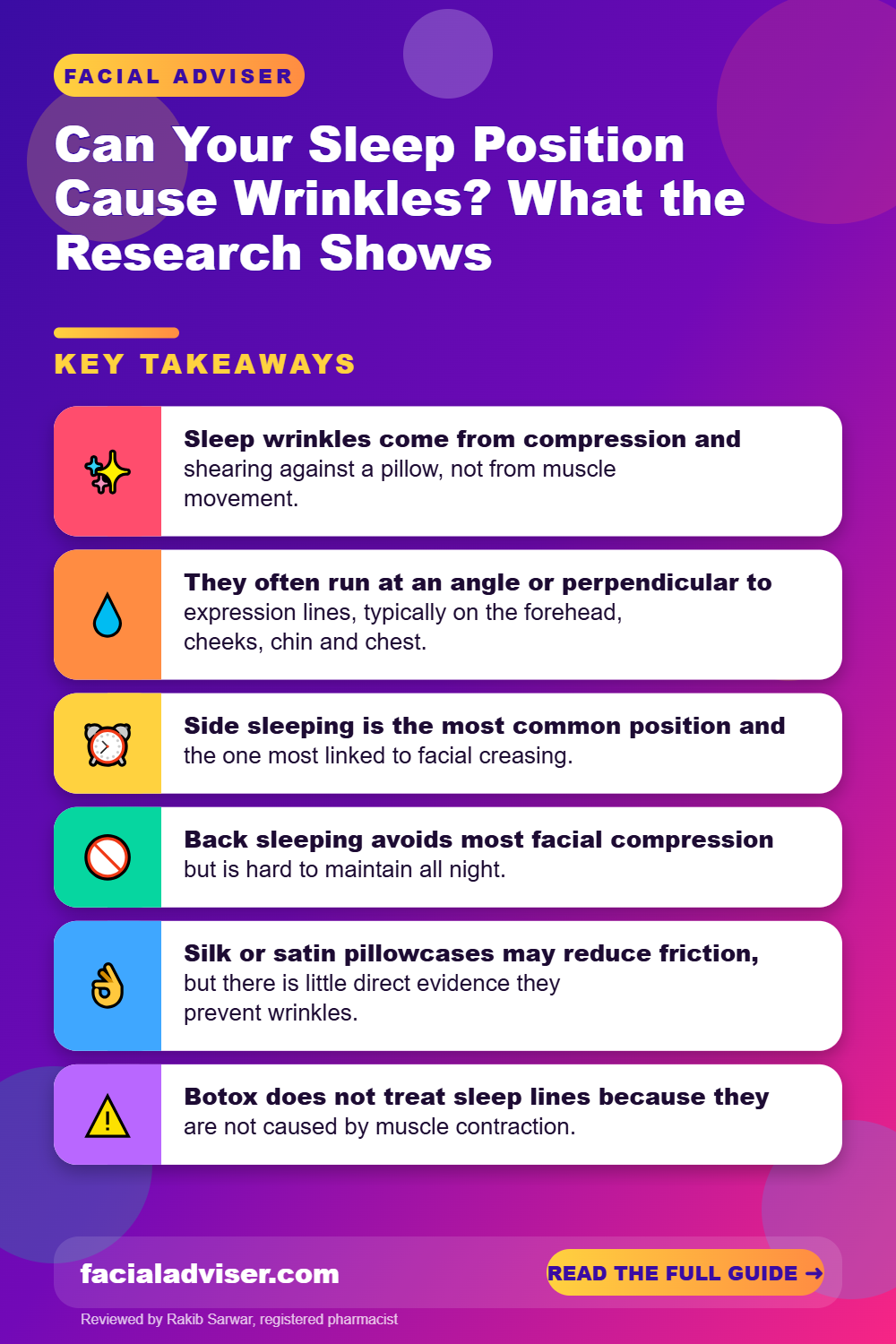
- Sleep wrinkles come from compression and shearing against a pillow, not from muscle movement.
- They often run at an angle or perpendicular to expression lines, typically on the forehead, cheeks, chin and chest.
- Side sleeping is the most common position and the one most linked to facial creasing.
- Back sleeping avoids most facial compression but is hard to maintain all night.
- Silk or satin pillowcases may reduce friction, but there is little direct evidence they prevent wrinkles.
- Botox does not treat sleep lines because they are not caused by muscle contraction.
- Daily sunscreen and a retinoid do more for overall wrinkling than any pillow.
Contents
- How Sleep Wrinkles Form
- A Morning Mirror Check
- Sleep Positions Compared
- How to Reduce Sleep Wrinkles
- Silk Pillowcases and Anti-Wrinkle Pillows: Honest Expectations
- Dos and Don’ts
- Where Sleep Fits in the Bigger Picture
- Honest Limits
- Treating Lines That Have Already Set In
- When to Talk to a Doctor
- Your Questions, Answered
- The Bottom Line
How Sleep Wrinkles Form
Expression lines form when muscles contract repeatedly in the same direction, folding the skin along predictable paths such as crow’s feet, frown lines and forehead lines. Sleep lines are different. They form when the face is pressed against a surface and the skin is squashed, folded and dragged in directions it does not usually move.
In the review by Anson and colleagues, the authors explained that sleep lines result from compression and shear forces and noted that people spend a large share of the night on their side (Anson et al., 2016). The accompanying press release from The Aesthetic Society summarised the finding that side sleeping accounted for about 65% of sleep time, back sleeping about 30% and stomach sleeping about 5% (The Aesthetic Society).
Young skin is springy, thanks to plenty of collagen and elastin, so it bounces back quickly. With age and sun damage, that recoil weakens. A crease that once vanished in 20 minutes might take hours, and eventually a faint line remains. Repetition matters: the same cheek on the same pillow in the same fold, night after night, for years.
| Feature | Sleep lines | Expression lines |
|---|---|---|
| Cause | Pressure and friction against a pillow | Repeated muscle movement |
| Direction | Often diagonal or vertical, across natural folds | Follow the pull of underlying muscles |
| Common spots | Forehead edge, cheek, chin, upper lip, chest | Forehead, between brows, around eyes and mouth |
| Side of face | Usually worse on your preferred sleeping side | Usually symmetrical |
| Responds to Botox | No | Often, for dynamic lines |
| Early stage | Visible in the morning, fades during the day | Visible when you move your face |
A Morning Mirror Check
You can get a fair idea of whether sleep is contributing to your lines with a few observations over a week.
- Look at your face as soon as you wake up, before washing. Note any creases and which side they are on.
- Check again two hours later and again at midday. Lines that fade are sleep creases that have not yet set in.
- Compare both sides of your face in good light. A deeper line on one cheek or one side of the forehead often matches your favourite sleeping side.
- Relax your face completely and look for vertical lines on the side of the forehead or diagonal lines across the cheek that do not match any expression you make.
- Check your chest. Vertical lines between the breasts are a classic sign of side sleeping.
If most of your lines are symmetrical and appear when you frown, squint or smile, they are expression lines and sleep position is a minor factor.
Sleep Positions Compared
| Position | Facial compression | Other considerations |
|---|---|---|
| Back | Minimal | Can worsen snoring and sleep apnoea for some people; ideal for faces |
| Side | High on one cheek and temple | Most common and often comfortable; can crease face and chest |
| Stomach | High, often on the forehead and both cheeks | Also strains the neck; tends to cause the most facial distortion |
| Switching sides | Moderate, spread across both sides | May reduce deep creasing on one side |
Back sleeping is the gold standard for your face, but it is not right for everyone. If you snore heavily or have been told you stop breathing in your sleep, sleeping on your back may make that worse, and your breathing matters far more than a crease.
How to Reduce Sleep Wrinkles
Start the night on your back
Use a supportive pillow that keeps your head and neck aligned. Even a few extra hours on your back reduces total compression.
Prop yourself if you drift
Place a pillow on each side of your body, or use a wedge, to make rolling onto your face less comfortable.
Choose a smooth pillowcase
Silk or satin creates less drag on the skin than rough cotton, which may reduce creasing.
Keep the face off the pillow edge
If you side sleep, rest your cheek on the pillow rather than pressing into it, and avoid tucking your hand or arm under your face.
Protect skin during the day
Wear broad-spectrum sunscreen every morning, since sun damage is the main reason skin loses its bounce.
Support skin repair at night
Use a retinoid in your evening routine, introduced slowly, to support collagen over time.
If you cannot stay on your back, try alternating sides from night to night. Spreading the pressure may be kinder than always creasing the same cheek.
Silk Pillowcases and Anti-Wrinkle Pillows: Honest Expectations
Silk and satin pillowcases are often marketed as anti-ageing products. The reasoning is that a smoother surface means less friction and less tugging on the skin. That makes sense, but there is very little direct research showing that silk pillowcases prevent wrinkles. Think of them as a comfortable, low-risk option that may help a little rather than a treatment.
Specially shaped ‘anti-wrinkle’ pillows aim to support the head while leaving the face free, or to make back sleeping easier. Again, the evidence is mostly theoretical and anecdotal. They can be worth trying if you are keen to change position, but no pillow stops ageing.
A pillow that keeps your neck poorly aligned can cause stiffness and headaches. Comfort and spinal support come first.
Dos and Don’ts
Good Habits
- Try starting each night on your back
- Use a clean, smooth pillowcase and change it weekly
- Wear sunscreen daily, including on the chest
- Use a retinoid or other proven anti-ageing ingredient
- Talk to a doctor if back sleeping worsens snoring
Common Mistakes
- Sleep face-down into the pillow
- Rest your face on your hand or forearm all night
- Expect a pillowcase alone to erase lines
- Assume Botox will fix sleep creases
- Sacrifice good sleep for a wrinkle-free position
Where Sleep Fits in the Bigger Picture
It is easy to fixate on sleep lines because you can see them forming. But the factors with the strongest evidence for visible ageing are ultraviolet exposure, smoking and genetics. The American Academy of Dermatology notes that the sun’s ultraviolet light speeds up skin ageing and recommends daily sunscreen as one of the most effective ways to prevent early wrinkles (AAD).
That means someone who sleeps on their side but protects their skin from the sun is likely to fare better than a devoted back sleeper who never wears sunscreen. Sleep position is a fine-tuning step, not the foundation.
Getting enough good-quality sleep also matters for how your face looks, largely through puffiness, dark circles and dullness after short nights. Chasing a perfect position at the cost of broken sleep is not a good trade.
If you are just starting with a retinoid, our guide on how to transition to retinol smoothly covers how to build up without irritation.
Honest Limits
Much of what is written about sleep wrinkles relies on clinical observation, expert opinion and small studies rather than large, long-term trials. We know compression creases the face and that creases can become permanent with time, but nobody has measured exactly how much of a person’s wrinkling comes from sleep versus everything else.
Also, you cannot fully control your position. Most people shift many times a night, and training yourself to stay on your back can take weeks and may never fully work. That is normal, and it is fine.
Do not tape your face, wear tight straps or use devices that restrict breathing to stay in one position. Safe, restful sleep is more important than preventing creases.
Treating Lines That Have Already Set In
Once a sleep line has become permanent, changing position will stop it deepening but will not erase it. Options a dermatologist might discuss include prescription retinoids, chemical peels, laser resurfacing, microneedling and hyaluronic acid fillers. Because sleep lines are not caused by muscle action, neurotoxin injections such as Botox are generally not effective for them.
Results vary with skin type, age and how deep the line is, so a consultation is the best way to find out what is realistic.
When to Talk to a Doctor
Wrinkles are not a medical problem, but a few situations deserve a professional opinion:
- You snore loudly, gasp at night or feel exhausted despite a full night’s sleep, which can point to sleep apnoea
- Neck or shoulder pain from trying to change your sleeping position
- Skin changes that are not wrinkles, such as a new or changing spot, a sore that does not heal, or rough scaly patches on sun-exposed skin
- Considering cosmetic procedures, which should be done by a qualified, board-certified practitioner
This article is for general information and is not a substitute for professional medical or dermatological advice. Speak to a doctor or dermatologist about concerns specific to your skin or sleep.
Your Questions, Answered
Does sleeping on your side really cause wrinkles?
It can contribute. Repeated compression on one side of the face creates creases that may become permanent as skin loses elasticity.
What is the best sleeping position for your skin?
Back sleeping puts the least pressure on your face. If that is not comfortable or worsens snoring, alternating sides is a reasonable compromise.
Do silk pillowcases prevent wrinkles?
They reduce friction and may help a little, but there is little direct evidence that they prevent wrinkles.
Why is one side of my face more wrinkled?
If you usually sleep on that side, compression is a likely factor. Sun exposure on one side, such as while driving, can also play a part.
Can sleep wrinkles go away?
Early creases fade within hours. Once they become permanent, they need treatments such as retinoids, resurfacing or fillers to soften.
Does Botox help sleep lines?
Generally no, because sleep lines are not caused by muscle movement.
At what age do sleep lines become permanent?
It varies. Many people notice lingering creases from their mid-30s onward, but sun damage and genetics change the timing.
Can sleep position cause chest wrinkles?
Yes. Side sleeping can cause vertical lines on the chest, sometimes called decollete wrinkles.
How can I train myself to sleep on my back?
Start the night on your back with a supportive pillow and place pillows at your sides. It can take several weeks to become a habit.
Is it worth buying an anti-wrinkle pillow?
It may help some people stay off their face, but evidence is limited. Try simpler changes first.
The Bottom Line
Sleep position does matter for wrinkles, just not as much as the sun, your genes or smoking. Side and stomach sleeping press and drag the face for hours, and as skin ages those morning creases can become lines that stay. Starting the night on your back, using a smooth pillowcase and not pressing your face into the pillow are easy ways to reduce that.
Keep perspective, though. Daily sunscreen and a well-chosen retinoid will do more for your skin than any pillow, and good, safe sleep is worth far more than a crease-free cheek. If you have lines that have already set, a dermatologist can tell you which treatments are realistic.

Written by
Registered pharmacist and founder of Facial Adviser. Rakib's pharmacy training covers how skincare actives work and interact; a later course in cosmetology turned that into a focus on facial treatments and skincare products. He plans, researches and edits every guide on the site and checks health claims against sources such as the American Academy of Dermatology, the FDA and the NIH. He is not a dermatologist; see the Editorial Policy and Medical Disclaimer.
About · Editorial policy · How we choose products · Medical disclaimer · Contact
Keep reading: Diet, sleep, stress and skin
- How Diet Impacts the Skin Microbiome: What the Science Actually Shows
- Thyroid Disorders and Facial Puffiness: Signs, Causes and Next Steps
- What Dehydration Does to Your Skin, Layer by Layer
- How Smoking Affects the Tiny Blood Vessels in Your Face
- Does Air Pollution Age Your Face? What Studies Show
- Can Your Mouth Affect Your Face? Oral Health and Facial Inflammation