How Do You Know If Makeup Is Fake? 8 Signs of Counterfeit Cosmetics
A favorite palette at half the usual price, a lipstick from an unfamiliar online seller, a bundle of high-end brushes that seems too good to pass up. Counterfeit makeup is widespread, and fakes are getting harder to spot at first glance.
Part of our guide to makeup how-to. Start with: How to Properly Put On Face Makeup: The Right Order, Step by Step
The most reliable signs that makeup is fake are where it came from and what it cost: unauthorized sellers and prices far below normal are the biggest red flags. After that, packaging details, batch codes, and the product’s smell, color, and texture can confirm your suspicions.
This is not just about getting what you paid for. According to the Personal Care Products Council, which cites reports from the US Department of Homeland Security, the FBI, and the OECD, counterfeit cosmetics have been found to contain arsenic, beryllium, cadmium, high levels of aluminum and mercury, and dangerous levels of bacteria. They are made without safety oversight and have been linked to allergic reactions, skin irritation, chemical burns, and eye infections.
If you suspect a product is fake, stop using it. Especially avoid putting it near your eyes, lips, or broken skin. Contact the seller or platform, and report it to the brand, which often tracks counterfeits.
This guide covers a step-by-step authenticity check, the most common signs of fakes, how to shop more safely online, and what to do if your skin reacts to a product you think may be counterfeit.
Shopping these picks?
Amazon Prime members get fast, free shipping on eligible items, plus Prime Video, Amazon Music and member deals. New members can start with a free trial.
Start a free Prime trialAged 18 to 24? Prime for Young Adults comes with a longer free trial and a lower price after it.
Affiliate link: we may earn a commission at no extra cost to you.
Recommended Drugstore Makeup Staples



In Brief
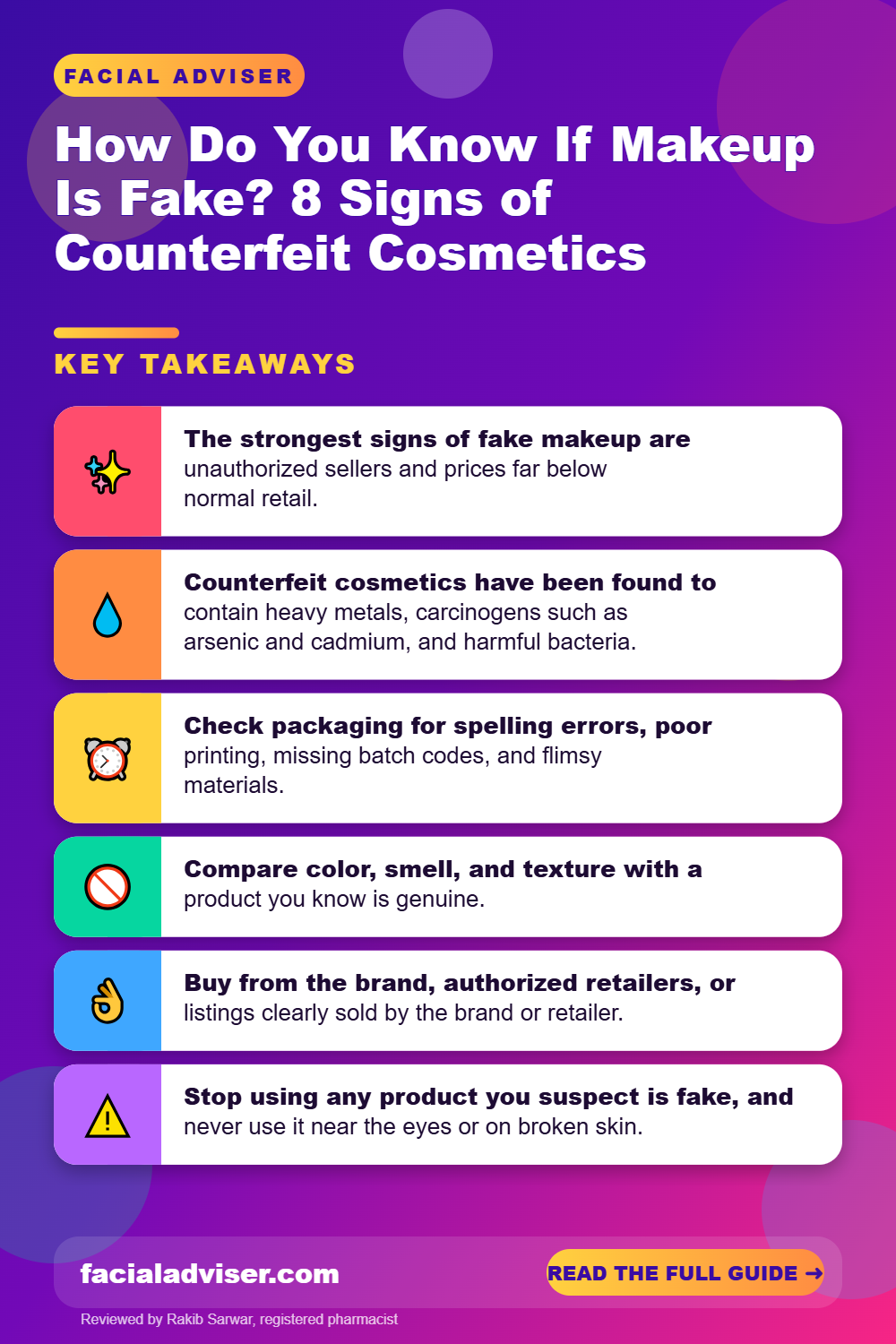
- The strongest signs of fake makeup are unauthorized sellers and prices far below normal retail.
- Counterfeit cosmetics have been found to contain heavy metals, carcinogens such as arsenic and cadmium, and harmful bacteria.
- Check packaging for spelling errors, poor printing, missing batch codes, and flimsy materials.
- Compare color, smell, and texture with a product you know is genuine.
- Buy from the brand, authorized retailers, or listings clearly sold by the brand or retailer.
- Stop using any product you suspect is fake, and never use it near the eyes or on broken skin.
- Skin reactions such as burning, swelling, or blisters after using makeup need medical attention.
Jump to a Section
- Why Fake Makeup Is a Real Risk
- A Step-by-Step Authenticity Check
- Common Signs of Counterfeit Makeup
- How to Shop Safely Online
- Products That Are Most Often Faked
- Gift Sets, Samples, and Travel Sizes
- Take Extra Care With Eye and Lip Products
- Fake vs Expired vs Contaminated
- What to Do If You Think Your Makeup Is Fake
- What You Cannot Tell at Home
- When to See a Doctor
- FAQ
- Final Word
Why Fake Makeup Is a Real Risk
Genuine cosmetics are made under manufacturing standards and must meet safety rules for ingredients, labeling, and contamination. Counterfeit makers skip all of that. They may use cheap or unapproved pigments, industrial ingredients, contaminated water, or unsanitary facilities.
Investigators have found counterfeit products containing heavy metals and carcinogenic substances, as well as bacteria at levels that can cause infections. Eye products are a particular concern, since contaminated mascara or eyeliner can lead to eye infections.
Fakes also tend to perform badly. Even if a counterfeit looks right in the package, it may apply patchily, change color, cause breakouts, or wear off quickly.
There is a financial cost too. The Personal Care Products Council estimates the cosmetics industry loses billions of dollars each year to counterfeit sales, and buyers lose out when products do not work, cannot be returned, or have to be thrown away. Legitimate brands also invest heavily in safety testing, which counterfeit makers simply skip.
A Step-by-Step Authenticity Check
Work through these steps whenever something about a product feels off.
Check where you bought it
Was it from the brand’s own store or website, a well-known retailer, or a listing clearly sold by the brand or an authorized retailer? If not, treat it with caution.
Compare the price
Look up the usual retail price. A deep discount on a popular or luxury item, especially from an unfamiliar seller, is a warning sign.
Inspect the packaging
Compare it with photos on the brand’s official website. Look for differences in fonts, logos, colors, spacing, spelling, and the quality of the box and plastic.
Find the batch code
Most genuine products have a batch or lot code printed or embossed on the product and the box, and they usually match. Missing, smudged, or mismatched codes are red flags.
Test the product itself
Check the smell, color, and texture against a product you know is genuine, or against a store tester. Strange smells, gritty texture, or unusual colors suggest a fake.
If you are unsure, contact the brand’s customer service with photos and the batch code. Many brands will confirm whether a product is genuine.
Common Signs of Counterfeit Makeup
| What to check | Genuine product | Possible fake |
|---|---|---|
| Price | Close to normal retail or a reasonable sale | Far below retail, especially for luxury brands |
| Seller | Brand store or authorized retailer | Unknown seller, marketplace listing with vague details |
| Packaging | Crisp printing, sturdy materials, correct fonts | Blurry print, misspellings, flimsy or wrong materials |
| Batch code | Present and usually matches box | Missing, smudged, or does not match |
| Seal | Intact safety seal where expected | Missing or loosely resealed |
| Smell | Familiar, consistent | Chemical, sour, or unusual odor |
| Texture and color | Smooth, true to shade | Gritty, chalky, greasy, or off-color |
One sign alone does not prove a product is fake, since brands occasionally update packaging. Several signs together are more telling.
How to Shop Safely Online
Online marketplaces are where most counterfeit cosmetics are sold, but you can reduce the risk.
Good Habits
- Buy from the brand’s official store or site.
- Check the sold by and ships from details on marketplace listings.
- Read recent reviews for mentions of fakes, strange smells, or reactions.
- Compare the listing photos with the brand’s official images.
- Keep receipts and order details in case you need to report a problem.
Common Mistakes
- Buy from sellers with no history or very few reviews.
- Trust listings with stock photos only and no details.
- Buy popular luxury makeup at a fraction of the usual price.
- Buy from social media ads that link to unfamiliar sites.
- Assume a sealed box means the product is genuine.
Discount stores and resellers are not always a problem. Legitimate overstock does exist. The concern is when price, seller, and packaging all look wrong together.
When shopping on a large marketplace, look for a brand storefront or a listing where the brand or a major retailer is the seller. Be wary of listings where the product page is genuine but many different third-party sellers offer it at very different prices.
Products That Are Most Often Faked
Counterfeiters focus on items that are popular, recognizable, and expensive enough to be worth copying. Some categories come up again and again.
- Eyeshadow palettes from well-known brands, especially limited editions and collaborations.
- Lip kits and liquid lipsticks, which are easy to fill and package cheaply.
- Foundations and concealers in popular shades, where color mismatches can be a giveaway.
- Mascara and eyeliner, which carry a higher infection risk if contaminated.
- Makeup brushes and sponges, where counterfeits may shed, smell, or fall apart quickly.
- Fragrance and skincare sets, often sold as gift bundles.
Limited editions and sold-out items deserve extra caution. When a product is hard to find through official channels, fakes often fill the gap on marketplaces and social media.
Gift Sets, Samples, and Travel Sizes
Deluxe samples and mini sizes are sometimes resold legitimately, but they are also an easy way to pass off counterfeits, because buyers expect simpler packaging and may not have a full-size product to compare with.
Be careful with sample lots sold in bulk, travel sizes that were never sold by the brand, and gift sets that do not appear on the brand’s website. Check that the brand actually made that size or set, and look for the same batch codes and printing quality you would expect on full-size products.
If you receive makeup as a gift and are unsure where it came from, you can still check the packaging and batch code, and contact the brand if something looks off. It is better to ask than to use a product near your eyes that you have doubts about.
Take Extra Care With Eye and Lip Products
Eye and lip products are applied to sensitive areas where contamination and harsh ingredients cause the most trouble. The skin around the eyes is thin, and bacteria in mascara or eyeliner can cause infections.
If you have any doubt about the authenticity of an eye product, it is safer not to use it. Our guide to makeup after pink eye explains why eye products need careful hygiene even when they are genuine.
Stop immediately if an eye product causes burning, stinging, redness, discharge, or blurred vision, and see a doctor if symptoms do not settle quickly.
Fake vs Expired vs Contaminated
Not every product that seems wrong is a counterfeit. Genuine makeup can also go bad.
- Expired makeup may separate, smell different, or change texture. Look for the open jar symbol with a number, such as 12M, which shows how many months the product is meant to last after opening.
- Contaminated makeup can grow bacteria from dirty tools or fingers. A 2019 Aston University study found that about nine in ten used makeup products carried potentially harmful bacteria.
- Counterfeit makeup was never genuine and may be unsafe from the start.
Keeping tools clean helps genuine products stay safer. Our guide on using and cleaning makeup sponges covers the basics.
What to Do If You Think Your Makeup Is Fake
If you suspect a counterfeit:
- Stop using the product.
- Take photos of the product, packaging, and batch code.
- Contact the seller or marketplace and request a refund.
- Report it to the brand, which may investigate.
- In the US, you can report counterfeit goods to the National Intellectual Property Rights Coordination Center, and report skin reactions to the FDA through MedWatch.
Keep the product until the issue is resolved, but store it out of reach of children and do not give it away.
What You Cannot Tell at Home
No home check can prove a product is safe. Heavy metals and bacteria cannot be seen or smelled, and some counterfeits look nearly identical to the real thing.
| Belief | Reality |
|---|---|
| If it looks right, it is safe | Harmful contaminants are invisible |
| Fakes only affect luxury brands | Drugstore brands are also counterfeited |
| Sealed means genuine | Counterfeits can be sealed too |
| A patch test proves safety | It can catch some reactions but not contaminants |
| Bad reviews always reveal fakes | Some fake listings have many reviews |
Buying from trusted sources is the only reliable way to reduce the risk.
When to See a Doctor
Seek medical care if, after using a product, you notice:
- Burning, blistering, or peeling skin.
- Swelling of the face, eyelids, or lips.
- A rash that spreads or does not settle after stopping the product.
- Eye pain, discharge, redness, or blurred vision.
- Painful or pus-filled bumps where you applied makeup.
- Difficulty breathing or throat tightness, which needs emergency care.
Medical disclaimer: This article is for general information and is not a substitute for professional medical advice. Seek medical care for skin or eye reactions to cosmetics.
FAQ
How can I tell if my makeup is fake?
Check the seller, price, packaging, batch code, and the product’s smell, color, and texture against a genuine version.
Is fake makeup dangerous?
It can be. Counterfeits have been found to contain heavy metals, carcinogens, and harmful bacteria.
What should I do if I bought fake makeup?
Stop using it, document it, ask the seller for a refund, and report it to the brand or platform.
Is makeup sold on marketplaces fake?
Not necessarily. Check the sold by details and buy from the brand or authorized sellers when possible.
Do fake makeup products have batch codes?
Some do, but they may be missing, smudged, or not match the box. Brands can often verify codes.
Can fake makeup cause acne?
It can cause breakouts, irritation, and infections due to poor ingredients and contamination.
Are drugstore brands counterfeited?
Yes. Counterfeiters target popular products at every price point.
Does a sealed package mean it is genuine?
No. Counterfeits can be shrink-wrapped and sealed.
How do I report counterfeit makeup?
Report to the seller, the brand, and in the US the National IPR Center. Report reactions to the FDA.
Can I tell if makeup is fake by smell?
A strange or chemical smell is a warning sign, but some fakes smell normal.
Final Word
The clearest signs that makeup is fake are an unfamiliar or unauthorized seller and a price far below normal. Packaging details, batch codes, and the product’s smell, color, and texture can help confirm it, but no home check can rule out invisible contaminants.
Buy from brands and authorized retailers, stop using anything that seems off, and be especially careful with eye and lip products. If a product causes burning, swelling, or eye symptoms, stop using it and seek medical care.

Written by
Registered pharmacist and founder of Facial Adviser. Rakib's pharmacy training covers how skincare actives work and interact; a later course in cosmetology turned that into a focus on facial treatments and skincare products. He plans, researches and edits every guide on the site and checks health claims against sources such as the American Academy of Dermatology, the FDA and the NIH. He is not a dermatologist; see the Editorial Policy and Medical Disclaimer.
About · Editorial policy · How we choose products · Medical disclaimer · Contact
Keep reading: Makeup basics and skin
- How to Properly Put On Face Makeup: The Right Order, Step by Step
- Where Do Makeup Ingredients Come From? Minerals, Plants, Animals, and Labs
- How to Wear the Least Amount of Makeup and Still Look Put Together
- Makeup Tips for Women Over 60: A Fresher, Lighter Approach
- How Early Should You Do Your Makeup Before Going Out?
- Are You Supposed to Put Makeup on Your Neck?
- What Can You Use to Make Your Makeup Stay On All Day? 9 Products and Tricks
- How to Get Started as a Freelance Makeup Artist: Training, Kit and Clients