10 Best Sunscreens for Sensitive Facial Skin (2026): Gentle Mineral SPF
Sensitive facial skin often reacts to the very product meant to protect it. Stinging eyes, red patches and a tight, itchy feeling after applying sunscreen are common complaints, and they lead many people to skip sun protection altogether. This list covers 10 options, mostly mineral formulas, from sheer tints to matte fluids, with notes on who each one suits.
Part of our guide to skincare products. Start with: What Does a Facial Toner Do? The Real Answer
The best sunscreen for sensitive facial skin is usually a fragrance-free, broad-spectrum mineral sunscreen with SPF 30 or higher that uses zinc oxide, titanium dioxide or both as its active ingredients. Mineral filters sit on the skin and are less likely to sting or trigger reactions than some chemical filters, especially around the eyes. Look for short ingredient lists, labels such as fragrance-free and non-comedogenic, and a texture you will happily wear every day. If white cast bothers you, a tinted mineral formula blends better on most skin tones and adds iron oxides that help against visible light.
In short: pick a fragrance-free mineral SPF 30+ you like wearing, apply enough and reapply.
The American Academy of Dermatology recommends a broad-spectrum, water-resistant sunscreen of SPF 30 or higher for everyone, and mineral filters such as zinc oxide or titanium dioxide are a common choice for skin that stings with other formulas. The FDA also stresses broad-spectrum protection and regular reapplication.
Below you will find the ten picks, how we chose them, which filters and ingredients suit sensitive skin, what to avoid, how to deal with white cast and how to apply sunscreen without irritation.
Shopping these picks?
Amazon Prime members get fast, free shipping on eligible items, plus Prime Video, Amazon Music and member deals. New members can start with a free trial.
Start a free Prime trialAged 18 to 24? Prime for Young Adults comes with a longer free trial and a lower price after it.
Affiliate link: we may earn a commission at no extra cost to you.
As an Amazon Associate we earn from qualifying purchases. This does not change which products we include.


On This Page
- The 10 Best Sunscreens for Sensitive Facial Skin Right Now
- How We Chose These Products
- Mineral vs Chemical Sunscreen for Sensitive Skin
- What to Look for on the Label
- Ingredients and Features to Avoid
- Choosing a Texture and Finish
- How to Deal With White Cast
- How to Choose and Apply Sunscreen on Sensitive Skin
- Fitting Sunscreen Into a Sensitive-Skin Routine
- Sunscreen for Rosacea, Eczema and Acne-Prone Sensitive Skin
- Dos and Don’ts
- Honest Limits
- When to See a Dermatologist
- FAQ
- Where This Leaves You
In Brief
- EltaMD UV Clear is our top pick for its oil-free, non-comedogenic formula made for sensitive and acne-prone skin.
- Colorescience Face Shield Flex is the pick for a 100% mineral tint that adapts to your skin tone.
- ISDIN Eryfotona Ageless suits sensitive, ageing skin with an ultralight tinted mineral fluid.
- Mineral filters (zinc oxide, titanium dioxide) are usually the gentlest choice.
- Choose broad spectrum, SPF 30 or higher and fragrance-free.
- Tinted mineral formulas reduce white cast and help with visible light.
- Patch test every new sunscreen and apply about a quarter teaspoon to the face.
The 10 Best Sunscreens for Sensitive Facial Skin Right Now
These ten face sunscreens were shortlisted from widely reviewed Amazon listings and are ranked by how gentle and clearly labelled each formula is, the filters it uses, its finish and how well it suits different skin types. Nine of the ten describe themselves as mineral, and each pick says who it suits and who should skip it.
| # | Product | Best For | Standout Feature | |
|---|---|---|---|---|
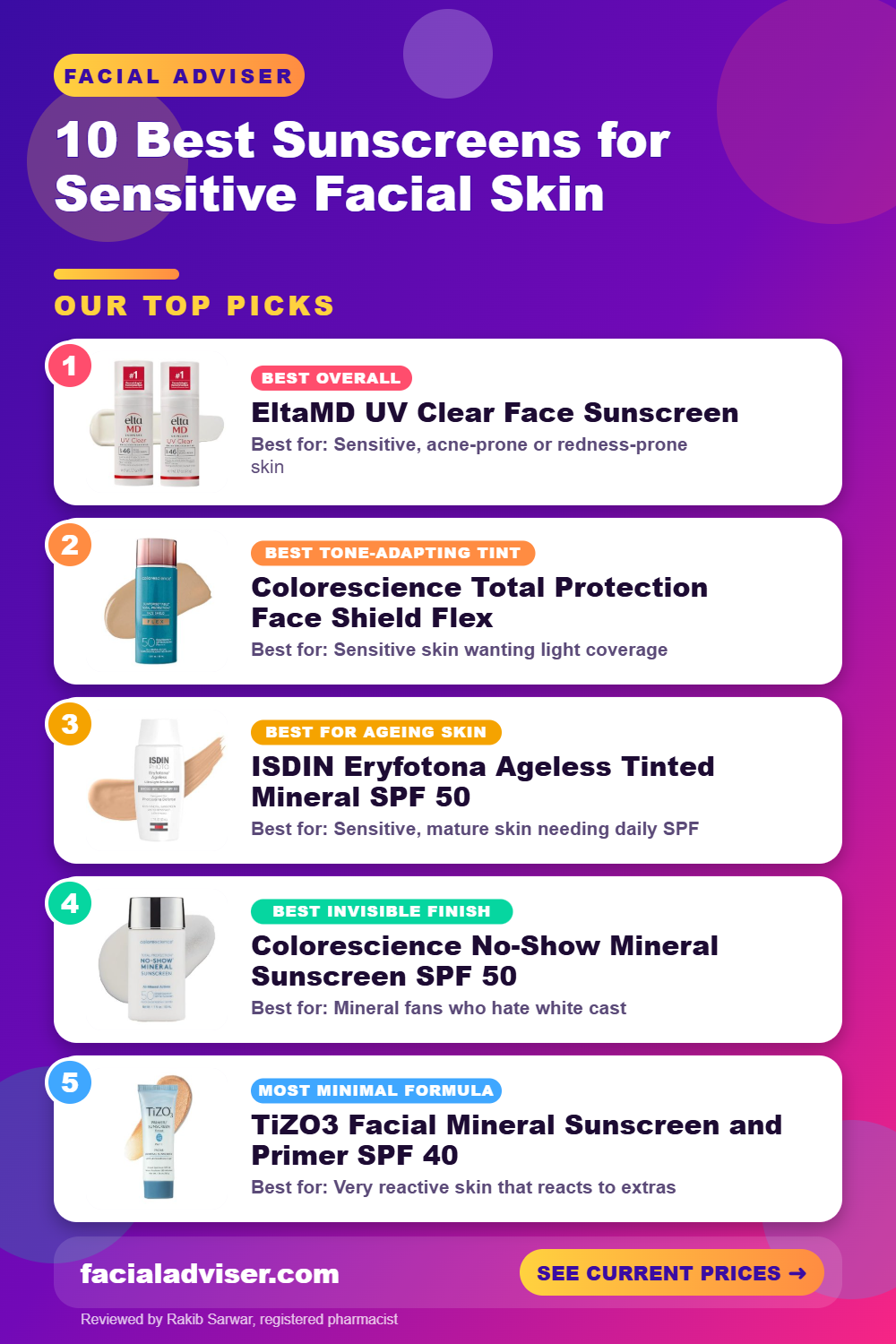
| 1 | EltaMD UV Clear Face Sunscreen | Sensitive, acne-prone or redness-prone skin | Oil-free with zinc oxide and niacinamide | View |
| 2 | Colorescience Total Protection Face Shield Flex | Sensitive skin wanting light coverage | 100% mineral tint that adapts as you blend | View |
| 3 | ISDIN Eryfotona Ageless Tinted Mineral SPF 50 | Sensitive, mature skin needing daily SPF | Ultralight tinted mineral fluid | View |
| 4 | Colorescience No-Show Mineral Sunscreen SPF 50 | Mineral fans who hate white cast | Designed to be invisible on skin | View |
| 5 | TiZO3 Facial Mineral Sunscreen and Primer SPF 40 | Very reactive skin that reacts to extras | No chemical filters, dyes, fragrance or oils | View |
| 6 | EltaMD UV AOX Elements Tinted Mineral SPF 50 | Covering redness on sensitive skin | Medium-coverage tinted mineral sunscreen | View |
| 7 | ISDIN Eryfotona Actinica Mineral SPF 50 | Sensitive skin with visible sun damage | Zinc oxide fluid with a universal tint | View |
| 8 | MDSolarSciences Mineral Creme SPF 50 | Oily or combination sensitive skin | Zinc and titanium with a velvety finish | View |
| 9 | Healthy Skin Lab Protect Tinted Moisturiser SPF 50 | Dry, sensitive skin wanting one step | Mineral SPF 50 with hyaluronic acid | View |
| 10 | Supergoop! Mattescreen Mineral Tinted SPF 40 | Oily, shine-prone sensitive skin | Matte tinted mineral face sunscreen | View |
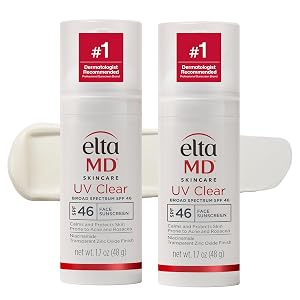
EltaMD UV Clear Face Sunscreen
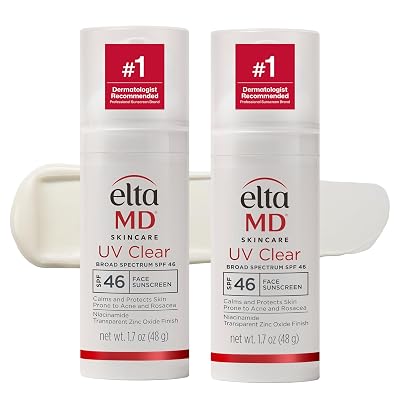
Best for: Sensitive, acne-prone or redness-prone skin
EltaMD UV Clear takes the top spot because it is built for exactly the skin this guide is about. The listing describes an oil-free, non-comedogenic face sunscreen for normal, acne-prone and sensitive skin, with transparent zinc oxide for broad-spectrum protection and niacinamide to help even out the look of skin tone.
Its light texture means most people will actually wear it daily, which matters more than any single ingredient. It comes in tinted and untinted versions and in a handy pump bottle. The listing highlights zinc oxide but does not describe it as 100% mineral, unlike the #2 and #4 picks, so check the active ingredients if you want mineral-only.
- Transparent zinc oxide, broad-spectrum protection
- Oil-free and non-comedogenic
- Niacinamide to help even skin tone
- Tinted and untinted versions; travel-size pump
Pros
- Made for sensitive and acne-prone skin
- Light, everyday texture
- Tinted option available
Cons
- Not described as 100% mineral
- Untinted version may still need a moisturiser on dry skin
Skip it if: Skip it if you want strictly mineral-only filters; the #2, #4 or #5 picks describe themselves that way.
Check Price on AmazonColorescience Total Protection Face Shield Flex

Best for: Sensitive skin wanting light coverage
Colorescience Face Shield Flex is a 100% mineral zinc oxide sunscreen with SPF 50 and a high PA rating, which the listing uses to indicate strong UVA protection. Its tint starts white and adapts to the skin as you blend it, and it comes in several flexible shades with buildable coverage.
The formula is free from synthetic fragrance, parabens, phthalates, talc and dyes, which suits reactive skin. It gives more coverage than the invisible #4 No-Show from the same brand, so it can double as a light base. Tints can transfer onto collars, and shade matching still matters on deeper skin tones despite the adaptive colour.
- 100% mineral zinc oxide, SPF 50 PA++++
- Tint that adapts as you blend
- Buildable coverage in flexible shades
- Free from synthetic fragrance, parabens, talc and dyes
Pros
- Mineral-only formula
- Evens redness and tone
- No synthetic fragrance
Cons
- Tint can transfer onto clothing
- Shade choice still matters on deeper tones
Skip it if: Skip it if you dislike any tint or coverage; the #4 No-Show is designed to be invisible.
Check Price on AmazonISDIN Eryfotona Ageless Tinted Mineral SPF 50

Best for: Sensitive, mature skin needing daily SPF
ISDIN Eryfotona Ageless is a tinted face sunscreen with 100% mineral UV filters in an ultralight emulsion. The listing positions it for protecting skin from the sun and for helping with signs of photoageing, and it is described as non-comedogenic with a versatile tint that blends into many skin tones.
The fluid texture is lighter than many mineral creams, which suits people who find zinc formulas heavy. Its antioxidant technology is aimed at photoageing; treat that as a bonus rather than a treatment, since daily broad-spectrum protection does most of the work. Compared with the #7 Actinica from the same brand, it is aimed more at ageing than at sun-damaged skin.
- 100% mineral UV filters
- Ultralight tinted emulsion
- Non-comedogenic
- Antioxidant technology aimed at photoageing
Pros
- Light fluid texture
- Versatile tint reduces white cast
- Mineral-only filters
Cons
- Anti-ageing extras add little beyond SPF itself
- Tint may not suit the deepest skin tones
Skip it if: Skip it if you want an untinted sunscreen; the #4 Colorescience No-Show is a better fit.
Check Price on AmazonColorescience No-Show Mineral Sunscreen SPF 50

Best for: Mineral fans who hate white cast
The Colorescience No-Show is designed for people who want mineral protection without a visible tint or chalky cast. The listing describes an ultra-lightweight, 100% mineral formula with non-nano zinc oxide at SPF 50, plus antioxidants and soothing bisabolol, and it is free from synthetic fragrance, parabens and phthalates, which suits reactive skin.
It can be worn alone or layered under makeup, which makes it more flexible than the tinted #2 Flex from the same brand. Invisible mineral formulas can still look slightly pale on deep skin tones if applied thickly, so apply two thin layers. It has fewer reviews than several picks, which is why it sits mid-list.
- 100% mineral, non-nano zinc oxide
- SPF 50 PA++++
- Antioxidants and soothing bisabolol
- Free from synthetic fragrance, parabens and phthalates
Pros
- Mineral-only with little visible cast
- Works alone or under makeup
- No synthetic fragrance
Cons
- Fewer reviews than most picks
- May look slightly pale on deep tones if over-applied
Skip it if: Skip it if you want coverage to even out redness; the #2 or #6 tinted picks do more.
Check Price on AmazonTiZO3 Facial Mineral Sunscreen and Primer SPF 40
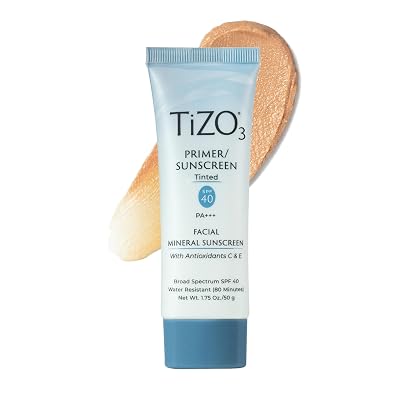
Best for: Very reactive skin that reacts to extras
TiZO3 is the pick for very reactive skin that seems to react to everything. The listing states that it contains no chemical sunscreens, dyes, fragrances, oils or preservatives, which leaves fewer ingredients to react to. It is a sheer tinted facial mineral sunscreen with broad-spectrum protection, made specifically for the face.
It doubles as a primer with a silky matte finish, and it is water resistant for 80 minutes, which is useful for active days. At SPF 40 it is a little lower than the SPF 50 picks, though still well above the SPF 30 the AAD recommends. The matte finish may feel dry on already dry skin, so apply a moisturiser first.
- Sheer tinted mineral sunscreen, broad spectrum
- No chemical filters, dyes, fragrance, oils or preservatives
- Silky matte finish; works as a primer
- Water resistant for 80 minutes
Pros
- Very short list of potential irritants
- Matte finish suits oily skin
- Water resistant
Cons
- Matte finish can feel dry on dry skin
- Tint may not suit every skin tone
Skip it if: Skip it if your skin is very dry and you dislike a matte finish; the #9 Healthy Skin Lab pick is more hydrating.
Check Price on AmazonEltaMD UV AOX Elements Tinted Mineral SPF 50

Best for: Covering redness on sensitive skin
EltaMD UV AOX Elements is a tinted face sunscreen with 100% mineral actives and medium coverage, so it can be worn alone as a light base or under makeup. That makes it useful if redness or uneven tone is part of why your skin feels sensitive, since the tint helps hide it while you protect.
The listing adds hyaluronic acid and bisabolol, aimed at hydrating and calming sensitive skin, plus antioxidants. It gives more coverage than the #2 Flex and is fully mineral, unlike the #1 UV Clear from the same brand. Medium coverage can feel heavy on hot days, and shade matching matters more than with sheer tints.
- 100% mineral actives, broad spectrum
- Medium-coverage tint
- Hyaluronic acid and bisabolol for sensitive skin
- Enriched with antioxidants
Pros
- Covers redness while protecting
- Mineral-only filters
- Hydrating base
Cons
- Medium coverage can feel heavy in heat
- Tint may not match every skin tone
Skip it if: Skip it if you want a barely-there finish; the #4 No-Show or #1 UV Clear is lighter.
Check Price on AmazonISDIN Eryfotona Actinica Mineral SPF 50
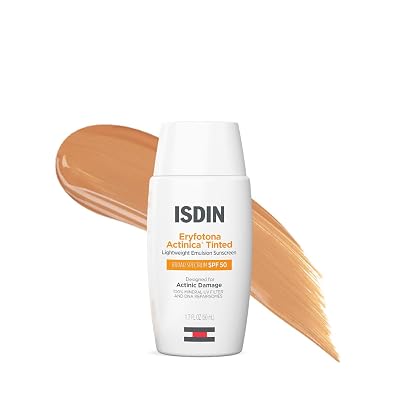
Best for: Sensitive skin with visible sun damage
ISDIN Eryfotona Actinica is a 100% mineral zinc oxide face sunscreen formulated for sun-damaged skin. The listing describes it as gentle and non-comedogenic for sensitive and acne-prone skin, with a universal tint in a fast-absorbing, non-greasy fluid that is designed to avoid the white cast that many zinc formulas leave.
It suits people who have already had sun damage and want a sunscreen they will wear daily without stinging. The listing makes repair claims for its ingredients; we do not repeat those, since sunscreen prevents further damage rather than reversing it. Compared with the #3 Ageless from the same brand, it is aimed at sun damage rather than general ageing.
- 100% mineral zinc oxide, broad spectrum
- Formulated for sun-damaged skin
- Non-comedogenic for sensitive and acne-prone skin
- Universal tint in a fast-absorbing fluid
Pros
- Gentle mineral fluid
- Universal tint limits white cast
- Suits acne-prone skin
Cons
- Repair claims go beyond what sunscreen can do
- Universal tint may not match every tone
Skip it if: Skip it if you have concerning spots; see a dermatologist rather than relying on a sunscreen.
Check Price on AmazonMDSolarSciences Mineral Creme SPF 50

Best for: Oily or combination sensitive skin
MDSolarSciences Mineral Creme uses micronized zinc oxide and titanium dioxide together, the two filters most often suggested for sensitive skin, for broad-spectrum SPF 50 protection. The listing describes a weightless formula with a silky matte, velvety finish that suits oily and combination skin and sits well under makeup or powder later in the day.
It adds antioxidants including vitamin C and is water resistant, which helps on warm days. Its matte feel is similar to the #5 TiZO3 but without a primer role. As with any matte sunscreen, dry skin may need a moisturiser underneath, and vitamin C can occasionally sting very reactive skin, so patch test first.
- Micronized zinc oxide and titanium dioxide
- Weightless formula with silky matte finish
- Antioxidants including vitamin C
- Water-resistant, broad spectrum SPF 50
Pros
- Two mineral filters combined
- Velvety matte finish
- Water resistant
Cons
- May feel dry on dry skin
- Vitamin C may sting very reactive skin
Skip it if: Skip it if your skin is dry and tight; the #9 Healthy Skin Lab tinted moisturiser is more hydrating.
Check Price on AmazonHealthy Skin Lab Protect Tinted Moisturiser SPF 50

Best for: Dry, sensitive skin wanting one step
Healthy Skin Lab Protect is a tinted moisturiser with mineral SPF 50, which suits people with dry, sensitive skin who want hydration, sun protection and a hint of colour in one step. The listing mentions a sheer universal tint for a natural look and hyaluronic acid for hydration, in a lightweight texture.
It is lighter in coverage than the #6 UV AOX Elements and more hydrating than the matte #5, #8 and #10 picks. It has fewer reviews than most sunscreens here, and a universal tint will not suit every skin tone. Remember to apply a generous amount, because a thin layer of tinted moisturiser will not reach the SPF on the label.
- Mineral SPF 50 broad spectrum
- Sheer universal tint
- Hyaluronic acid for hydration
- Lightweight tinted moisturiser
Pros
- Moisture, tint and SPF in one
- Suits dry skin
- Sheer, natural finish
Cons
- Fewer reviews than most picks
- Universal tint will not suit every tone
Skip it if: Skip it if your skin is oily; the #8 MDSolarSciences or #10 Supergoop pick is more matte.
Check Price on AmazonSupergoop! Mattescreen Mineral Tinted SPF 40

Best for: Oily, shine-prone sensitive skin
Supergoop Mattescreen is a tinted mineral face sunscreen with a matte finish, which makes it a good choice for sensitive skin that is also oily or shiny by midday. A matte mineral formula can reduce the greasy feel that puts many people with oily skin off wearing sunscreen every single day.
It has a lighter SPF 40 than the SPF 50 picks, which is still above the SPF 30 the AAD recommends for daily use. The listing gives few formula details, so check the ingredient list for fragrance if you are very reactive. Compared with the #5 TiZO3 it is a similar matte idea from a larger sunscreen brand.
- Mineral filters
- Matte finish for the face
- Tinted formula
- SPF 40 protection
Pros
- Controls shine
- Tint reduces white cast
- From a dedicated sunscreen brand
Cons
- Listing gives limited ingredient detail
- Matte finish can feel dry on dry skin
Skip it if: Skip it if your skin is dry or flaky; the #9 Healthy Skin Lab pick is more comfortable.
Check Price on AmazonHow We Chose These Products
We shortlisted face sunscreens from Amazon listings that are highly rated by a large number of shoppers, favouring established brands and fuller-featured formulas with broad-spectrum protection, SPF 30 or higher and clearly stated filters. We then checked each product’s listed features against the sun-protection guidance cited in this post from the AAD and the FDA, and gave extra weight to mineral filters and fragrance-free or synthetic-fragrance-free claims.
These are research-based picks, not hands-on lab tests. We did not measure SPF or wear these sunscreens ourselves, so rankings reflect listing detail, filters and finish rather than personal results. Nine picks describe themselves as mineral; the top pick highlights zinc oxide but its listing does not call it 100% mineral, so check the active ingredients if you want mineral-only protection.
- Strong ratings from a large number of shoppers
- Face-specific, broad-spectrum formulas of SPF 30 or higher
- Mineral filters and fragrance-free claims favoured
- Listed features checked against the cited AAD and FDA guidance
- Body and sport sprays, and thin or unclear listings, excluded
Mineral vs Chemical Sunscreen for Sensitive Skin
Sunscreen filters fall into two groups. Mineral, sometimes called physical, filters are zinc oxide and titanium dioxide. Chemical, or organic, filters absorb UV rays inside the top layers of skin. Both protect well when used correctly, but they behave differently on reactive skin.
| Feature | Mineral filters | Chemical filters |
|---|---|---|
| Active ingredients | Zinc oxide, titanium dioxide | Avobenzone, octocrylene, homosalate and others |
| Stinging risk | Low | Higher, especially near eyes |
| Allergy risk | Very low | Low but possible with some filters |
| Texture | Can be thicker | Usually lighter and clear |
| White cast | Common, less with tinted versions | Rare |
| UVA coverage | Zinc oxide covers a wide range | Depends on filter combination |
| Works | Straight away | Straight away in modern formulas |
For most people with sensitive, rosacea-prone or eczema-prone skin, a mineral formula is the safest place to start. If mineral textures do not suit you, a chemical formula is still far better than no sunscreen; simply choose a fragrance-free version and patch test it. Our guide to physical vs chemical SPF explains the differences in more detail.
What to Look for on the Label
You do not need to understand every ingredient. A few label checks will filter out most products that are likely to cause trouble.
- Broad spectrum: protects against both UVA and UVB rays.
- SPF 30 or higher for daily use; SPF 50 for long outdoor days.
- Zinc oxide and/or titanium dioxide listed as the active ingredients.
- Fragrance-free, not just unscented, which can still contain masking fragrance.
- Non-comedogenic if you are also prone to breakouts.
- Water-resistant (40 or 80 minutes) if you will sweat or swim.
- Soothing base ingredients such as glycerin, ceramides, niacinamide or panthenol.
Short ingredient lists are easier to check and give fewer chances for a reaction. Our guide on how to spot fragrance in an ingredient list shows the names hidden fragrance can go by.
Ingredients and Features to Avoid
Some ingredients are more likely to irritate sensitive skin. They are not dangerous for everyone, but they are worth avoiding if your skin reacts easily.
- Added fragrance, perfume or parfum, including natural essential oils.
- High levels of denatured alcohol, which can sting and dry the skin.
- Spray sunscreens on the face, which are hard to apply evenly and easy to inhale.
- Menthol, peppermint, citrus oils and other cooling or scented extracts.
- Products with SPF below 30 or without a broad-spectrum claim.
- Very glittery or shimmer formulas, which often add fragrance and extra ingredients.
Stop using a sunscreen that causes burning, swelling, hives or a spreading rash. Wash it off gently with water and a mild cleanser, and see a doctor if the reaction is severe or spreads to your eyes or lips.
Choosing a Texture and Finish
Texture decides whether you will actually wear your sunscreen every day. Sensitive skin can also be dry, oily or both, so match the base to your skin type.
| Skin type | Best texture | Why |
|---|---|---|
| Dry and sensitive | Cream or lotion with ceramides or glycerin | Adds moisture and cushions the skin |
| Oily and sensitive | Light fluid or gel-cream, non-comedogenic | Less shine and fewer clogged pores |
| Combination | Lotion or fluid | Balances dry and oily areas |
| Rosacea-prone | Tinted mineral cream | Evens redness and avoids stinging |
| Very reactive | Minimal-ingredient mineral lotion | Fewer ingredients to react to |
| Around the eyes | Mineral stick | Less likely to run into eyes |
If you already use a moisturiser, a sunscreen lotion can often replace it in the morning, especially on normal or oily skin. On very dry skin, apply a simple moisturiser first and let it settle before your sunscreen.
How to Deal With White Cast
White cast is the main complaint about mineral sunscreens, and it is especially noticeable on medium and deep skin tones. It comes from zinc oxide and titanium dioxide reflecting light. There are practical ways to reduce it without giving up mineral protection.
- Choose a tinted mineral sunscreen that matches your skin tone.
- Apply in two thinner layers rather than one thick one.
- Warm the product between your fingertips before pressing it in.
- Let each layer set for a minute before adding makeup.
- Try a sheer fluid texture, which tends to blend more easily than a thick cream.
Tinted mineral sunscreens contain iron oxides, which give the colour and also help protect against visible light. This can be useful if you are prone to melasma or dark marks that worsen in the sun.
How to Choose and Apply Sunscreen on Sensitive Skin
Follow these steps to pick a sunscreen your skin tolerates and to apply it in a way that protects properly.
Check the actives
Look for zinc oxide, titanium dioxide or both, broad spectrum and SPF 30 or higher.
Check for fragrance
Choose fragrance-free and avoid essential oils and alcohol-heavy formulas.
Patch test
Apply a small amount along the jawline or behind the ear once a day for three to five days.
Prepare your skin
Cleanse gently and apply a simple moisturiser if your skin is dry.
Use enough
Apply about a quarter teaspoon to the face and neck, or two finger lengths.
Press, do not rub
Pat the sunscreen in to reduce friction and white streaks.
Reapply
Reapply every two hours outdoors and after swimming or sweating.
The AAD page on how to apply sunscreen covers timing, quantity and reapplication in more depth.
Keep a mineral stick or compact in your bag for reapplication. It is easier to use over makeup and less likely to drip into your eyes than a lotion.
Fitting Sunscreen Into a Sensitive-Skin Routine
Sunscreen is the last skincare step in the morning, after cleanser, any serum and moisturiser, and before makeup. Give it a minute or two to set so foundation or powder does not move it around. Keeping the rest of your routine simple makes it easier to find out which product is causing a reaction.
If your skin barrier is already damaged, almost any product will sting. Repairing it first with a gentle routine often makes sunscreen far easier to tolerate. Our guide on how to repair your moisture barrier explains the basics.
- Morning: gentle cleanse or water rinse, moisturiser, sunscreen.
- Evening: remove sunscreen with a mild cleanser, then moisturise.
- Avoid adding several new actives in the same week as a new sunscreen.
- Use shade, hats and sunglasses as well, especially at midday.
Sunscreen for Rosacea, Eczema and Acne-Prone Sensitive Skin
Sensitive skin is not one condition. Many people who describe their skin as sensitive also have rosacea, eczema or breakouts, and each of these changes what the best sunscreen looks like.
- Rosacea: heat and sun are common triggers, so daily protection matters. Tinted mineral formulas help hide redness, and fragrance-free, alcohol-free bases are less likely to cause flushing.
- Eczema: choose a creamy mineral formula with barrier-supporting ingredients such as ceramides or glycerin, and apply it over a moisturiser if the skin is very dry.
- Acne-prone: choose a lightweight, non-comedogenic mineral fluid or gel-cream and remove it fully at night with a gentle cleanser.
- Post-procedure skin: after peels, lasers or retinoid use, skin burns more easily and stings more, so a simple mineral sunscreen is usually the most comfortable option.
If you use prescription creams, apply them at night unless your doctor tells you otherwise, and keep your morning routine to cleanser, moisturiser and sunscreen. This makes it easier to tell which product is responsible if your skin reacts. When a flare-up is active, even a gentle sunscreen can sting briefly; shade, a wide-brimmed hat and staying out of midday sun help reduce how much you need to rely on the product while the skin settles.
Dos and Don’ts
Good Habits
- Choose broad-spectrum mineral SPF 30 or higher
- Patch test every new formula
- Apply a generous amount every morning
- Reapply every two hours outdoors
- Remove sunscreen gently at night
Common Mistakes
- Rely on makeup SPF alone
- Choose a formula because it smells nice
- Rub sunscreen in hard on irritated skin
- Use sprays directly on the face
- Skip sunscreen on cloudy days
Honest Limits
No sunscreen is guaranteed to suit every sensitive face. Mineral formulas lower the risk of stinging, but people can still react to preservatives, emollients or other base ingredients, so patch testing is always worth it.
Sunscreen also cannot block all UV rays, and the SPF on the label is only reached when you apply a generous layer. Most people use too little. The FDA explains that sunscreen should be part of a wider plan that includes shade, clothing and limiting time in the sun; you can read its overview on sunscreen and sun protection. Labels such as hypoallergenic and dermatologist tested are not strictly defined and do not guarantee that a product will not irritate you.
When to See a Dermatologist
- Every sunscreen you try stings, burns or causes a rash.
- You get itchy bumps or blisters after sun exposure, which can be a sun allergy.
- You have rosacea, eczema or melasma that flares with sun or products.
- You notice a new, changing or bleeding spot or mole.
A dermatologist can patch test you to identify the ingredient you react to, which makes shopping far easier. They can also check whether redness, burning or bumps are really a product reaction or a skin condition such as rosacea, eczema or a sun allergy that needs its own treatment. Take the products you have tried, or photos of their labels, to your appointment so the doctor can look for ingredients they have in common.
This article is for general information and does not replace professional medical advice. See a board-certified dermatologist for persistent reactions, skin conditions or any concerning spots.
FAQ
What is the best sunscreen for sensitive facial skin?
Our top pick is EltaMD UV Clear; for mineral-only protection, the Colorescience Face Shield Flex is a strong choice.
Is zinc oxide or titanium dioxide better for sensitive skin?
Both are gentle; zinc oxide covers a wider UVA range, so many formulas use it alone or with titanium dioxide.
Why does my sunscreen sting my face?
Often fragrance, alcohol or certain chemical filters, or a damaged skin barrier.
Is SPF 50 better than SPF 30 for sensitive skin?
SPF 50 gives slightly more UVB protection; applying enough matters more.
Can mineral sunscreen clog pores?
Some rich formulas can; choose non-comedogenic if you break out.
How do I stop sunscreen from burning my eyes?
Use a mineral formula, avoid the lid area, and try a stick near the eyes.
Is tinted sunscreen good for sensitive skin?
Yes, tinted mineral formulas reduce white cast and help against visible light.
Which sunscreen on this list is best for oily sensitive skin?
The Supergoop Mattescreen, TiZO3 or MDSolarSciences Mineral Creme give a matte finish.
How much sunscreen should I use on my face?
About a quarter teaspoon for the face and neck.
Which tinted sunscreen suits sensitive skin best?
The Colorescience Face Shield Flex adapts to many tones; EltaMD UV AOX Elements gives more coverage.
Where This Leaves You
For sensitive facial skin, the best choice is usually a fragrance-free, broad-spectrum mineral sunscreen with SPF 30 or higher in a texture you enjoy wearing; EltaMD UV Clear is our top pick overall.
Patch test before committing, apply a generous layer every morning, reapply outdoors, and see a dermatologist if every sunscreen seems to irritate your skin.
Our top pick: EltaMD UV Clear Face Sunscreen
The EltaMD UV Clear takes the top spot because it is an oil-free, non-comedogenic face sunscreen designed for sensitive and acne-prone skin, with a light texture most people will happily wear every day. Choose the Colorescience Face Shield Flex instead if you want a 100% mineral formula with a tint that adapts to your skin, or the ISDIN Eryfotona Ageless if you want an ultralight tinted mineral fluid with an anti-ageing focus.
Check Price on Amazon
Written by
Registered pharmacist and founder of Facial Adviser. Rakib's pharmacy training covers how skincare actives work and interact; a later course in cosmetology turned that into a focus on facial treatments and skincare products. He plans, researches and edits every guide on the site and checks health claims against sources such as the American Academy of Dermatology, the FDA and the NIH. He is not a dermatologist; see the Editorial Policy and Medical Disclaimer.
About · Editorial policy · How we choose products · Medical disclaimer · Contact
Keep reading: Toners, mists and sunscreen
- What Does a Facial Toner Do? The Real Answer
- 10 Best Facial Toners for Dry Skin (2026): Hydrate Without Sting
- Uneven Tone After Sun Exposure: Tan, Sunspots or Melasma and How to Fade It
- Rough, Bumpy Forehead After Sunscreen? Causes and Fixes
- Do You Need a pH-Balancing Toner? When It Helps, When It Does Not
- Why Does My Toner Sting Sometimes? Causes and What to Do
- 10 Best Facial Moisturizers for Dry Skin (2026): Rich, Gentle Creams
- 10 Best Facial Serums for Aging Skin (2026): Picks by Concern