Makeup Remover vs Micellar Water: The Real Difference
Drugstore shelves stock both as if they’re two separate essentials, so in a real makeup remover vs micellar water comparison, is either one actually a distinct chemical category once the marketing language is set aside?
Part of our guide to makeup how-to. Start with: Best Way to Use Makeup Remover: Micellar Water, Balms, Oils and Eye Removers
Micellar water works through tiny surfactant clusters called micelles, suspended in water, that trap oil and dirt without needing to be rinsed off — a genuinely different delivery mechanism from traditional oil-based, cream-based, or bi-phase makeup removers. Cosmetic chemists themselves genuinely disagree on how distinct micellar water really is as a category, with some describing it as fundamentally the same surfactant chemistry used in ordinary cleansers rather than something formulated in a truly novel way.
A point of real, honest disagreement worth naming rather than glossing over: dermatologists are split on whether micellar water needs to be rinsed afterward, with some recommending a rinse for residue and others noting the formula was specifically designed to be left on skin.
This guide covers the real surfactant chemistry behind both product types, how they perform differently against waterproof and heavy makeup, and where the genuine expert disagreement leaves you on rinsing and everyday routine.
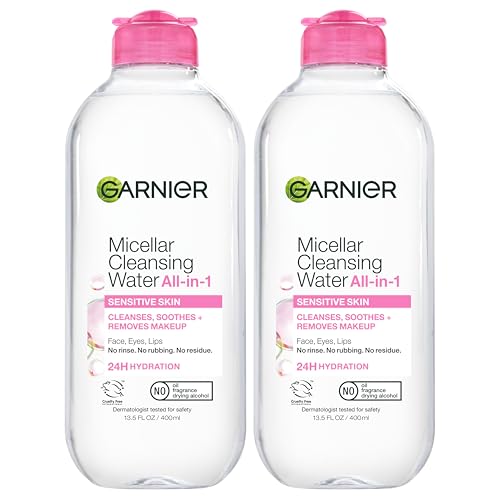
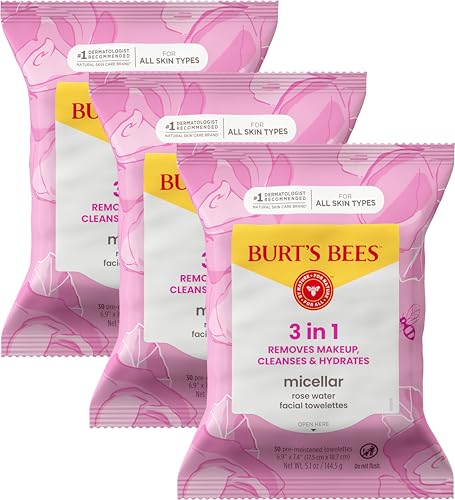
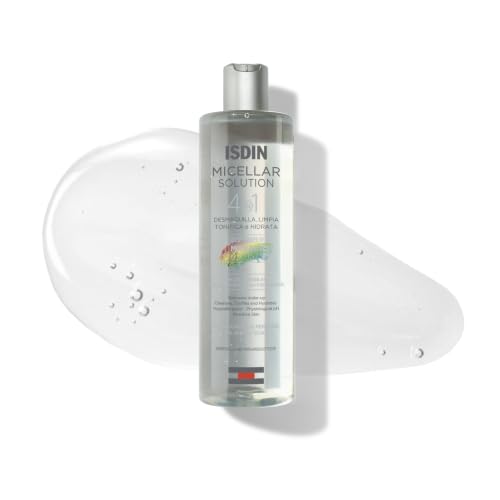
Recommended Micellar Waters and Makeup Removers




The Short Answer
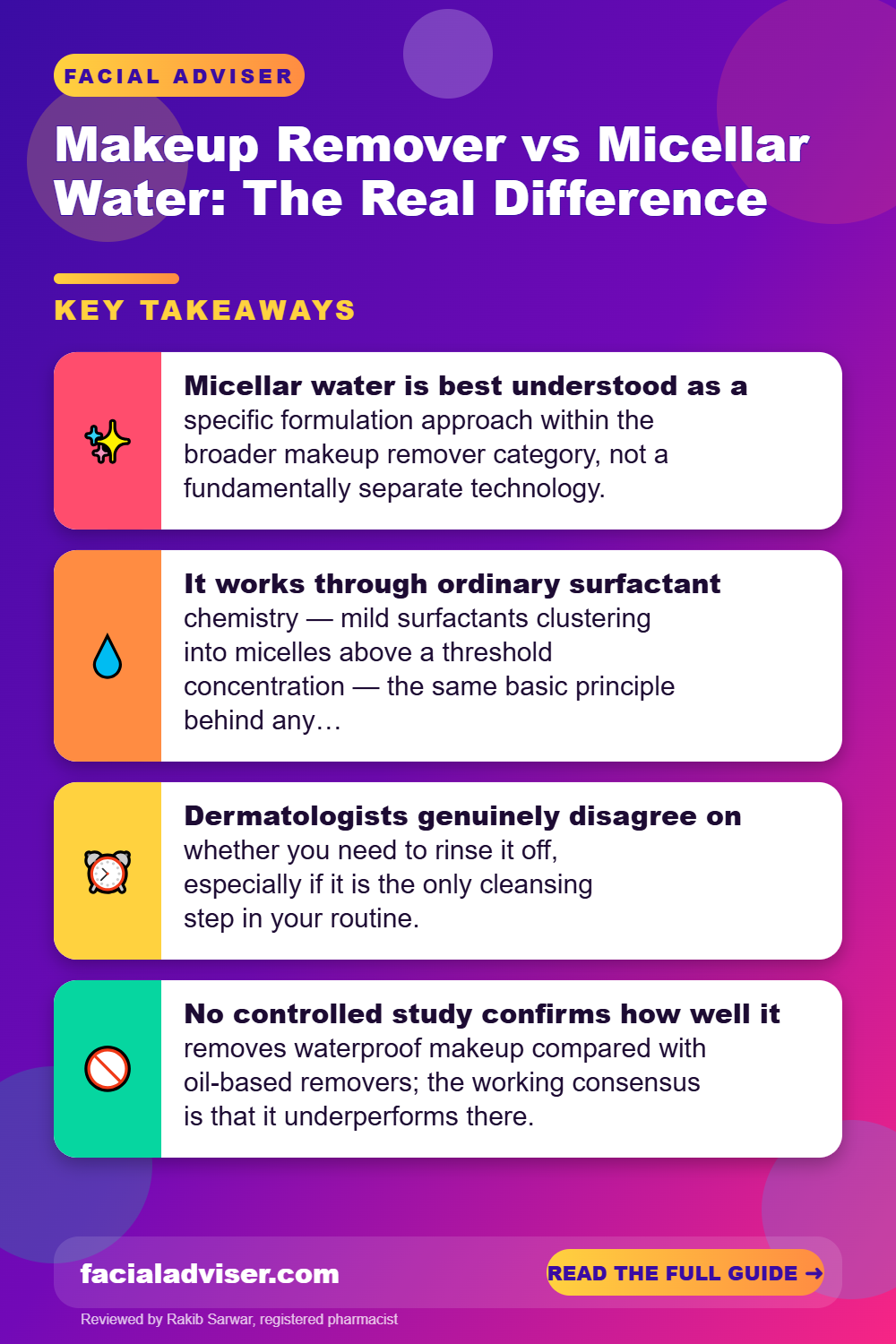
- Micellar water is best understood as a specific formulation approach within the broader makeup remover category, not a fundamentally separate technology.
- It works through ordinary surfactant chemistry — mild surfactants clustering into micelles above a threshold concentration — the same basic principle behind any surfactant solution, including dish soap.
- Dermatologists genuinely disagree on whether you need to rinse it off, especially if it is the only cleansing step in your routine.
- No controlled study confirms how well it removes waterproof makeup compared with oil-based removers; the working consensus is that it underperforms there.
What’s Covered Below
- How Micellar Water Actually Works
- The Mild Surfactants Behind the Formula
- How Traditional Removers Compare
- Is Micellar Water a Real Category, or Just Marketing?
- The Chemistry Term Behind the Debate
- Does It Actually Remove Waterproof Makeup?
- Should You Rinse It Off? Dermatologists Disagree
- When Micellar Water Alone Is Enough
- The Double-Cleanse Method, Explained
- Matching Remover Type to Skin Type
- Do’s and Don’ts at a Glance
- Using Micellar Water Correctly, Step by Step
- Frequently Asked Questions
- Bottom Line
How Micellar Water Actually Works
Micellar water works through a process called surfactant self-assembly. Each surfactant molecule has a hydrophilic, water-loving head and a hydrophobic, oil-loving tail. Above a certain concentration — the critical micelle concentration — these molecules spontaneously cluster into spherical structures called micelles, hydrophobic tails pointing inward, hydrophilic heads facing outward into the water. Oil, pigment, and sebum get trapped inside the hydrophobic core, while the water-soluble exterior keeps the whole structure dissolvable, which is why it wipes away with a cotton pad without needing a rinse.
Shopping these picks?
Amazon Prime members get fast, free shipping on eligible items, plus Prime Video, Amazon Music and member deals. New members can start with a free trial.
Start a free Prime trialAged 18 to 24? Prime for Young Adults comes with a longer free trial and a lower price after it.
Affiliate link: we may earn a commission at no extra cost to you.
This mechanism is described in an academic explainer published by The Conversation, an outlet that publishes only under named academic bylines as part of its editorial model, lending it real credibility as a science-communication source even where a specific author name is hard to track down.
The Mild Surfactants Behind the Formula
Dr. Zoe Diana Draelos, a dermatologist writing in Dermatology Times, identifies the specific ingredients typically used: cetrimonium bromide, a cationic surfactant also common in hair conditioners; polysorbate 20, a non-foaming surfactant; and amphoteric surfactants such as disodium cocoamphodiacetate, similar in mildness to baby-shampoo surfactants. These are chosen specifically for how mild they are relative to standard face-wash surfactants, which is the practical reason micellar water is marketed as gentle.
How Traditional Removers Compare
Oil-based and cream-based removers work through direct solvency, on the “like dissolves like” principle: oil dissolves oil-based makeup, sebum, and sunscreen directly, and generally needs rinsing or wiping away afterward. Bi-phase, or dual-layer, removers combine two immiscible layers, oil and water, shaken together before use; the oil phase dissolves oil-based or waterproof pigment while the water phase lifts water-soluble debris, typically reserved for waterproof eye makeup. Micellar water differs from both by being a single-phase, surfactant-in-water system that lifts oil and dirt without a separate oil layer and without needing a rinse, exactly what manufacturers position as gentler and lower-effort.
| Remover Type | How It Works | Typical Use Case |
|---|---|---|
| Oil-based or cream | Dissolves oil-based makeup and sebum directly through solvency | Heavy or long-wear makeup; needs rinsing or wiping after use |
| Bi-phase (dual layer) | Combines an oil layer and a water layer, shaken together before use | Waterproof eye makeup specifically |
| Micellar water | Mild surfactants self-assemble into micelles that trap oil and pigment | Everyday or light makeup; no-rinse convenience |
Is Micellar Water a Real Category, or Just Marketing?
This is genuinely contested among the people who formulate these products. In a discussion on Chemists Corner, a professional cosmetic-science forum, a contributor going by “Perry,” very likely the well-known cosmetic chemist Perry Romanowski, states plainly: “Micellar water is a marketing term, not a scientific term. You can call whatever you want micellar water.” Another, “Pharma,” pushes back: “Every surfactant in water, at a given minimum concentration, aka CMC, builds micelles.”
The most defensible answer: micellar water is best understood as a specific formulation approach within the broader makeup-remover category — a low-surfactant-concentration, commonly cited around 1 to 2 percent, leave-on, single-phase aqueous cleanser — rather than a fundamentally separate class of product. What differentiates it is the choice of unusually mild surfactants at low concentration, not a unique mechanism nobody else uses.
The Chemistry Term Behind the Debate
The critical micelle concentration, or CMC, is the threshold above which surfactant molecules in water start spontaneously forming micelles rather than floating as individual molecules. Every surfactant has its own CMC, and once a solution crosses it, micelle formation happens automatically as physical chemistry, not something unique to any product line. That is precisely why the “micellar” branding is not meaningless but also not proprietary: it describes real chemistry happening in any surfactant solution above its own CMC, cosmetic or otherwise. What sets a given micellar water apart is the specific surfactants chosen for mildness and the concentration used, not the underlying mechanism itself.
Does It Actually Remove Waterproof Makeup?
No controlled comparative study was located testing micellar water’s removal efficacy against oil-based or bi-phase removers on waterproof formulas. What exists instead is manufacturer and beauty-editorial guidance, including brand-published education from Garnier, claiming micellar water “can” remove waterproof mascara while generally recommending double-cleansing or an oil-based step for genuinely waterproof or heavy-coverage products. Read that as industry convention, not clinical evidence.
| Scenario | Best Approach | Why |
|---|---|---|
| Light or everyday makeup | Micellar water alone is generally sufficient | Mild surfactants lift moderate oil, pigment, and dirt without a separate oil step |
| Waterproof mascara or heavy-coverage makeup | Pair with an oil-based cleanser, or double-cleanse | Working industry consensus is that micellar water alone underperforms here, though no controlled study confirms this precisely |
| Sensitive or reactive skin | Follow with a rinse or gentle cleanser | At least one dermatologist recommends rinsing to avoid leftover surfactant residue |
Should You Rinse It Off? Dermatologists Disagree
Dr. Morales Raya, a dermatologist and aesthetic-medicine specialist who directs his own clinic, told Hello! Magazine: “Yes, it is highly advisable to rinse it off, particularly if it’s used as the only cleansing step.” His reasoning: leftover residue could interfere with subsequent treatments or cause dryness or irritation for reactive skin.
When Micellar Water Alone Is Enough
Putting the waterproof and rinsing questions together, a workable rule of thumb emerges: micellar water alone is generally fine for light, everyday makeup on skin that is not particularly reactive, especially when followed later by a normal shower or face wash. It becomes a weaker standalone choice when either condition changes — the makeup is waterproof or heavy-coverage, or it is genuinely the only cleansing step used that day.
The Double-Cleanse Method, Explained
Double cleansing sidesteps both open questions at once. The first pass, using micellar water or an oil-based product, breaks down makeup, sunscreen, and the day’s buildup of sebum. The second pass, using a regular gentle cleanser, removes whatever residue the first step left behind and actually cleans the skin underneath it, rather than just lifting makeup off the surface.
Matching Remover Type to Skin Type
Oil-based removers tend to suit dry skin well, since they supply emollient content the skin may already be lacking, on top of dissolving makeup directly. Micellar water, given its unusually mild surfactant selection, is generally positioned as suitable across most skin types, including sensitive skin, though the rinsing disagreement above still applies to anyone with reactive skin specifically. Bi-phase removers are less about skin type and more about the specific job at hand, since they are formulated primarily for waterproof eye makeup regardless of the skin underneath.
Do’s and Don’ts at a Glance
Do
- Reach for micellar water for daily, light makeup removal.
- Follow it with a proper cleanser if it is your only step that day.
- Patch-test a new formula if your skin tends toward reactivity.
Don’t
- Assume micellar water alone reliably removes waterproof mascara.
- Skip rinsing if your skin is prone to irritation.
- Treat “micellar” as a proprietary technology rather than a mild surfactant formulation choice.
Using Micellar Water Correctly, Step by Step
Saturate the pad
Apply enough micellar water that the cotton pad is fully damp, not just lightly misted.
Hold before wiping
Press the pad against closed eyes or heavy makeup for a few seconds to let the surfactants start breaking the pigment down.
Wipe gently
Use light, sweeping motions rather than aggressive rubbing, which can irritate skin without actually removing makeup faster.
Reassess waterproof areas
Go back over stubborn waterproof mascara or long-wear lip color with a fresh pad, or switch to an oil-based remover if it is not lifting.
Follow with a cleanser
Especially if this is your only makeup-removal step for the day, rinse or cleanse afterward to clear any leftover residue.
Frequently Asked Questions
Is micellar water the same thing as makeup remover?
Chemically it is best understood as a specific formulation approach within the broader makeup remover category, not a completely separate technology.
How does micellar water actually remove makeup?
Mild surfactants above a critical concentration self-assemble into micelles that trap oil, pigment, and sebum in a water-soluble structure that wipes away easily.
Do I need to rinse micellar water off my face?
Dermatologists disagree; one recommends rinsing, especially for reactive skin or when it is the only cleansing step, while other sources note the surfactants are mild enough that many people leave it on without irritation.
Can micellar water remove waterproof mascara?
It can help, but the working industry consensus is that it underperforms on waterproof formulas compared with an oil-based remover, and no controlled study directly compares them.
What surfactants are typically used in micellar water?
A dermatologist writing in Dermatology Times identifies mild options such as cetrimonium bromide, polysorbate 20, and amphoteric surfactants like disodium cocoamphodiacetate.
Is “micellar” just a marketing term?
Cosmetic chemists disagree; one calls it purely a marketing term, while another points out that any surfactant solution above its critical micelle concentration is technically micellar.
Should I use micellar water instead of a cleanser?
Many sources treat it as a first step rather than a full replacement, particularly for waterproof or heavy makeup, and recommend following it with a proper cleanse.
Is micellar water gentler than other makeup removers?
It is generally formulated with unusually mild, low-concentration surfactants specifically chosen to minimize irritation compared with standard cleansing surfactants.
What is the difference between micellar water and a bi-phase remover?
Bi-phase removers use a separate oil layer and water layer shaken together, mainly for waterproof eye makeup, while micellar water is a single-phase system without an oil layer.
Does double cleansing solve both the waterproof and residue problems?
Using micellar water or an oil-based product first, followed by a gentle cleanser, addresses both waterproof removal and any leftover surfactant residue in one routine.
Bottom Line
Micellar water is not a fundamentally different technology from makeup remover; it is a specific, deliberately mild formulation approach within the same broader category, built on ordinary surfactant chemistry that also occurs in far less glamorous products. That does not make it a lesser choice — the mild surfactant selection is a real, meaningful design decision, and the no-rinse convenience is a genuine benefit for everyday, light makeup removal.
Where the honest answer gets more nuanced is waterproof makeup and whether to rinse afterward: neither question has a single settled answer, with real disagreement among dermatologists on rinsing and only industry convention, not controlled evidence, behind the waterproof guidance. Double cleansing sidesteps both uncertainties at once, which makes it a reasonable default rather than a fussy extra step.

Written by
Registered pharmacist and founder of Facial Adviser. Rakib's pharmacy training covers how skincare actives work and interact; a later course in cosmetology turned that into a focus on facial treatments and skincare products. He plans, researches and edits every guide on the site and checks health claims against sources such as the American Academy of Dermatology, the FDA and the NIH. He is not a dermatologist; see the Editorial Policy and Medical Disclaimer.
About · Editorial policy · How we choose products · Medical disclaimer · Contact
Keep reading: Makeup removal and hygiene
- Best Way to Use Makeup Remover: Micellar Water, Balms, Oils and Eye Removers
- How Do You Get Makeup Out of Clothes? A Stain-by-Stain Guide
- How Do You Know If Makeup Is Expired? Signs, Shelf Life and Symbols
- Are Makeup Wipes Bad for Your Face? What to Use Instead
- Should You Keep Cosmetics in the Fridge?
- How to Choose the Right Eye Makeup Color for Your Eyes and Skin
- What Can You Use to Make Your Makeup Stay On All Day? 9 Products and Tricks