
What Is a Chelating Agent in a Cosmetic Formula?
Scan the ingredient list of almost any cleanser, shampoo or moisturiser and you are likely to find disodium EDTA, tetrasodium EDTA, sodium phytate or tetrasodium glutamate diacetate near the end. These are chelating agents, and although they rarely appear in marketing, they do an important behind-the-scenes job that affects how long your products stay fresh.
Part of our guide to cosmetic science. Start with: How to Read a Cosmetic Ingredient List: A Beginner Guide
A chelating agent is an ingredient that binds to metal ions, such as calcium, magnesium, iron and copper, and holds them so they cannot react with other ingredients. In cosmetics, chelating agents help keep formulas stable, stop them discolouring or going rancid, help preservatives work better and let cleansers foam properly in hard water. They are used at low concentrations, and common ones such as disodium EDTA have been assessed as safe for use in cosmetics.
The word chelate comes from the Greek for claw, which describes how these molecules grab metal ions. Once a metal ion is held, it is much less likely to trigger unwanted chemical reactions in the product.
Metal ions get into cosmetics from tap water used in manufacturing, from raw materials such as clays and plant extracts, and from contact with equipment and packaging. Even tiny amounts can affect how a product looks, smells and performs over time.
This guide explains what chelating agents do, the most common ones you will see on labels, how safe they are, and why some brands are switching to newer alternatives.
Shopping these picks?
Amazon Prime members get fast, free shipping on eligible items, plus Prime Video, Amazon Music and member deals. New members can start with a free trial.
Start a free Prime trialAged 18 to 24? Prime for Young Adults comes with a longer free trial and a lower price after it.
Affiliate link: we may earn a commission at no extra cost to you.
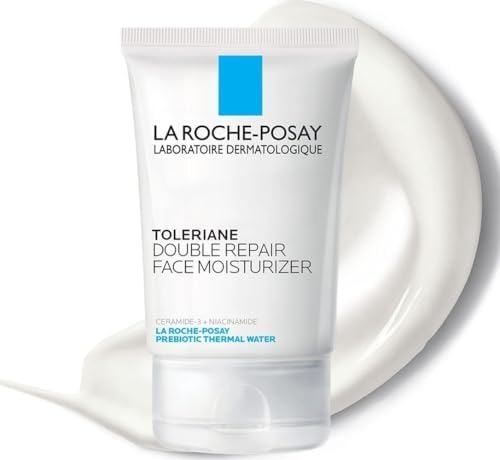
Recommended Gentle Everyday Products


Contents
- What Chelating Agents Do in a Formula
- How Chelation Works
- Common Chelating Agents on Labels
- Are Chelating Agents Safe?
- The Environmental Question
- Chelating Agents and Hard Water
- Why They Matter for Active Ingredients
- How to Spot Chelating Agents on a Label
- Chelating Agents in Natural and DIY Products
- Dos and Don’ts
- Honest Limits
- When to See a Dermatologist
- Questions People Ask
- The Takeaway
At a Glance
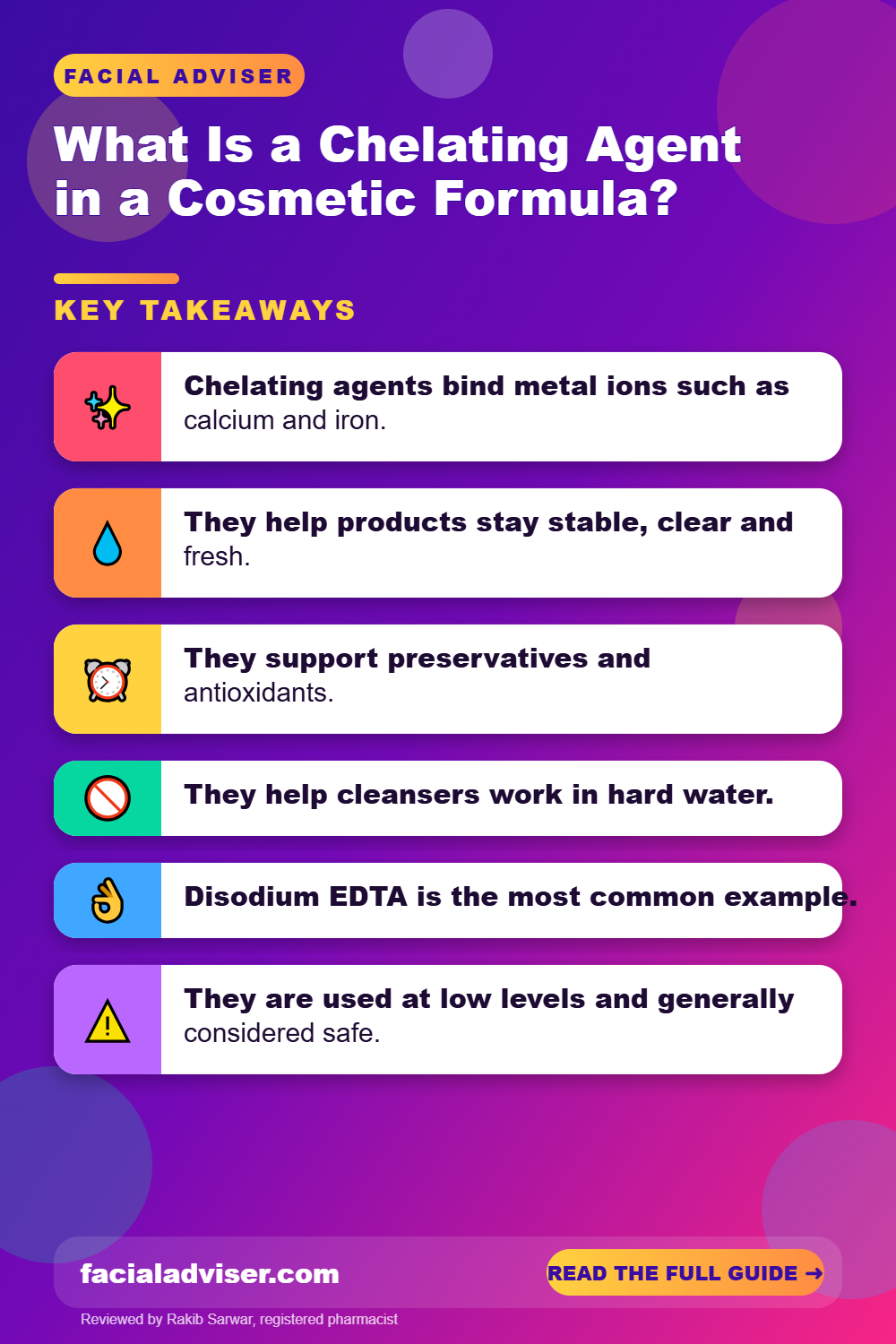
- Chelating agents bind metal ions such as calcium and iron.
- They help products stay stable, clear and fresh.
- They support preservatives and antioxidants.
- They help cleansers work in hard water.
- Disodium EDTA is the most common example.
- They are used at low levels and generally considered safe.
- Newer biodegradable alternatives are becoming more common.
What Chelating Agents Do in a Formula
| Problem caused by metal ions | What happens | How chelating agents help |
|---|---|---|
| Oxidation | Oils go rancid; vitamins break down | Bind metals that speed up oxidation |
| Colour change | Products yellow or darken over time | Prevent metal-catalysed reactions |
| Weaker preservatives | Microbes grow more easily | Help preservatives work efficiently |
| Poor foaming in hard water | Cleansers lather less | Tie up calcium and magnesium |
| Cloudiness or residue | Minerals react with other ingredients | Keep minerals in solution |
Metals such as iron and copper act as catalysts, speeding up reactions that break down ingredients. By holding on to them, chelating agents slow these reactions and extend a product’s shelf life.
They are part of a team. Antioxidants mop up free radicals once oxidation starts, preservatives control microbes, and packaging limits exposure to air and light. Chelating agents work at the start of the chain by removing one of the main triggers, which makes all the other protections more effective.
Chelating agents do not usually have a direct benefit for your skin. Their job is to protect the formula so that the active and moisturising ingredients stay effective.
How Chelation Works
Metal ions carry a positive charge and are attracted to parts of other molecules that carry a negative charge. A chelating agent has several of these negatively charged or electron-rich sites arranged so they can wrap around a single metal ion at once.
Because the metal is held at several points, the bond is strong and stable. The metal ion stays dissolved but is effectively locked away, so it can no longer drive reactions such as oxidation.
Different chelating agents prefer different metals. Some are particularly good at binding calcium and magnesium, which matter most for hard water, while others bind iron and copper, which matter most for preventing oxidation. Formulators choose the chelating agent, and sometimes a combination, to match the problems a particular product is likely to face.
The amount needed depends on the water used, the raw materials and the type of product. That is why the same brand may use different chelating agents across its range.
Common Chelating Agents on Labels
| Name on label | Type | Notes |
|---|---|---|
| Disodium EDTA | Synthetic | Most widely used; very effective |
| Tetrasodium EDTA | Synthetic | Common in cleansers and soaps |
| Trisodium EDTA | Synthetic | Similar function to other EDTA salts |
| Tetrasodium glutamate diacetate (GLDA) | Plant-derived or biobased | Readily biodegradable alternative to EDTA |
| Sodium phytate, phytic acid | Plant-derived | Natural-positioned alternative |
| Trisodium ethylenediamine disuccinate | Synthetic | Biodegradable alternative |
| Citric acid, sodium citrate | Naturally occurring | Weak chelators; mainly pH adjusters |
| Sodium gluconate | Naturally derived | Mild chelator |
You will usually find these near the end of the ingredient list, because they are effective at very low concentrations, often well under one percent. Their position on the list says little about their importance; a tiny amount can make a big difference to how long a product stays stable.
Are Chelating Agents Safe?
For use on skin, the common chelating agents have a good safety record. The Cosmetic Ingredient Review expert panel published a safety assessment of EDTA and its salts, concluding that they are safe as used in cosmetic formulations.
The same report noted that EDTA can increase how easily some other ingredients pass into the skin. This is one reason formulators consider the whole formula rather than each ingredient in isolation, and why concentrations are kept low.
Chelating agents are also used in some foods and medicines, which means their behaviour in the body has been studied more than many cosmetic ingredients. The amounts in skincare are small, and very little is absorbed through intact skin.
Allergic reactions to chelating agents are uncommon. If you react to a product that contains one, the cause is more likely to be fragrance, a preservative or another ingredient, though patch testing is the only way to know for sure.
If a product causes itching, redness or a rash, stop using it and keep the ingredient list. A dermatologist can use patch testing to identify the cause.
The Environmental Question
The main concern with EDTA is environmental rather than a direct risk to skin. EDTA breaks down slowly in the environment, and because it is used in many household and industrial products, it can persist in waterways.
This has led some brands to switch to more readily biodegradable chelating agents such as GLDA, sodium phytate and trisodium ethylenediamine disuccinate. These can perform well, although they may need to be used at slightly different levels or combined with other ingredients.
From a skin point of view, both EDTA and its alternatives are generally well tolerated. The choice between them is more about environmental priorities and formulation needs than safety on the skin.
Our guide on where makeup ingredients come from covers how natural and synthetic ingredients are sourced.
Chelating Agents and Hard Water
Hard water contains high levels of calcium and magnesium. These minerals can react with the cleansing agents in soaps and some cleansers, forming a residue and reducing lather.
Chelating agents in cleansers bind these minerals, helping the cleanser foam and rinse cleanly. This is one reason they are especially common in shampoos, body washes and bar soaps.
Hard water can also leave a film of mineral salts and soap residue on the skin, which some people find drying or irritating, particularly if they have eczema. If you live in a hard-water area and your skin feels tight or coated after washing, a gentle cleanser formulated with chelating agents, or a rinse-free option such as micellar water, may feel more comfortable. Our guide to cleansing oils versus micellar water covers when each is useful.
Why They Matter for Active Ingredients
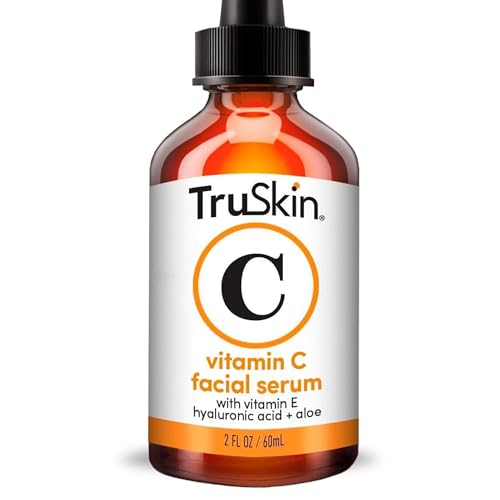
Some active ingredients are particularly sensitive to metal ions. Vitamin C, for example, oxidises faster in the presence of trace iron or copper, which is one reason vitamin C serums often include a chelating agent alongside antioxidants such as vitamin E and ferulic acid.
Oils and butters can go rancid more quickly when metals are present. A chelating agent helps them stay fresh for longer and keeps their smell from changing.
Our guide on how to store vitamin C serum explains other ways to slow oxidation at home.
Retinol, some plant extracts and fragrance ingredients can also be affected by trace metals. In each case, the chelating agent is quietly helping the ingredients you paid for stay effective until the bottle is finished.
How to Spot Chelating Agents on a Label
Look near the end of the list
Chelating agents are used in small amounts and usually appear towards the end.
Look for EDTA
Disodium EDTA, tetrasodium EDTA and trisodium EDTA are the most common.
Check for alternatives
Look for tetrasodium glutamate diacetate, sodium phytate or phytic acid.
Note citrates and gluconates
Citric acid, sodium citrate and sodium gluconate can play a minor chelating role.
Consider your priorities
If environmental impact matters to you, you may prefer products using biodegradable alternatives.
Many products labelled EDTA-free simply use a different chelating agent. The label tells you which one was chosen, not whether the product needs one.
Chelating Agents in Natural and DIY Products
Products marketed as natural often avoid EDTA and use sodium phytate, phytic acid or citrates instead. These can work well, but some are weaker chelators, so natural formulas may rely more on careful packaging, antioxidants and shorter shelf lives.
Homemade skincare usually has no chelating agent at all. Combined with tap water, plant oils and no reliable preservative system, this is one reason homemade creams and lotions can spoil quickly, sometimes within days.
If you make your own products, using distilled water, clean equipment and small batches helps. Water-free recipes such as oils and balms are less affected by metal ions and microbes than water-based ones.
Our guide on which cosmetic preservatives are mild explains why preservation matters so much in water-based products.
Dos and Don’ts
Worth Doing
- Understand that chelating agents protect the formula
- Choose biodegradable alternatives if the environment is a priority
- Use gentle cleansers in hard-water areas
- Store products away from heat and light
- Patch test new products
Skip It
- Assume EDTA-free means better for your skin
- Blame a chelating agent first if you react
- Expect chelating agents to treat skin concerns
- Ignore changes in colour or smell
- Keep products past their expiry date
Honest Limits
This article gives a general overview. The exact role of a chelating agent depends on the rest of the formula, and different products use them at different levels for different reasons.
Research on the environmental impact of cosmetic EDTA specifically, as opposed to industrial uses, is limited. Brands’ claims about switching to greener alternatives should be read with that in mind.
For your skin, the presence or absence of a chelating agent is rarely the deciding factor. How well the whole product suits your skin type matters far more. A well-formulated product with or without EDTA will serve you better than a poorly formulated one that avoids it for marketing reasons.
When to See a Dermatologist
- You react to many skincare or cosmetic products.
- You have persistent redness, itching or rash after washing.
- You suspect hard water is irritating your skin and nothing helps.
- You want patch testing to identify ingredient allergies.
This article is for general information and does not replace professional medical advice. See a dermatologist for persistent skin concerns.
Questions People Ask
What is a chelating agent in cosmetics?
An ingredient that binds metal ions to keep a formula stable and effective.
What is disodium EDTA used for?
It is a common chelating agent that helps stabilise products and support preservatives.
Is EDTA safe in skincare?
An expert safety review concluded EDTA and its salts are safe as used in cosmetics.
Why do cleansers contain chelating agents?
They help cleansers foam and rinse properly, especially in hard water.
Are there natural chelating agents?
Yes. Sodium phytate, phytic acid and citrates are naturally derived options.
What is GLDA?
Tetrasodium glutamate diacetate, a readily biodegradable alternative to EDTA.
Do chelating agents benefit the skin directly?
Not usually; they mainly protect the formula.
Why is EDTA an environmental concern?
It breaks down slowly and can persist in waterways.
Can chelating agents cause allergies?
Reactions are uncommon; other ingredients are more often the cause.
Do vitamin C serums need chelating agents?
Many include them, as metal ions can speed up vitamin C oxidation.
The Takeaway
Chelating agents such as disodium EDTA bind metal ions from water and raw materials, keeping cosmetics stable, clear and well preserved and helping cleansers work in hard water.
They are used at low levels and are considered safe for skin. The main debate is environmental, which is why biodegradable alternatives such as GLDA and sodium phytate are becoming more common.

Written by
Registered pharmacist and founder of Facial Adviser. Rakib's pharmacy training covers how skincare actives work and interact; a later course in cosmetology turned that into a focus on facial treatments and skincare products. He plans, researches and edits every guide on the site and checks health claims against sources such as the American Academy of Dermatology, the FDA and the NIH. He is not a dermatologist; see the Editorial Policy and Medical Disclaimer.
About · Editorial policy · How we choose products · Medical disclaimer · Contact
Keep reading: How cosmetics are made