How Foundation Shades Are Formulated (and Why Matching Is Hard)
Finding a foundation that matches your skin can feel like guesswork. One shade looks right in the bottle and orange on your face; another matches your jaw but turns grey on your cheeks by lunchtime. Understanding how shades are made explains a lot of these frustrations.
Part of our guide to makeup how-to. Start with: How to Find the Right Shade of Makeup: Undertone, Depth and Testing
Most foundation shades are built from a small set of pigments: white titanium dioxide for lightness and coverage, and red, yellow and black iron oxides for colour. Changing the ratio of these pigments creates depth, from fair to deep, and undertone, from cool pink to warm golden or neutral. Formulators adjust the mix for each shade, then test it on real skin, because the same pigment ratio can look different depending on the base, finish and how the foundation oxidises on skin.
This is why shade ranges take so much work. Adding more shades is not just a matter of adding more pigment; deep shades in particular need a different balance of pigments to avoid looking ashy, grey or too red.
All the colour additives in these formulas must be permitted for use in cosmetics. In the United States, the FDA keeps a list of colour additives permitted in cosmetics, which includes titanium dioxide and iron oxides.
This guide explains how foundation shades are built, why undertone matters as much as depth, why foundation can change colour on your skin, and how to use that knowledge to find a better match.
Shopping these picks?
Amazon Prime members get fast, free shipping on eligible items, plus Prime Video, Amazon Music and member deals. New members can start with a free trial.
Start a free Prime trialAged 18 to 24? Prime for Young Adults comes with a longer free trial and a lower price after it.
Affiliate link: we may earn a commission at no extra cost to you.
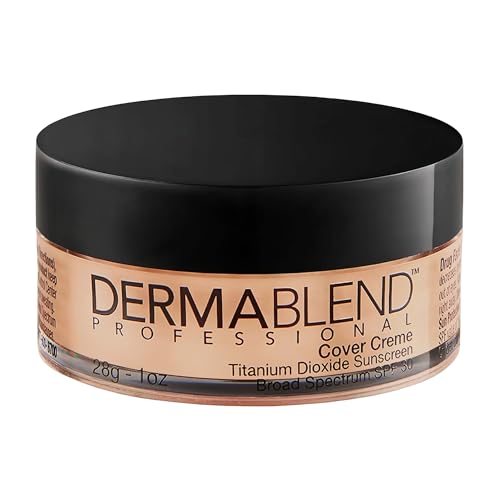
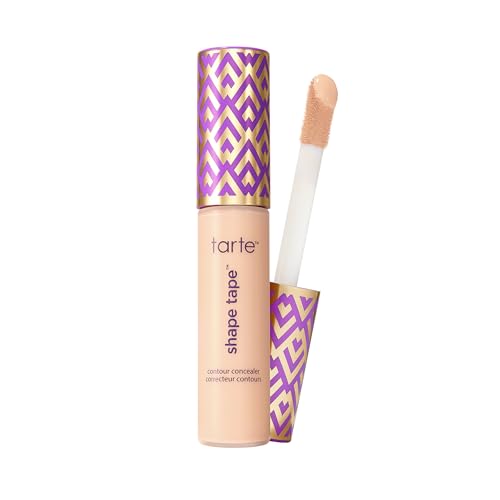
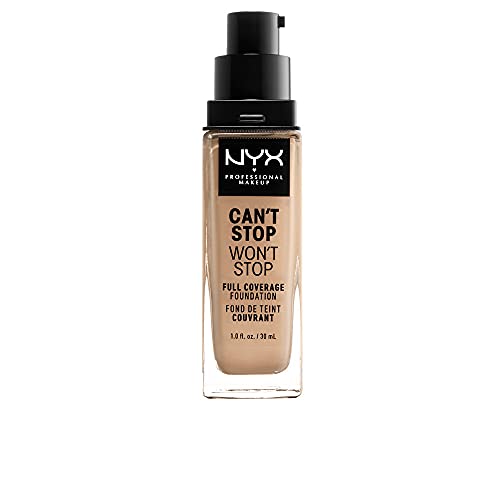
Recommended Wide-Range Foundations and Tools


Key Takeaways
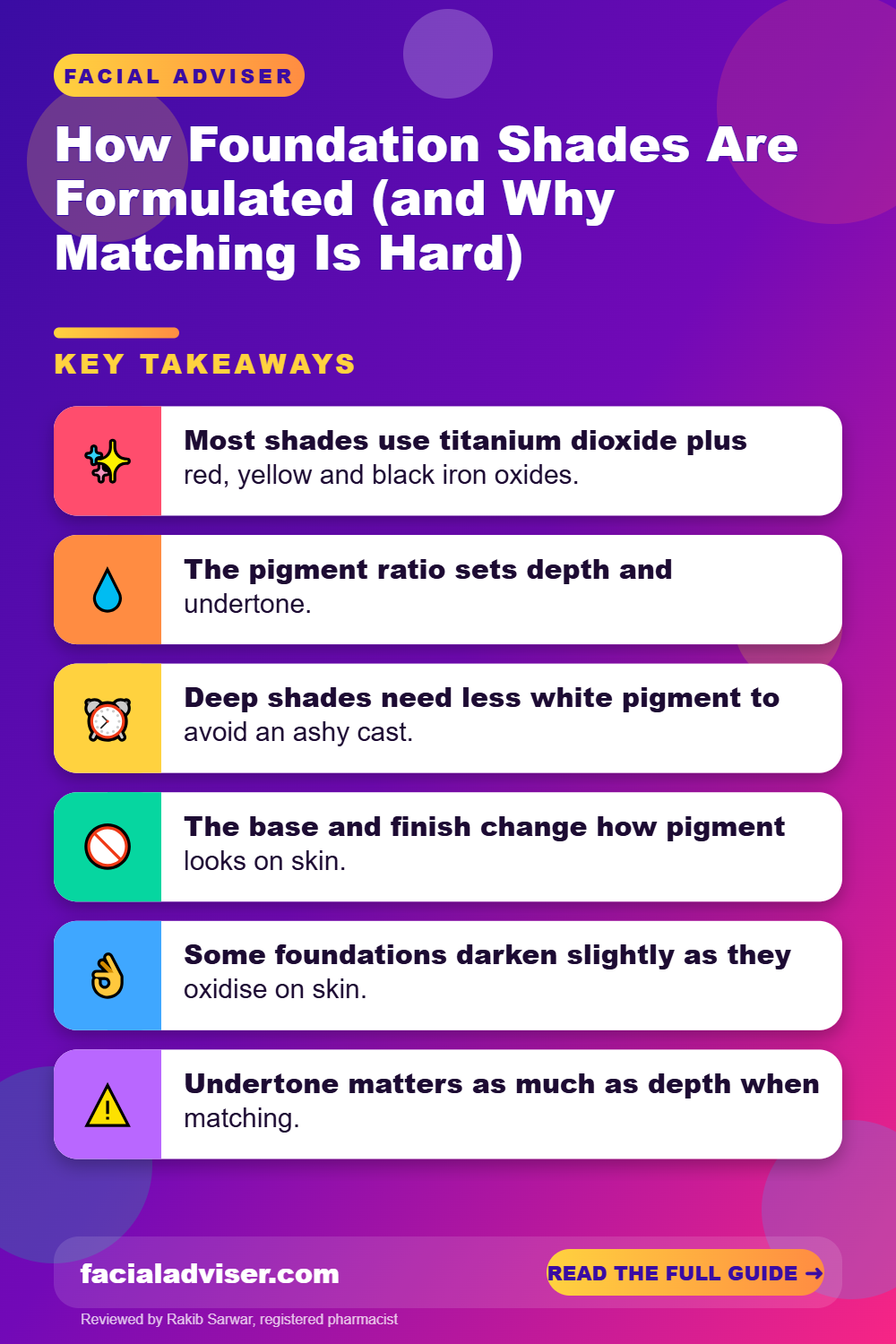
- Most shades use titanium dioxide plus red, yellow and black iron oxides.
- The pigment ratio sets depth and undertone.
- Deep shades need less white pigment to avoid an ashy cast.
- The base and finish change how pigment looks on skin.
- Some foundations darken slightly as they oxidise on skin.
- Undertone matters as much as depth when matching.
- Test shades on the jawline in daylight.
In This Guide
- The Building Blocks of a Shade
- Creating Depth: Fair to Deep
- Undertone: Why It Matters as Much as Depth
- How the Formula Changes the Colour
- Why Foundation Changes Colour on Your Skin
- How to Find Your Foundation Shade
- Common Shade-Matching Mistakes
- How Brands Develop and Test Shades
- Matching Concealer and Powder
- Dos and Don’ts
- Honest Limits
- When to See a Dermatologist
- Questions People Ask
- The Takeaway
The Building Blocks of a Shade
| Pigment | Colour | What it does to a shade |
|---|---|---|
| Titanium dioxide (CI 77891) | White | Lightens and adds coverage |
| Yellow iron oxide (CI 77492) | Yellow | Adds warmth and golden tones |
| Red iron oxide (CI 77491) | Red | Adds warmth, pink or red tones |
| Black iron oxide (CI 77499) | Black | Deepens and neutralises |
| Other pigments (in some formulas) | Various | Fine-tune difficult shades |
A fair shade might be mostly titanium dioxide with a small amount of yellow and red. A deep shade uses much more iron oxide, especially red and black, and relatively little titanium dioxide.
Undertone comes from the balance between the iron oxides. More yellow makes a shade warmer, more red makes it pinker or cooler-looking, and black adjusts depth and can help neutralise.
Pigments are often added to foundation as pre-dispersed colour concentrates rather than dry powders. This helps make each batch consistent and the colour even.
Creating Depth: Fair to Deep
Moving along a shade range from fair to deep mainly means reducing white pigment and increasing iron oxides. But it is not a straight line. Simply adding more of the same brown mix to a light shade tends to create muddy or grey results in the deeper shades.
Deeper skin tones often have rich red, golden or neutral undertones and can look ashy if there is too much titanium dioxide. Formulators usually rebalance the pigment mix for deep shades, sometimes reducing titanium dioxide significantly and adjusting the ratio of red, yellow and black.
This is one reason some brands have historically offered fewer deep shades, and why wider shade ranges are a genuine formulation achievement rather than a simple extension.
Very fair shades have their own challenges. Too much white pigment can look chalky or flat, so formulators often keep a little warmth or pink in even the lightest shades to stop them looking lifeless on skin.
Undertone: Why It Matters as Much as Depth
| Undertone | How it looks | Common shade labels |
|---|---|---|
| Cool | Pink, red or bluish tones | C, pink, rosy |
| Warm | Yellow, golden or peachy tones | W, golden, warm |
| Neutral | A balance of both | N, neutral, beige |
| Olive | Greenish or grey-green cast | O, olive, sometimes neutral |
Many people choose the right depth but the wrong undertone, which is why a foundation can look orange, pink or grey even when it is roughly the right lightness.
Olive undertones are among the hardest to match, because they are not simply warm or cool. Some brands now label olive shades separately.
Popular tricks such as checking the colour of the veins on your wrist or whether gold or silver jewellery suits you can give a rough hint, but they are not reliable for everyone. Testing foundation shades directly on your face is a much better guide than any rule of thumb.
Compare two shades of the same depth but different undertones side by side on your jaw. The one that seems to disappear into your skin is your undertone.
How the Formula Changes the Colour
The same pigment mix can look different depending on the rest of the formula. Matte foundations can look slightly lighter or flatter, while dewy formulas reflect more light and can look brighter.
Coverage level matters too. A sheer tint lets your own skin show through, so shade matching is more forgiving. A full-coverage formula replaces more of your natural colour, so a mismatch is easier to see. Our guide on what makes makeup high coverage explains why.
Sunscreen filters in foundation can also affect the look. Mineral filters such as titanium dioxide and zinc oxide add white pigment, which can lighten a shade or give a slight cast in flash photography. Our guide to physical versus chemical SPF in cosmetics covers this in more detail.
Why Foundation Changes Colour on Your Skin
Many people notice that foundation looks slightly darker or more orange after an hour or two. This is often called oxidation, although several things can contribute.
- Oil on the skin mixes with the foundation and can deepen its colour.
- Evaporation of water or volatile ingredients concentrates the pigment.
- Ingredients in the formula, including some plant extracts and antioxidants, can darken when exposed to air.
- Your skincare underneath can interact with the foundation.
- Lighting in different places makes colour look different.
Checking a new foundation after 15 to 30 minutes, rather than immediately, gives a truer idea of how it will look through the day. Oilier skin tends to show more change than dry skin. If a shade consistently darkens on you, choosing one a touch lighter can help.
If a foundation causes itching, stinging, redness or a rash, remove it and stop using it, whatever the shade. Fragrance and some pigments or preservatives can cause reactions.
How to Find Your Foundation Shade
Start with clean, moisturised skin
Apply your usual skincare so the test reflects real wear.
Choose two or three candidates
Pick shades close in depth but with different undertones.
Swatch on your jawline
Apply thin stripes along the jaw, where face and neck meet.
Wait 15 to 30 minutes
Let the foundation settle and any oxidation occur.
Check in daylight
Look in natural light near a window, not under shop lighting.
Pick the shade that disappears
Choose the stripe that blends into both face and neck.
If you are between shades, many people mix two foundations to get a custom match. You can also use a slightly deeper shade around the edges of the face and a lighter one in the centre, which adds a little natural dimension as well as improving the match.
Common Shade-Matching Mistakes
- Testing on the back of the hand or wrist, which is often a different colour from the face.
- Choosing a shade under bright shop lights.
- Matching the face but not the neck, creating a visible line at the jaw.
- Ignoring undertone and focusing only on depth.
- Not waiting for the foundation to settle before deciding.
- Using the same shade all year when your skin tone changes with the seasons.
Skin tone often changes through the year with sun exposure. Many people need a slightly deeper shade in summer and a lighter one in winter, or mix the two in between.
How Brands Develop and Test Shades
Developing a shade range usually starts with defining the skin tones it should cover. Formulators then create a series of pigment blends and test them on people with a wide range of skin tones and undertones, adjusting each shade until it looks natural in different lighting.
Testing on real skin is essential because the same blend can look different once it mixes with skin oils and settles. A shade that looks right in the lab may look too warm or too light after an hour of wear.
Batch consistency is another challenge. Pigments can vary slightly between production runs, so manufacturers check colour against standards to keep each shade consistent from bottle to bottle.
Brands with very wide shade ranges often space their shades more closely in the areas where many people fall, and add distinct undertone options at each depth, rather than simply stepping evenly from light to dark.
Matching Concealer and Powder
Concealer and powder follow the same pigment principles as foundation, but you may not want an exact match. Under the eyes, many people choose a concealer one shade lighter or with a slightly peachy undertone to brighten and offset darkness.
For blemishes and redness, a concealer that matches your foundation exactly usually looks most natural. A lighter concealer on a spot can draw attention to it.
Setting powders can also shift the colour of your base. Translucent powders are designed to add as little colour as possible, while tinted powders add a small amount of pigment. If your foundation looks lighter or ashier after setting, the powder may be the cause.
Dos and Don’ts
Worth Doing
- Swatch on the jawline
- Check shades in natural daylight
- Consider undertone as well as depth
- Wait before deciding
- Use samples before buying full sizes
Skip It
- Test on your hand
- Judge under shop lighting
- Match only your face, not your neck
- Assume one shade fits all year
- Keep a shade that consistently looks orange or grey
Honest Limits
Shade names and numbers are not standardised between brands. A 220 in one range may be nothing like a 220 in another, so you often need to re-test when you switch brands.
This article simplifies how pigments work. Real formulation involves many more variables, including particle size, coatings on the pigments and how they are dispersed, all of which affect how a shade looks on skin.
Online shade finders and photos can help narrow things down, but screens and lighting vary widely. Trying the product on your own skin remains the most reliable test. Many brands and shops offer samples or small sizes, which are worth using before committing to a full bottle, especially with a new brand.
When to See a Dermatologist
- You use foundation to cover patches of skin that are changing in colour.
- You have uneven pigmentation, such as melasma, that is getting worse.
- You notice a new or changing spot under your makeup.
- Foundation regularly causes itching, redness or a rash.
This article is for general information and does not replace professional medical advice. See a dermatologist for persistent skin concerns.
Questions People Ask
How are foundation shades made?
By mixing white titanium dioxide with red, yellow and black iron oxides in different ratios.
What gives foundation its undertone?
The balance of red and yellow iron oxides, adjusted with black.
Why do some foundations look ashy on dark skin?
Too much white pigment relative to iron oxides can leave a grey cast.
Why does my foundation turn orange?
Oil, evaporation, formula ingredients and lighting can make it look darker or warmer.
Where should I test foundation?
On the jawline, in natural daylight.
What is an olive undertone?
A greenish or grey-green cast that is neither clearly warm nor cool.
Can I mix two foundation shades?
Yes. Many people mix shades to get a custom match.
Why does my shade change between seasons?
Sun exposure can deepen skin tone in summer.
Are shade numbers the same across brands?
No. Shade names and numbers are not standardised.
Does SPF in foundation change the colour?
Mineral filters can lighten a shade slightly or cause a cast in photos.
The Takeaway
Foundation shades are built mainly from titanium dioxide and red, yellow and black iron oxides. The ratio sets both depth and undertone, and deep shades need careful rebalancing to avoid an ashy look.
To find your match, test two or three shades on your jawline, wait for them to settle and check them in daylight. Pay as much attention to undertone as to depth, and adjust your shade as your skin changes through the year.

Written by
Registered pharmacist and founder of Facial Adviser. Rakib's pharmacy training covers how skincare actives work and interact; a later course in cosmetology turned that into a focus on facial treatments and skincare products. He plans, researches and edits every guide on the site and checks health claims against sources such as the American Academy of Dermatology, the FDA and the NIH. He is not a dermatologist; see the Editorial Policy and Medical Disclaimer.
About · Editorial policy · How we choose products · Medical disclaimer · Contact
Keep reading: Foundation, BB cream and base
- How to Find the Right Shade of Makeup: Undertone, Depth and Testing
- What Makes Foundation Waterproof? The Science Explained
- How Color Correctors Neutralize Undertones: Which Shade Fixes What
- Why Foundation Oxidizes on Skin (and How to Stop It Turning Orange)
- How Particle Size Affects Foundation Finish, Coverage and Wear
- Makeup Base Order: Primer vs Sunscreen, Which Goes First?
- How to Get Started as a Freelance Makeup Artist: Training, Kit and Clients
- Best Way to Use Makeup Remover: Micellar Water, Balms, Oils and Eye Removers