Waxing vs Shaving Facial Hair: Which Is Better for Your Skin?
Unwanted facial hair is extremely common, whether it is fine peach fuzz along the cheeks, darker hairs on the upper lip and chin, or the daily stubble of a beard. For most people, the choice for quick, affordable removal comes down to two methods: shaving and waxing.
Part of our guide to at-home facial devices. Start with: 10 Best Products for Women's Facial Hair Removal (2026): Gentle Picks
Shaving cuts hair at the surface, so it is fast and painless but grows back within a day or two. Waxing pulls hair from the root, so results last about three to six weeks, but it hurts more and carries a higher risk of irritation. Neither is better for everyone. The right choice depends on your hair, your skin, and how much time and discomfort you are willing to accept.
One myth is worth clearing up early. Shaving does not make hair grow back thicker, darker, or faster. A controlled study published in 1970 in the Journal of Investigative Dermatology found that shaving had no effect on the rate of hair growth or hair thickness. Regrowth only feels coarser because the hair is cut bluntly rather than tapering to a point.
Your skin and medications matter as much as your hair. If you use a retinoid, have sensitive or acne-prone skin, or have recently had a peel, waxing can remove a layer of skin along with the hair. In those cases, shaving is usually the safer choice.
This guide compares the two methods head to head, walks you through a quick check to find which suits you, explains how to do each safely, and covers the signs that facial hair growth may need a medical checkup.
Shopping these picks?
Amazon Prime members get fast, free shipping on eligible items, plus Prime Video, Amazon Music and member deals. New members can start with a free trial.
Start a free Prime trialAged 18 to 24? Prime for Young Adults comes with a longer free trial and a lower price after it.
Affiliate link: we may earn a commission at no extra cost to you.
Recommended Tools for Waxing and Shaving Facial Hair




Contents
- How Each Method Works
- Waxing vs Shaving at a Glance
- A Quick Check to Find Your Best Method
- Does Shaving Make Hair Grow Back Thicker?
- How to Shave Facial Hair Safely
- How to Wax Facial Hair Safely
- Other Quick Options Worth Knowing
- What Neither Method Can Do
- When Facial Hair Needs a Doctor
- FAQ
- The Takeaway
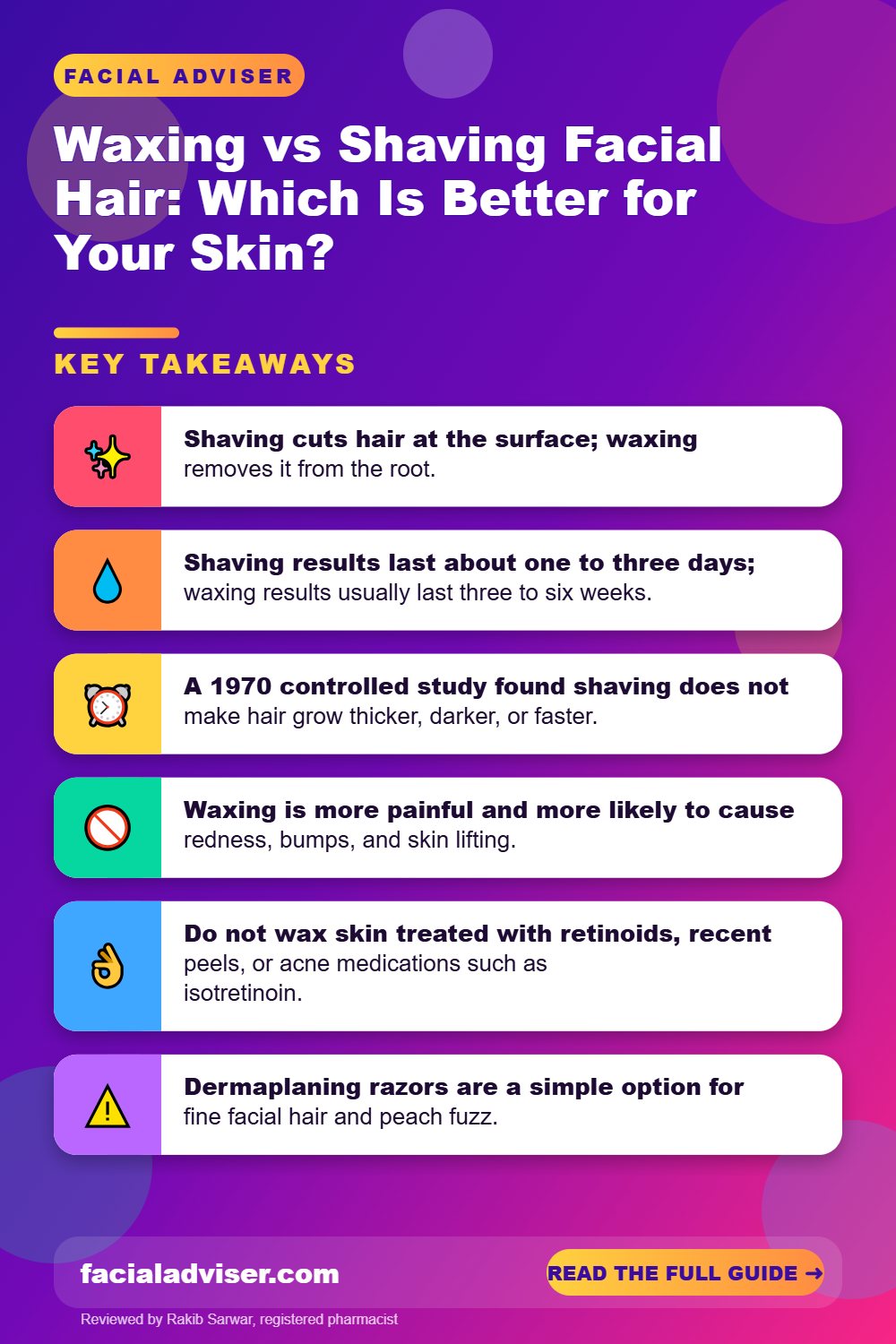
In Brief
- Shaving cuts hair at the surface; waxing removes it from the root.
- Shaving results last about one to three days; waxing results usually last three to six weeks.
- A 1970 controlled study found shaving does not make hair grow thicker, darker, or faster.
- Waxing is more painful and more likely to cause redness, bumps, and skin lifting.
- Do not wax skin treated with retinoids, recent peels, or acne medications such as isotretinoin.
- Dermaplaning razors are a simple option for fine facial hair and peach fuzz.
- Sudden or significant new facial hair growth in women should be checked by a doctor.
How Each Method Works
Shaving
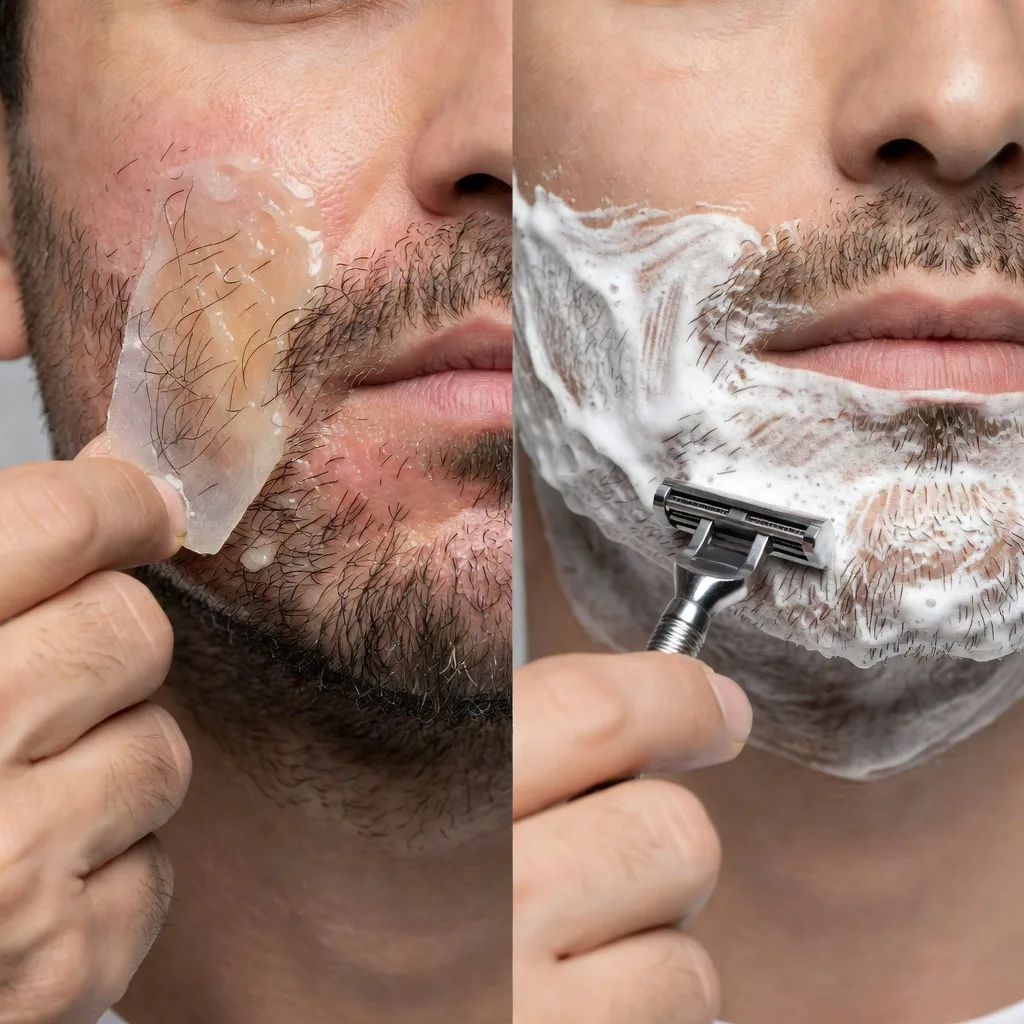
Shaving uses a blade to cut hair level with the skin. For fine facial hair, many people use a single-blade dermaplaning razor, which also removes a thin layer of dead skin. For beard hair, a multi-blade razor or electric shaver is more common. Because the root is untouched, hair reappears within a day or two.
Waxing
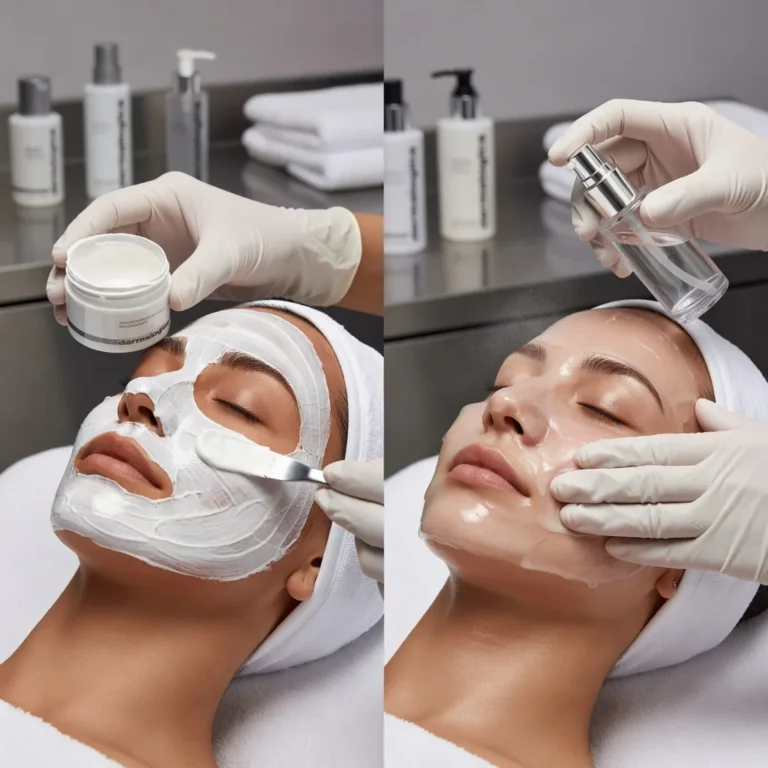
Waxing uses warm or cold wax to grip hairs and pull them out from the follicle. Soft wax is applied thinly and removed with a cloth strip, while hard wax sets and is removed on its own, which many estheticians prefer for the face because it grips hair more than skin. Regrowth usually takes three to six weeks because the hair has to grow back from the root.
If you are considering longer-lasting options, our comparison of laser vs electrolysis for facial hair covers permanent and long-term reduction.
Waxing vs Shaving at a Glance
| Feature | Shaving | Waxing |
|---|---|---|
| How it removes hair | Cuts at the surface | Pulls from the root |
| How long results last | 1 to 3 days | 3 to 6 weeks |
| Pain | Painless when done well | Moderate, brief sting |
| Irritation risk | Razor bumps, nicks | Redness, bumps, skin lifting, burns |
| Minimum hair length | Any length | About 1/4 inch for wax to grip |
| Time | A few minutes | 15 to 30 minutes |
| Safe with retinoids | Usually yes | Usually no |
| Best for | Fine hair, frequent touch-ups, sensitive skin | Longer gaps between sessions, coarser hair |
Many people use both: shaving or dermaplaning for fine peach fuzz, and waxing or threading for the brows or upper lip.
A Quick Check to Find Your Best Method
Answer these questions in order. The first one that clearly applies to you often decides the answer.
Check your medications
If you use a topical retinoid, benzoyl peroxide, or took isotretinoin in the past six months, skip waxing on your face. Choose shaving or dermaplaning.
Look at your skin
If you have active acne, rosacea, eczema, sunburn, or broken skin in the area, avoid waxing until it heals. Shaving gently around problem areas is safer.
Look at your hair
Fine, light peach fuzz usually responds well to a dermaplaning razor. Dark, coarse hairs on the chin or upper lip may be better suited to waxing or threading.
Think about maintenance
If you are happy with a quick daily or every-other-day routine, shaving works. If you want weeks between sessions and can tolerate some discomfort, waxing may fit better.
Do a patch test
Before a full wax, test a small area near the jaw. Watch for 24 hours for redness, bumps, or skin lifting before waxing larger areas.
Do not let hair grow out just to wax if it causes you distress. You can shave now and plan a wax later, allowing about two to three weeks of growth.
Does Shaving Make Hair Grow Back Thicker?
No. This is one of the most persistent beauty myths. In a 1970 study in the Journal of Investigative Dermatology, Lynfield and Macwilliams compared shaved and unshaved areas and found that shaving did not change the rate of hair growth, hair width, or the amount of hair. Earlier work by Mildred Trotter in 1928 reached a similar conclusion.
The reason regrowth can feel thicker is shape. A natural hair tapers to a fine tip. A shaved hair is cut straight across, so the blunt end feels coarser and can look darker as it first pokes through the skin.
Waxing does not permanently thin hair either, although some people notice that regrowth looks finer over time. Evidence for that is anecdotal rather than well studied.
How to Shave Facial Hair Safely
For fine facial hair, use a clean, sharp dermaplaning razor on dry or lightly oiled skin. For beard hair, soften it with warm water and a shave cream or gel first.
Helps
- Start with clean skin and a fresh, sharp blade.
- Hold skin taut and use short, light strokes.
- Shave in the direction of hair growth to reduce bumps.
- Rinse with cool water and apply a gentle moisturizer.
- Replace or clean the blade after each use.
Backfires
- Use a dull or rusty blade.
- Press hard or go over the same area many times.
- Shave over active pimples or cold sores.
- Share razors with anyone else.
- Apply acids or retinoids right after shaving.
If you get razor bumps, try shaving less often, always with the grain, and using a single-blade razor. For persistent bumps on the beard area, see a doctor, as prescription treatments can help.
How to Wax Facial Hair Safely
Waxing the face works best on clean, dry skin with hair about a quarter inch long. Always test the wax temperature on your inner wrist first, since facial skin burns easily.
Apply wax in the direction of hair growth, hold the skin taut, and remove it quickly against the direction of growth, keeping the strip close to the skin. Do not wax the same area more than once in a session. Afterward, apply a cool compress and a gentle, fragrance-free moisturizer or aloe gel.
Waxing can lift the top layer of skin, leaving a raw, shiny patch that may scab or darken. This is much more likely if you use retinoids, have recently had a peel, or wax too hot or too often.
If you have darker skin, be especially careful, since irritation from waxing can leave post-inflammatory hyperpigmentation that lasts for weeks or months. A professional using hard wax may reduce that risk.
Other Quick Options Worth Knowing
Shaving and waxing are not the only temporary methods. Depending on the area and your skin, one of these may suit you better.
- Threading uses a twisted cotton thread to pull out rows of hair. It is popular for brows and the upper lip, avoids hot wax, and suits many people who use retinoids, although it can still sting.
- Tweezing works for a few stray chin hairs. It is precise but slow, and it can lead to ingrown hairs if the hair snaps below the surface.
- Depilatory creams dissolve hair at the surface. Only use products labeled for the face, since body formulas can burn facial skin, and always patch test first.
- Epilators pull out many hairs at once. They last as long as waxing but are uncomfortable on the face for most people.
Pick one method per area. Switching between waxing, threading, and tweezing on the same spot every few days gives skin no time to recover and increases irritation and ingrown hairs.
If you are comparing two root-removal methods, our guide to epilators versus waxing covers the practical differences in pain, time, and regrowth. Whatever you choose, clean skin, clean tools, and gentle aftercare do more to prevent problems than the method itself.
What Neither Method Can Do
Shaving and waxing are both temporary. Neither changes the number of hair follicles you have, and neither reduces hair that is driven by hormones or medical conditions.
| Common belief | What is actually true |
|---|---|
| Shaving makes hair grow thicker | Studies show no effect on thickness or growth rate |
| Waxing removes hair permanently | Hair regrows in about three to six weeks |
| Waxing works on any length | Hair usually needs to be about 1/4 inch |
| Shaving causes more ingrown hairs | Both can cause them, depending on hair and technique |
| Home waxing is always safe | Burns and skin lifting are common mistakes |
For longer-lasting reduction, laser hair removal and electrolysis are the main options, and our guide on whether home laser hair removal is safe covers at-home devices.
When Facial Hair Needs a Doctor
Some facial hair is completely normal, but certain patterns can signal an underlying condition, especially in women. See a doctor if you notice:
- Sudden or rapidly increasing coarse hair on the chin, jaw, chest, or upper lip.
- Facial hair along with irregular periods, acne, or thinning scalp hair.
- Deepening voice or other signs of increased male hormones.
- New hair growth after starting a new medication.
- Painful, pus-filled bumps that keep recurring after hair removal.
- Dark patches that appear or persist after waxing or shaving.
Polycystic ovary syndrome is one of the most common causes of excess facial hair in women. Our guide on normal facial hair vs PCOS explains what to look for.
Medical disclaimer: This article is for general information and is not a substitute for professional medical advice. Talk to a healthcare provider about sudden or excessive hair growth.
FAQ
Is waxing or shaving better for facial hair?
Neither is better for everyone. Shaving is quick and painless but short-lasting. Waxing lasts weeks but hurts more and irritates skin more easily.
Does shaving your face make hair grow back thicker?
No. A 1970 controlled study found shaving does not change hair thickness, color, or growth rate.
How long does facial waxing last?
Usually three to six weeks, depending on your hair growth cycle.
Can I wax my face if I use retinol?
It is best not to. Retinoids thin the outer skin layer, which makes skin lifting and burns more likely.
Is dermaplaning the same as shaving?
It is a form of shaving with a single blade that also removes dead skin. Results last about as long as regular shaving.
Which causes more ingrown hairs?
Both can. Shaving against the grain and waxing coarse, curly hair both raise the risk.
Can I wax my upper lip at home?
Yes, with care. Test the temperature, use a small amount of wax, and avoid waxing the same spot twice.
Should women shave their faces?
Many do, particularly with dermaplaning razors for fine hair. It is safe when done gently with a clean blade.
What should I put on my face after waxing?
A cool compress and a gentle, fragrance-free moisturizer or aloe gel. Avoid makeup, acids, and sun for a day.
When should I see a doctor about facial hair?
If growth is sudden, coarse, or comes with irregular periods, acne, or hair thinning, as it may be hormonal.
The Takeaway
Shaving and waxing both remove facial hair temporarily, but they suit different needs. Shaving is quick, painless, and safer for sensitive or retinoid-treated skin, while waxing lasts weeks longer but hurts more and carries a higher risk of redness, bumps, and skin lifting. And no, shaving will not make your hair grow back thicker.
Check your medications and skin first, match the method to your hair type and maintenance preferences, and patch test before waxing. If facial hair appears suddenly or comes with other symptoms, see a doctor before focusing on removal.

Written by
Registered pharmacist and founder of Facial Adviser. Rakib's pharmacy training covers how skincare actives work and interact; a later course in cosmetology turned that into a focus on facial treatments and skincare products. He plans, researches and edits every guide on the site and checks health claims against sources such as the American Academy of Dermatology, the FDA and the NIH. He is not a dermatologist; see the Editorial Policy and Medical Disclaimer.
About · Editorial policy · How we choose products · Medical disclaimer · Contact
Keep reading: Facial hair removal
- 10 Best Products for Women's Facial Hair Removal (2026): Gentle Picks
- Beard vs Clean-Shaven: What Facial Hair Does for Your Skin and Look
- Laser vs Electrolysis for Facial Hair: Which Works for Your Hair and Skin
- Epilator vs Waxing for Facial Hair: Pain, Results, and Skin Safety
- Facial Razor vs Normal Razor: Can You Use a Regular Razor on Your Face?
- 10 Best IPL Hair Removal Systems (2026): Smoother Skin at Home
- 10 Best LED Light Therapy Masks (2026): Clearer Skin, Softer Lines
- How to Incorporate Microcurrent Into Your Routine: Gel, Timing and Safety