Magnesium Deficiency and Skin: What Is Known and What Is Hype
Magnesium has a reputation as a wellness cure-all. Online, low magnesium is blamed for everything from acne and dull skin to wrinkles and eczema, and magnesium sprays, oils and supplements are sold as skin fixes.
Part of our guide to lifestyle and skin. Start with: How Diet Impacts the Skin Microbiome: What the Science Actually Shows
Magnesium is essential for hundreds of processes in the body, including some involved in skin repair and inflammation, but there is little direct evidence that mild magnesium deficiency causes acne, wrinkles or dull skin. The strongest skin-related evidence is for topical use: bathing in magnesium-rich Dead Sea salt improved dryness and barrier function in one small study of people with atopic dry skin.
True magnesium deficiency, where blood levels fall low enough to cause symptoms, is uncommon in healthy people who eat a varied diet. It is more likely in people with digestive diseases such as Crohn’s or coeliac disease, type 2 diabetes, heavy alcohol use or in older adults. Its main symptoms are fatigue, nausea, weakness and, when severe, muscle cramps, tingling and heart rhythm problems, not skin changes.
That said, many people eat less magnesium than recommended, often because their diets are low in whole grains, nuts, seeds, beans and leafy greens. Improving intake from food is worthwhile for general health, and the same foods tend to support skin too.
Below we separate the evidence from the marketing, cover who might be low in magnesium, what topical magnesium can do, how to get enough safely, and when to see a doctor.
Shopping these picks?
Amazon Prime members get fast, free shipping on eligible items, plus Prime Video, Amazon Music and member deals. New members can start with a free trial.
Start a free Prime trialAged 18 to 24? Prime for Young Adults comes with a longer free trial and a lower price after it.
Affiliate link: we may earn a commission at no extra cost to you.
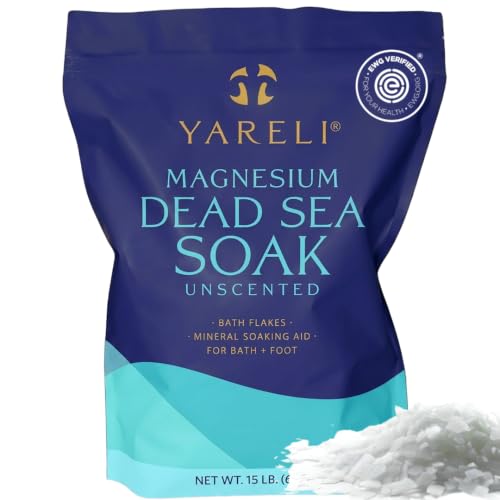
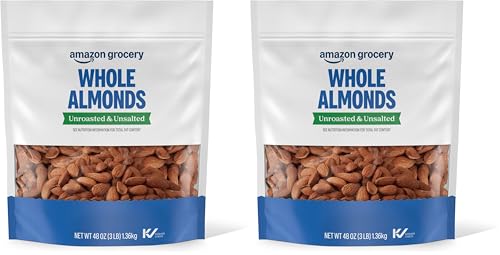
Recommended Magnesium Foods, Supplements and Bath Soaks





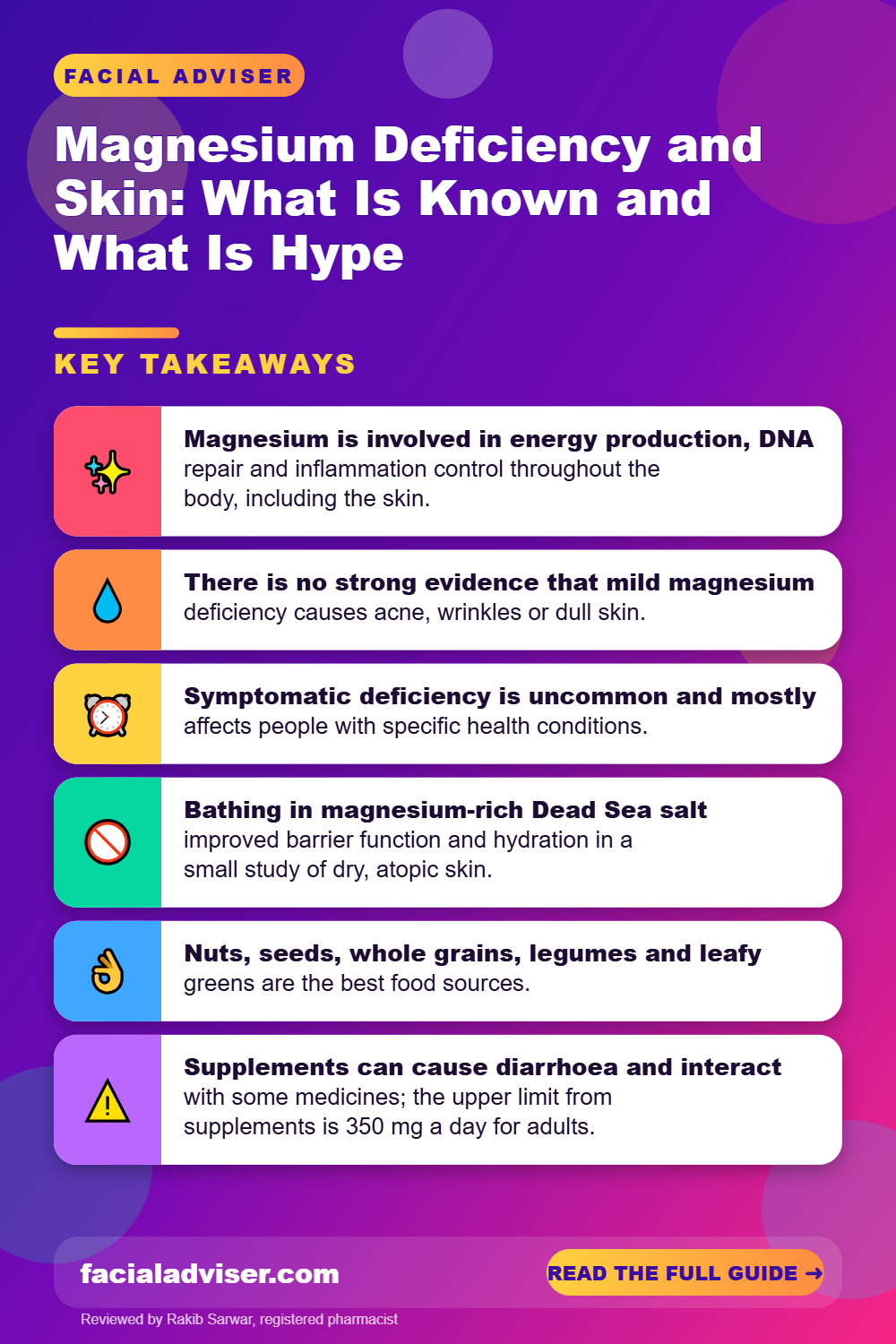
Key Takeaways
- Magnesium is involved in energy production, DNA repair and inflammation control throughout the body, including the skin.
- There is no strong evidence that mild magnesium deficiency causes acne, wrinkles or dull skin.
- Symptomatic deficiency is uncommon and mostly affects people with specific health conditions.
- Bathing in magnesium-rich Dead Sea salt improved barrier function and hydration in a small study of dry, atopic skin.
- Nuts, seeds, whole grains, legumes and leafy greens are the best food sources.
- Supplements can cause diarrhoea and interact with some medicines; the upper limit from supplements is 350 mg a day for adults.
- People with kidney disease should not take magnesium supplements without medical advice.
On This Page
- What Magnesium Does in the Body and Skin
- Who Is Actually at Risk of Low Magnesium?
- Could Your Magnesium Intake Be Low?
- Topical Magnesium: Baths, Oils and Sprays
- Magnesium and Specific Skin Conditions
- Getting Enough Magnesium From Food
- How to Get Enough Magnesium
- Supplements: When and How
- Dos and Don’ts
- Honest Limits
- When to See a Doctor
- Your Questions, Answered
- The Takeaway
What Magnesium Does in the Body and Skin
Magnesium is a mineral needed for more than 300 enzyme reactions. It helps turn food into energy, supports muscle and nerve function, keeps the heart rhythm steady and is involved in making DNA and proteins.
In the skin, magnesium plays a role in cell growth and repair and in regulating inflammation. Laboratory studies suggest it may help skin cells cope with stress and support the barrier. That is the basis for many skin claims, but results in cells and animals do not always translate into visible changes in people.
| Claim | What the evidence says |
|---|---|
| Low magnesium causes acne | No reliable human studies show this |
| Magnesium supplements clear skin | Not supported by trials |
| Magnesium reduces skin ageing | Lab data only; no human evidence |
| Magnesium baths help dry, itchy skin | Small study support for Dead Sea salt in atopic dry skin |
| Magnesium helps sleep and stress, indirectly helping skin | Some evidence for sleep in older adults; skin effect unproven |
Who Is Actually at Risk of Low Magnesium?
The NIH Office of Dietary Supplements lists groups more likely to be low in magnesium: people with gastrointestinal diseases such as Crohn’s disease or coeliac disease, people with type 2 diabetes, people with long-term alcohol problems and older adults (NIH ODS).
Some medicines can also lower magnesium, including long-term use of proton pump inhibitors for acid reflux and some diuretics.
The NIH notes that low intake in the short term often causes no symptoms. Over time, deficiency can cause loss of appetite, nausea, fatigue and weakness, and in severe cases numbness, tingling, muscle cramps, seizures and abnormal heart rhythms.
Skin changes are not a recognised sign of magnesium deficiency. If you have persistent skin problems, other causes are far more likely and worth investigating first.
Could Your Magnesium Intake Be Low?
- You rarely eat nuts, seeds, beans, lentils, whole grains or leafy green vegetables.
- You drink alcohol heavily or regularly.
- You have Crohn’s disease, coeliac disease or another condition affecting absorption.
- You have type 2 diabetes.
- You take a proton pump inhibitor or diuretic long term.
- You are over 70.
If several apply, talk to your doctor. A blood test can check magnesium, although blood levels do not always reflect total body stores. Improving your diet is a safe first step for almost everyone, and it is far more likely to benefit your skin than any single supplement.
Topical Magnesium: Baths, Oils and Sprays
The most interesting skin evidence involves applying magnesium to the skin rather than swallowing it. In a study of volunteers with atopic dry skin, soaking one forearm in a 5% Dead Sea salt solution for 15 minutes a day for six weeks improved skin barrier function, increased hydration and reduced roughness and redness compared with the other arm soaked in tap water (Proksch et al., 2005).
Dead Sea salt is rich in magnesium but also contains other minerals, so it is hard to credit magnesium alone. Epsom salt is magnesium sulphate, a different compound, and has not been studied the same way for skin.
Magnesium oils and sprays are popular for ‘absorbing magnesium through the skin’. There is little good evidence that meaningful amounts reach the bloodstream this way, and they can sting or itch, especially on the face.
If you want to try a mineral soak for dry body skin, keep water warm rather than hot, limit baths to 15 minutes and apply moisturiser straight afterwards to lock in hydration.
Magnesium and Specific Skin Conditions
Eczema and very dry skin
The Dead Sea salt study is the main piece of evidence here. It was small and focused on forearm skin rather than the face, but it suggests mineral soaks may be a reasonable add-on for dry, rough body skin, alongside emollients and any prescribed treatment.
Psoriasis
Treatment at the Dead Sea itself, combining mineral-rich water with natural sunlight, has long been used for psoriasis. It is hard to separate the effect of magnesium from UV exposure and the other minerals, and home bath products cannot recreate the full setting.
Acne and rosacea
There is no solid evidence that magnesium supplements or topical magnesium improve acne or rosacea. Proven options such as retinoids, azelaic acid, benzoyl peroxide and prescription treatments remain the way to go.
Facial skin
Most magnesium products are designed for the body. Magnesium sprays and oils can sting, and facial skin is thinner and more reactive, so it is best to avoid using them on the face unless a product is specifically formulated for it.
Getting Enough Magnesium From Food
The NIH recommends 400 to 420 mg a day for adult men and 310 to 320 mg for adult women. Food is the best way to get there.
| Food group | Examples | Notes |
|---|---|---|
| Seeds | Pumpkin seeds, chia seeds, flaxseed | Among the richest sources |
| Nuts | Almonds, cashews, peanuts | Also provide healthy fats |
| Legumes | Black beans, kidney beans, lentils, edamame | Add fibre and protein |
| Whole grains | Oats, brown rice, wholewheat bread, quinoa | Refined grains lose much of their magnesium |
| Leafy greens | Spinach, chard, kale | Also rich in vitamins |
| Other | Dark chocolate, cacao, avocado, bananas, yoghurt | Useful extras |
Many of these foods also supply zinc, omega-3 fats, vitamin E and fibre, all of which support skin health in their own ways.
How to Get Enough Magnesium
Add seeds daily
A small handful of pumpkin seeds or a spoon of chia goes a long way.
Swap to whole grains
Choose oats, brown rice and wholewheat bread instead of refined versions.
Include beans or lentils
Aim for a portion several times a week.
Eat leafy greens
Add spinach or chard to meals and smoothies.
Limit alcohol
Heavy drinking increases magnesium loss.
Ask before supplementing
Check with a doctor or pharmacist, especially if you take other medicines or have kidney problems.
Supplements: When and How
Supplements may be worthwhile if you are at risk of deficiency or your doctor finds low levels. Forms such as glycinate and citrate tend to be better absorbed and gentler on the stomach than oxide.
The upper limit for magnesium from supplements and medicines is 350 mg a day for adults, separate from food. High doses commonly cause diarrhoea, nausea and cramping, and very large doses can be dangerous, particularly for people with kidney disease.
Magnesium supplements can interact with certain antibiotics, osteoporosis medicines and thyroid medication. Take them at a different time of day from these medicines and check with a pharmacist.
Dos and Don’ts
Do
- Get magnesium mainly from food
- Talk to a doctor if you are in a higher-risk group
- Choose well-absorbed forms if you do supplement
- Moisturise after baths
- Look for other causes of persistent skin problems
Don’t
- Assume magnesium will clear acne
- Exceed 350 mg a day from supplements without advice
- Take magnesium if you have kidney disease without medical guidance
- Spray magnesium oil on broken or sensitive facial skin
- Self-diagnose deficiency from skin symptoms
Honest Limits
Much of what is written about magnesium and skin extrapolates from its general biology. It is true that magnesium matters for cells, inflammation and stress responses. It is not established that topping up magnesium changes skin in healthy people.
Sleep and stress are often mentioned as indirect routes. Some small studies suggest magnesium may improve sleep quality in older adults, and better sleep can help skin look less tired. But this is a long chain of reasoning with weak links, and good sleep habits are a more reliable first step.
If a product promises clear, glowing skin because of magnesium, treat that as marketing rather than science.
| Nutrient | Skin role with stronger evidence |
|---|---|
| Vitamin C | Needed to make collagen; deficiency causes skin and gum problems |
| Zinc | Wound healing; low levels linked to rashes and slow healing |
| Vitamin A | Skin cell turnover; the basis for retinoid treatments |
| Omega-3 fats | Barrier lipids and inflammation control |
| Protein | Building blocks for collagen and skin repair |
If you are going to focus on diet for your skin, these nutrients have a clearer track record than magnesium, and a varied diet built on whole foods will cover most of them at once.
When to See a Doctor
See a doctor if you have symptoms that could point to low magnesium or a related problem, such as:
- Ongoing muscle cramps, twitching or weakness
- Numbness or tingling
- An irregular or racing heartbeat
- Persistent fatigue, nausea or loss of appetite
- Diarrhoea or digestive symptoms that could affect absorption
For skin concerns such as persistent acne, eczema or dryness, a dermatologist can identify the cause and suggest treatments with proven benefit.
This article is for general information and does not replace medical advice. Speak to a doctor or pharmacist before starting supplements, particularly if you have kidney disease or take regular medication.
Your Questions, Answered
Can magnesium deficiency cause acne?
There is no reliable evidence that magnesium deficiency causes acne.
Does magnesium help dry skin?
Bathing in magnesium-rich Dead Sea salt improved dryness in a small study of people with atopic dry skin.
What are the signs of magnesium deficiency?
Fatigue, nausea, weakness and, in severe cases, muscle cramps, tingling and heart rhythm problems. Skin changes are not a typical sign.
Can I absorb magnesium through my skin?
There is little good evidence that magnesium oils or sprays significantly raise body levels.
Which foods are high in magnesium?
Pumpkin seeds, chia, almonds, beans, lentils, whole grains and leafy greens.
How much magnesium do I need?
Adult men need about 400 to 420 mg a day and women about 310 to 320 mg, mainly from food.
Which magnesium supplement is best?
Glycinate and citrate are generally well absorbed and gentle on the stomach.
Are Epsom salt baths good for skin?
They are relaxing, but there is little evidence for specific skin benefits. Moisturise afterwards to prevent dryness.
Can too much magnesium be harmful?
High doses from supplements can cause diarrhoea and, in people with kidney disease, dangerous levels.
Does magnesium help with sleep and stress?
Some small studies suggest benefits for sleep in older adults, but evidence is limited.
The Takeaway
Magnesium is essential, and many people could eat more of it, but the idea that low magnesium is behind acne, dull skin or early wrinkles is not supported by good evidence. Symptomatic deficiency is uncommon and usually tied to specific health conditions, and its symptoms are mostly fatigue, weakness and cramps rather than skin changes.
The best-supported skin use is topical: magnesium-rich Dead Sea salt baths helped dry, atopic skin in a small study. For everyone else, eat more seeds, nuts, beans, whole grains and greens, keep supplements within safe limits and see a dermatologist if a skin problem persists.

Written by
Registered pharmacist and founder of Facial Adviser. Rakib's pharmacy training covers how skincare actives work and interact; a later course in cosmetology turned that into a focus on facial treatments and skincare products. He plans, researches and edits every guide on the site and checks health claims against sources such as the American Academy of Dermatology, the FDA and the NIH. He is not a dermatologist; see the Editorial Policy and Medical Disclaimer.
About · Editorial policy · How we choose products · Medical disclaimer · Contact
Keep reading: Diet, sleep, stress and skin
- How Diet Impacts the Skin Microbiome: What the Science Actually Shows
- How Indoor Air Quality Affects Skin Health: Dryness, Pollutants and What Helps
- Your Skin Has a Body Clock: How Circadian Rhythm Shapes Skin Repair
- Does Caffeine Constrict Facial Blood Flow? Coffee, Skin and Redness
- How to Lower Cortisol for Better Skin: What Stress Really Does
- Cold vs Warm Compress for the Face: Effects on Blood Flow and When to Use Each