Your Skin Has a Body Clock: How Circadian Rhythm Shapes Skin Repair
‘Beauty sleep’ sounds like an old wives’ tale, but there is real biology behind it. Almost every cell in your body, including skin cells, runs on an internal 24-hour clock that switches different jobs on and off at different times of day.
Part of our guide to lifestyle and skin. Start with: How Diet Impacts the Skin Microbiome: What the Science Actually Shows
Skin follows a circadian rhythm: during the day it prioritises defence against UV light, pollution and water loss, and at night it shifts toward repair, cell division and renewal. Skin blood flow and water loss also rise in the evening. Poor or irregular sleep disrupts this rhythm and is linked to slower barrier recovery and more visible signs of ageing. Timing skincare to match, with protection in the morning and repair-focused products at night, makes sense.
The master clock sits in the brain and is set mainly by light. It coordinates smaller clocks in organs and tissues, including the skin. When your sleep and light exposure are consistent, these clocks stay in step. When they are not, as with shift work, jet lag or late-night screens, the skin’s timing can drift.
Much of the detailed research comes from laboratory and animal studies, so not every popular claim about ‘skin cell repair between 11pm and 4am’ is backed up. But the broad picture, and the practical advice that follows from it, is consistent.
This guide explains what the skin’s clock does across the day, what happens when sleep is disrupted, how to time your skincare and habits to work with it, and when sleep or skin problems need medical attention.
Shopping these picks?
Amazon Prime members get fast, free shipping on eligible items, plus Prime Video, Amazon Music and member deals. New members can start with a free trial.
Start a free Prime trialAged 18 to 24? Prime for Young Adults comes with a longer free trial and a lower price after it.
Affiliate link: we may earn a commission at no extra cost to you.
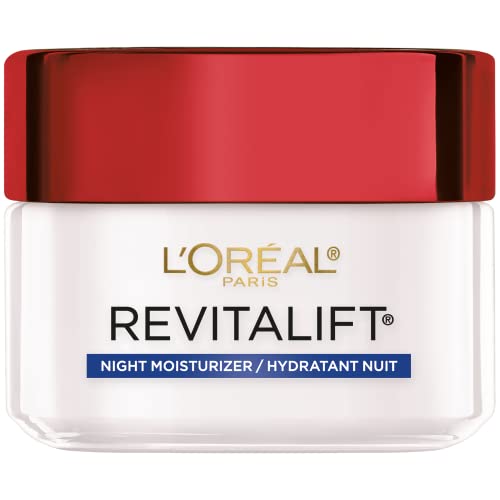
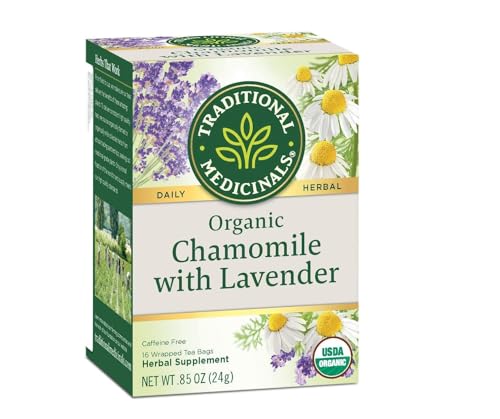
Recommended Products for Better Sleep and Night-Time Skin Repair


In This Guide
- How the Skin’s Clock Works
- Cortisol, Melatonin and the Skin
- Early Birds, Night Owls and Shift Workers
- What Poor Sleep Does to Skin
- Common Ways the Skin Clock Gets Disrupted
- Is Your Skin Clock Out of Sync?
- How to Work With Your Skin’s Body Clock
- Which Ingredients Suit Which Time of Day
- Dos and Don’ts
- Honest Limits
- When to See a Doctor
- Frequently Asked Questions
- Where This Leaves You
What to Know First
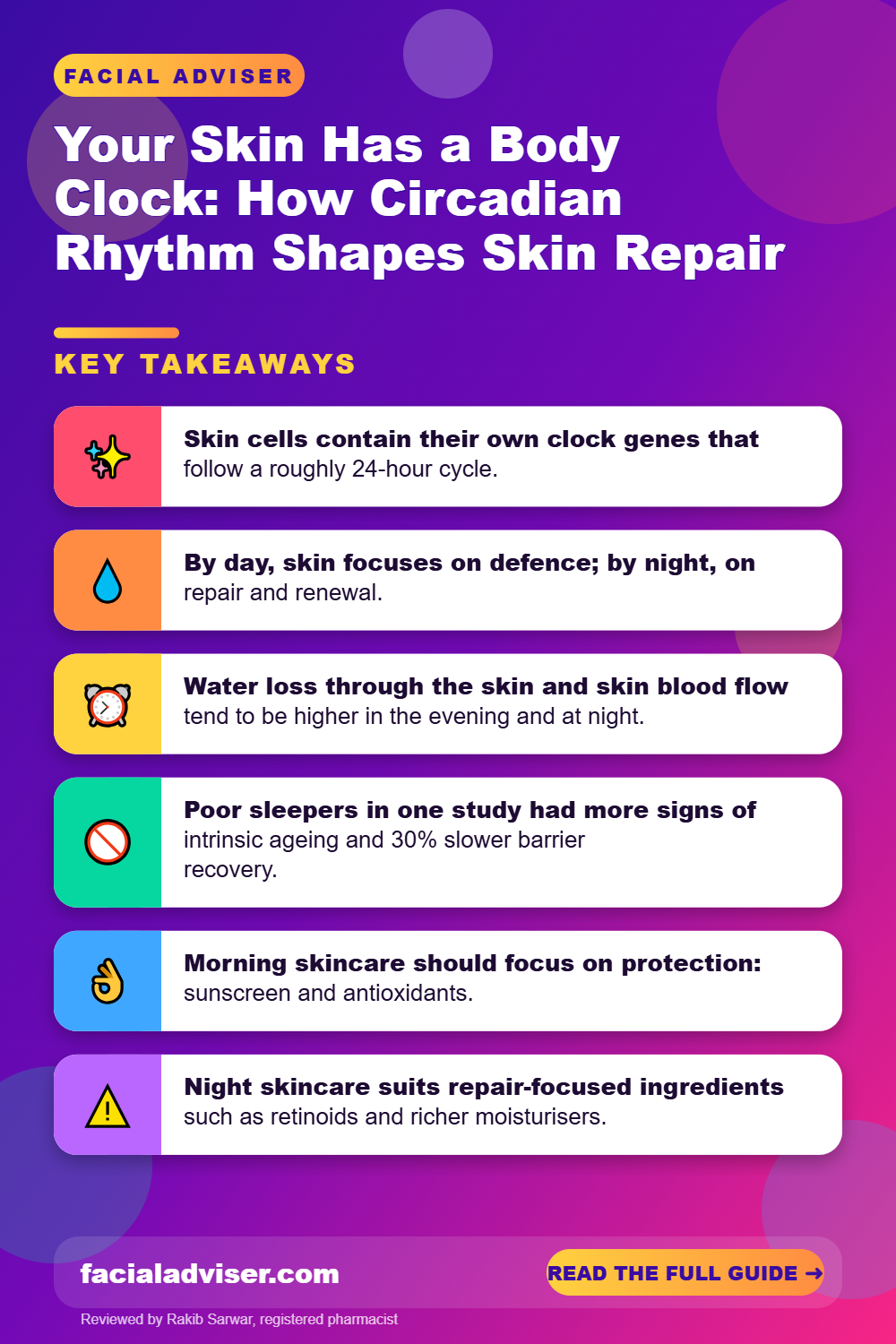
- Skin cells contain their own clock genes that follow a roughly 24-hour cycle.
- By day, skin focuses on defence; by night, on repair and renewal.
- Water loss through the skin and skin blood flow tend to be higher in the evening and at night.
- Poor sleepers in one study had more signs of intrinsic ageing and 30% slower barrier recovery.
- Morning skincare should focus on protection: sunscreen and antioxidants.
- Night skincare suits repair-focused ingredients such as retinoids and richer moisturisers.
- Consistent sleep timing and morning daylight help keep the skin’s clock in step.
How the Skin’s Clock Works
The body’s master clock is a small group of nerve cells in the brain called the suprachiasmatic nucleus. Light entering the eyes, especially morning daylight, sets it each day. It then sends signals, including hormones such as melatonin and cortisol, that keep clocks in other tissues in time.
Skin cells, including keratinocytes, fibroblasts and pigment cells, carry their own versions of the clock genes. These genes switch hundreds of other genes on and off across the day, affecting how cells divide, repair DNA, make oil and protect themselves.
| Time of day | What skin tends to prioritise | What that means for you |
|---|---|---|
| Morning | Barrier function, oil production rising, antioxidant defences | Protect with sunscreen and antioxidants |
| Midday | Peak UV defence and oil production | Reapply sunscreen when outdoors |
| Evening | Water loss and blood flow increase, barrier more permeable | Good time to apply treatments and moisturisers |
| Night | Cell division, DNA repair and renewal | Retinoids and rich creams work with this phase |
This pattern is a broad trend drawn from research in people and animals. Individual timing varies, particularly between early risers and night owls.
Cortisol, Melatonin and the Skin
Two hormones help carry the master clock’s timing to the skin. Cortisol, the main stress hormone, normally peaks shortly after waking and falls through the day. It helps mobilise energy and damps down inflammation. When stress keeps cortisol high in the evening, sleep suffers and some skin conditions, including acne and eczema, can flare.
Melatonin rises in the evening as light fades and signals to the body that it is night. Besides helping with sleep, melatonin acts as an antioxidant, and skin cells can make and respond to it. Bright light late in the evening, especially from screens, suppresses melatonin and pushes the whole rhythm later.
Growth hormone, released in bursts during deep sleep, also supports tissue repair. Short or fragmented sleep reduces the amount of deep sleep you get, which is one more reason regular, sufficient sleep matters for skin.
Early Birds, Night Owls and Shift Workers
Not everyone’s clock runs on the same schedule. Some people naturally feel alert early and sleep early; others are wired to stay up late. Your chronotype shifts the timing of your skin’s rhythm too, so the idea of a single universal repair window is too simple.
What matters most is regularity. A night owl who sleeps from 1am to 9am every day is likely to have a steadier rhythm than someone who swings between 10pm and 3am bedtimes. If your schedule is irregular because of work, try to keep your main sleep block as consistent as possible and protect it with blackout curtains, an eye mask and quiet.
For shift workers, the skin routine can follow your own day rather than the clock on the wall. Apply protective products, including sunscreen if you will be outdoors in daylight, when you start your ‘day’, and repair-focused products before your main sleep.
What Poor Sleep Does to Skin
Short, poor-quality sleep is one of the most common ways the skin’s clock gets disrupted. In a study of 60 women, poor sleepers had higher intrinsic ageing scores, more water loss from the skin and 30% less barrier recovery 72 hours after the skin was deliberately damaged. They also recovered more slowly from UV-induced redness (Oyetakin-White et al., 2015). The study was funded by a cosmetics company and was relatively small, but the findings fit with other research.
Other people notice too. In a Swedish study published in the BMJ, observers rated photos of people after a night of sleep deprivation as looking more tired, less healthy and less attractive than photos of the same people after normal sleep (Axelsson et al., 2010).
- Puffier eyes and darker circles
- Duller, paler complexion
- More visible fine lines
- Slower healing of spots and small wounds
- Flare-ups of eczema, psoriasis or acne in some people
Common Ways the Skin Clock Gets Disrupted
| Disruptor | Why it matters | What helps |
|---|---|---|
| Irregular sleep times | Clocks lose their daily anchor | Keep wake time consistent, even at weekends |
| Late-night screens and bright light | Delays melatonin release | Dim lights and screens an hour before bed |
| Shift work | Sleep and light fall at the ‘wrong’ times | Blackout curtains, consistent sleep blocks, eye mask |
| Jet lag | Clocks are suddenly out of step with local time | Seek daylight at the new destination’s morning |
| Late heavy meals and alcohol | Disturb sleep quality | Eat earlier; limit alcohol in the evening |
| Stress | Raises cortisol at night | Wind-down routine, relaxation techniques |
Is Your Skin Clock Out of Sync?
- You regularly sleep less than seven hours.
- Your bedtime and wake time vary by more than an hour or two across the week.
- You use your phone or laptop in bed.
- You work nights or rotating shifts.
- You wake up with puffy eyes and dull skin most mornings.
- Your skin seems to flare or break out during stressful, sleep-short periods.
If several apply, improving sleep consistency is likely to help your skin as much as any product. Start with just one change, such as a fixed wake-up time or putting your phone outside the bedroom, and add others once it feels routine. Small, steady changes to sleep habits tend to stick far better than a complete overhaul, and your skin will usually show the benefit within a few weeks.
How to Work With Your Skin’s Body Clock
Protect in the morning
Cleanse gently, apply an antioxidant serum such as vitamin C, then a broad-spectrum sunscreen.
Treat and repair at night
Cleanse thoroughly, then use a retinoid or other active treatment, followed by a moisturiser.
Keep a regular sleep window
Aim for seven to nine hours, going to bed and getting up at similar times each day.
Get morning daylight
Spend 10 to 30 minutes outdoors in the morning to set your master clock.
Dim the evening
Lower lights and screens for the last hour before bed.
Make the bedroom dark and cool
Use blackout curtains or an eye mask and keep the room comfortably cool.
Apply your night routine an hour or so before bed rather than just before lying down. It gives products time to absorb and keeps more on your skin instead of your pillowcase.
Which Ingredients Suit Which Time of Day
| Ingredient | Best time | Why |
|---|---|---|
| Sunscreen | Morning | Protects during daylight hours |
| Vitamin C | Morning | Antioxidant support against UV and pollution |
| Niacinamide | Morning or night | Well tolerated at any time |
| Retinoids | Night | Break down in sunlight and increase sun sensitivity |
| Exfoliating acids (AHA, BHA) | Night | Can increase sun sensitivity |
| Rich moisturisers and occlusives | Night | Support barrier repair when water loss is higher |
Retinoids are applied at night mainly because sunlight breaks them down and they can make skin more sun-sensitive, not because they only work at night. The timing happens to line up nicely with the skin’s repair phase.
Dos and Don’ts
Helps
- Keep consistent sleep and wake times
- Use sunscreen every morning
- Put retinoids and acids in your night routine
- Get daylight early in the day
- Keep the bedroom dark, quiet and cool
Backfires
- Scroll on your phone in bed
- Rely on skincare to make up for chronic sleep loss
- Apply retinoids in the morning without sunscreen
- Sleep in makeup
- Assume a special ‘night cream’ is essential; any good moisturiser works
Honest Limits
Much of the detailed science on skin clocks comes from cell and animal studies. Claims that skin repairs itself during a precise window, such as between 11pm and 4am, go beyond what the evidence shows in people, and the timing likely varies with your own schedule.
Similarly, night creams are not fundamentally different from day creams, apart from usually being richer and not containing sunscreen. A good moisturiser used consistently matters more than its label, and there is no need to buy separate day and night versions if one product suits you.
Melatonin supplements are sometimes promoted for skin. There is early research on topical melatonin as an antioxidant, but not enough to recommend it for skin, and oral melatonin should be discussed with a doctor, as it is regulated differently in different countries.
Do not use sleeping pills or supplements to improve your skin without medical advice. Treating an underlying sleep problem is safer and more effective.
When to See a Doctor
See a doctor if you have ongoing sleep problems, such as:
- Trouble falling or staying asleep most nights for more than a few weeks
- Loud snoring, gasping or pauses in breathing during sleep
- Feeling exhausted during the day despite enough time in bed
- Sleep problems linked to low mood, anxiety or stress
- Skin conditions such as eczema or psoriasis that keep you awake with itching
Treating conditions like sleep apnoea, insomnia or itchy skin can improve both sleep and skin.
This article is for general information and is not a substitute for medical advice. If you have persistent sleep problems or a skin condition that affects your sleep, speak to a doctor.
Frequently Asked Questions
Does skin repair itself at night?
Yes, research suggests skin shifts toward repair and cell renewal at night, although exact timing varies between people.
Is beauty sleep real?
Studies link poor sleep with slower barrier recovery, more signs of ageing and looking more tired to others.
Should I use retinol at night?
Yes. Retinoids break down in sunlight and increase sun sensitivity, so night use is standard.
Do I need a separate night cream?
Not necessarily. Any moisturiser suited to your skin works; night creams are usually just richer.
How much sleep does skin need?
Most adults need seven to nine hours for overall health, which also benefits skin.
Does shift work affect skin?
Disrupted sleep and light exposure can affect skin, so protecting your sleep window is especially important.
Can blue light from screens damage skin?
Research is limited. The bigger issue is that evening screen use can delay sleep.
Is it bad to sleep in makeup?
It can clog pores and irritate skin. Cleanse before bed.
Does melatonin help skin?
Evidence is limited. Talk to a doctor before taking melatonin supplements.
When is the best time to apply skincare at night?
About an hour before bed gives products time to absorb.
Where This Leaves You
Your skin runs on a daily clock, defending itself during the day and turning toward repair and renewal at night. Poor or irregular sleep throws that rhythm off, and studies link it with slower barrier recovery, more visible signs of ageing and a more tired appearance.
You can work with the clock rather than against it: protect in the morning with sunscreen and antioxidants, treat and repair at night with retinoids and a good moisturiser, and above all keep a regular sleep schedule with morning daylight and a dark, calm bedroom. If sleep problems persist, see a doctor, since better sleep is one of the most underrated skin treatments there is.

Written by
Registered pharmacist and founder of Facial Adviser. Rakib's pharmacy training covers how skincare actives work and interact; a later course in cosmetology turned that into a focus on facial treatments and skincare products. He plans, researches and edits every guide on the site and checks health claims against sources such as the American Academy of Dermatology, the FDA and the NIH. He is not a dermatologist; see the Editorial Policy and Medical Disclaimer.
About · Editorial policy · How we choose products · Medical disclaimer · Contact
Keep reading: Diet, sleep, stress and skin
- How Diet Impacts the Skin Microbiome: What the Science Actually Shows
- Does Caffeine Constrict Facial Blood Flow? Coffee, Skin and Redness
- How to Lower Cortisol for Better Skin: What Stress Really Does
- Cold vs Warm Compress for the Face: Effects on Blood Flow and When to Use Each
- Can Vitamin D Deficiency Cause Acne? What Studies Show
- Can Iron Deficiency Cause Pale Skin? Signs, Tests and Fixes