Dermaplaning Facial: What the Evidence Shows
A dermaplaning facial is deceptively simple: a blade, held at a shallow angle, shaves off dead surface cells and fine facial hair in one pass, with no chemicals and no heat involved.
Part of our guide to at-home facial devices. Start with: 10 Best Products for Women's Facial Hair Removal (2026): Gentle Picks
A 2023 lab study measuring skin barrier disruption confirmed the technique genuinely changes how well certain products penetrate afterward, but that’s ex-vivo tissue evidence, not a human trial proving your specific serum performs better. The same study found real operator-to-operator variability, a legitimate reason results differ between a trained provider and an unsupervised at-home pass.
Professional blades and at-home oscillating devices sit in two different FDA regulatory categories, and at least one FDA-logged adverse event exists for a popular at-home device used exactly as directed.
This guide covers what the research actually supports, corrects the persistent hair-regrowth myth, and lays out exactly who should postpone a session and why.
Recommended Dermaplaning Tools and Aftercare
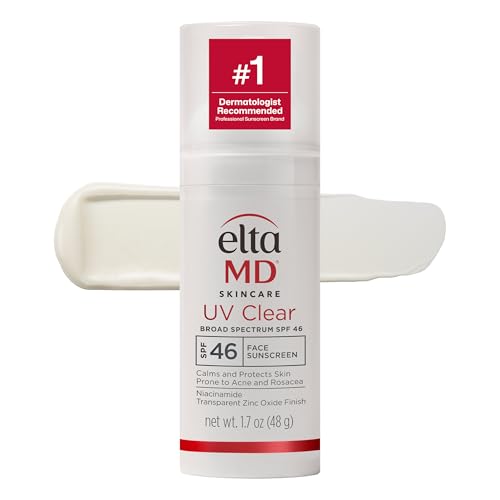

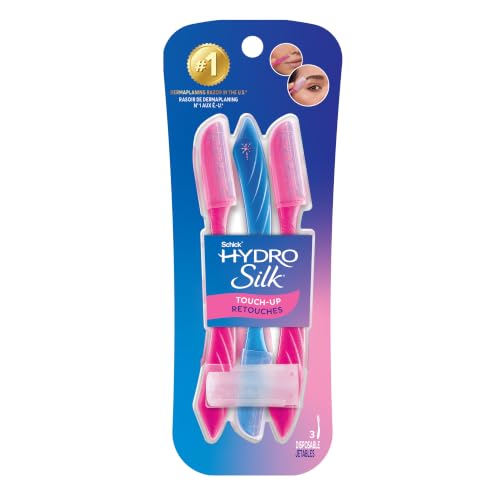

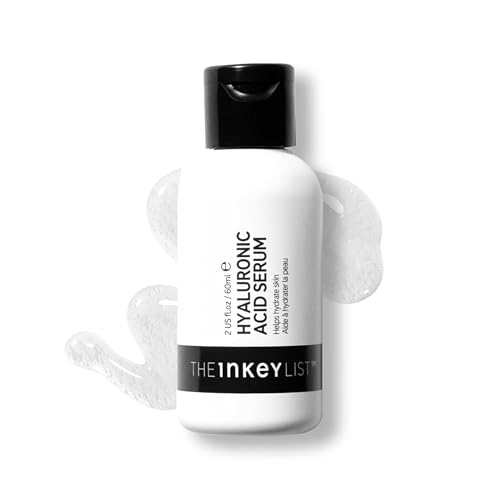
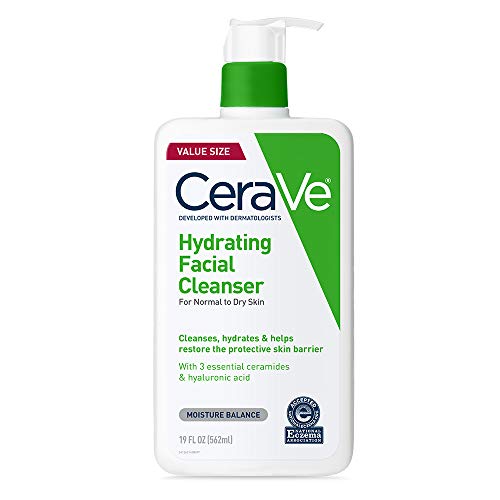
What Dermaplaning Actually Is
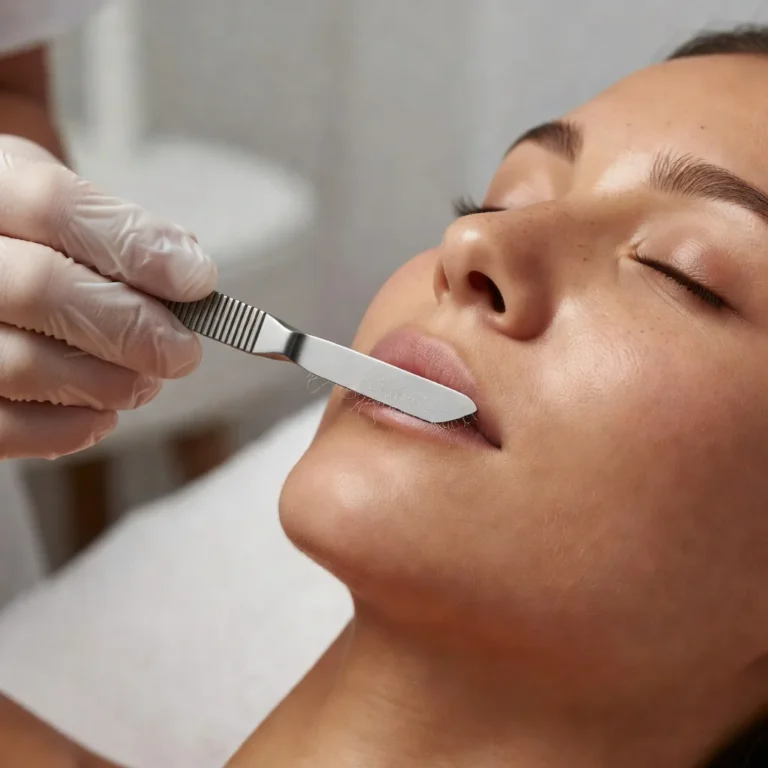
Dermaplaning is a purely mechanical exfoliation technique: a trained provider (or, increasingly, a consumer at home) holds a blade — usually a #10 surgical scalpel in a professional setting — at roughly a 45-degree angle and drags it across the skin in short, feathering strokes. There’s no chemical involved and no device generating heat or suction. The blade does two things at once: it shaves off the outermost layer of dead, compacted skin cells (the stratum corneum) and it cuts away vellus hair, the fine, unpigmented “peach fuzz” that covers most of the face.
Shopping these picks?
Amazon Prime members get fast, free shipping on eligible items, plus Prime Video, Amazon Music and member deals. New members can start with a free trial.
Start a free Prime trialAged 18 to 24? Prime for Young Adults comes with a longer free trial and a lower price after it.
Affiliate link: we may earn a commission at no extra cost to you.
Quick Summary
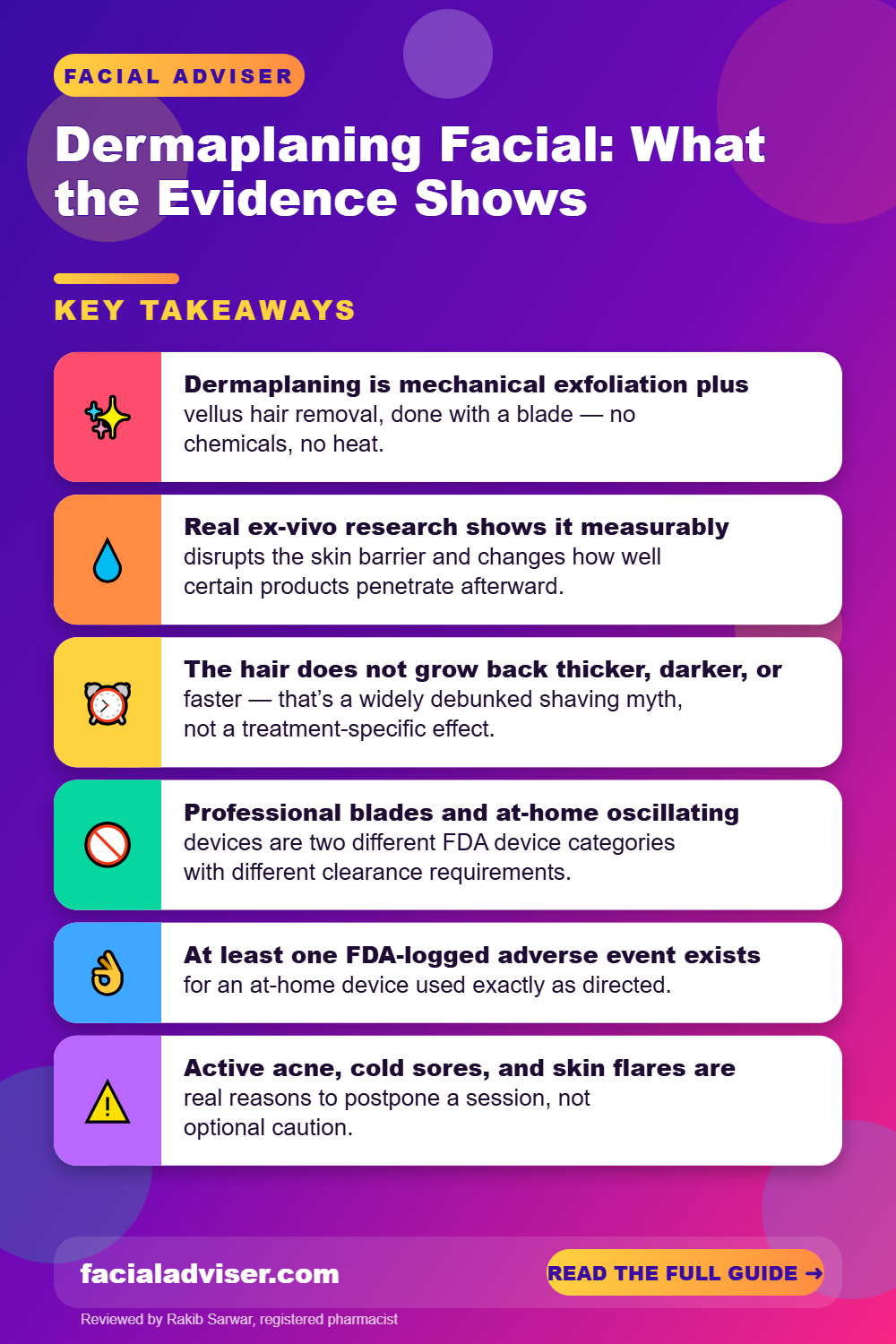
- Dermaplaning is mechanical exfoliation plus vellus hair removal, done with a blade — no chemicals, no heat.
- Real ex-vivo research shows it measurably disrupts the skin barrier and changes how well certain products penetrate afterward.
- The hair does not grow back thicker, darker, or faster — that’s a widely debunked shaving myth, not a treatment-specific effect.
- Professional blades and at-home oscillating devices are two different FDA device categories with different clearance requirements.
- At least one FDA-logged adverse event exists for an at-home device used exactly as directed.
- Active acne, cold sores, and skin flares are real reasons to postpone a session, not optional caution.
What You’ll Learn
- What Dermaplaning Actually Is
- What the Research Actually Shows
- The Hair-Regrowth Myth, Corrected
- Professional Blade vs. At-Home Device
- FDA Classification: Two Different Categories
- What a Professional Session Looks Like
- Step by Step: A Typical Session
- At-Home Dermaplaning: What Changes
- Who’s a Good Candidate
- Who Should Skip It
- When to See a Dermatologist Instead
- A One-Minute Check Before You Book
- Where the Evidence Runs Out
- Frequently Asked Questions
What the Research Actually Shows
The most useful real evidence on dermaplaning comes from a 2023 study published in AAPS PharmSciTech, which tested dermaplaning’s effect on excised human skin in a lab setting. Researchers measured the skin’s electrical resistance — a proxy for how intact the barrier is — before and after four dermaplaning strokes, and found a statistically significant drop (p<0.05), confirming that the technique genuinely disrupts the stratum corneum. They also tested whether that disruption changed how well a model drug penetrated afterward: a hydrophilic compound (baclofen) showed significantly increased permeation, while a hydrophobic compound (diclofenac) behaved differently.
That’s real, citable evidence for a plausible mechanism — barrier removal changing penetration — but it’s ex-vivo lab data, not a human clinical trial proving that your serum “works better” after a session. The honest way to describe dermaplaning’s benefit is: it removes a physical barrier layer, which can plausibly help topical products penetrate and gives skin an immediately smoother, more even surface for makeup application. Cleveland Clinic states dermaplaning “can help minimize the appearance of acne scars, fine lines, wrinkles, and dull skin” — that’s a clinical-consensus, expert-opinion claim about visible texture and light reflection, not a controlled trial demonstrating measurable wrinkle reduction.
One more finding from the same study is worth knowing before you decide between professional and at-home: the researchers found significant operator-to-operator variability in how much barrier disruption a given set of strokes produced. In plain terms, technique and pressure matter a lot, and that variability is a real, evidence-based reason results are less predictable in untrained hands.
The Hair-Regrowth Myth, Corrected
The single most common hesitation about dermaplaning is the fear that shaved vellus hair will grow back thicker, darker, or faster. It won’t. This is standard dermatologic teaching: a blade only cuts the visible hair shaft, it doesn’t touch the follicle, the root, or the growth cycle underneath the skin. The “grows back thicker” sensation people report after any kind of shaving — legs, face, anywhere — comes from the blunt, flat-cut tip of regrowing hair feeling coarser to the touch temporarily, not from any actual change to the hair’s diameter, color, or density. No peer-reviewed evidence supports a lasting texture change from blade-based hair removal of any kind.
Professional Blade vs. At-Home Device
“Dermaplaning” now covers two genuinely different tools, and the distinction matters for both results and safety.
| Feature | Professional (surgical scalpel) | At-home (oscillating device) |
|---|---|---|
| Tool | Single-use #10 surgical blade, held by hand | Powered handset with a replaceable oscillating blade cartridge |
| Control | Trained operator adjusts angle/pressure in real time | Fixed oscillation, angle controlled entirely by the user |
| FDA category | Class I, 510(k)-exempt manual surgical instrument | Class I, but 510(k) clearance IS required |
| Typical setting | Med spa, dermatology office, licensed esthetician | Bathroom, unsupervised |
| Depth control | High — visual feedback, trained hand | Lower — consumer discretion only |
FDA Classification: Two Different Categories
This is a genuinely underused distinction: professional dermaplaning blades and at-home oscillating devices don’t just look different, they sit in different FDA regulatory buckets. The manual surgical scalpel used in offices falls under product code GES, regulated under 21 CFR 878.4800, as a Class I, 510(k)-exempt general-use surgical instrument — essentially the same regulatory tier as a plain scalpel used for minor procedures. Powered at-home devices, by contrast, fall under product code GFE (“Brush, Dermabrasion, Powered”), regulated under 21 CFR 878.4820. That’s still Class I, but unusually for that class, 510(k) premarket clearance is actually required — meaning the manufacturer had to submit the device for FDA review before it could be sold.
| Category | Product code | Regulation | 510(k) required? |
|---|---|---|---|
| Manual surgical scalpel | GES | 21 CFR 878.4800 | No (exempt) |
| Powered dermabrasion brush/device | GFE | 21 CFR 878.4820 | Yes |
What a Professional Session Looks Like
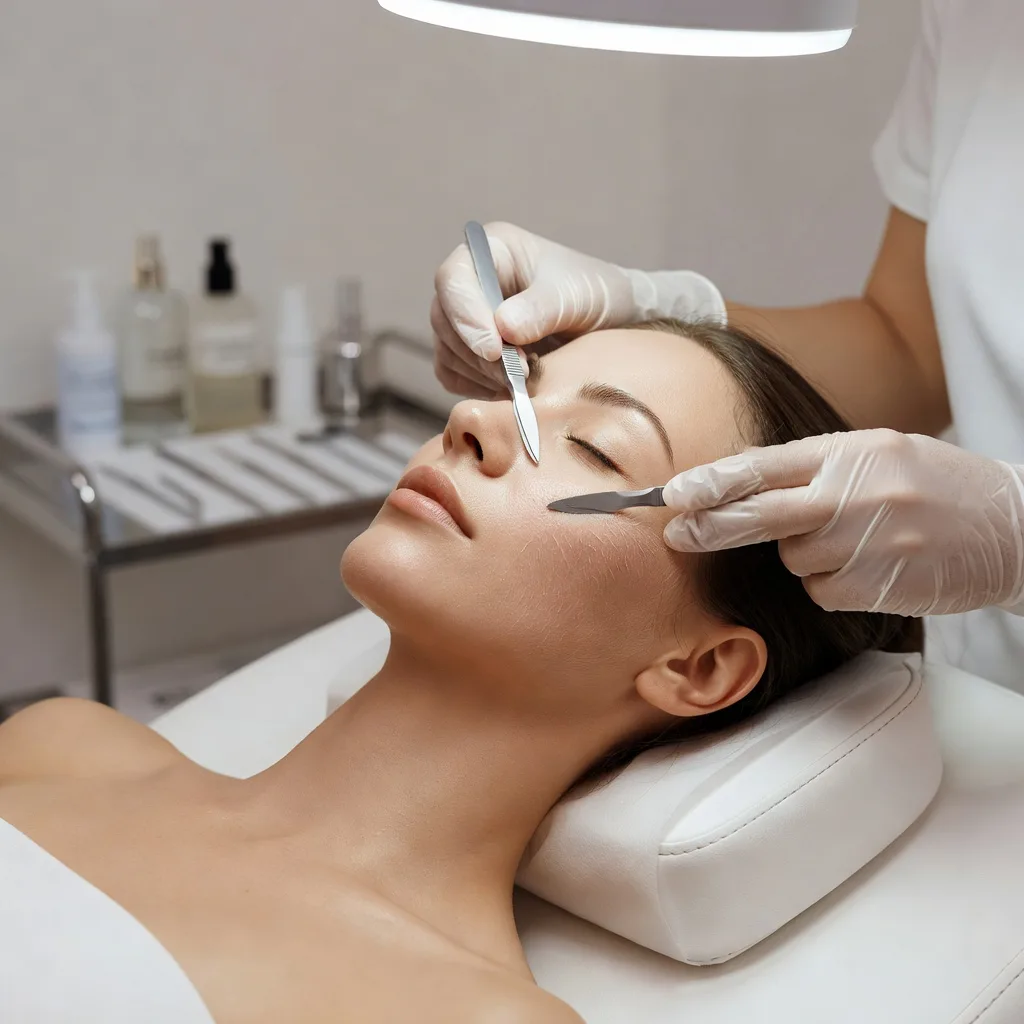
A typical in-office dermaplaning appointment runs 30 to 45 minutes and follows a consistent structure: a double cleanse to remove makeup and surface oil, the provider stretches small sections of skin taut and passes the blade over them in short strokes, working systematically across the forehead, cheeks, jaw, and around (never directly over) the eyes and lips, then finishes with a calming serum and broad-spectrum sunscreen, since freshly exfoliated skin is more sun-sensitive for a few days.
Step by Step: A Typical Session
Cleanse and dry
Skin is double-cleansed and patted completely dry — a wet or oily surface makes blade control less precise.Stretch and shave
The provider stretches a section of skin taut with one hand and passes the blade at roughly 45 degrees in short strokes with the other.Work systematically
Forehead, cheeks, and jawline are covered section by section, with special care taken around the eye area, nose, and lip lines.Calm and protect
A soothing, fragrance-light serum is applied, followed by broad-spectrum SPF, since the treated skin is temporarily more UV-sensitive.
At-Home Dermaplaning: What Changes
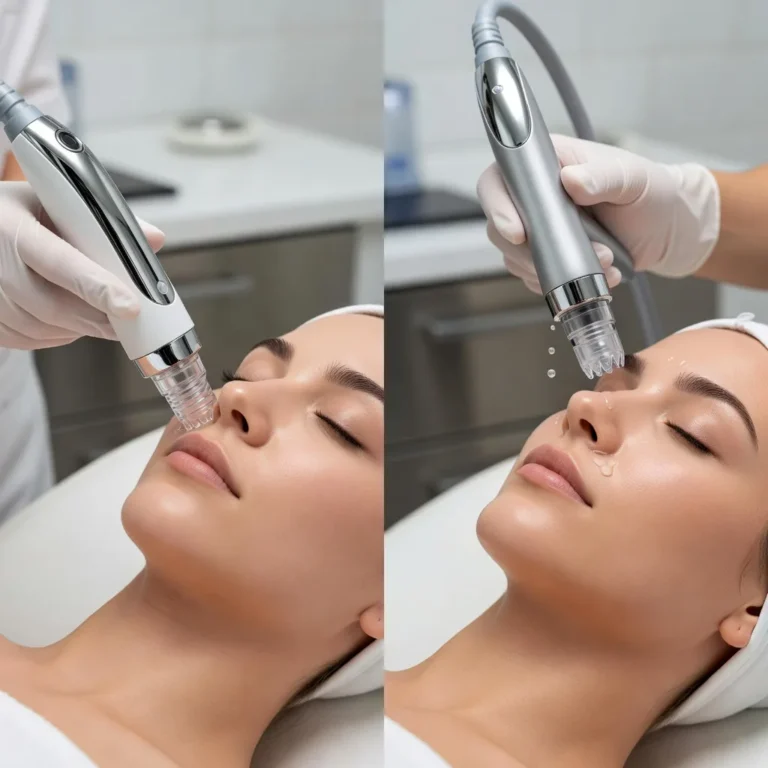
At-home devices use a powered, oscillating blade cartridge rather than a fixed surgical blade, specifically because full surgical-blade control in untrained hands raises the risk of nicks, uneven exfoliation, or accidentally catching a raised mole or skin tag. The oscillation is a genuine safety design choice, but it also means the operator has less real-time feedback and control than a trained provider holding a fixed blade — which lines up with the ex-vivo study’s finding that technique meaningfully changes how much barrier disruption actually occurs.
Who’s a Good Candidate
Dermaplaning tends to suit people with dry or dull-looking skin who want an immediate, no-downtime texture improvement before an event, people who want smoother makeup application, and people who specifically want visible vellus hair reduced without the follicle-level commitment of laser hair removal (since, unlike laser, it doesn’t touch the follicle at all — the hair simply grows back at its normal rate).
Do
- Confirm active acne, cold sores, or a skin flare aren’t present before booking
- Wear SPF daily for at least a week afterward
- Ask a professional to demonstrate blade angle if you’re considering an at-home device
Don’t
- Use retinoids or exfoliating acids for 2-3 days before or after a session
- Attempt to shave over raised moles, skin tags, or active breakouts
- Expect a lasting change in how thick or dark vellus hair grows back
Who Should Skip It
Real, consistently cited contraindications include active acne — especially inflamed, pustular breakouts, which are also a reason to postpone microdermabrasion, since a blade can spread bacteria and cause bleeding or scarring — active cold sores or any herpes simplex outbreak, eczema or psoriasis flares, sunburned skin, and raised moles or skin tags a blade could nick. Documented complications when these are ignored include infection, hypertrophic or keloid scarring, and post-inflammatory hyper- or hypopigmentation, with the pigmentation risk elevated in darker (Fitzpatrick IV-VI) skin tones if technique is poor.
When to See a Dermatologist Instead
Dermaplaning is a cosmetic, surface-level procedure — it isn’t a substitute for medical evaluation of a skin concern. See a board-certified dermatologist rather than booking a facial if you notice a new or changing mole, a lesion that bleeds or won’t heal, signs of a skin infection (spreading redness, warmth, pus), or acne that hasn’t responded to standard over-the-counter treatment. This article is educational and doesn’t replace individualized medical advice; anyone with an active skin condition should get it evaluated before considering mechanical exfoliation of any kind.
A One-Minute Check Before You Book
Look in a mirror under good light and run through this: any active pimples with visible pus or inflammation? Any cold sore, even a small tingling spot? Any patch of eczema or psoriasis currently flared? Any sunburn from the last few days? Any raised mole or skin tag in the area you’d want treated? A “yes” to any of these is a genuine reason to reschedule, not a minor detail to mention after the fact — tell the provider (or skip an at-home session) if any apply.
Where the Evidence Runs Out
Be clear-eyed about what dermaplaning can’t do: it doesn’t touch the follicle, so it isn’t a hair-reduction method the way laser hair removal is; it doesn’t rebuild collagen or reverse structural aging, since it only affects the very outermost dead-cell layer; and the improved-penetration evidence comes from lab-based ex-vivo tissue, not a human trial confirming that your specific serum performs measurably better afterward. Anyone expecting a med-spa-grade collagen-remodeling result is asking more of this technique than the evidence supports.
Frequently Asked Questions
Does dermaplaning hurt?
Most people describe it as a light scratching sensation, not pain. There’s no anesthesia used or needed for a standard session.
Will my facial hair grow back thicker?
No. Cutting a hair shaft with a blade doesn’t change the follicle, so regrowth returns to its normal texture, color, and rate — the “thicker” feeling is a temporary blunt-tip sensation, not a real change.
How often can I get dermaplaning done?
Most providers recommend spacing sessions three to four weeks apart, roughly matching the skin’s natural cell-turnover cycle.
Is at-home dermaplaning as effective as a professional session?
There’s no published trial directly comparing the two, and the underlying ex-vivo research found real operator-to-operator variability — so results are plausibly less consistent at home, even though the tool itself is designed to be safer for untrained use.
Can I wear makeup right after?
Yes, and many people find makeup applies more smoothly immediately afterward since the surface is freshly exfoliated.
Is dermaplaning safe during pregnancy?
The mechanical technique itself has no known pregnancy-specific risk, but always confirm with your own provider, especially regarding any products applied afterward.
Can dermaplaning cause breakouts?
Rarely, if performed on already-inflamed acne, since the blade can spread bacteria — which is exactly why active breakouts are a standard reason to reschedule.
Do I need to avoid the sun afterward?
Yes — freshly exfoliated skin is more sun-sensitive for several days, so daily broad-spectrum SPF matters more than usual in that window.
What’s the difference between dermaplaning and microdermabrasion?
Dermaplaning uses a blade with no abrasive particles or suction; microdermabrasion uses crystals, a diamond tip, or suction to mechanically exfoliate — different tools, similar depth of effect on the stratum corneum.
Are at-home dermaplaning tools regulated by the FDA?
Yes — powered at-home devices require FDA 510(k) clearance under product code GFE, a real regulatory step manufacturers must complete before selling them.

Written by
Registered pharmacist and founder of Facial Adviser. Rakib's pharmacy training covers how skincare actives work and interact; a later course in cosmetology turned that into a focus on facial treatments and skincare products. He plans, researches and edits every guide on the site and checks health claims against sources such as the American Academy of Dermatology, the FDA and the NIH. He is not a dermatologist; see the Editorial Policy and Medical Disclaimer.
About · Editorial policy · How we choose products · Medical disclaimer · Contact
Keep reading: Facial hair removal
- 10 Best Products for Women's Facial Hair Removal (2026): Gentle Picks
- Is Home Laser Hair Removal Safe? Real Data
- Facial Bleach: What It Actually Does to Your Skin
- Dark Upper Lip Treatment: What Actually Works
- How to Use a Blackhead Extractor Tweezer
- What Is Skin Dermaplaning? How It Works, Benefits and Risks
- 10 Best Facial Tools (2026): LED, Cleansing, Gua Sha and More
- 10 Best LED Light Therapy Masks (2026): Clearer Skin, Softer Lines