Electric Current Facial: Galvanic vs. Microcurrent
An electric current facial is really a marketing umbrella for two genuinely different technologies, galvanic and microcurrent, sold under overlapping language that makes it hard to tell which specific claim applies to which specific device.
Part of our guide to at-home facial devices. Start with: How to Incorporate Microcurrent Into Your Routine: Gel, Timing and Safety
NuFace, the best-known consumer microcurrent brand, does hold real FDA 510(k) clearance, but that pathway means substantial equivalence to a prior device, not independent proof its toning claims are true, and a brand-new 2026 peer-reviewed study found 28 adverse-event reports in the FDA’s own database, including one retinal detachment case. That’s a genuinely new safety data point most existing content hasn’t caught up to yet.
Marketing for microcurrent “toning” frequently cites muscle-thickness statistics that actually come from NMES, a stronger, unrelated technology, a dosing mismatch rarely disclosed on the label, while galvanic current’s real, narrower job is assisting product penetration and follicle-level cleansing, not “detoxifying” anything.
This guide covers how galvanic and microcurrent actually differ, what the FDA clearance behind NuFace really means, the new safety data worth knowing, and how to vet any electric current device before trying one.
Recommended Products for At-Home Facial Devices


In Short
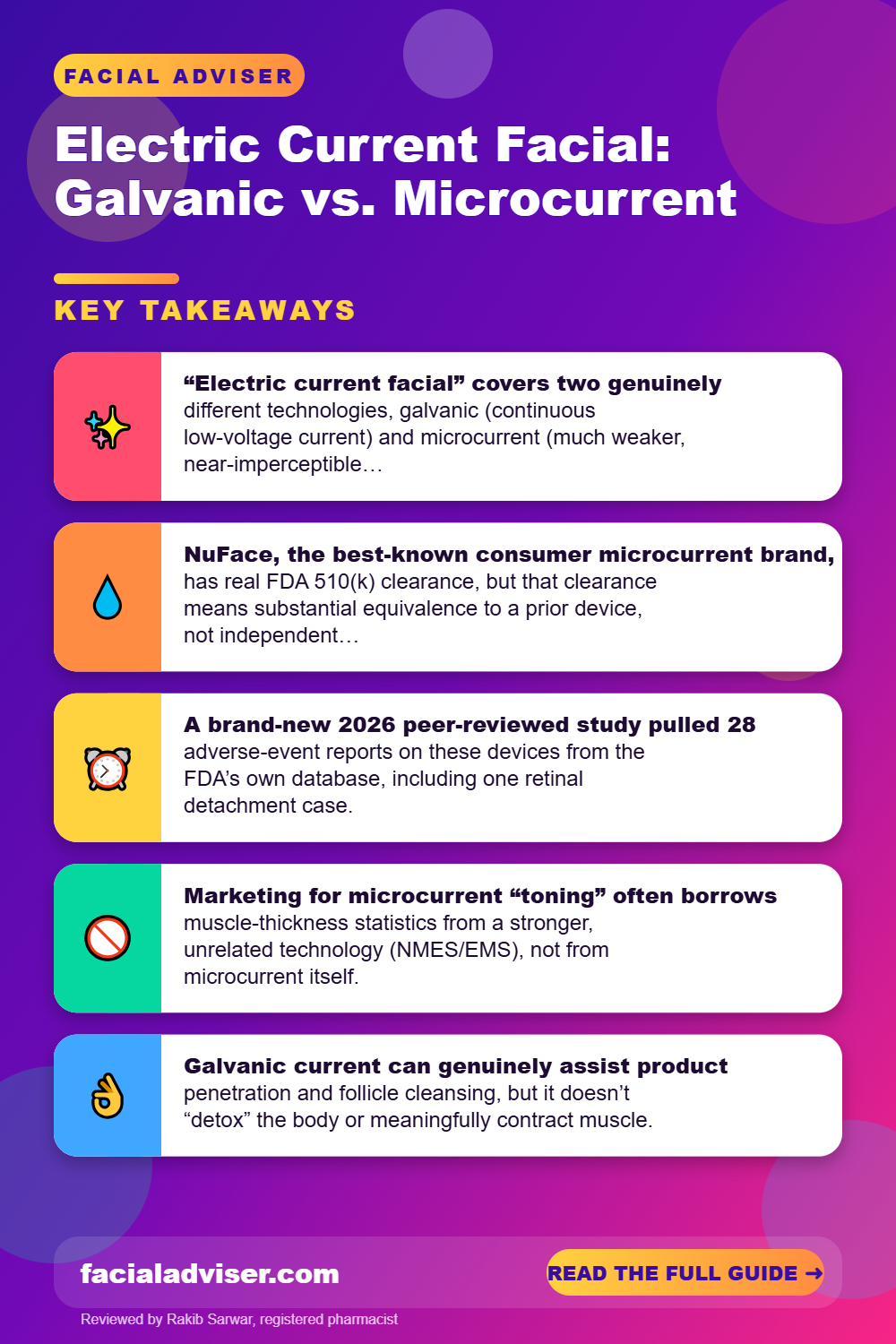
- “Electric current facial” covers two genuinely different technologies, galvanic (continuous low-voltage current) and microcurrent (much weaker, near-imperceptible current), marketed under one umbrella term.
- NuFace, the best-known consumer microcurrent brand, has real FDA 510(k) clearance, but that clearance means substantial equivalence to a prior device, not independent proof its toning claims are true.
- A brand-new 2026 peer-reviewed study pulled 28 adverse-event reports on these devices from the FDA’s own database, including one retinal detachment case.
- Marketing for microcurrent “toning” often borrows muscle-thickness statistics from a stronger, unrelated technology (NMES/EMS), not from microcurrent itself.
- Galvanic current can genuinely assist product penetration and follicle cleansing, but it doesn’t “detox” the body or meaningfully contract muscle.
Section Guide
- Two Different Technologies, One Marketing Term
- How Galvanic Current Actually Works
- The FDA Clearance Behind NuFace
- A Genuinely New Safety Study
- Where the “Muscle Toning” Claims Actually Come From
- Marketing Claims vs. What Holds Up
- The “5-Minute Facelift” Claim, Specifically
- At-Home Devices vs. Professional Treatment
- Who Should Not Use These Devices
- Do This, Not That
- Vetting Any Electric Current Device
- When to See a Dermatologist
- Frequently Asked Questions
- The Bottom Line
Two Different Technologies, One Marketing Term
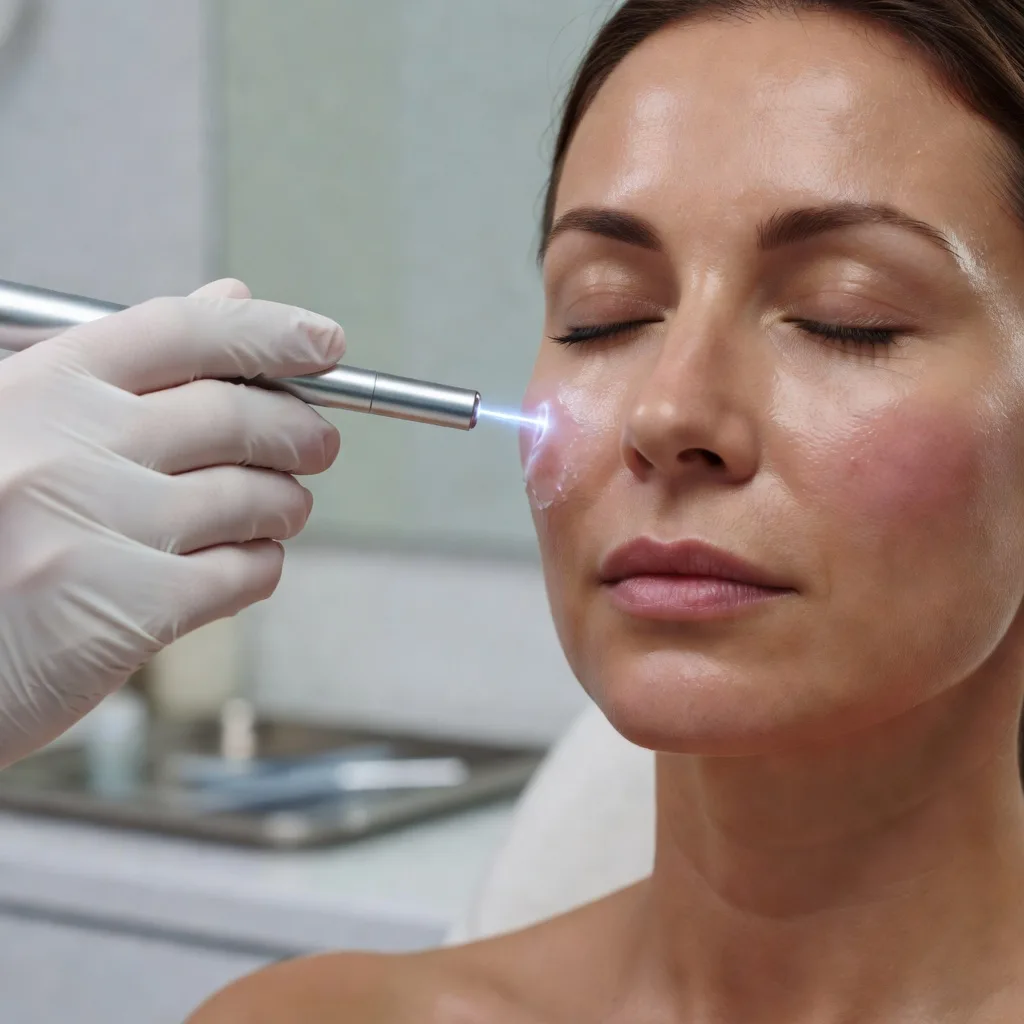
“Electric current facial” is a marketing umbrella covering at least two genuinely different technologies: galvanic current and microcurrent. Galvanic devices deliver a continuous, low-voltage direct current at a constant polarity, used in two distinct modes, desincrustation and iontophoresis. Microcurrent devices deliver a far weaker, microamp-level current, generally below the threshold most people can consciously feel, marketed as mimicking the body’s own endogenous bioelectric signals to stimulate cellular activity and produce a very low-level muscle response.
Shopping these picks?
Amazon Prime members get fast, free shipping on eligible items, plus Prime Video, Amazon Music and member deals. New members can start with a free trial.
Start a free Prime trialAged 18 to 24? Prime for Young Adults comes with a longer free trial and a lower price after it.
Affiliate link: we may earn a commission at no extra cost to you.
These are not interchangeable technologies, they operate at different current strengths, target different depths and structures, and rest on different (and differently sized) bodies of evidence. Treating them as one thing, the way most marketing copy does, obscures which specific claims apply to which specific device.
How Galvanic Current Actually Works
Galvanic facials use two polarity modes in sequence. Desincrustation runs on negative polarity, a process sometimes called cataphoresis, which is thought to saponify, or chemically soften, sebum within the follicle, supporting deeper pore cleansing than manual extraction alone. Iontophoresis then switches to positive polarity, using electrorepulsion to help drive charged skincare ingredients further into the skin’s upper layers than passive application would achieve on its own.
| Mode | Polarity | Claimed Purpose |
|---|---|---|
| Desincrustation | Negative | Softens sebum, deeper follicle cleansing |
| Iontophoresis | Positive | Drives charged ingredients into upper skin layers |
At the intensities used in cosmetic galvanic facials, this is surface-level ion movement, not neuromuscular stimulation, the current isn’t strong enough to meaningfully contract facial muscle, whatever a “toning” claim on the box might imply.
The FDA Clearance Behind NuFace
NuFace, the most recognizable consumer microcurrent brand, holds FDA 510(k) clearance K072260, cleared November 27, 2007, under product code NFO, a Class II device pathway for muscle stimulators. Its cleared indication is for facial stimulation intended for over-the-counter cosmetic use.
Important: a 510(k) clearance means the FDA determined a device is substantially equivalent to an already-legally-marketed device, a regulatory pathway, not an independent finding that the specific toning, lifting, or firming claims printed on a product’s marketing are scientifically proven. That distinction applies broadly across many consumer device categories, not just this one, and is worth understanding before treating “FDA-cleared” as equivalent to “clinically proven effective for the claim on the label.”
Independent microcurrent research that does exist tends to be small in sample size, short in duration (rarely longer than about 12 weeks), and frequently funded by device manufacturers themselves, all reasons to weigh it cautiously rather than dismiss it outright.
A Genuinely New Safety Study
Real risk: a 2026 study in Cutis (Kadam P, Lipner SR) queried the FDA’s MAUDE adverse-event database from January 2013 through March 2025 and found 28 total adverse-event reports tied to at-home electric facial devices, 25 of them involving NuFace specifically. Reported issues included arrhythmia (28%), pain (24%), dizziness (16%), headache (16%), and localized inflammation (16%). One case (4%) involved a retinal detachment. A separate device, TheraFace PRO, was linked to reports of overheating, and a FOREO BEAR device was linked to a reported case of facial deformity.
The study’s authors were direct about the implication: at-home microcurrent devices “may carry major risks” that existing research, built on small samples and limited follow-up periods, isn’t positioned to fully characterize. They specifically called for larger, longer-term studies given how quickly this consumer device category has grown alongside minimal regulatory oversight of individual product safety claims. This is a genuinely new data point, most existing consumer content on these devices predates it entirely.
Where the “Muscle Toning” Claims Actually Come From
A specific pattern shows up repeatedly in microcurrent marketing: statistics like “an 18.6% increase in muscle thickness” or “around 80% of users noticed more firmness” get cited to support a consumer microcurrent device’s toning claim. The problem is that these figures typically originate from research on NMES (neuromuscular electrical stimulation, also called EMS), a meaningfully stronger, milliamp-level technology that produces a visible, forceful muscle contraction, not from microcurrent itself, which operates at a far lower, generally imperceptible current strength.
| Technology | Current Strength | Produces Visible Contraction? |
|---|---|---|
| Microcurrent (consumer facial devices) | Microamp-level | No, generally below sensory threshold |
| NMES / EMS | Milliamp-level | Yes, visible forceful contraction |
Borrowing NMES data to market a microcurrent device is a dosing mismatch, the technology being sold isn’t the one the cited statistic actually measured, and that distinction is rarely disclosed in the marketing copy itself.
Marketing Claims vs. What Holds Up
| Claim | Reality |
|---|---|
| “FDA-cleared for muscle stimulation” | True for some devices, but clearance ≠ proof of the specific toning/lifting claim |
| “18%+ increase in muscle thickness” | Figure typically comes from NMES research, a different, stronger technology |
| “Ionic deep cleansing” (galvanic) | Assists penetration/desincrustation at the surface; doesn’t “detox” |
| “Equivalent to professional treatment” | Not established; independent trials are small and short |
| “Permanent lifting effect” | Not supported; any real effect requires ongoing, repeated use |
The “5-Minute Facelift” Claim, Specifically
The most disputed claim in this category is some version of a “5-minute facelift” or “instant micro-lift,” visible tightening promised from a single short session. A more plausible explanation for any immediate visible change is a transient fluid shift or mild, temporary edema from the massage-like handling and current application, or simply an expectation effect from looking closely at your own face right after a treatment, rather than genuine, measurable muscle toning. The muscle-thickness data actually capable of supporting a toning claim comes from the stronger NMES technology described above, evidence that doesn’t transfer to a five-minute microcurrent session.
Galvanic marketing has its own version of overreach: “ionic deep cleansing” or “detox” language implies the current is flushing toxins from the body. What iontophoresis and desincrustation actually do is assist ingredient penetration and follicle-level sebum softening at the skin’s surface, a real, narrower mechanism that doesn’t extend to detoxifying anything beyond the treated skin.
At-Home Devices vs. Professional Treatment
A licensed esthetician using a professional galvanic or microcurrent unit can generally apply a wider treatment intensity range and adjust technique to an individual’s skin in real time, closer to how a professional radiofrequency skin-tightening treatment is delivered under trained supervision rather than self-administered. Consumer devices are deliberately capped at a lower, OTC-safe intensity, which is part of why any independent evidence for at-home units tends to show smaller, more modest effects than device marketing implies, and why the adverse-event reports cited above involve unsupervised, repeated home use rather than single supervised sessions.
Who Should Not Use These Devices
Standard contraindications for both galvanic and microcurrent facial devices include pacemakers or other implanted electronic devices, pregnancy (as a precaution), active epilepsy, metal implants in the treatment area, and active skin infection. The retinal detachment case identified in the 2026 MAUDE review is a specific reminder that using any electric current device near the eye area carries a real, if rare, documented risk that consumer marketing rarely mentions.
Do This, Not That
Do
- Understand whether your device is galvanic, microcurrent, or NMES before believing a specific claim
- Check the device’s actual FDA clearance and product code
- Keep any electric current device away from the eye area and implanted electronics
Don’t
- Assume a muscle-thickness statistic on a microcurrent box came from microcurrent research
- Expect a single session to produce a lasting “facelift” effect
- Use any electric current device with a pacemaker or other implanted electronic device
Vetting Any Electric Current Device
Identify the actual technology
Galvanic, microcurrent, and NMES are three different things marketed under overlapping language.Look up the specific FDA clearance
Confirm the device name and product code exist in the FDA’s public database, and understand what “cleared” actually means.Trace any cited statistic to its actual source technology
A muscle-thickness percentage should be checked against which technology it was actually measured on.Screen your own health history first
Implanted electronics, pregnancy, epilepsy, and metal implants in the area are standard reasons to avoid these devices.
Try this: ask a prospective provider or brand directly which peer-reviewed studies used the exact device you’re considering, not just the technology category, since device-specific evidence is far more informative than a category-wide claim.
When to See a Dermatologist
See a dermatologist or skin specialist before starting any electric current device if you have a pacemaker or other implanted electronic device, are pregnant, have epilepsy, or notice any vision changes, persistent pain, or skin reaction after use, given the documented adverse-event pattern above.
Frequently Asked Questions
What is an electric current facial?
A marketing umbrella term covering two different technologies, galvanic (continuous low-voltage current) and microcurrent (much weaker, near-imperceptible current).
Is NuFace FDA-approved?
It holds FDA 510(k) clearance, which means substantial equivalence to a prior device, not independent proof that its specific toning claims are true.
Are electric current facial devices safe?
A 2026 study found 28 adverse-event reports in the FDA’s database, including arrhythmia, pain, dizziness, and one retinal detachment case, so real if uncommon risks exist.
Does microcurrent actually tone facial muscles?
The strongest muscle-thickness statistics cited in marketing typically come from NMES, a stronger, different technology, not from microcurrent itself.
What’s the difference between microcurrent and NMES?
Microcurrent runs at a much lower, generally imperceptible current and doesn’t produce visible contraction; NMES runs at a stronger, milliamp-level current that does.
Does galvanic current detox the skin?
No; it assists ingredient penetration and follicle cleansing at the surface, a real but narrower mechanism than “detox” implies.
Can a single session really produce a “facelift” effect?
Any immediate visible change is more likely temporary fluid shift or expectation effect than genuine muscle toning.
Who shouldn’t use an electric current facial device?
Anyone with a pacemaker or other implanted electronic device, pregnant people, and anyone with epilepsy or metal implants in the treatment area.
Is professional treatment different from an at-home device?
Yes; professional units allow a wider, supervised intensity range, while consumer devices are capped lower for OTC safety.
How do I check if a specific claim is trustworthy?
Trace the cited statistic back to the technology it was actually measured on, and look up the device’s specific FDA clearance yourself.
The Bottom Line
“Electric current facial” bundles together at least two distinct technologies with different mechanisms, different evidence bases, and different real risks. Galvanic current can genuinely assist product penetration and follicle cleansing; microcurrent’s muscle-toning claims frequently borrow evidence from a stronger, unrelated technology. A brand-new 2026 safety study adds real, previously undocumented adverse-event data, including a retinal detachment case, that anyone considering one of these devices deserves to know about before assuming “FDA-cleared” means “clinically proven” for the specific claim on the box.

Written by
Registered pharmacist and founder of Facial Adviser. Rakib's pharmacy training covers how skincare actives work and interact; a later course in cosmetology turned that into a focus on facial treatments and skincare products. He plans, researches and edits every guide on the site and checks health claims against sources such as the American Academy of Dermatology, the FDA and the NIH. He is not a dermatologist; see the Editorial Policy and Medical Disclaimer.
About · Editorial policy · How we choose products · Medical disclaimer · Contact
Keep reading: Microcurrent and RF devices
- How to Incorporate Microcurrent Into Your Routine: Gel, Timing and Safety
- Radiofrequency Facial: What FDA Clearance Really Means
- Microcurrent Facial: Steps, Benefits, Cost
- Galvanic Facial Treatments: What Actually Works
- Best Microcurrent Facial Devices (2026): What to Look For Before You Buy
- Is RF Microneedling Better Than Laser?
- 10 Best Gua Sha Facial Tools (2026): Stone and Steel Picks Compared
- 10 Best Facial Tools (2026): LED, Cleansing, Gua Sha and More