How to Use a Blackhead Extractor Tweezer
How to use a blackhead extractor tweezer safely comes down almost entirely to technique and knowing which blemishes to leave alone.
Part of our guide to at-home facial devices. Start with: 10 Best Products for Women's Facial Hair Removal (2026): Gentle Picks
The AAD generally discourages at-home extraction, citing real risks of deeper tissue trauma, infection, and worsened acne, yet a 2024 split-face clinical trial found manual comedone extraction achieved a 46.36% average reduction in dense comedones with no permanent or severe side effects. No peer-reviewed research distinguishes tweezer-style tools from loop-style extractors, despite what marketing implies.
Forcing resistant material, not the tool itself, is the documented mechanical cause of scarring.
This guide covers correct technique, which lesions are actually ready for extraction, and when to put the tool down and see a professional instead.
Recommended Extraction Tools and Aftercare Products


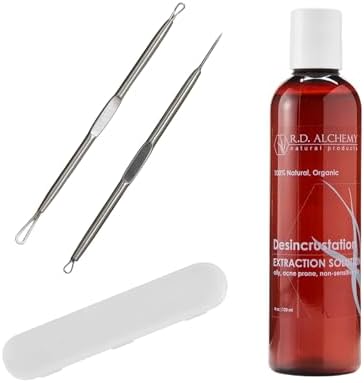
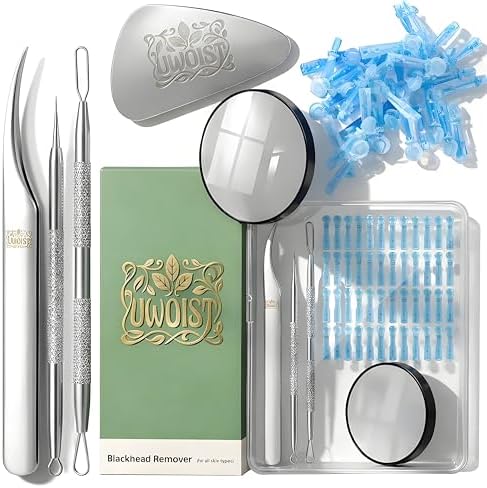


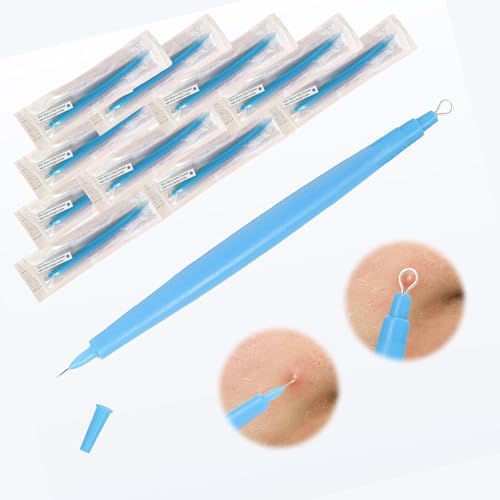
Key Facts
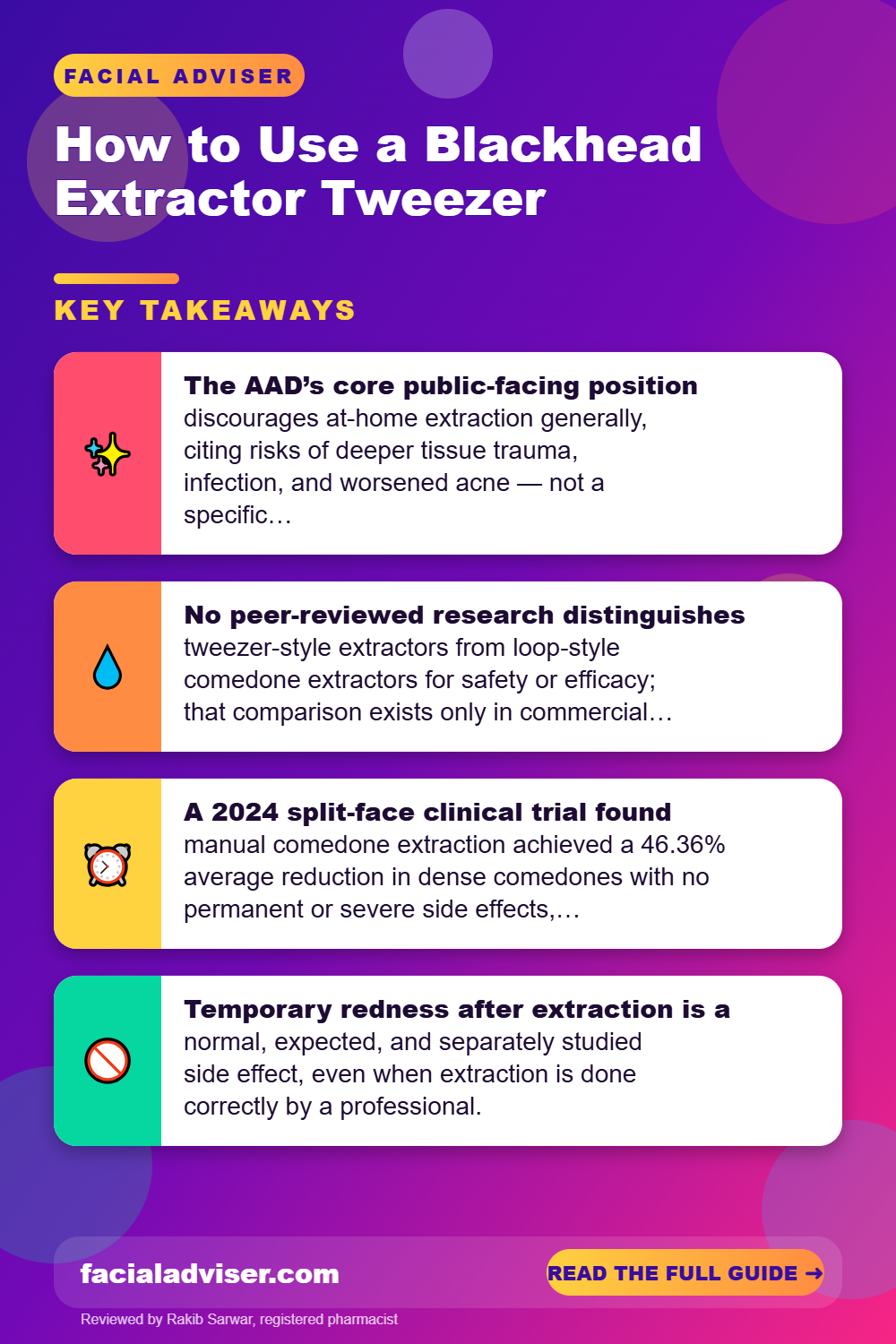
- The AAD’s core public-facing position discourages at-home extraction generally, citing risks of deeper tissue trauma, infection, and worsened acne — not a specific technique it endorses.
- No peer-reviewed research distinguishes tweezer-style extractors from loop-style comedone extractors for safety or efficacy; that comparison exists only in commercial and blog sources.
- A 2024 split-face clinical trial found manual comedone extraction achieved a 46.36% average reduction in dense comedones with no permanent or severe side effects, though it was less effective than laser-assisted extraction.
- Temporary redness after extraction is a normal, expected, and separately studied side effect, even when extraction is done correctly by a professional.
Guide Outline
- What a Blackhead Extractor Tweezer Actually Is
- What the AAD Actually Says About DIY Extraction
- Tweezer vs. Loop: What the Evidence Does and Doesn’t Say
- What Controlled Research Shows About Manual Extraction
- Tweezer vs. Loop vs. Professional Extraction
- Which Lesions Are (and Aren’t) Ready for Extraction
- Do This, Not That
- Steps for Using a Tweezer Extractor as Safely as Possible
- Why Redness Afterward Is Normal
- The Real Mechanical Cause of Scarring
- When to See a Dermatologist Instead
- What This Article Can’t Tell You
- Frequently Asked Questions
What a Blackhead Extractor Tweezer Actually Is
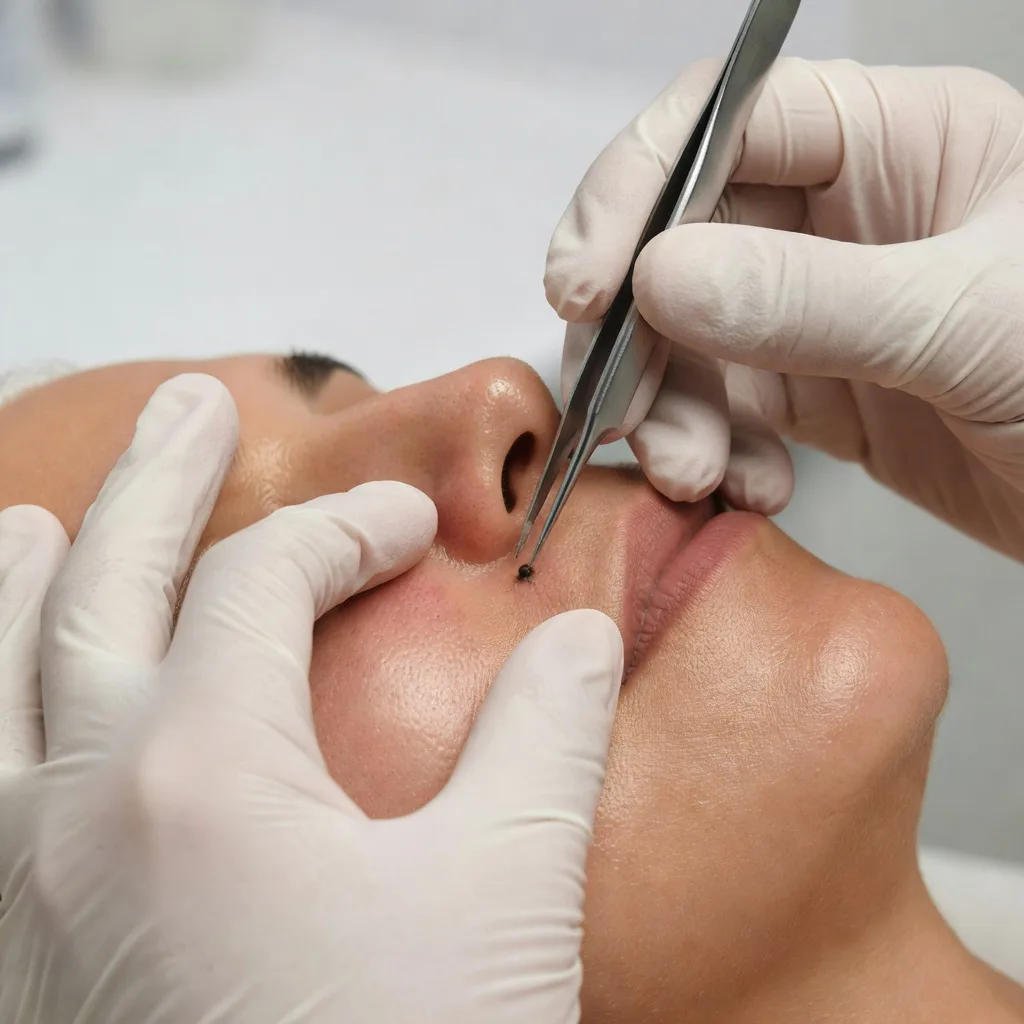
A blackhead extractor tweezer is a metal tool with two angled prongs designed to pinch and apply pressure on either side of an open comedone (a blackhead), pushing the trapped debris up and out through the follicle opening. It’s a genuinely different design from the more commonly discussed loop-style comedone extractor, which uses a small metal ring to apply even, circumferential pressure around the comedone rather than pinching it between two points. Both tools are widely sold for at-home use, and both are also standard equipment in professional extraction settings.
Shopping these picks?
Amazon Prime members get fast, free shipping on eligible items, plus Prime Video, Amazon Music and member deals. New members can start with a free trial.
Start a free Prime trialAged 18 to 24? Prime for Young Adults comes with a longer free trial and a lower price after it.
Affiliate link: we may earn a commission at no extra cost to you.
What the AAD Actually Says About DIY Extraction
The American Academy of Dermatology’s consumer guidance on this topic is direct: it discourages at-home popping and extraction generally, warning that improper technique risks pushing blemish contents deeper into skin, increasing inflammation, and potentially causing permanent acne scarring. It also flags a real infection risk from bacteria on unwashed hands or unsterilized tools, and states plainly that DIY extraction attempts can result in more painful acne as a direct consequence of poor technique. The AAD’s recommended safer alternatives for actively inflamed lesions are ice, to reduce swelling and pain, and simply leaving the area alone, with professional in-office extraction using sterile instruments positioned as the sanctioned option, and corticosteroid injection or incision-and-drainage reserved for cysts and nodules when medically appropriate. It’s worth being clear about what this means for this article: the AAD’s own materials are built to discourage DIY extraction broadly, not to endorse a specific tweezer or loop technique, so any at-home steps in this guide should be read as harm reduction for people who choose to do this anyway, not as a dermatologist-endorsed protocol.
Tweezer vs. Loop: What the Evidence Does and Doesn’t Say
There is a genuine gap in the literature here worth stating plainly rather than papering over: no dermatology-society guideline or peer-reviewed comparison distinguishes tweezer-style extractors from loop-style extractors on safety or efficacy outcomes. That specific comparison exists only in commercial and blog sources, not in controlled research. What can be said with reasonable mechanical confidence, though only as an inference rather than a trial finding, is that a loop applies more even, distributed pressure around a comedone’s circumference, while a tweezer concentrates pressure between two contact points — which plausibly raises the risk of pinching or bruising surrounding tissue if the angle or applied pressure isn’t well controlled. This is a reasonable mechanical inference, not an evidence-backed clinical recommendation, and it should be labeled as exactly that rather than presented as settled science.
What Controlled Research Shows About Manual Extraction
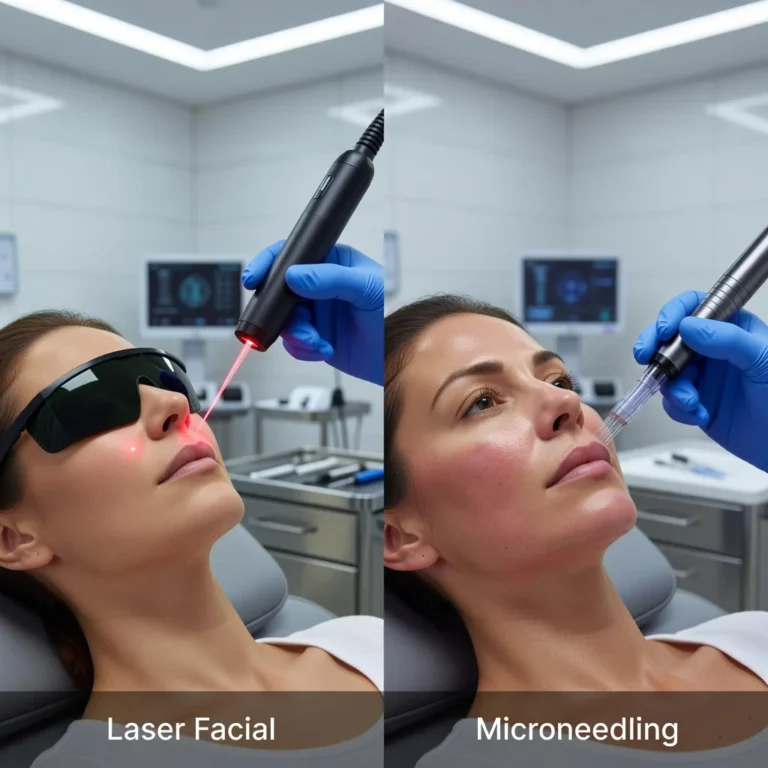
Despite the AAD’s cautious public messaging, controlled clinical research does show that manual comedone extraction, performed correctly, is a real and moderately effective treatment. A 2024 prospective, randomized, split-face, evaluator-blind controlled trial compared an ultra-pulse dynamic CO2 laser against a manual comedone extractor for dense comedones, with each patient’s own two cheeks serving as the paired comparison across four sessions spaced two weeks apart. The manual extractor achieved a 46.36 percent average comedone reduction rate, with 37.5 percent of patients reaching at least 50 percent clearance on the extractor-treated side, compared with a 64.49 percent average reduction and 79.16 percent of patients reaching at least 50 percent clearance on the laser-treated side (a statistically significant difference favoring the laser, p<0.001). Critically for the safety question, the trial reported no permanent or severe side effects on either side of any patient’s face — meaning properly performed manual extraction is genuinely effective, clearing nearly half of comedones on average in a controlled setting, it’s simply measurably less effective than laser-assisted extraction, and patients reported more pain with the manual extractor than with the laser.
Tweezer vs. Loop vs. Professional Extraction
| Method | Pressure pattern | Evidence status |
|---|---|---|
| Tweezer-style extractor | Concentrated between two pinch points | No peer-reviewed comparison to loop style exists |
| Loop-style extractor | Even, circumferential pressure | Same evidence gap; mechanically plausible advantage is inference only |
| Professional in-office extraction | Sterile instruments, trained technique | Manual extraction shown effective (46.36% reduction) in a 2024 split-face RCT |
Which Lesions Are (and Aren’t) Ready for Extraction
| Lesion type | Appropriate for extraction? |
|---|---|
| Ready, non-inflamed open comedone (blackhead) | Generally acceptable with correct technique, per AAD’s broader guidance framework |
| Non-inflamed closed comedone (whitehead) that yields easily | Generally acceptable with correct technique and gentle pressure |
| Inflamed papule or pustule | Not appropriate — risk of pushing content deeper and worsening inflammation |
| Nodule or cyst | Not appropriate for home extraction — needs professional evaluation, possibly injection or drainage |
Do This, Not That
Do
- Sterilize the tool with alcohol before and after each use
- Only attempt extraction on a ready, non-inflamed comedone that yields to gentle pressure
- Stop immediately if you see bleeding or the material doesn’t come out easily
Don’t
- Force a comedone that resists gentle pressure — forcing resistant material is the direct mechanical cause of scarring, not the tool itself
- Attempt extraction on inflamed papules, pustules, nodules, or cysts
- Assume a tweezer-style tool is safer or more effective than a loop style — no peer-reviewed evidence supports that comparison either way
Steps for Using a Tweezer Extractor as Safely as Possible
Wash hands and cleanse skin
Remove makeup and debris, and wash your hands thoroughly before touching your face.Soften the area
A warm compress or brief steam can help soften trapped debris, making extraction gentler.Sterilize the tweezer
Wipe the tool with isopropyl alcohol before use.Position gently around the comedone
Apply light, even pressure with the two prongs on either side of the opening — never dig or press directly into the skin.Stop if it resists
If the material doesn’t release with gentle pressure, stop. Forcing it is the documented mechanical cause of scarring, not a sign you need more pressure.Calm the skin afterward
Apply a soothing, non-comedogenic product, and expect some temporary redness, which is a normal and separately studied post-extraction response.
Why Redness Afterward Is Normal
Post-extraction redness is a real, expected, and separately studied phenomenon, not a sign that something went wrong. A 2024 randomized, split-face controlled trial specifically studied a pulsed dye laser as an adjuvant treatment for post-comedone-extraction erythema and further comedone reduction — a trial that exists precisely because this redness is common enough, even with correct professional technique, to warrant its own dedicated research. Transient redness lasting a day or two is expected; persistent redness beyond that may be worth discussing with a professional, but it isn’t automatically evidence of a mistake.
The Real Mechanical Cause of Scarring
The clearest, most actionable safety principle from the broader comedone-extraction literature is that forcing resistant material out — not the extraction tool itself — is the direct mechanical cause of scarring. A comedone that’s genuinely ready for extraction should yield to gentle, even pressure; one that doesn’t isn’t ready yet, and continued forcing simply increases tissue trauma without improving the outcome. This distinction matters more for actual safety than which specific tool shape you use, since a well-controlled tweezer used on a ready comedone and a poorly controlled loop forced against resistant material carry very different real-world risk, despite the tool type itself getting most of the marketing attention.
When to See a Dermatologist Instead
A dermatologist or licensed esthetician is worth seeing instead of continuing at-home extraction if you’re dealing with inflamed, cystic, or nodular acne rather than simple open or closed comedones, if you’ve noticed scarring developing from prior extraction attempts, if comedones keep recurring in the same spots despite consistent extraction, or if you’re simply not confident you can tell a ready comedone from one that will resist and potentially scar. Professional extraction uses sterile instruments and trained technique, and the clinical evidence reviewed here shows it’s a genuinely effective option, not just a safer-sounding upsell.
What This Article Can’t Tell You
Frequently Asked Questions
Is it safe to use a blackhead extractor tweezer at home?
The AAD generally discourages at-home extraction due to risks of deeper tissue trauma, infection, and worsened acne, but controlled research shows correctly performed manual extraction on ready, non-inflamed comedones can be genuinely effective with a good safety profile.
Is a tweezer extractor better than a loop extractor?
No peer-reviewed research compares the two tool types directly. Any preference for one over the other is a mechanical inference, not an evidence-backed recommendation.
How effective is manual comedone extraction?
A 2024 split-face clinical trial found manual extraction achieved a 46.36% average comedone reduction rate, compared with 64.49% for laser-assisted extraction — genuinely effective, though less so than a more intensive professional treatment.
What causes scarring from blackhead extraction?
Forcing resistant material that doesn’t release with gentle pressure is the documented mechanical cause of scarring, not the tool itself.
Which blemishes should never be extracted at home?
Inflamed papules, pustules, nodules, and cysts should not be extracted at home; only ready, non-inflamed open or closed comedones are generally appropriate.
Is redness after extraction normal?
Yes. Temporary redness is a well-documented, expected response even when extraction is performed correctly and professionally; it’s specifically studied in its own clinical trials.
How do I sterilize a blackhead extractor tweezer?
Wipe the tool with isopropyl alcohol before and after each use to reduce infection risk.
Does the AAD recommend using a blackhead extractor?
Not specifically. The AAD’s public guidance discourages DIY extraction generally and positions professional in-office extraction as the safer, sanctioned option.
What should I do if a comedone doesn’t come out easily?
Stop. Forcing it increases tissue trauma and is the documented pathway to scarring, not a sign you need more pressure.
Can extraction tools introduce infection?
Yes, if not properly sterilized or if used with unwashed hands, which is one of the specific risks the AAD cites in discouraging casual at-home extraction.

Written by
Registered pharmacist and founder of Facial Adviser. Rakib's pharmacy training covers how skincare actives work and interact; a later course in cosmetology turned that into a focus on facial treatments and skincare products. He plans, researches and edits every guide on the site and checks health claims against sources such as the American Academy of Dermatology, the FDA and the NIH. He is not a dermatologist; see the Editorial Policy and Medical Disclaimer.
About · Editorial policy · How we choose products · Medical disclaimer · Contact
Keep reading: Facial hair removal
- 10 Best Products for Women's Facial Hair Removal (2026): Gentle Picks
- What Is Skin Dermaplaning? How It Works, Benefits and Risks
- Trimming vs Shaving Facial Hair: Which Is Better for Your Skin?
- Peach Fuzz vs Facial Hair: How to Tell the Difference and What to Do
- Facial Waxing vs Dermaplaning: Which Is Better for Facial Hair and Smooth Skin?
- Microdermabrasion vs Dermaplaning: Differences, Results and Which to Choose
- How to Incorporate Microcurrent Into Your Routine: Gel, Timing and Safety
- 10 Best Gua Sha Facial Tools (2026): Stone and Steel Picks Compared