
How to Use a Comedone Extractor on Your Face
How to use a comedone extractor on your face without causing the scarring dermatologists actually warn about?
Part of our guide to at-home facial devices. Start with: 10 Best Facial Tools (2026): LED, Cleansing, Gua Sha and More
The AAD’s core guidance is blunt: never pick, pop, or squeeze breakouts, but that warning targets inflamed lesions, not every blackhead — extraction on a genuinely “ready,” non-inflamed comedone with a sterilized tool and gentle pressure is a different, lower-risk category. Forcing out material that resists is the direct mechanical cause of the scarring and dark marks people actually worry about.
Getting the distinction right, lesion by lesion, matters more than any single tip about the tool itself.
This guide covers what dermatologists actually say, correct step-by-step technique, and exactly when to put the tool down and see a professional instead.
Recommended Comedone Extractor Tools




Bottom Line
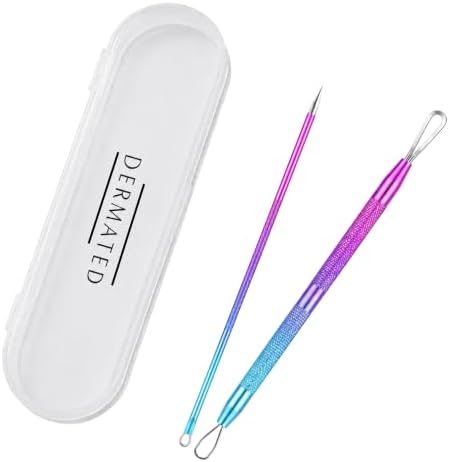
- Dermatologists broadly advise against picking, popping, or squeezing breakouts — but that guidance is aimed mainly at inflamed lesions, not every comedone.
- A comedone extractor is appropriate only for “ready,” non-inflamed blackheads and whiteheads, not for inflamed papules, pustules, nodules, or cysts.
- Sterilizing the tool before and after every use is not optional; unsterilized tools can introduce infection into an open follicular channel.
- Forcing material out that doesn’t release easily is the direct mechanical cause of scarring and dark marks — not the tool itself.
- Pore vacuum devices are a separate, higher-variable-risk category from manual extractor loops, especially at high suction.
In This Guide
- What Dermatologists Actually Say About Extraction
- When Extraction Is (and Isn’t) Appropriate
- Lesion Types Compared
- Proper Technique, Step by Step
- Manual Extractor vs. Pore Vacuum
- Loop Sizes and Tool Variations, Explained
- The Real Risks, and What Actually Causes Them
- Do This, Not That
- How to Tell If a Blackhead Is “Ready”
- How Often You Can Safely Do This
- When to Let a Professional Handle It Instead
- What Extraction Can’t Fix
- Frequently Asked Questions
What Dermatologists Actually Say About Extraction
The American Academy of Dermatology’s public guidance is direct: never pick, pop, scratch, or squeeze breakouts, because manipulating a lesion increases inflammation, which raises the risk of scarring, infection, and lasting dark marks. It’s tempting to read that as a blanket ban on any form of home extraction, but the AAD’s own guidance draws a distinction between deep, painful, inflamed lesions, which a board-certified dermatologist should treat, and the broader category of routine blackhead and whitehead care.
Shopping these picks?
Amazon Prime members get fast, free shipping on eligible items, plus Prime Video, Amazon Music and member deals. New members can start with a free trial.
Start a free Prime trialAged 18 to 24? Prime for Young Adults comes with a longer free trial and a lower price after it.
Affiliate link: we may earn a commission at no extra cost to you.
Professional extraction, done in a sterile clinical setting by a trained esthetician or dermatologist, is a genuinely different risk category from careless home manipulation — the difference comes down to training, sterile technique, and correct lesion selection, all of which are things a careful home user can also apply, just with more room for error.
When Extraction Is (and Isn’t) Appropriate
Extraction is reasonable for open comedones (blackheads) and, with more caution, whiteheads that are genuinely “ready” — meaning the material has surfaced, there’s no surrounding inflammation, and there’s no pain or swelling. It is not appropriate for inflamed papules, pustules, nodules, or cysts. These deeper, actively inflamed lesions carry a substantially higher scarring risk from any manipulation, and they’re precisely the lesion type the AAD’s core warning is aimed at.
Lesion Types Compared
| Lesion type | Safe to extract at home? | Why |
|---|---|---|
| Open comedone (blackhead) | Yes, if ready | Surfaced, non-inflamed, minimal tissue disruption |
| Ready whitehead | Yes, with caution | Surfaced but slightly more enclosed than a blackhead |
| Inflamed papule/pustule | No | Active inflammation, higher scarring risk |
| Nodule or cyst | No | Deep, requires medical treatment |
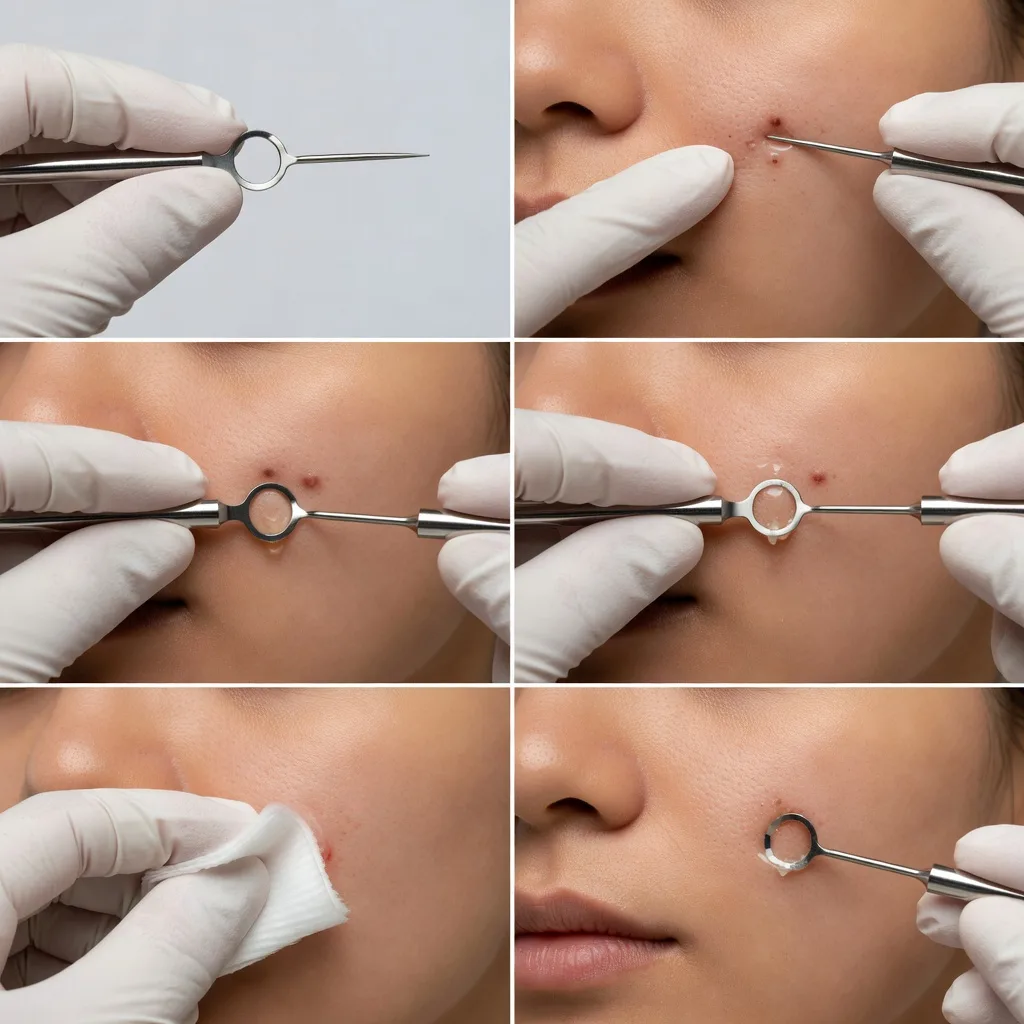
Proper Technique, Step by Step
Sterilize the tool
Wipe it down with isopropyl alcohol before and after every use; treat it as single-person use, never shared.
Prep the skin
Cleanse the area, then apply gentle heat — a warm compress or a few minutes of steam — to soften the plug and slightly widen the follicular opening.
Position the loop
Center the extractor’s loop directly over the comedone.
Apply gentle, even pressure
Press down directly rather than dragging or scraping. If the material doesn’t release within a couple of seconds of gentle pressure, stop.
Never force it
Forcing material that isn’t ready to come out is the direct mechanical cause of tearing the follicle wall — and that tearing, not the tool itself, is what causes scarring.
Finish with aftercare
Apply a soothing, antiseptic product, and use sunscreen on the area that day, since freshly extracted skin’s compromised barrier is more vulnerable to sun-triggered dark marks.
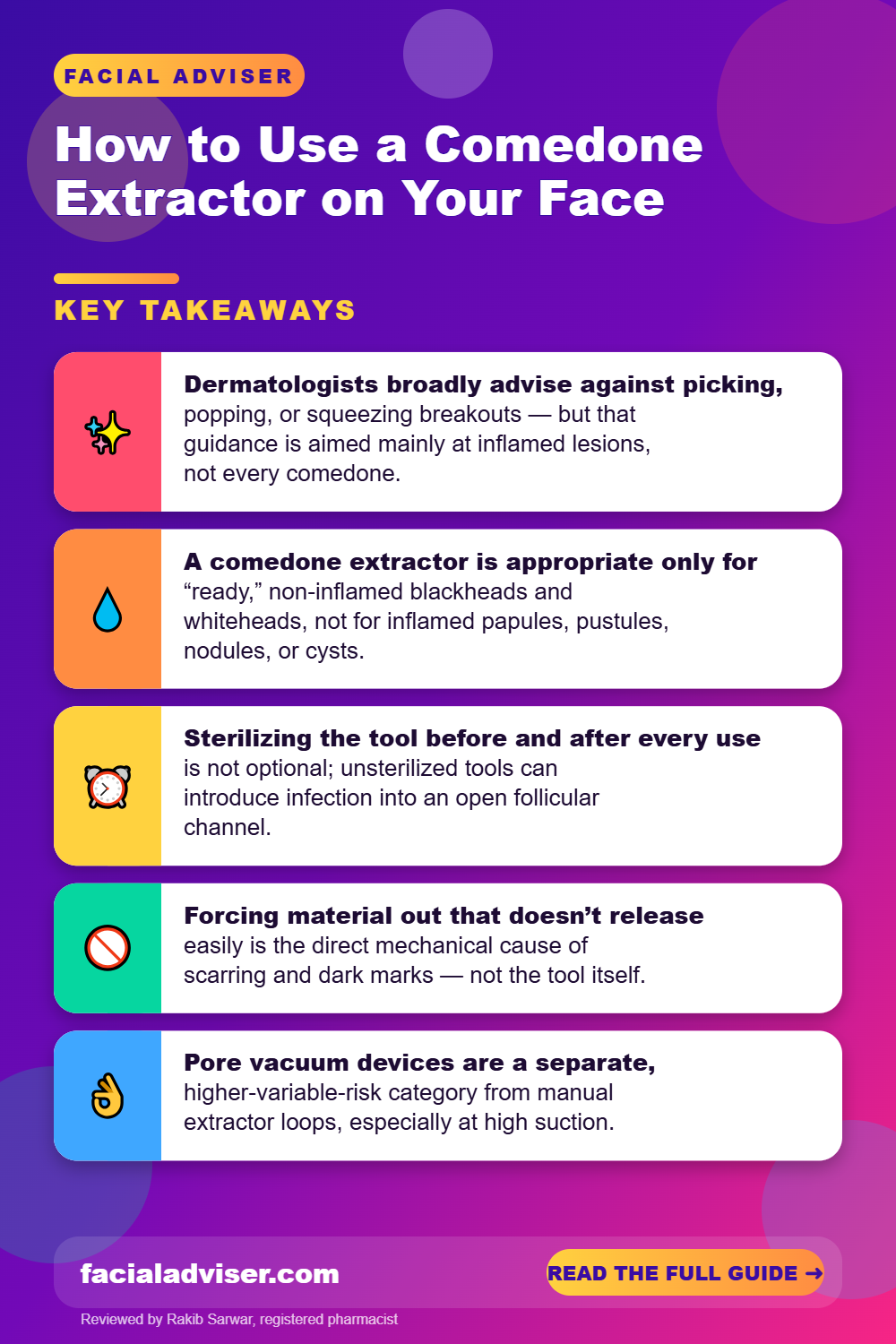
Manual Extractor vs. Pore Vacuum
| Manual comedone extractor | Pore vacuum device | |
|---|---|---|
| Best for | Individually assessed, ready lesions | Already-loosened surface debris generally |
| Control over force | High, if used correctly | Lower; suction level can be hard to judge |
| Main risk | Scarring/PIH from force on the wrong lesion | Bruising, broken capillaries from excess suction |
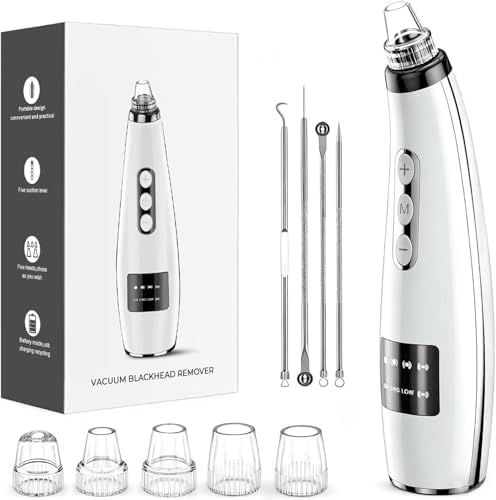
Loop Sizes and Tool Variations, Explained
Most comedone extractors sold as a single tool actually offer two ends: a small, round wire loop for blackheads and finer comedones, and a larger, sometimes spoon-shaped loop for whiteheads or slightly larger lesions. Choosing the right end for the lesion in front of you matters more than most buying guides emphasize — a loop that’s too large for a small blackhead concentrates pressure unevenly around the lesion, which can bruise or irritate the surrounding skin even when the extraction itself goes fine, while a loop that’s too small for a whitehead may require pressing harder to get adequate contact, increasing the risk of forcing the lesion rather than gently coaxing it.
Some extractor designs also include a sharp lancet point on one end, intended for very lightly nicking the very surface of a whitehead before extraction to release trapped material. This variation is closer to a minor clinical procedure than a simple squeeze, and it meaningfully raises the infection and scarring stakes if the tool isn’t properly sterilized or if it’s used with anything more than the lightest possible touch. Most home users are better served sticking to the loop-only design and skipping the lancet function entirely, reserving that specific technique for a trained professional.
Material matters too: stainless steel tools can be sterilized reliably with isopropyl alcohol or boiling water and reused indefinitely with proper care, while cheaper plated metal tools may corrode or degrade with repeated alcohol exposure, which can create tiny surface irregularities that are harder to fully sterilize over time. A quality stainless steel tool, properly maintained, is a reasonable one-time purchase rather than something that needs regular replacement.
The Real Risks, and What Actually Causes Them
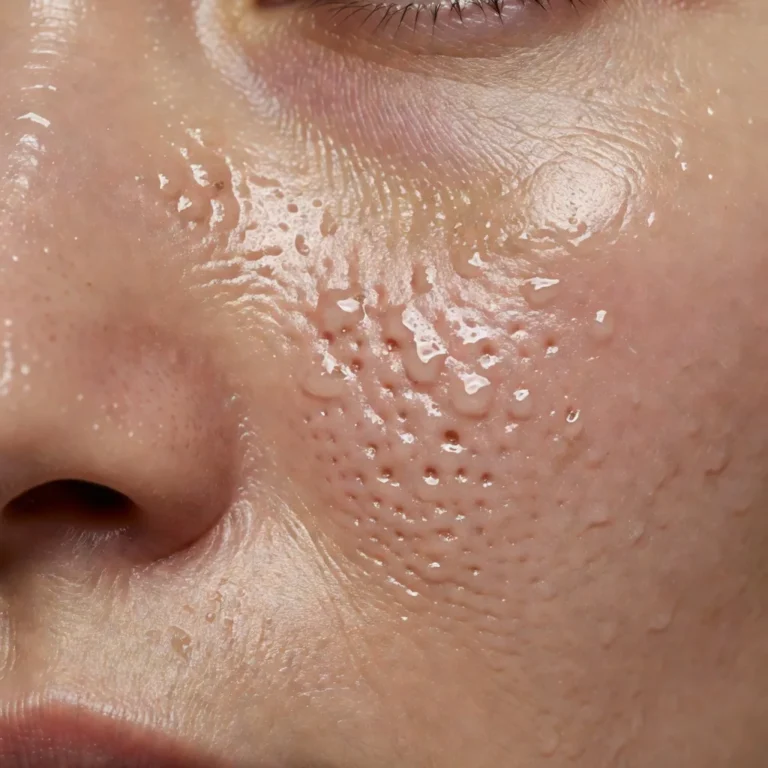
Scarring results from mechanical tearing of the follicle wall and surrounding tissue — either from forcing out material that isn’t ready, or from repeated trauma to the same spot over time. Infection follows from unsterilized tools introducing bacteria into an open follicular channel. Post-inflammatory hyperpigmentation (PIH) is a well-documented consequence of inflammatory trauma to skin, more pronounced in medium-to-deep skin tones and worsened by subsequent sun exposure on unhealed skin. Broken capillaries and bruising are more specifically associated with excessive suction from pore vacuum devices than with manual extractor loops used correctly.
Do This, Not That
Do
- Sterilize your extractor tool before and after every use
- Soften the skin with heat or steam before attempting extraction
- Stop immediately if material doesn’t release with gentle pressure
- Apply sunscreen to the area afterward
Don’t
- Attempt to extract inflamed papules, pustules, nodules, or cysts
- Force material out with increasing pressure
- Share your extractor tool with anyone else
- Repeatedly work the same spot in one session
How to Tell If a Blackhead Is “Ready”
There’s no laboratory-grade test for this, but a genuinely useful practical check exists: after cleansing and a few minutes of gentle steam or a warm compress, apply light, even pressure with the extractor loop. If the material releases easily within a second or two, it was ready. If it resists at all, stop — that resistance is the clearest sign the lesion isn’t suited to extraction right now, and continuing risks the follicle-wall tearing described above.
How Often You Can Safely Do This
There’s no universal number that applies to every face, but the underlying principle is straightforward: extraction should be occasional spot-treatment, not a daily or every-other-day ritual. Skin needs time to fully recover from even a correctly performed extraction — the follicle opening needs to settle, and any minor surface disruption needs to heal — before the same area is worked on again. Most people who use a comedone extractor as part of an otherwise reasonable skincare routine do so somewhere in the range of once every one to two weeks on any given spot, and only on lesions that are actually ready at that time, rather than working through the whole face on a fixed schedule regardless of readiness.
A useful mental check before reaching for the tool: if the same pore was extracted within the last several days and still looks slightly pink, mildly swollen, or generally irritated, that’s a sign to leave it alone rather than repeat the process, even if a new plug has already reformed. Repeated extraction on the exact same follicle in a short window is one of the more common ways people unintentionally escalate a minor blackhead into a lingering mark, simply because the skin never gets a full recovery window between sessions.
It’s also worth resisting the urge to treat a single session as a race to clear every visible spot. Working through many lesions back-to-back increases cumulative trauma to the skin even when each individual extraction is done correctly, and it makes it much harder to notice when technique is starting to slip from gentle pressure into forcing. Spacing sessions out, and keeping each one limited to a small number of genuinely ready spots, is a more sustainable approach than treating the tool as a once-a-week deep-clean event for the entire face.
When to Let a Professional Handle It Instead
See a board-certified dermatologist or licensed esthetician for extractions if you have persistent inflamed acne, if deeper lesions are involved, if you’re unsure whether a spot is “ready,” or if home extraction attempts have led to scarring or dark marks in the past. Professional extraction under sterile, trained conditions substantially reduces the risk profile compared to repeated home attempts on the wrong lesion type.
What Extraction Can’t Fix
Extraction addresses visible surface congestion, not the underlying causes of acne or the structural size of the pore itself. It won’t prevent new comedones from forming, and it isn’t a substitute for an actual acne treatment plan if breakouts are frequent or inflamed. For the fuller picture on what actually reduces pore visibility over time, see how can I make my pores less visible.
Frequently Asked Questions
Is it safe to use a comedone extractor at home?
Yes, on ready, non-inflamed blackheads and whiteheads, with a sterilized tool and gentle technique; it’s not safe for inflamed or deep lesions.
What does the AAD say about extracting blackheads yourself?
Their core public guidance warns against picking or squeezing breakouts generally, with deep or painful lesions specifically flagged for professional treatment.
How do I sterilize a comedone extractor?
Wipe it thoroughly with isopropyl alcohol before and after each use, and never share it with anyone else.
What happens if I force out a blackhead that isn’t ready?
Forcing material that resists can tear the follicle wall, which is the direct mechanical cause of scarring and dark marks.
Can extraction cause acne scars?
Improper technique or extracting inflamed lesions can cause scarring; correct technique on ready, non-inflamed lesions carries much lower risk.
Are pore vacuums safer than manual extractors?
Not necessarily; pore vacuums carry a real risk of bruising and broken capillaries from excessive suction that manual tools used correctly don’t share.
Should I steam my face before extracting blackheads?
Yes; gentle heat softens the plug and slightly widens the opening, reducing the force needed and the resulting trauma.
How can I tell if a whitehead is ready to extract?
If material releases easily with gentle pressure after cleansing and warmth, it’s ready; any resistance means it isn’t.
Is it ever appropriate to extract a cyst or nodule at home?
No; these deep, inflamed lesions require professional or medical treatment, not a home extractor tool.
When should I see a dermatologist instead of extracting at home?
If breakouts are frequent, inflamed, or deep, or if past home extraction has caused scarring, a dermatologist is the safer path forward.

Written by
Registered pharmacist and founder of Facial Adviser. Rakib's pharmacy training covers how skincare actives work and interact; a later course in cosmetology turned that into a focus on facial treatments and skincare products. He plans, researches and edits every guide on the site and checks health claims against sources such as the American Academy of Dermatology, the FDA and the NIH. He is not a dermatologist; see the Editorial Policy and Medical Disclaimer.
About · Editorial policy · How we choose products · Medical disclaimer · Contact
Keep reading: Cleansing brushes and skin tools
- 10 Best Facial Tools (2026): LED, Cleansing, Gua Sha and More
- Is Steaming Your Face Good for Your Skin? Benefits, Myths and Safe Use
- Facial Steamer vs Humidifier: Which Is Better for Dry Skin?
- Best Skin Scrubber: How to Choose an Ultrasonic Spatula for Your Skin
- 10 Best Blackhead Extractor Tools for Beginners (2026): Gentle Picks
- 10 Best Facial Steamers for Home Spa Treatments (2026): Safe Picks
- 10 Best Gua Sha Facial Tools (2026): Stone and Steel Picks Compared
- 10 Best LED Light Therapy Masks (2026): Clearer Skin, Softer Lines


One Comment