Filler vs Pigment in Makeup: What Each Does and Why It Matters
When people say a makeup product is highly pigmented, they usually mean it gives strong colour in one swipe. When they call something chalky or patchy, they often blame fillers. Both words get used loosely, and fillers in particular have picked up a bad reputation they do not entirely deserve.
Part of our guide to cosmetic science. Start with: How to Read a Cosmetic Ingredient List: A Beginner Guide
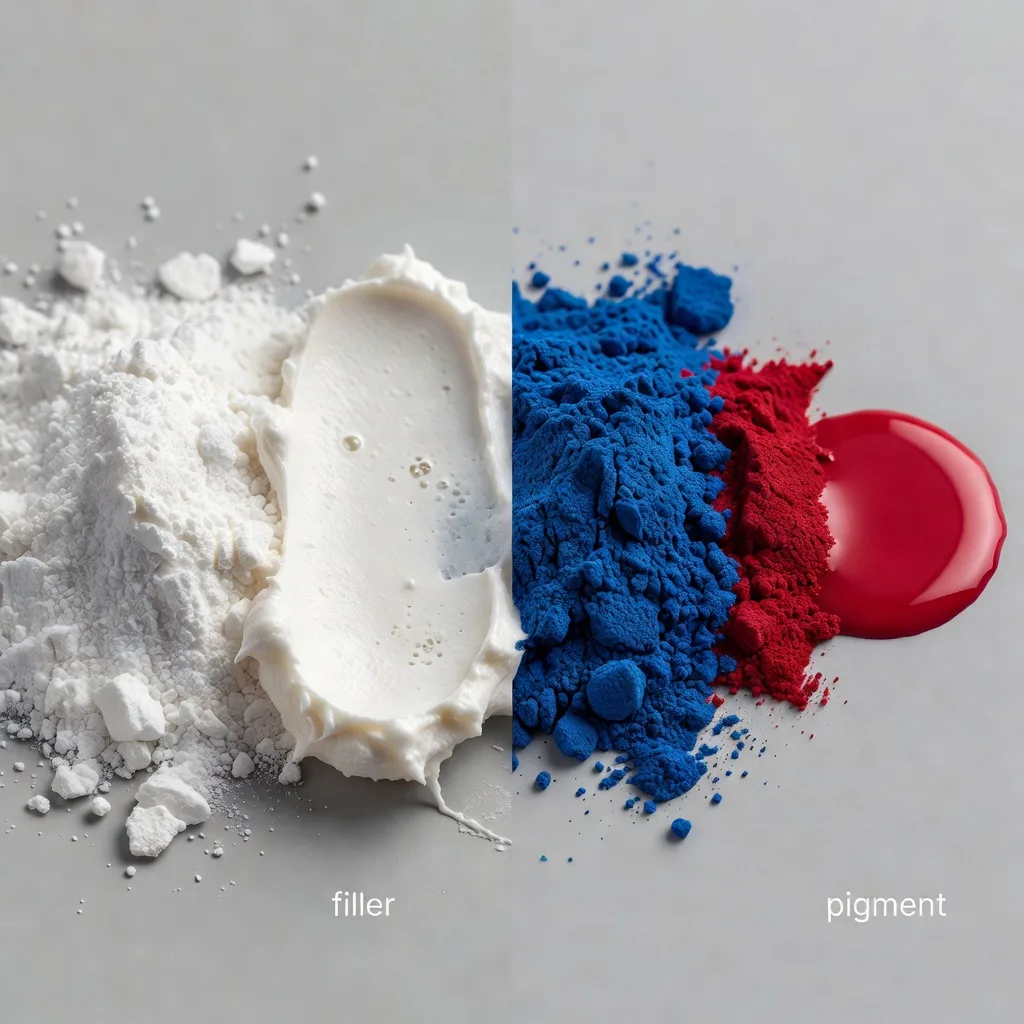
Pigments are the ingredients that give makeup its colour, such as iron oxides, titanium dioxide, ultramarines and approved organic colourants. Fillers are mostly colourless or white powders such as talc, mica, silica, kaolin, starches and nylon that make up the bulk of a powder product. Fillers dilute pigment so colour can be controlled, and they shape texture, slip, blendability, oil absorption and how well a product presses into a pan. A good product needs both. Too little filler can make a shade harsh and hard to blend, while too much can make it chalky or weak. The right balance depends on what the product is meant to do.
A translucent setting powder, for example, is almost all filler by design. A bold eyeshadow has much more pigment, but still relies on fillers to blend smoothly.
The FDA regulates the colourants used in cosmetics and publishes a list of colour additives permitted in cosmetics, which is where most of the pigments on makeup labels come from.
This guide explains what pigments and fillers are, how their balance changes a product, how to read a label and how to judge payoff for yourself.
Shopping these picks?
Amazon Prime members get fast, free shipping on eligible items, plus Prime Video, Amazon Music and member deals. New members can start with a free trial.
Start a free Prime trialAged 18 to 24? Prime for Young Adults comes with a longer free trial and a lower price after it.
Affiliate link: we may earn a commission at no extra cost to you.
Recommended Powders, Palettes and Tools


At a Glance
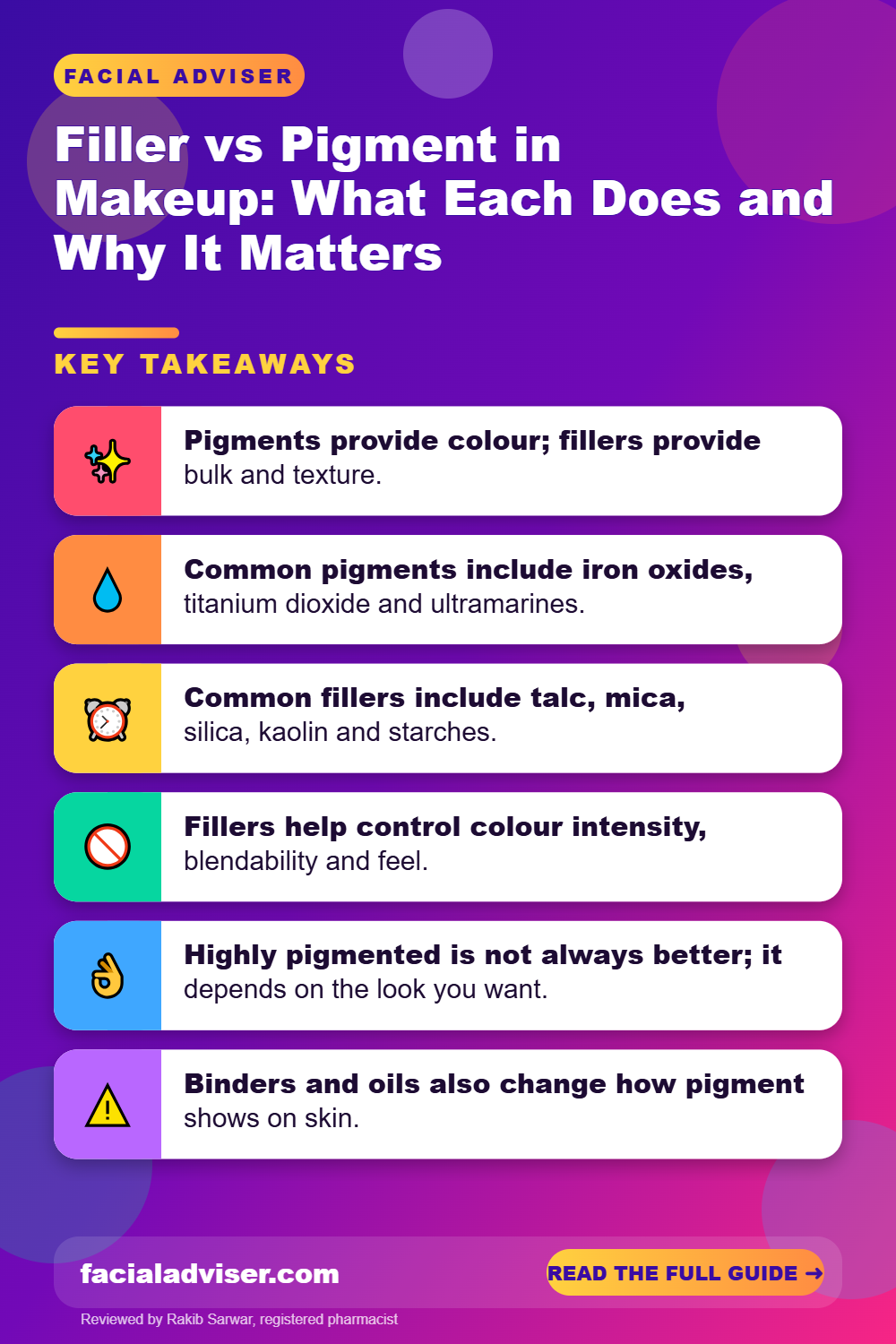
- Pigments provide colour; fillers provide bulk and texture.
- Common pigments include iron oxides, titanium dioxide and ultramarines.
- Common fillers include talc, mica, silica, kaolin and starches.
- Fillers help control colour intensity, blendability and feel.
- Highly pigmented is not always better; it depends on the look you want.
- Binders and oils also change how pigment shows on skin.
- Swatching and blending tests tell you more than the label.
What This Covers
- What Pigments Do
- What Fillers Do
- How the Balance Changes a Product
- Binders, Oils and Why Swatches Differ
- How to Judge Pigment and Filler in a Product
- Reading the Ingredient List
- Choosing by Your Skin and Skill Level
- Safety and Sensitivity
- Dos and Don’ts
- Honest Limits
- When to See a Dermatologist
- Questions People Ask
- Final Word
What Pigments Do
Pigments are insoluble particles that absorb some wavelengths of light and reflect others, which is what we see as colour. In makeup they are suspended in the product rather than dissolved, which is why they sit on the skin rather than staining it.
| Pigment | Colour | Where you find it |
|---|---|---|
| Iron oxides | Yellow, red, brown, black | Foundations, concealers, bronzers, eyeshadows |
| Titanium dioxide | White, opacity | Foundations, concealers, lightening shades |
| Zinc oxide | White, mild opacity | Mineral foundations, some powders |
| Ultramarines | Blue, violet, pink | Eyeshadows, some powders |
| Chromium oxide greens | Green | Eyeshadows, colour-correctors |
| Carmine | Red, pink | Blushes, lipsticks, eyeshadows |
| Lakes and organic colourants | Bright reds, oranges, pinks | Lipsticks, blushes, bright eyeshadows |
In foundation, a mix of iron oxides and titanium dioxide creates skin tones. The more pigment, the more coverage. In eyeshadow and blush, pigment level decides how much colour shows with each swipe.
The FDA’s list of colour additives permitted in cosmetics sets out which colourants can be used and where. Some are approved for general use but not around the eyes or on the lips, which is why certain bright shades carry warnings.
Pigment particles are also milled to specific sizes. Finer pigments usually give smoother, more even colour, while coarser ones can look speckled or streaky. Good dispersion, where pigment particles are evenly spread through the formula rather than clumped together, is one of the main differences between a smooth, blendable product and a patchy one.
What Fillers Do
Fillers are the bulk of most powder products. The word makes them sound like cheap padding, but they do real work.
- Control intensity: Pure pigment is far too strong to wear. Fillers dilute it so a shade applies evenly.
- Improve texture: Talc and mica give slip; silica and nylon give a silky, soft-focus feel.
- Aid blending: Fillers help colour diffuse so edges soften instead of looking harsh.
- Absorb oil: Silica, kaolin and starches help powders reduce shine and last longer.
- Help pressing: Fillers with binders let powders hold their shape in a pan.
Fillers also affect how a product ages on the skin through the day. Oil-absorbing fillers help a matte finish last, while softer, more emollient fillers can keep powders from looking dry but may fade faster on oily skin. This is why many long-wear products blend several fillers rather than relying on just one.
Common fillers include talc, mica, silica, kaolin clay, corn or rice starch, nylon-12, boron nitride and magnesium stearate. Our guide on whether talc causes breakouts looks at one of the most common fillers in more detail.
Some ingredients do more than one job. Mica is a filler that adds slip, but coated mica also creates shimmer. Titanium dioxide is a pigment but also adds opacity and can make a formula feel thicker.
How the Balance Changes a Product
| Balance | How it looks | How it feels | Typical use |
|---|---|---|---|
| High pigment, low filler | Intense colour in one swipe | Can be dense, hard to blend, may stain | Bold eyeshadows, pressed pigments |
| Balanced | Buildable colour, smooth blend | Soft, even, easy to control | Most blushes and everyday eyeshadows |
| Low pigment, high filler | Sheer colour or translucent | Light, silky, sometimes chalky | Setting powders, sheer blushes, finishing powders |
The balance also affects how much product you use, since sheer formulas need more layers to reach the same intensity. Neither end is automatically better. A sheer, buildable blush is easier to wear for many people than an intense one, and a translucent powder should have almost no pigment at all.
Problems usually appear when the balance does not suit the product’s purpose. A bold eyeshadow shade that looks bright in the pan but chalky on the lid may have too much filler or the wrong filler for that colour. A foundation that looks heavy and masky may have more pigment than you need for your skin.
Price is not a reliable guide to the balance either. Some inexpensive palettes are richly pigmented, while some expensive powders are deliberately sheer. The most useful question is whether the product gives the result you want with the tools and technique you already use.
Binders, Oils and Why Swatches Differ
Pigment and filler are not the whole story. Binders such as oils, esters, silicones and waxes hold pressed powders together and help them stick to skin. They also change how intense colour looks.
A small amount of binder makes pigment look richer and more saturated, which is why a shade often looks brighter when applied with a damp brush or over a cream base. Too much binder can make a powder hard and difficult to pick up, sometimes called hardpan.
This is also why the same shade can look different in different formulas. A cream eyeshadow stick with the same pigment level as a powder usually looks more intense, because the pigment is suspended in oils and waxes rather than in dry filler.
Mica-based shimmers add another layer of complexity. Our guide on how mica creates shimmer explains how coated mica creates colour through light rather than absorption.
How to Judge Pigment and Filler in a Product
Read the first few ingredients
Fillers such as talc, mica or silica near the top are normal in powders.
Check the colourants
Look for CI numbers and names such as iron oxides at the end of the list, often after may contain.
Swatch with a dry finger
One pass shows raw pigment payoff.
Blend the swatch
Rub the edge to see whether colour diffuses smoothly or goes patchy.
Try a brush application
Apply with your usual brush to see real-world payoff.
Wear it for a few hours
Check for fading, creasing or colour change.
Swatching on the inner arm often looks brighter than on the face or lids. For a realistic test, swatch on your jawline or eyelid in natural daylight.
Reading the Ingredient List
In many powder products, you will see fillers and binders listed first, followed by a may contain list of colourants with CI numbers. This is normal. The may contain section lets a brand use one ingredient list for a whole range of shades.
CI numbers identify colourants: CI 77491, 77492 and 77499 are iron oxides, CI 77891 is titanium dioxide and CI 77019 is mica. A long list of colourants does not necessarily mean a highly pigmented shade; it may simply cover the whole range.
Ingredient order tells you roughly how much of each ingredient is present, but not exactly. Two products with talc listed first can still differ widely in how much pigment they contain.
Choosing by Your Skin and Skill Level
Beginners: balanced or sheer, buildable formulas are easier to control and forgiving if you apply too much. Deeper skin tones: higher pigment levels usually show better, and fillers that are too white can look ashy. Look for shades that swatch true on your skin. Oily skin: powders with oil-absorbing fillers such as silica and starches can extend wear. Dry or mature skin: very filler-heavy powders can look chalky and settle into lines. Cream products or finely milled powders with more binder often look smoother. Sensitive eyes: simple, well-milled formulas with fewer loose particles tend to cause less fallout and irritation.Our guide on where makeup ingredients come from covers how common pigments and fillers are made.
Safety and Sensitivity
Pigments and fillers used in cosmetics are generally well tolerated. Reactions are more often linked to fragrance, preservatives or specific colourants such as carmine than to common fillers.
Some colourants are permitted for general cosmetic use but not near the eyes. Using lip or face products on the eyes, or craft pigments not made for cosmetics, can cause irritation.
Only use pigments sold as cosmetics on your skin and eyes. Craft pigments, art supplies and some loose pigments are not made for cosmetic use and may contain colourants not permitted around the eyes.
Dos and Don’ts
Helps
- Swatch on the face or lid in daylight
- Blend swatches to test diffusion
- Use a damp brush to intensify powder
- Choose buildable formulas if you are learning
- Check colourants for eye safety
Backfires
- Assume more pigment is always better
- Judge a product only by an arm swatch
- Use craft pigments on the eyes
- Assume fillers are useless padding
- Rely on the ingredient order alone
Honest Limits
Brands rarely publish exact pigment or filler percentages, so the balance is hard to judge from the label alone. Performance testing on your own skin is the most reliable guide.
Particle size, milling quality and binders affect results as much as the ratio of pigment to filler, which is why two products with similar ingredient lists can perform very differently.
Terms such as highly pigmented and buttery are marketing descriptions, not measured standards. Reviews with swatches on skin similar to yours are usually more helpful. Formulas can also change over time as brands reformulate, so a shade you loved years ago may not perform exactly the same today, even under the same name. If a repurchased product suddenly behaves differently, a reformulation is often the reason.
When to See a Dermatologist
- You develop itching, redness or a rash after using coloured makeup.
- Your eyelids are repeatedly irritated or flaky.
- You react to certain shades but not others.
- You want to identify specific colourants you are allergic to.
This article is for general information and does not replace professional medical advice. See a dermatologist for persistent skin reactions.
Questions People Ask
What is the difference between filler and pigment?
Pigments give colour; fillers provide bulk, texture and control intensity.
Are fillers bad in makeup?
No. They improve texture, blending and wear, and are needed in most powders.
What are common makeup fillers?
Talc, mica, silica, kaolin, starches and nylon.
What are common makeup pigments?
Iron oxides, titanium dioxide, ultramarines and approved organic colourants.
Why is my eyeshadow chalky?
It may have too much or the wrong type of filler for that shade.
Does highly pigmented mean better?
Not always. Buildable formulas are often easier to wear.
Why does a shade look brighter wet?
Moisture and binders make pigment look more saturated.
What does may contain mean on a label?
It lists colourants that may appear across different shades.
What does CI 77491 mean?
It is the colour index number for a red iron oxide.
Is translucent powder all filler?
Mostly, by design, with little or no pigment.
Final Word
Pigments give makeup its colour, while fillers give it bulk, texture and control. A good product balances the two for its purpose, whether that is a bold eyeshadow or a barely-there setting powder.
Read the label for clues, but swatch, blend and wear products to judge them properly. Neither pigment nor filler is good or bad on its own; the balance is what matters.

Written by
Registered pharmacist and founder of Facial Adviser. Rakib's pharmacy training covers how skincare actives work and interact; a later course in cosmetology turned that into a focus on facial treatments and skincare products. He plans, researches and edits every guide on the site and checks health claims against sources such as the American Academy of Dermatology, the FDA and the NIH. He is not a dermatologist; see the Editorial Policy and Medical Disclaimer.
About · Editorial policy · How we choose products · Medical disclaimer · Contact
Keep reading: How cosmetics are made
- How to Read a Cosmetic Ingredient List: A Beginner Guide
- How to Choose Cruelty-Free Brands: Logos, Loopholes and What to Check
- Pigment vs Dye in Makeup: Why Some Colours Stain and Others Wipe Off
- What Is the Soft-Focus Effect in Makeup? How Blurring Products Work
- What Does Paraben-Free Mean? Parabens, Safety and What Replaces Them
- Why Is Fragrance Added to Makeup? Reasons, Risks and Alternatives