What Does Paraben-Free Mean? Parabens, Safety and What Replaces Them
Paraben-free is one of the most common claims on skincare and makeup. For many shoppers it has become shorthand for safer or gentler, and some people avoid parabens entirely. But what does the label actually tell you, and is a paraben-free product always the better choice?
Part of our guide to cosmetic science. Start with: How to Read a Cosmetic Ingredient List: A Beginner Guide
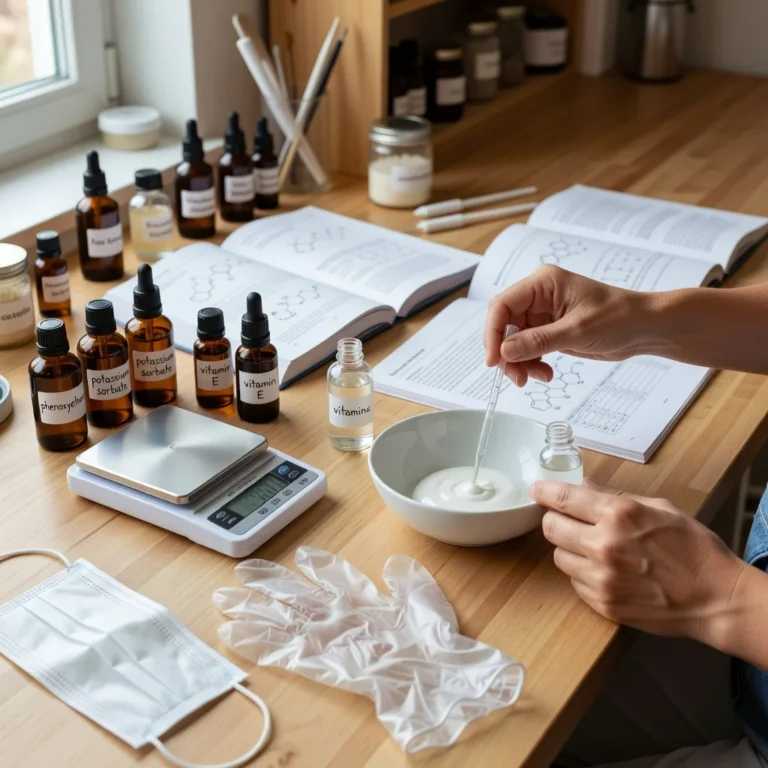
Paraben-free means a product does not contain parabens, a family of preservatives that includes methylparaben, ethylparaben, propylparaben and butylparaben. Parabens have been used for decades to stop bacteria, yeast and mould from growing in water-based products. Concerns about weak hormone-like activity led many brands to remove them, but the FDA says it does not currently have information showing that parabens as used in cosmetics affect human health. Paraben-free products still need preservatives, so they use alternatives such as phenoxyethanol, organic acids or preservative boosters. Paraben-free is a choice, not a guarantee of being safer, gentler or better for sensitive skin.
Some people have good reasons to avoid parabens, such as a confirmed allergy or a personal preference for simpler formulas. For most people, how well a product is preserved matters more than which preservative it uses.
The FDA’s page on parabens explains that they must be listed by name on ingredient labels, which makes them easy to identify if you prefer to avoid them.
This guide explains what parabens do and why they became so controversial, what replaces them and how to read paraben-free labels.
Shopping these picks?
Amazon Prime members get fast, free shipping on eligible items, plus Prime Video, Amazon Music and member deals. New members can start with a free trial.
Start a free Prime trialAged 18 to 24? Prime for Young Adults comes with a longer free trial and a lower price after it.
Affiliate link: we may earn a commission at no extra cost to you.
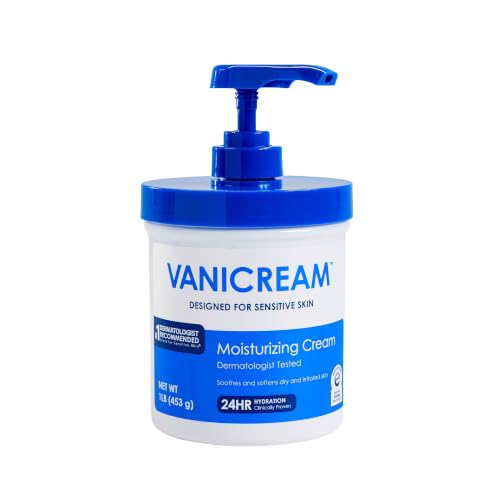
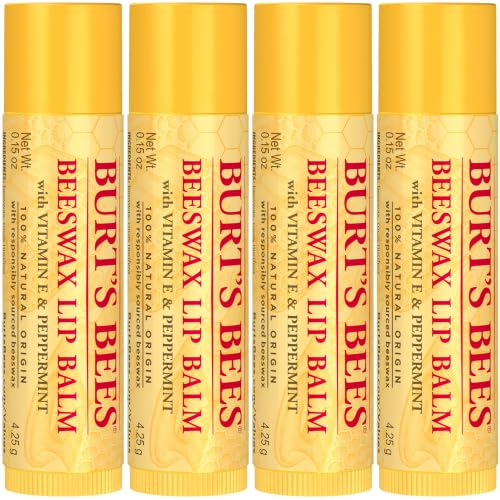
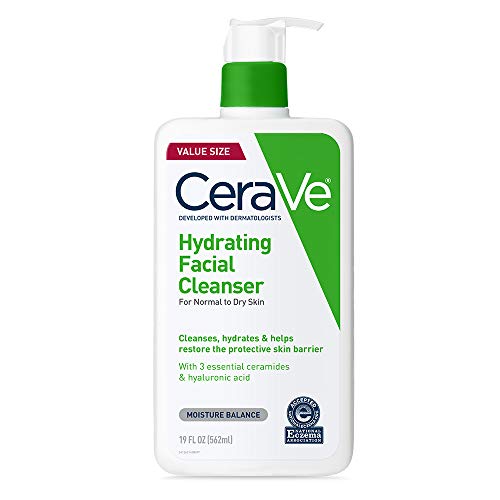
Recommended Paraben-Free Cleansers and Moisturisers


On This Page
- What Parabens Are and What They Do
- Why Parabens Became Controversial
- What Replaces Parabens
- How to Read a Paraben-Free Label
- Parabens and Sensitive Skin
- Parabens in Makeup and Skincare Products
- Paraben-Free and Clean Beauty
- Risks of Poorly Preserved Products
- Dos and Don’ts
- Honest Limits
- When to See a Dermatologist
- Common Questions
- The Takeaway
Quick Answer
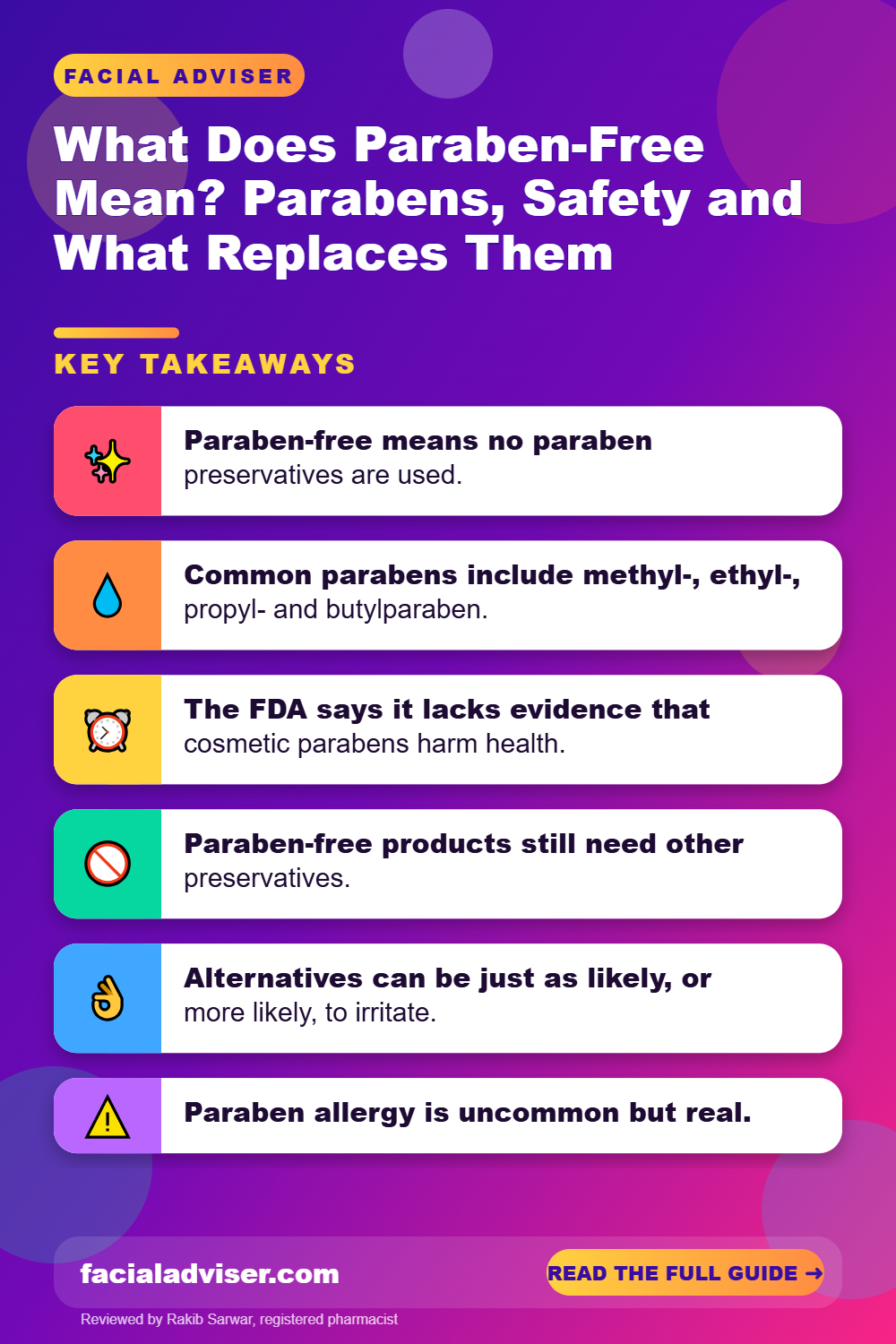
- Paraben-free means no paraben preservatives are used.
- Common parabens include methyl-, ethyl-, propyl- and butylparaben.
- The FDA says it lacks evidence that cosmetic parabens harm health.
- Paraben-free products still need other preservatives.
- Alternatives can be just as likely, or more likely, to irritate.
- Paraben allergy is uncommon but real.
- Good preservation matters more than the preservative name.
What Parabens Are and What They Do
Parabens are esters of para-hydroxybenzoic acid. They are effective against a broad range of bacteria and fungi, work at low concentrations, are stable across a range of pH levels and are inexpensive. That is why they became some of the most widely used preservatives in cosmetics, food and medicines.
Any product that contains water, such as creams, lotions, liquid foundations, cleansers and mascaras, can grow microbes once opened. Preservatives stop that growth so products stay safe throughout their use. Every time you dip a finger into a jar, touch a sponge to a bottle opening or leave a cap off in a humid bathroom, you introduce new microbes, so preservation has to keep working for months, not just days.
| Paraben | Where you might see it | Notes |
|---|---|---|
| Methylparaben | Creams, lotions, cleansers | Among the most common and widely studied |
| Ethylparaben | Creams and makeup | Often used in combination |
| Propylparaben | Makeup, lotions | Commonly paired with methylparaben |
| Butylparaben | Some creams and makeup | Less common now |
| Other parabens | Rare in modern products | Some are restricted in certain markets |
The FDA’s page on parabens in cosmetics lists methylparaben, propylparaben, butylparaben and ethylparaben as the most common and notes they must be listed by name on labels.
Paraben-free does not mean preservative-free. Almost all water-based paraben-free products use a different preservative system.
Why Parabens Became Controversial
Concern about parabens grew in the early 2000s after laboratory research showed that some parabens have weak oestrogen-like activity, and a small study reported finding parabens in breast tissue. The study did not show that parabens caused disease, but it attracted widespread attention.
Since then, parabens have been studied extensively. Regulators and safety panels in several regions have reviewed the evidence. Commonly used parabens such as methylparaben and ethylparaben are generally considered safe at the levels used in cosmetics, while some longer-chain parabens have tighter limits or restrictions in certain markets.
Rules differ around the world. The European Union, for example, has banned several less common parabens in cosmetics and set lower maximum levels for propylparaben and butylparaben, while continuing to allow methylparaben and ethylparaben within set limits. Brands that sell internationally often reformulate to meet the strictest rules, which is one reason paraben-free products became so widespread.
The FDA states that it does not currently have information showing that parabens as used in cosmetics have an effect on human health, and that it continues to monitor new research.
Public perception has moved faster than the science, and many brands removed parabens partly because customers asked for it. Some experts have pointed out that this shift may have had unintended effects, since some replacement preservatives turned out to cause more allergic reactions than the parabens they replaced. Methylisothiazolinone is the best-known example, and its use in leave-on products was later restricted in some regions after a rise in contact allergy.
What Replaces Parabens
| Alternative | Common in | Things to know |
|---|---|---|
| Phenoxyethanol | Creams, serums, makeup | Widely used; generally well tolerated at typical levels |
| Sodium benzoate and potassium sorbate | Water-based and natural-leaning products | Work best in more acidic formulas |
| Benzyl alcohol | Various products | Can also act as a fragrance component |
| Ethylhexylglycerin and caprylyl glycol | Paired with other preservatives | Boost preservative systems and add skin feel |
| Methylisothiazolinone (MI) | Rinse-off products | A well-known cause of contact allergy; restricted in leave-on products in some regions |
| Formaldehyde releasers | Some shampoos and cleansers | Can cause allergy in sensitised people |
The key point is that removing parabens means adding something else. Some alternatives are very well tolerated; others are more likely to cause allergy than the parabens they replaced. Our guide to which cosmetic preservatives are mild explains the trade-offs.
Paraben-free formulas can also rely on packaging such as airless pumps and on lower water content to reduce the amount of preservative needed. Some brands describe their products as self-preserving, meaning they use ingredients with antimicrobial properties, such as certain glycols or low water activity, rather than traditional preservatives. These systems can work well but depend heavily on good formulation and testing.
How to Read a Paraben-Free Label
Check the ingredient list
Look for names ending in -paraben to confirm the claim.
Find the replacement
Identify which preservatives are used instead.
Look for known triggers
Check for methylisothiazolinone, formaldehyde releasers or fragrance if you are sensitive.
Consider the packaging
Airless pumps and tubes help protect products with gentler preservatives.
Note the period after opening
Use the product within the time shown on the open-jar symbol.
Patch test
Try new products on a small area before regular use.
If you know you react to a particular preservative, write its name in your phone. Checking for your specific trigger is far more useful than relying on general free-from claims, and it takes only a few seconds once you know what to look for.
Parabens and Sensitive Skin
Allergy to parabens is uncommon, especially compared with fragrance and some other preservatives. Parabens have sometimes been described as among the less allergenic preservatives when used on healthy skin, although reactions can be more likely on damaged or eczema-affected skin.
If you have been diagnosed with a paraben allergy through patch testing, avoiding parabens matters and paraben-free labels are genuinely helpful. In that case, read every label, because parabens can also appear in medicines and some foods, and your dermatologist can advise on what else to watch for.
For most people with sensitive skin, fragrance-free and short ingredient lists make a bigger difference than paraben-free claims. Our guide on what hypoallergenic makeup really means explains how to find your real triggers.
Parabens in Makeup and Skincare Products
Creams and lotions. These contain a lot of water and are often used from jars, so they need robust preservation. Paraben-free creams commonly use phenoxyethanol with boosters such as ethylhexylglycerin. Liquid foundation and concealer. These are water-based emulsions and are applied with fingers, sponges and brushes that can introduce microbes. A strong preservative system matters, whichever one is used. Mascara and liquid eyeliner. These are among the highest-risk products because the wand goes back into the tube after touching the eye area. Replacing them about every three months is important regardless of preservative. Powders. Pressed and loose powders contain little or no water, so they need less preservation. Many are naturally paraben-free. Balms and ointments. Water-free products such as lip balms and petrolatum ointments often need no preservative at all, which is why many are paraben-free without making a claim. Rinse-off products. Cleansers and shampoos stay on the skin briefly, so preservative exposure is lower. They still need preservation because they are stored in warm, wet bathrooms.Paraben-Free and Clean Beauty
Paraben-free is one of the most common exclusions in clean beauty standards. It often appears alongside claims such as sulfate-free, phthalate-free and fragrance-free.
As with other clean claims, paraben-free tells you what a product leaves out, not how well it works or whether it will suit you. Our guide on what clean-label cosmetics are covers how to evaluate these claims.
Paraben-free claims are sometimes used alongside words such as natural or non-toxic, which have no legal definition. A product can be paraben-free and still contain fragrance, essential oils or other ingredients that irritate sensitive skin. If you prefer paraben-free products for personal reasons, that is a valid choice. The important thing is to make sure the product is still properly preserved and suits your skin.
Risks of Poorly Preserved Products
The biggest real-world risk with preservatives is not having enough of them. Contaminated creams, liquid makeup and mascaras can grow bacteria and fungi that cause skin or eye infections.
Poorly preserved products can also separate, change smell or colour and break down faster. Our guide on why emulsions separate over time explains what those changes can mean.
Be cautious with homemade or unpreserved water-based products, and never add water to thin a cream or mascara. Throw away any product that smells sour, grows mould or changes colour.
Paraben-free products that use gentler or self-preserving systems may have a shorter life after opening. Check the open-jar symbol on the pack and replace them on time, even if they still look fine.
Dos and Don’ts
Good Habits
- Check what preservative replaces parabens
- Choose fragrance-free if you are sensitive
- Use products within the period after opening
- Patch test new products
- Store products away from heat
Common Mistakes
- Assume paraben-free means safer
- Buy unpreserved water-based products
- Add water to thin products
- Ignore signs of spoilage
- Rely on free-from claims alone
Honest Limits
Research on preservatives continues, and regulators in different regions sometimes reach different conclusions about specific parabens and limits. Guidance can change as new evidence appears.
This article summarises the current regulatory view and general evidence; it cannot tell you how your own skin will react. Patch testing, with a dermatologist if necessary, is the only reliable way to identify personal allergies. It is also worth remembering that a product’s overall formula, including its fragrance, pH and how it is packaged and stored, usually has a bigger effect on how your skin responds than any single preservative.
Choosing paraben-free products is a personal decision. It is reasonable either way, as long as the choice is based on accurate information and the product is well preserved.
When to See a Dermatologist
- You get repeated rashes or itching from skincare or makeup.
- You suspect a preservative allergy.
- Your eczema flares after using new products.
- You want patch testing to find specific allergens.
This article is for general information and does not replace professional medical advice. See a dermatologist for persistent skin reactions.
Common Questions
What does paraben-free mean?
The product contains no paraben preservatives.
Are parabens bad for you?
The FDA says it lacks evidence that parabens as used in cosmetics affect human health.
Why do brands go paraben-free?
Mainly because of consumer concern about hormone-like activity.
Does paraben-free mean preservative-free?
No. Most paraben-free products use other preservatives.
What replaces parabens?
Phenoxyethanol, organic acids, benzyl alcohol and preservative boosters.
Is paraben-free better for sensitive skin?
Not necessarily; some alternatives are more irritating.
How do I spot parabens on a label?
Look for ingredient names ending in -paraben.
Can you be allergic to parabens?
Yes, but it is uncommon.
Is phenoxyethanol safe?
It is widely used and generally well tolerated at typical levels.
Should I avoid parabens?
It is a personal choice; good preservation matters more.
The Takeaway
Paraben-free means a product uses no paraben preservatives, but it still needs another way to stay free of microbes. The FDA says it does not currently have evidence that parabens as used in cosmetics harm human health.
If you prefer paraben-free products, check what replaces them, look out for your personal triggers and make sure the product is well preserved. For most sensitive skin, fragrance-free and simple formulas matter more than a paraben-free label.

Written by
Registered pharmacist and founder of Facial Adviser. Rakib's pharmacy training covers how skincare actives work and interact; a later course in cosmetology turned that into a focus on facial treatments and skincare products. He plans, researches and edits every guide on the site and checks health claims against sources such as the American Academy of Dermatology, the FDA and the NIH. He is not a dermatologist; see the Editorial Policy and Medical Disclaimer.
About · Editorial policy · How we choose products · Medical disclaimer · Contact
Keep reading: How cosmetics are made
- How to Read a Cosmetic Ingredient List: A Beginner Guide
- Why Is Fragrance Added to Makeup? Reasons, Risks and Alternatives
- Can Cosmetics Cause Heart Disease? What the Evidence Actually Shows
- 8 Ways You Can Use Fragrance Oils Safely
- What Happens When Makeup Is Tested on Animals?
- What Is the Difference Between Makeup and Cosmetics?