10 Best Facial Products for Aging Skin (2026): Serums, SPF and Creams
The anti-aging aisle is crowded with creams, serums, oils and devices, many making big promises about wrinkles, sagging and dark spots. Most people do not need a long list of products. This list covers 10 options across the steps that matter most, from vitamin C and peptide serums to mineral sunscreens and retinol night creams, with notes on who each suits.
Part of our guide to facial treatments. Start with: What Is the Best Anti-Aging Facial Treatment? Options Compared by Goal
The best facial products for aging skin are a broad-spectrum sunscreen of SPF 30 or higher every morning, a retinoid such as retinol at night, an antioxidant serum such as vitamin C in the morning, a moisturiser suited to your skin type and a gentle, non-stripping cleanser. Sunscreen prevents further sun damage, which causes most visible skin aging, while retinoids have the strongest evidence for softening fine lines and improving texture over months. Peptides, niacinamide and hyaluronic acid are useful supporting ingredients. Products promising instant lifting or facelift-like results are hype, and price does not predict how well a product works.
In short: protect by day, repair by night, keep skin moisturised and be patient.
The American Academy of Dermatology calls sunscreen and moisturiser the two most effective anti-aging products you can buy, and advises realistic expectations because creams give modest results.
Below you will find the ten picks, how we chose them, each core product type, the ingredients worth paying for, the claims to ignore and how to put it all together without irritating your skin.
Shopping these picks?
Amazon Prime members get fast, free shipping on eligible items, plus Prime Video, Amazon Music and member deals. New members can start with a free trial.
Start a free Prime trialAged 18 to 24? Prime for Young Adults comes with a longer free trial and a lower price after it.
Affiliate link: we may earn a commission at no extra cost to you.
As an Amazon Associate we earn from qualifying purchases. This does not change which products we include.


The Short Version
- Vibriance Super C Serum is our top pick for an easy, gentle morning vitamin C step on mature skin.
- Biossance Squalane + Copper Peptide Serum is the best hydrating serum for dry, dull-looking skin.
- Colorescience Face Shield Flex is a premium tinted mineral SPF 50 that doubles as a makeup base.
- Daily broad-spectrum sunscreen is the single most important anti-aging product.
- Retinoids such as the pro-retinol in Olay Retinol MAX have the strongest evidence for fine lines.
- Peptides, niacinamide and hyaluronic acid are helpful supporting players; instant-lift claims are hype.
- Introduce one active at a time to avoid irritation.
Jump to a Section
- The 10 Best Facial Products for Aging Skin Right Now
- How We Chose These Products
- The Core Anti-Aging Routine: Five Products That Matter
- Sunscreen: The Most Important Anti-Aging Product
- Retinoids: The Best-Studied Anti-Aging Ingredient
- Antioxidant Serums: Vitamin C and Beyond
- Moisturisers and Peptide Creams
- What Works and What Is Hype
- Choosing Anti-Aging Products for Your Skin Type
- How to Build an Anti-Aging Routine Step by Step
- What to Avoid
- Honest Limits
- When to See a Dermatologist
- Questions People Ask
- Where This Leaves You
The 10 Best Facial Products for Aging Skin Right Now
These ten products were shortlisted from widely reviewed Amazon listings and cover the core steps of an anti-aging routine: antioxidant and peptide serums, mineral sunscreens and night creams. Each pick explains which routine step it fills, who it suits and who should skip it.
| # | Product | Best For | Standout Feature | |
|---|---|---|---|---|
| 1 | Vibriance Super C Vitamin C Serum (3 Pack) | A gentle morning vitamin C step | Vitamin C serum made for mature skin | View |
| 2 | Biossance Squalane + Copper Peptide Serum | Dry, dull skin that wants plumpness | Squalane, hyaluronic acid and copper peptides | View |
| 3 | Colorescience Face Shield Flex SPF 50 | Tinted mineral SPF that replaces foundation | Tone-adapting mineral SPF 50 with coverage | View |
| 4 | MAELOVE Peptide Squad Collagen Renewal Serum | Skin that cannot tolerate retinoids | Several peptides plus barrier-support ingredients | View |
| 5 | EltaMD UV Skin Recovery SPF 50 | Redness-prone and rosacea-prone skin | Mineral SPF 50 that tones down redness | View |
| 6 | Olay Regenerist Retinol MAX Night Cream | A first step into retinoids | Fragrance-free pro-retinol night moisturiser | View |
| 7 | EltaMD UV Restore Mineral SPF 40 | Mature, sun-damaged skin | Mineral SPF made for mature skin | View |
| 8 | ISDIN Eryfotona Actinica SPF 50 | Sensitive or acne-prone mature skin | Ultralight mineral fluid without white cast | View |
| 9 | DRMTLGY Peptide Night Cream | Gentle overnight hydration | Peptides, ceramides and hyaluronic acid | View |
| 10 | Healthy Skin Lab Tinted Moisturizer SPF 50 | Light coverage with mineral SPF | Sheer universal tint with hyaluronic acid | View |
Vibriance Super C Vitamin C Serum (3 Pack)

Best for: A gentle morning vitamin C step
The Vibriance Super C Serum takes the top spot because it makes the antioxidant step of an anti-aging routine simple to keep up. It is a vitamin C serum formulated for mature skin, and the seller describes it as hydrating and designed to avoid irritation, which matters because many vitamin C serums sting drier, thinner skin.
It comes as a three pack, so one order covers months of daily use, and the brand says it is suitable for all skin types. Use it in the morning under sunscreen, where antioxidants help most. Remember that vitamin C adds brightness and support rather than dramatic change, so pair it with the #7 EltaMD UV Restore or another SPF and a night retinoid such as the #6 Olay.
- Vitamin C serum formulated for mature skin
- Hydrating formula designed to avoid irritation
- Quick-absorbing texture for morning layering
- Three bottles in one pack
Pros
- Gentle positioning suits drier, sensitive skin
- Three pack lasts for months
- Layers easily under sunscreen
Cons
- Costs more up front than a single bottle
- Firming claims go beyond what vitamin C can do
Skip it if: Skip it if vitamin C has stung your skin before; start with a peptide serum such as the MAELOVE or Biossance picks.
Check Price on AmazonBiossance Squalane + Copper Peptide Serum

Best for: Dry, dull skin that wants plumpness
The Biossance Squalane + Copper Peptide Rapid Plumping Serum is the pick for mature skin that looks dull and feels dry through the day. It layers several hydrators, including hyaluronic acid, polyglutamic acid and squalane oil, with vegan copper peptides, so the surface looks smoother and more bouncy soon after you apply it.
The seller also includes paracress extract for an instant firming feel, but treat that as a short-lived surface effect rather than a lift. Its strength is hydration, which makes fine lines look softer while you work on longer-term steps. It is richer in hydrators than the #4 MAELOVE serum, which leans harder on a longer list of peptides.
- Hyaluronic acid, polyglutamic acid and squalane
- Vegan copper peptides
- Paracress extract for a tightening feel
- Ectoin to help defend against environmental stress
Pros
- Noticeable hydration soon after applying
- Suits all skin types, including dry
- Works morning or night
Cons
- Instant firming effect is temporary
- No retinoid or vitamin C, so it is a support step
Skip it if: Skip it if you want a single product with the strongest evidence for lines; a retinoid such as the Olay pick does more.
Check Price on AmazonColorescience Face Shield Flex SPF 50

Best for: Tinted mineral SPF that replaces foundation
The Colorescience Total Protection Face Shield Flex earns its place because it combines the most important anti-aging step, daily sunscreen, with light makeup. It is a 100% zinc oxide SPF 50 with broad-spectrum protection, and iron oxide pigments that start white and adapt to your skin tone as you blend, giving buildable, soft coverage.
Iron oxides also help block visible light, which is useful if you have pigmentation. The listing excludes chemical filters, synthetic fragrance, talc and parabens. Compared with the #10 Healthy Skin Lab tinted moisturiser it offers more coverage and shade flexibility, while the untinted #7 and #8 picks suit people who prefer their own foundation.
- 100% mineral zinc oxide, SPF 50 PA++++
- Iron oxide pigments that adapt to skin tone
- Buildable, demi-matte coverage
- No chemical filters, synthetic fragrance, talc or parabens
Pros
- Sunscreen and base makeup in one step
- Tinted mineral formula helps against visible light
- Suits sensitive skin that dislikes chemical filters
Cons
- Shade match can still vary on very deep or very fair skin
- Needs generous application for the stated protection
Skip it if: Skip it if you dislike any tint or coverage; the ISDIN or EltaMD UV Restore picks are sheer.
Check Price on AmazonMAELOVE Peptide Squad Collagen Renewal Serum

Best for: Skin that cannot tolerate retinoids
The MAELOVE Peptide Squad Collagen Renewal Serum is the pick for people who want a peptide-focused serum, especially if retinoids irritate them. It combines copper peptides, Matrixyl 3000, Argireline and rice peptides with hyaluronic acid, ceramides and jojoba oil, then adds niacinamide, panthenol and red algae for barrier support in the same bottle.
Peptides have more modest evidence than retinoids, so expect smoother-feeling skin rather than a big change in wrinkles. The soothing blend of allantoin, aloe, green tea and bisabolol makes it a comfortable choice for reactive mature skin. It covers more barrier-support ingredients than the #2 Biossance serum, while the #6 Olay cream remains the stronger option for lines.
- Copper peptides, Matrixyl 3000, Argireline and rice peptides
- Hyaluronic acid, ceramides and jojoba oil
- Niacinamide, panthenol and red algae for the barrier
- Soothing allantoin, aloe, green tea and bisabolol
Pros
- Retinoid-free option for sensitive skin
- Many barrier-friendly ingredients in one step
- Easy to layer with a moisturiser
Cons
- Peptide evidence is weaker than retinoid evidence
- Long ingredient list makes reactions harder to trace
Skip it if: Skip it if you tolerate retinoids and want the biggest effect on lines; the Olay Retinol MAX cream is more proven.
Check Price on AmazonEltaMD UV Skin Recovery SPF 50

Best for: Redness-prone and rosacea-prone skin
The EltaMD UV Skin Recovery is the pick for aging skin that also flushes or looks red. It is an untinted mineral SPF 50 with a colour-correcting effect that neutralises the look of redness as it blends, and the listing describes it as lightweight, oil-free, hypoallergenic and non-comedogenic, so it sits well under makeup.
The seller pitches it at sensitive, rosacea-prone and post-procedure skin, which suits people using retinoids or recovering from in-office treatments. A sunscreen cannot treat rosacea, so see a dermatologist if redness persists. It comes in a small travel pump, so heavy daily users may prefer the larger #7 EltaMD UV Restore, which targets sun-damaged mature skin more directly.
- Mineral SPF 50 with a redness-neutralising effect
- Lightweight, oil-free and non-comedogenic
- Pitched at sensitive and rosacea-prone skin
- Travel-size pump bottle
Pros
- Tones down visible redness while protecting
- Gentle, fast-absorbing texture
- Handy for bags and travel
Cons
- Small bottle runs out quickly with generous use
- Does not treat the cause of redness
Skip it if: Skip it if you have no redness and want a larger everyday bottle; the EltaMD UV Restore or ISDIN picks suit you better.
Check Price on AmazonOlay Regenerist Retinol MAX Night Cream
Best for: A first step into retinoids
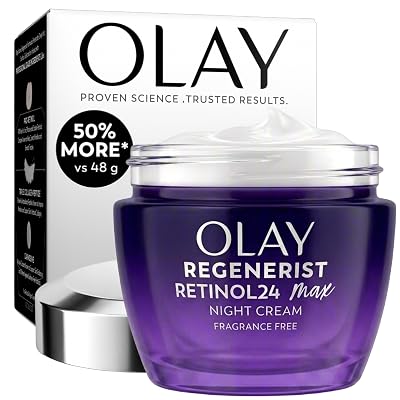
The Olay Retinol MAX night cream fills the step with the strongest evidence for fine lines: a retinoid. It combines pro-retinol with deep hydration and a peptide blend in one fragrance-free moisturiser, so you can start retinoid use without adding a separate serum, which keeps the routine short for beginners.
The seller positions it as an over-the-counter step to try before prescription options, and it has more pro-retinol than the brand’s earlier Retinol24. Introduce it two or three nights a week, build up slowly and wear sunscreen daily, because retinoids can cause dryness and sun sensitivity. It is stronger for lines than the #9 DRMTLGY peptide cream but less gentle.
- Pro-retinol night moisturiser
- More pro-retinol and hydrators than Retinol24
- Includes a collagen peptide blend
- Fragrance-free, fast-absorbing, non-greasy
Pros
- Retinoid and moisturiser in one step
- Fragrance-free
- Good bridge before prescription retinoids
Cons
- Can cause dryness or flaking at first
- Not for use during pregnancy without medical advice
Skip it if: Skip it if you are pregnant or trying to conceive, or if your skin is very reactive; the DRMTLGY peptide cream is gentler.
Check Price on AmazonEltaMD UV Restore Mineral SPF 40

Best for: Mature, sun-damaged skin
The EltaMD UV Restore is the sunscreen we would suggest to most readers with mature skin, because it is designed specifically for that group. It is a lightweight 100% mineral SPF 40 with zinc oxide and titanium dioxide, plus squalane to support moisture, which helps drier skin feel comfortable through the day.
The listing describes it as hypoallergenic, non-comedogenic and free from dyes, parabens and fragrance, and it is meant to be the last step in the morning, under makeup or alone. It is untinted, so it will not match the coverage of the #3 Colorescience or #10 Healthy Skin Lab picks, but that makes it easier to pair with your own foundation.
- Mineral SPF 40 with zinc oxide and titanium dioxide
- Made for mature, sun-damaged skin
- Squalane and ginger root extract
- Fragrance-free, dye-free and non-comedogenic
Pros
- Designed for mature skin
- Comfortable for drier complexions
- Works well under makeup
Cons
- SPF 40 rather than 50
- Mineral texture may need thorough blending
Skip it if: Skip it if you want tinted coverage from your sunscreen; the Colorescience or Healthy Skin Lab picks add colour.
Check Price on AmazonISDIN Eryfotona Actinica SPF 50

Best for: Sensitive or acne-prone mature skin
The ISDIN Eryfotona Actinica is the pick for people who have given up on mineral sunscreens because of white cast. It is a zinc oxide SPF 50 in an ultralight, tintless fluid that the seller says melts into skin without a white film, and it is non-comedogenic, so it suits mature skin that still breaks out.
The brand includes enzymes it links to repairing sun damage, but that claim goes beyond what a sunscreen should be relied on for; its real value is dependable mineral protection. It is lighter than the #7 EltaMD UV Restore and has no tint, unlike the #3 Colorescience, which makes it a good base for makeup or for men who want an invisible finish.
- 100% mineral zinc oxide, SPF 50+
- Ultralight, tintless fluid with no white cast
- Non-comedogenic for sensitive and acne-prone skin
- Includes enzymes the brand links to repair
Pros
- Sheer finish on most skin tones
- Light enough for oily or breakout-prone skin
- Suits post-procedure skin
Cons
- Repair claims are not a reason to buy
- Fluid texture can feel thin on very dry skin
Skip it if: Skip it if your skin is very dry; the EltaMD UV Restore with squalane feels more comforting.
Check Price on AmazonDRMTLGY Peptide Night Cream

Best for: Gentle overnight hydration
The DRMTLGY Peptide Night Cream is the pick for people who want a comforting, retinoid-free night moisturiser. It combines peptides with hyaluronic acid and ceramides to support the moisture barrier and prevent overnight dryness, and the seller describes a rich but lightweight texture that absorbs without a greasy feel or clogged pores.
It is labelled suitable for sensitive skin and nightly use, so it pairs well with a retinoid serum on alternate nights or works alone for people who cannot tolerate retinoids. Expect softer, better-hydrated skin by morning rather than a lift. It is gentler than the #6 Olay Retinol MAX cream, though less proven for fine lines.
- Peptide formula for smoother-looking skin
- Hyaluronic acid and ceramides for overnight hydration
- Rich yet lightweight, non-greasy texture
- Suitable for sensitive skin and nightly use
Pros
- Gentle enough for every night
- Supports the barrier when using retinoids
- Comfortable for dry mature skin
Cons
- No retinoid, so modest effect on lines
- Firming claims should be taken lightly
Skip it if: Skip it if you want a retinoid built into your night cream; the Olay Retinol MAX covers that.
Check Price on AmazonHealthy Skin Lab Tinted Moisturizer SPF 50

Best for: Light coverage with mineral SPF
The Healthy Skin Lab Protect Tinted Moisturizer is the pick for people who want one quick morning product. It is a broad-spectrum mineral SPF 50 with a sheer universal tint, plus hyaluronic acid for hydration, so it moisturises, protects and evens skin tone lightly in a single step, which suits busy mornings.
The listing describes it as dermatologist-tested, non-comedogenic and hypoallergenic, with a soft, radiant finish rather than full coverage. A single universal shade will not suit every skin tone equally, so the #3 Colorescience offers more flexibility. Apply generously, because a thin layer of any tinted moisturiser gives less protection than the label states.
- Broad-spectrum mineral SPF 50
- Sheer universal tint for most skin tones
- Hyaluronic acid for hydration
- Non-comedogenic and hypoallergenic
Pros
- Moisturiser, SPF and tint in one
- Light, natural-looking finish
- Suits sensitive skin
Cons
- One shade may not suit very deep skin tones
- Light coverage will not hide marked pigmentation
Skip it if: Skip it if you need real coverage or a precise shade match; the Colorescience Face Shield Flex is more adaptable.
Check Price on AmazonHow We Chose These Products
We shortlisted anti-aging products from Amazon listings that are highly rated by a large number of shoppers, favouring established skincare brands and fuller-featured formulas in the product types with the best evidence: sunscreen, retinoids, antioxidant serums and moisturisers. We then checked each product’s listed features against the guidance cited in this post, including the AAD’s advice on choosing anti-aging skin care.
These are research-based picks, not hands-on lab tests. We did not use the products ourselves, so the ranking reflects listing detail, ingredients and fit for aging skin rather than personal results. Where a listing makes a bold claim, such as repairing damage or lifting skin, we have not repeated it as fact.
- Strong ratings from a large number of shoppers
- Established brands and fuller-featured formulas preferred
- Only product types with good evidence for aging skin considered
- Listed features checked against the cited AAD and FDA guidance
- Thin or unclear listings and miracle claims excluded
The Core Anti-Aging Routine: Five Products That Matter
Most dermatologist-recommended anti-aging routines come down to the same five product types. Each has a clear job, and together they cover prevention, repair and comfort.
| Product | Main job | When to use | What to look for |
|---|---|---|---|
| Gentle cleanser | Removes dirt and sunscreen without stripping | Morning and night | Non-foaming or low-foam, fragrance-free |
| Antioxidant serum | Helps defend against sun and pollution damage, brightens | Morning | Vitamin C (L-ascorbic acid or stable derivatives), vitamin E, ferulic acid |
| Retinoid | Boosts cell turnover and collagen, softens fine lines | Night | Retinol, retinal or adapalene, starting at a low strength |
| Moisturiser | Hydrates, supports the barrier, plumps fine lines | Morning and night | Ceramides, glycerin, hyaluronic acid, peptides |
| Sunscreen | Prevents further sun damage and dark spots | Every morning, reapplied outdoors | Broad spectrum, SPF 30 or higher |
If you only buy two products, make them sunscreen and a moisturiser. If you add a third, make it a retinoid. Everything else, including eye creams, essences, toners and facial oils, is optional and should earn its place by solving a specific problem you actually have.
Harsh foaming cleansers and scrubs strip oils that aging skin already has less of, which can leave the face tight, flaky and more easily irritated by retinoids. Choose a cream, milk, gel or low-foam cleanser that leaves your face comfortable, not tight.
Sunscreen: The Most Important Anti-Aging Product
Ultraviolet light breaks down collagen and elastin and triggers uneven pigment. That is why sun-exposed skin on the face and hands ages faster than skin that is usually covered. UVA rays pass through clouds and window glass, so daily protection matters even on grey days and when you spend long hours near a window.
- Choose broad spectrum SPF 30 or higher for daily use.
- Use enough: roughly a quarter to a third of a teaspoon for the face.
- Mineral formulas with zinc oxide often suit sensitive skin; tinted versions also help with dark spots.
- A moisturiser with SPF is fine for most indoor days if you apply it generously.
The AAD’s guide to selecting anti-aging skin care products recommends broad-spectrum, SPF 30 or higher sunscreen as a foundation of any routine, and its page on how to apply sunscreen explains how much to use and when to reapply.
Sunscreen will not erase existing wrinkles, but it lets your skin repair itself and protects the results of every other product you use. Retinoids and acids also make skin more sun-sensitive, so they need sunscreen to be worthwhile.
Retinoids: The Best-Studied Anti-Aging Ingredient
Retinoids are vitamin A derivatives. They speed up skin cell turnover and encourage collagen production, which over months can soften fine lines, smooth texture and fade some dark spots.
- Retinol is the most common over-the-counter form and is converted to the active form in the skin.
- Retinal (retinaldehyde) is one step closer to the active form and can work a little faster.
- Adapalene is available without a prescription in some countries and is well studied for acne.
- Prescription tretinoin is the strongest option and is worth discussing with a dermatologist.
Results take patience: most people notice smoother texture after a couple of months and softer fine lines after three to six months of regular use. Dryness, flaking and stinging are common in the first weeks. Our guide on how to transition to retinol smoothly explains how to start slowly and build tolerance.
Antioxidant Serums: Vitamin C and Beyond
Antioxidant serums help neutralise free radicals created by sunlight and pollution. They work best in the morning, under sunscreen, rather than as a replacement for it.
- L-ascorbic acid is the most researched form of vitamin C but can sting and oxidise quickly.
- Derivatives such as sodium ascorbyl phosphate and ascorbyl glucoside are gentler and more stable.
- Vitamin E and ferulic acid can help stabilise vitamin C.
- Niacinamide is a gentle all-rounder that supports the barrier and evens tone.
Vitamin C can sting on sensitive or freshly shaved skin, so start with a lower strength or a derivative if you react. Vitamin C serum that turns dark orange or brown has oxidised and is less effective. Our guide to storing vitamin C serum properly explains how to keep it fresh for longer.
Moisturisers and Peptide Creams
Aging skin produces less oil and loses water more easily, so it often feels drier and looks more lined. A good moisturiser plumps the surface within minutes, which makes fine lines look softer.
- Ceramides, cholesterol and fatty acids help repair the skin barrier.
- Glycerin and hyaluronic acid draw water into the skin.
- Peptides are short chains of amino acids that may support firmness; evidence is promising but more modest than for retinoids.
- Richer creams suit dry skin; lighter lotions and gels suit oily or combination skin.
A peptide cream is a sensible choice if your skin cannot tolerate retinoids, or as a night moisturiser alongside one. Do not expect it to lift sagging skin. Eye creams are usually just gentler moisturisers in smaller tubes; a fragrance-free face cream can often be used around the eyes instead, as long as it does not sting.
What Works and What Is Hype
Marketing for aging skin relies on dramatic language. This table separates well-supported ingredients from claims that outrun the evidence.
| Claim or product | Reality |
|---|---|
| Instant lift or facelift in a jar | Temporary tightening at most; no cream lifts sagging skin |
| Collagen in creams rebuilds collagen | Collagen molecules are too large to be absorbed; they hydrate the surface |
| Stem cell and gold creams | Little good evidence in human skin |
| Expensive means more effective | Effective products exist at every price point |
| Retinoids | Strong, long-standing evidence for fine lines and texture |
| Daily sunscreen | Strong evidence for preventing visible aging |
| Vitamin C serum | Good evidence for antioxidant protection and brightness |
| Peptides | Promising but more modest evidence |
If a product promises results similar to injections or surgery, treat that as a sign to look elsewhere. Also be wary of long lists of botanical extracts presented as breakthroughs. Plant oils and extracts can make a product feel pleasant, but they rarely have the human evidence behind retinoids or sunscreen, and fragrant extracts are a common cause of irritation in mature, sensitive skin.
Choosing Anti-Aging Products for Your Skin Type
The same ingredients work for most skin types, but the texture and strength you choose should match your skin. The wrong format is a common reason people give up on a routine.
| Skin type | Retinoid format | Moisturiser | Sunscreen |
|---|---|---|---|
| Dry | Retinol in a cream base, used after moisturiser | Rich cream with ceramides | Hydrating lotion or cream SPF |
| Oily or acne-prone | Retinol serum or adapalene gel | Light, non-comedogenic gel or lotion | Oil-free, matte-finish SPF |
| Combination | Retinol serum | Lotion, with extra cream on dry patches | Lightweight fluid SPF |
| Sensitive | Low-strength retinol or retinal, two nights a week | Fragrance-free barrier cream | Mineral SPF with zinc oxide |
| Very mature or thin skin | Gentle retinol, buffered with moisturiser | Richer cream, used morning and night | Tinted mineral SPF |
Hormonal changes around menopause often make skin drier and more sensitive. If products that suited you for years start to sting, switch to richer, fragrance-free textures and lower-strength actives rather than stopping sunscreen or moisturiser.
How to Build an Anti-Aging Routine Step by Step
Build your routine gradually so you can see what works and spot anything that irritates.
Start with the basics
Use a gentle cleanser, moisturiser and daily SPF 30 for two weeks.
Add a retinoid at night
Apply a pea-sized amount two or three nights a week, after cleansing and before moisturiser.
Increase slowly
Move to every other night, then nightly, as your skin tolerates it.
Add vitamin C in the morning
Apply after cleansing and before moisturiser and sunscreen.
Keep sunscreen last
Apply generously as the final morning step and reapply outdoors.
Give it time
Assess results after three to six months, not three weeks.
If your skin is dry or sensitive, apply moisturiser first and retinoid on top, or mix the retinoid into your moisturiser. This buffers irritation while you build tolerance.
What to Avoid
Try This
- Patch test new actives on the jaw
- Introduce one new product at a time
- Use sunscreen every day
- Keep the routine simple and consistent
- Choose fragrance-free if you are sensitive
Avoid This
- Use a retinoid and strong acids on the same night
- Stack several new actives at once
- Scrub mature skin with harsh exfoliants
- Buy products based on miracle claims
- Skip sunscreen while using retinoids
Do not use retinoids, including over-the-counter retinol, if you are pregnant, trying to conceive or breastfeeding unless a doctor advises otherwise. Stop any product that causes swelling, blistering or persistent burning.
Honest Limits
Even the best facial products for aging skin deliver modest, gradual improvements. They can soften fine lines, improve texture and even tone, but they cannot reverse deep wrinkles, restore lost volume or tighten loose skin the way professional procedures can.
Overdoing actives is one of the most common mistakes, and irritated skin often looks older rather than younger. Lifestyle also matters: not smoking, sleeping well and protecting skin from the sun have a larger effect over the years than any single cream, and genetics decide a good deal of how and when lines appear. Our guide on whether anti-aging creams can age you explains how too many products can backfire.
When to See a Dermatologist
- You want a prescription retinoid or stronger treatment for sun damage.
- Over-the-counter products irritate your skin every time.
- You have dark patches, such as melasma, that keep returning.
- You notice a new, changing or bleeding spot or mole.
This article is for general information and does not replace professional medical advice. See a board-certified dermatologist for skin concerns, prescription treatments and any new or changing spots.
Questions People Ask
What is the best product for aging skin?
Daily broad-spectrum sunscreen, followed by a retinoid.
Is retinol or vitamin C better for aging skin?
They do different jobs; retinol at night, vitamin C in the morning.
Do peptide creams work?
They may help modestly, but less than retinoids.
At what age should I start anti-aging products?
Sunscreen from any age; retinoids often from the mid-twenties onward.
Can I use retinol every night?
Yes, once your skin has adjusted gradually.
Is the most expensive anti-aging product worth it?
Not necessarily. The Vibriance three pack and Colorescience SPF are premium, but the Olay Retinol MAX cream covers the best-studied step for less.
Does collagen cream add collagen to skin?
No, it mainly hydrates the surface.
Which sunscreen on this list is best for sensitive or red skin?
The EltaMD UV Skin Recovery is made for redness-prone and rosacea-prone skin; the EltaMD UV Restore suits mature, sun-damaged skin.
How long do anti-aging products take to work?
Around three to six months for visible change.
Which pick is best if I want one product for the morning?
A tinted mineral SPF such as the Healthy Skin Lab Tinted Moisturizer or Colorescience Face Shield Flex, applied generously.
Where This Leaves You
The best facial products for aging skin are simple: sunscreen every morning, a retinoid at night, an antioxidant serum, a moisturiser and a gentle cleanser.
Start slowly, stay consistent and ignore miracle claims; the routine you can stick to is the one that shows results.
Our top pick: Vibriance Super C Vitamin C Serum (3 Pack)
The Vibriance Super C Serum takes the top spot because it is a vitamin C serum made for mature skin, pitched as gentle enough for sensitive faces and sold as a three pack that lasts for months, which makes the antioxidant step easy to keep up. If you can only buy one product, though, make it a daily sunscreen such as the EltaMD UV Restore, and add the Olay Retinol MAX night cream when you are ready for a retinoid.
Check Price on Amazon
Written by
Registered pharmacist and founder of Facial Adviser. Rakib's pharmacy training covers how skincare actives work and interact; a later course in cosmetology turned that into a focus on facial treatments and skincare products. He plans, researches and edits every guide on the site and checks health claims against sources such as the American Academy of Dermatology, the FDA and the NIH. He is not a dermatologist; see the Editorial Policy and Medical Disclaimer.
About · Editorial policy · How we choose products · Medical disclaimer · Contact
Keep reading: Anti-aging facials and treatments
- What Is the Best Anti-Aging Facial Treatment? Options Compared by Goal
- Best Facial Procedures for Aging Skin: Botox, Fillers, Lasers and Peels
- Best Facial for Wrinkles: Professional Treatments vs At-Home Options
- Sagging Jowls in Your 30s: Causes and Options That Work
- Why Do I Have Crepey Skin on My Cheeks? Causes and Treatments That Help
- Facial Skin Tightening After Weight Loss: Realistic Options That Help
- Is Hydrafacial a Gimmick? What Evidence Shows
- Ultimate Guide Microdermabrasion: What to Know