Foot Massage Reflexology Benefits and Risks, Honestly
Foot massage reflexology benefits and risks get debated in two lazy extremes online, uncritical organ-map promotion or a dismissive “it’s totally fake” takedown, and the real evidence supports neither one cleanly.
Part of our guide to lifestyle and skin. Start with: How Diet Impacts the Skin Microbiome: What the Science Actually Shows
The most rigorous systematic review found 18 RCTs on reflexology; only 9 met a minimum quality threshold, and 7 of those 9 showed negative results, including both of the two largest trials in the entire review. No established anatomical or neurological mechanism connects a specific foot zone to a specific internal organ’s function.
What does hold up is general massage physiology, relaxation, reduced sympathetic tone, and mechanoreceptor stimulation, benefits NCCIH itself acknowledges even while stating plainly that organ-correspondence claims “have not been proven.”
This guide covers the actual review numbers most content never cites, real contraindications like DVT and diabetic neuropathy, a one-minute pre-session screening check, and where reflexology sits between pseudoscience and legitimate relaxation therapy.
Recommended Foot Massagers and Reflexology Tools




Fast Facts
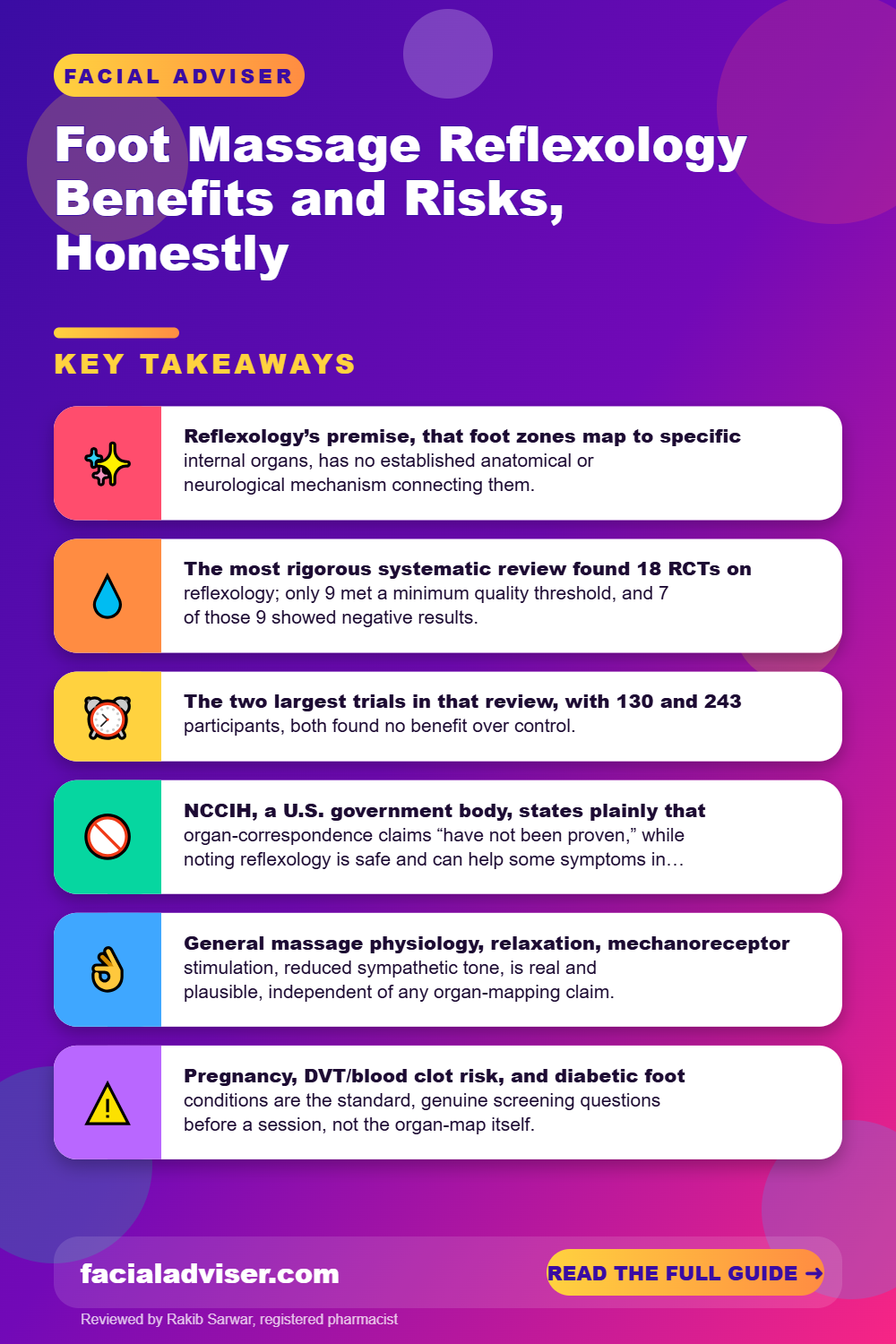
- Reflexology’s premise, that foot zones map to specific internal organs, has no established anatomical or neurological mechanism connecting them.
- The most rigorous systematic review found 18 RCTs on reflexology; only 9 met a minimum quality threshold, and 7 of those 9 showed negative results.
- The two largest trials in that review, with 130 and 243 participants, both found no benefit over control.
- NCCIH, a U.S. government body, states plainly that organ-correspondence claims “have not been proven,” while noting reflexology is safe and can help some symptoms in some contexts.
- General massage physiology, relaxation, mechanoreceptor stimulation, reduced sympathetic tone, is real and plausible, independent of any organ-mapping claim.
- Pregnancy, DVT/blood clot risk, and diabetic foot conditions are the standard, genuine screening questions before a session, not the organ-map itself.
Table of Contents
- What Reflexology Actually Claims
- Is There a Real Mechanism?
- The Systematic Review Numbers Nobody Cites
- What NCCIH Actually Says
- Reflexology vs. Standard Foot Massage
- Do This, Not That
- Real Contraindications
- A Reflexology Session, Step by Step
- One-Minute Check: Should You Skip This Session?
- What It’s Actually Good For
- Where the Organ-Map Idea Actually Came From
- Pseudoscience vs. “Not Proven for This Claim”
- Choosing a Practitioner and What to Expect Cost-Wise
- When Foot Pain Needs a Doctor, Not a Massage
- Frequently Asked Questions
- How This Compares to Other Adjacent Wellness Claims
- The Bottom Line
What Reflexology Actually Claims
Reflexology’s core premise is that specific zones on the foot, and sometimes the hand or ear, correspond via reflex maps to specific internal organs, such that pressure on a designated “kidney point” therapeutically affects kidney function. That’s the claim worth examining directly, since it’s the actual crux of whether this is pseudoscience or legitimate therapy, and the honest answer depends entirely on which specific claim you’re asking about.
Shopping these picks?
Amazon Prime members get fast, free shipping on eligible items, plus Prime Video, Amazon Music and member deals. New members can start with a free trial.
Start a free Prime trialAged 18 to 24? Prime for Young Adults comes with a longer free trial and a lower price after it.
Affiliate link: we may earn a commission at no extra cost to you.
Is There a Real Mechanism?
No established anatomical, neurological, or physiological mechanism connects a specific foot-surface pressure point to a specific internal organ’s function. What is physiologically plausible and mechanistically uncontroversial is that foot massage, like massage anywhere on the body, activates cutaneous pressure and mechanoreceptors, can promote local vasodilation and circulation, reduces sympathetic nervous system activation, and produces general relaxation responses similar to any other massage modality. Those effects are about general massage physiology, not organ-specific reflex maps.
The Systematic Review Numbers Nobody Cites
| Review Detail | Result |
|---|---|
| Total RCTs reviewed (Medical Journal of Australia, 2009) | 18, out of 217 screened publications, 1977-2009 |
| Trials meeting minimum quality threshold | 9 of 18 |
| Higher-quality trials showing negative results | 7 of those 9 |
| Two largest trials (n=130 and n=243) | Both found no benefit over control |
The review’s own conclusion, quoted directly: “the best evidence available to date does not demonstrate convincingly that reflexology is an effective treatment for any medical condition.” Only 5 of the 18 trials overall suggested any positive effect, with the author noting modest promise specifically in cancer-palliation-related symptom research, not cure or disease modification, as the one area meriting further study. A related updated systematic review reinforces the same overall conclusion of insufficient, unconvincing evidence for organ- or disease-specific claims.
What NCCIH Actually Says
FYI: the National Center for Complementary and Integrative Health, part of the NIH, states plainly that pressure-point-to-organ correspondence claims “have not been proven.” It separately notes reflexology was found safe even for the most fragile patients in a breast-cancer symptom study, with some symptom improvement, like shortness of breath, but not others, and that evidence is insufficient for multiple sclerosis symptom relief and too limited for irritable bowel syndrome to draw conclusions. That’s a neutral-authority summary worth taking at face value: not “totally debunked and harmful,” but explicitly “unproven for organ or disease claims, plausible only as general relaxation.”
Reflexology vs. Standard Foot Massage
| Factor | Reflexology | Standard Foot Massage |
|---|---|---|
| Claimed mechanism | Organ-specific reflex zones | General relaxation, circulation, mechanoreceptor stimulation |
| Evidence for organ-specific claims | Not demonstrated in the best available RCTs | Not claimed in the first place |
| Evidence for relaxation benefit | Plausible, consistent with general massage physiology | Same, well-established |
Practically, the two overlap heavily in what a session actually feels like and delivers. The meaningful difference is the organ-mapping narrative layered on top, which the evidence doesn’t support, not the physical relaxation benefit itself.
Do This, Not That
Do
- Book a session for relaxation and general stress relief, a legitimate, well-supported benefit
- Disclose pregnancy, diabetes, or any circulation issues before a session
- Treat it as a genuine, low-risk relaxation modality, comparable to a regular foot massage
Don’t
- Expect it to treat, diagnose, or cure a specific organ condition
- Substitute it for medical care of a diagnosed disease
- Book vigorous foot work over an active wound, infection, or unexplained foot pain
Real Contraindications
Caution: pregnancy, particularly in the first trimester, is commonly flagged for caution around certain foot and ankle pressure points traditionally associated with uterine stimulation, based more on precaution than controlled evidence of harm. Deep vein thrombosis or an existing blood clot carries a real, if theoretical, risk that vigorous massage could dislodge a clot. Diabetic peripheral neuropathy or peripheral vascular disease reduces sensation and impairs healing, so vigorous pressure risks unnoticed tissue damage. Osteoporosis, recent foot surgery or injury, gout flare-ups, and open skin lesions or infections are additional standard contraindications.
A Reflexology Session, Step by Step
Health screening
A trained practitioner should ask about pregnancy, diabetes, circulation issues, and any recent foot injury before starting.Assessment
The practitioner examines the feet for wounds, infections, or areas to avoid.Pressure-point work
Systematic pressure is applied across foot zones according to the traditional reflex map, generally at a comfortable, not painful, intensity.Relaxation close
A session typically ends with lighter, general massage strokes to leave the feet relaxed rather than tender.
One-Minute Check: Should You Skip This Session?
Tip: before any foot massage or reflexology session, ask yourself: am I pregnant, in my first trimester specifically; do I have diagnosed diabetes with reduced foot sensation; do I have an active blood clot, gout flare, open wound, or recent foot injury? A yes to any of these is a genuine, defensible reason to reschedule or get medical clearance first, not a generic caution.
What It’s Actually Good For
A small pilot study measuring salivary cortisol, melatonin, and anxiety following reflexology represents the kind of general-relaxation-response research that’s more mechanistically defensible than organ-specific claims, though as a single small pilot, it’s preliminary, not confirmatory, evidence. Combined with NCCIH’s own acknowledgment of some symptom improvement in specific measures, the honest, defensible use case for reflexology is stress reduction and general relaxation, the same category of benefit you’d expect from lymphatic facial massage or any other well-supported massage modality, not organ-specific disease treatment.
Where the Organ-Map Idea Actually Came From
Modern reflexology traces largely to early-20th-century “zone therapy,” popularized in the United States in the 1910s and later expanded into detailed foot charts in the 1930s, work that was based on proposed energy zones running the length of the body rather than on any dissected neurological pathway. The specific foot-to-organ maps used by practitioners today descend from that same era and haven’t been revised based on subsequent anatomical or neurological findings, which is part of why the maps vary somewhat between reflexology schools and traditions, a detail that itself undercuts the idea of a single, precise, physiologically discovered correspondence.
Pseudoscience vs. “Not Proven for This Claim”
Calling reflexology “completely pseudoscience with zero legitimate use” is also an overstatement, just in the other direction. The more accurate, more useful position, per both the systematic review and NCCIH, is that reflexology is pseudoscientific specifically regarding organ-mapping and disease-treatment claims, while remaining a legitimate, low-risk relaxation modality comparable to a regular foot massage. That dual conclusion is more nuanced than most content, which tends to pick one extreme or the other.
Choosing a Practitioner and What to Expect Cost-Wise
A reasonable practitioner will ask about your health history before starting and won’t claim the session can diagnose or cure a specific disease, a good filter for separating a legitimate relaxation-focused provider from one overselling the organ-mapping premise. Sessions are typically priced in line with a standard massage of similar length, relative to other spa or wellness treatments rather than a medical visit, and most people book them the same way they’d book any other relaxation-focused bodywork, as an occasional or regular stress-relief practice rather than a treatment plan for a diagnosed condition.
When Foot Pain Needs a Doctor, Not a Massage
See a doctor rather than booking a reflexology session for any diagnosed medical condition you’re hoping the session will treat, for unexplained foot pain, numbness, or swelling, or for symptoms that could reasonably be connected to chronic stress rather than a foot-specific issue. Reflexology can be a reasonable complement to stress management, but it isn’t a substitute for diagnosis or treatment of an actual medical condition.
Frequently Asked Questions
Does reflexology actually treat organ problems?
No; the best available systematic review found no convincing evidence for organ-specific or disease-treatment claims.
Is reflexology completely fake, then?
Not entirely; it’s unproven for organ-mapping claims specifically, while remaining a legitimate, low-risk relaxation modality.
What did the systematic review actually find?
Of 18 RCTs, only 9 met a quality threshold, and 7 of those 9 showed negative results, including both of the largest trials.
Is reflexology safe during pregnancy?
Caution is commonly advised around certain foot and ankle points, especially in the first trimester, based more on precaution than proven harm.
Can reflexology help with stress?
Plausibly yes, through general massage physiology and relaxation response, though dedicated evidence for reflexology specifically is thin.
Who should avoid a reflexology session?
Anyone with an active blood clot, diabetic neuropathy with reduced sensation, an open wound or infection, or a recent foot injury.
What does NCCIH say about reflexology?
That organ-correspondence claims haven’t been proven, while the practice is safe and shows some symptom benefit in specific contexts.
Is reflexology different from a regular foot massage?
Mechanically similar in practice; the meaningful difference is the organ-mapping narrative, which the evidence doesn’t support.
Can reflexology replace medical treatment?
No; it should never substitute for diagnosis or treatment of an actual medical condition.
Is reflexology risky for diabetics?
It can be, if peripheral neuropathy or vascular disease is present, since reduced sensation raises the risk of unnoticed tissue damage.
How This Compares to Other Adjacent Wellness Claims
Reflexology’s evidence pattern, a plausible general-relaxation mechanism paired with an unproven specific claim, is a shape worth recognizing across other wellness treatments too. It’s a similar structure to how a facial’s genuine hydration or exfoliation benefit sometimes gets stretched into an unsupported “detox” claim, or how a device’s real, narrow FDA clearance sometimes gets marketed well beyond what that clearance actually covers. Naming that pattern makes it easier to evaluate the next overreaching claim you encounter, in this category or any other.
The Bottom Line
Reflexology’s organ-mapping premise doesn’t hold up against the best available evidence, the most rigorous systematic review found no convincing support for any disease-specific claim, and the two largest trials both found no benefit over control. That’s worth stating plainly rather than softening into “mixed evidence.”
What does hold up is the general relaxation and stress-reduction benefit shared with any legitimate massage modality, real, plausible, and worth booking for that reason alone, just not as a substitute for diagnosing or treating an actual organ-specific medical condition.

Written by
Registered pharmacist and founder of Facial Adviser. Rakib's pharmacy training covers how skincare actives work and interact; a later course in cosmetology turned that into a focus on facial treatments and skincare products. He plans, researches and edits every guide on the site and checks health claims against sources such as the American Academy of Dermatology, the FDA and the NIH. He is not a dermatologist; see the Editorial Policy and Medical Disclaimer.
About · Editorial policy · How we choose products · Medical disclaimer · Contact