How Can I Smile More Attractively?
How can I smile more attractively, based on what dental-esthetics research actually finds rather than popular beauty formulas?
Part of our guide to lifestyle and skin. Start with: How Diet Impacts the Skin Microbiome: What the Science Actually Shows
The “golden proportion” ideal tooth-width ratio is explicitly labeled a myth by the most rigorous systematic review available, while a consonant smile arc, minimal gum display, and genuine, eye-engaging smiling all correlate with higher attractiveness ratings across multiple real studies. Dental professionals and laypeople frequently disagree on the exact ideal amount of gum show.
Perfectly symmetric faces don’t consistently outrate naturally asymmetric ones either, despite what “symmetry equals beauty” marketing implies.
This guide walks through each evidence-backed factor individually, and the two commonly repeated claims that don’t hold up under scrutiny.
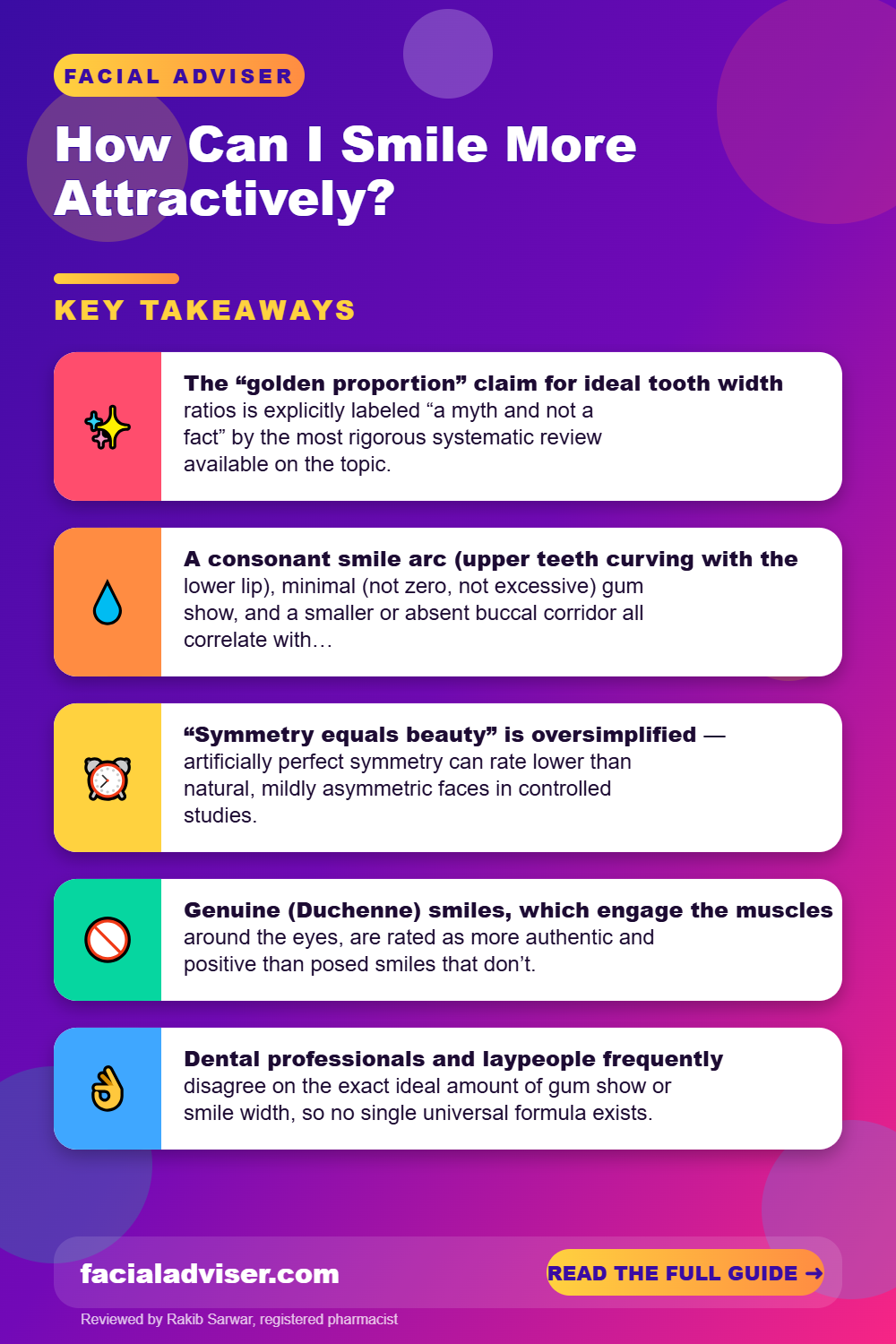
Recommended Products for a Brighter Smile

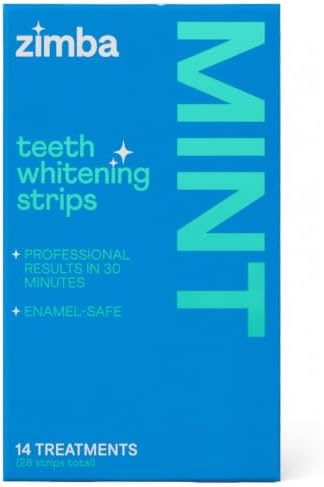
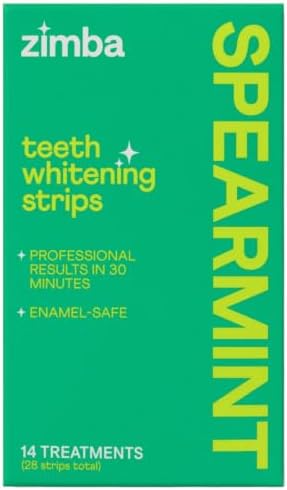


What the Research Actually Shows
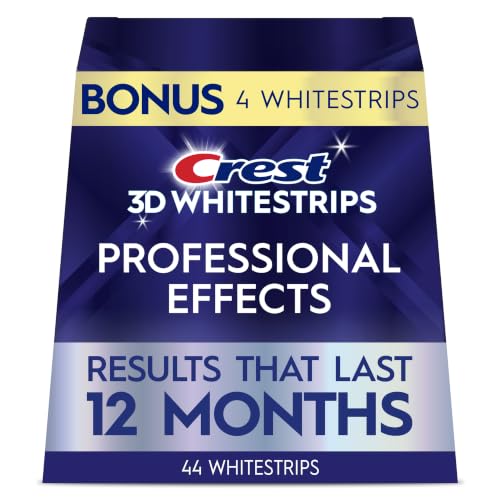
- The “golden proportion” claim for ideal tooth width ratios is explicitly labeled “a myth and not a fact” by the most rigorous systematic review available on the topic.
- A consonant smile arc (upper teeth curving with the lower lip), minimal (not zero, not excessive) gum show, and a smaller or absent buccal corridor all correlate with higher attractiveness ratings across multiple studies.
- “Symmetry equals beauty” is oversimplified — artificially perfect symmetry can rate lower than natural, mildly asymmetric faces in controlled studies.
- Genuine (Duchenne) smiles, which engage the muscles around the eyes, are rated as more authentic and positive than posed smiles that don’t.
- Dental professionals and laypeople frequently disagree on the exact ideal amount of gum show or smile width, so no single universal formula exists.
What’s Covered
- The Golden Proportion Myth
- Gum Display: What the Data Actually Shows
- Buccal Corridor: The Smile-Width Factor
- Smile Arc: The Factor With the Clearest Evidence
- Facial Symmetry, Reconsidered
- Why Genuine Smiles Read as More Attractive
- Factors Compared by Evidence Strength
- How Professionals and Laypeople Differ
- Do This, Not That
- Steps for a More Attractive Smile, Evidence-First
- The Self-Esteem Connection
- When to See a Dentist or Orthodontist
- What This Article Can’t Tell You
- Frequently Asked Questions
The Golden Proportion Myth
One of the most repeated claims in cosmetic dentistry marketing is that the most attractive smiles follow the “golden proportion” — a mathematical ratio of 1.618 applied to relative tooth widths. A systematic review and meta-analysis screened more than 566 initial search results down to six studies that actually met inclusion criteria for testing this claim rigorously, and its conclusion was direct: evidence supporting the existence of the golden proportion in natural smiles is lacking, and the existence of the golden proportion in dentistry is, in the review’s own words, a myth and not a fact. The same review found tooth dimension proportions vary meaningfully by race, ethnicity, and sex, meaning a single universal numeric ratio isn’t empirically grounded in natural human dentition at all. This is a genuine case of a marketing claim not holding up against the best available evidence, despite how often it’s repeated as settled fact.
Shopping these picks?
Amazon Prime members get fast, free shipping on eligible items, plus Prime Video, Amazon Music and member deals. New members can start with a free trial.
Start a free Prime trialAged 18 to 24? Prime for Young Adults comes with a longer free trial and a lower price after it.
Affiliate link: we may earn a commission at no extra cost to you.
Gum Display: What the Data Actually Shows
How much gum tissue shows when you smile — sometimes called a “gummy smile” when there’s a lot of it — is a genuinely contested variable rather than one with a fixed ideal number. A 2023 study of 320 Saudi Arabian raters, split between 138 dental professionals and 182 laypeople, had participants rate digitally altered smiles with gingival display manipulated from 4mm of gum coverage to 4mm of gum exposure in 1mm increments. Dental professionals rated a 1mm low lip line, meaning minimal gum show, as most attractive for both female and male smiles. Laypeople largely agreed for male smiles but preferred slightly more gum show (2mm) for female smiles. Notably, professionals and laypeople actively disagreed on zero gum show at all: 59 percent of professionals rated a fully gum-free smile as attractive, while nearly half of laypeople rated the identical image as unattractive. A separate, more recent study of 40 evaluators similarly found that zero millimeters of gum display was rated most favorable by both dentists and laypeople, with 2 to 3mm of display rated as the least attractive amount by both groups. The honest synthesis across both studies: minimal gum display is consistently preferred over a pronounced “gummy” smile, but there’s no single universal millimeter number that qualifies as “the” ideal — it shifts by population sampled and by whether the rater is a trained professional or a layperson.
Buccal Corridor: The Smile-Width Factor
The “buccal corridor” refers to the dark negative space visible at the corners of the mouth between the teeth and the inner cheek when you smile. The same recent 40-evaluator study found both dentists and laypeople strongly preferred smiles with little to no visible buccal corridor, with progressively larger corridor space rated as progressively less attractive by both groups. This is broadly consistent with older orthodontic literature that has debated for well over a decade exactly how much this specific factor matters, with some research in that broader literature suggesting the buccal corridor’s effect size on perceived attractiveness may be smaller than that of the smile arc or gum display — a real but comparatively minor factor rather than the dominant one some marketing implies.
Smile Arc: The Factor With the Clearest Evidence
The smile arc describes the curve formed by the edges of the upper front teeth relative to the curve of the lower lip when smiling. Across the smile-esthetics literature, a “consonant” smile arc — one that curves in parallel with the lower lip — is consistently rated as more attractive than a flat or reverse (“nonconsonant”) arc. The same 40-evaluator study found consonant arcs rated meaningfully more attractive than nonconsonant ones by both dentists and laypeople, with dental professionals penalizing a flat or reverse arc even more heavily than laypeople did. Of all the individual factors examined in the smile-esthetics research, the smile arc shows some of the most consistent agreement across studies and rater groups.
Facial Symmetry, Reconsidered
Foundational research on facial attractiveness established a real correlation between facial symmetry and perceived attractiveness. But more recent work examining study methodology found this effect is highly sensitive to how researchers actually test it: studies using artificially mirrored, perfectly symmetric composite faces — which tend to look subtly unnatural — can produce lower attractiveness ratings than studies comparing real faces with their natural, mild degree of asymmetry. In other words, perfect, artificial symmetry isn’t what the evidence actually supports as most attractive. Natural near-symmetry, which is what essentially every real human face has, correlates modestly with attractiveness ratings, but a person’s normal, everyday facial asymmetry isn’t the aesthetic deficit that some marketing framing implies.
Why Genuine Smiles Read as More Attractive
A meta-analysis of research on smile authenticity found that genuine smiles — technically called Duchenne smiles, which engage the orbicularis oculi muscles around the eyes, producing the visible “eye crinkle” — are perceived as more authentic and positive than posed smiles that only involve the mouth. This is a mechanistic point worth taking seriously alongside all the dental and orthodontic factors above: a technically well-aligned smile that looks posed and doesn’t engage the eyes reads differently to observers than a less “perfect” smile that’s genuinely felt. The eyes are doing real perceptual work here, not just the teeth.
Factors Compared by Evidence Strength
| Factor | Evidence strength | Honest takeaway |
|---|---|---|
| Consonant smile arc | Strong, consistent across studies | One of the more reliably supported preference factors |
| Minimal (not zero) gum display | Moderate, but contested exact ideal | Direction is consistent; exact millimeter target varies by rater group |
| “Golden proportion” tooth ratios | Explicitly debunked by the most rigorous review | Labeled a myth, not a fact, by systematic review |
| Perfect facial symmetry | Weak/overstated in popular framing | Correlation is real but modest, and artificial symmetry can rate worse than natural asymmetry |
| Genuine (Duchenne) smiling | Strong for perceived authenticity | Independent of dental alignment factors entirely |
How Professionals and Laypeople Differ
| Feature | Dental professionals’ preference | Laypeople’s preference |
|---|---|---|
| Gum display (female smile) | 1mm (minimal) | 2mm (slightly more) |
| Zero gum display | Majority rated attractive | Nearly half rated unattractive |
| Flat/reverse smile arc | Penalized more heavily | Penalized, but less severely |
Do This, Not That
Do
- Focus on smile arc and gum-display balance if you’re consulting a cosmetic dentist, since these have the most consistent supporting evidence
- Practice smiling in a way that engages your eyes, not just your mouth, if you want your smile to read as more genuine
- Consider that professional and personal aesthetic preferences may differ — ask what specifically a provider is optimizing for
Don’t
- Chase a “golden ratio” tooth-width formula — the most rigorous review available found it’s not supported by evidence in natural dentition
- Assume your face’s natural asymmetry is an aesthetic flaw to correct — near-universal in real faces and only modestly linked to attractiveness ratings
- Judge your own smile only against posed photos — genuine, eye-engaging smiles are rated as more attractive than technically posed ones
Steps for a More Attractive Smile, Evidence-First
Assess your smile arc
Notice whether your upper front teeth curve with your lower lip (consonant) or appear flat/reversed — this is one of the more consistently supported factors.Evaluate gum display honestly
Minimal gum show is generally preferred, but there’s no single perfect number — don’t chase an extreme (zero) if it isn’t natural for your anatomy.Consider buccal corridor only as a secondary factor
It matters less consistently than arc or gum display in the research.Practice genuine, eye-engaging smiles
A Duchenne smile is rated as more attractive and authentic independent of any dental work.Consult a professional for individualized advice
If considering orthodontic or cosmetic work, ask specifically which factors they’re optimizing and why, given how much rater disagreement exists in the research.
The Self-Esteem Connection
A growing body of cross-sectional research links perceived smile and dental aesthetics to self-esteem scores in both adolescents and adults, supporting the idea that smile appearance carries a real measurable psychosocial impact. It’s worth being honest about the limits of this research, though: most of it is correlational rather than experimental, meaning it shows an association between smile aesthetics and self-esteem without proving that a cosmetic intervention causes an improvement in self-esteem — a notably weaker claim than what cosmetic dentistry and orthodontic marketing often implies.
When to See a Dentist or Orthodontist
A consultation is worth pursuing if you have a specific, identifiable concern — a flat or reversed smile arc, gum display that bothers you specifically, or alignment issues — rather than a vague sense that your smile should look different. It’s also worth raising the research on rater disagreement directly with your provider: ask what specific outcome they’re optimizing for, and whether that matches what you personally find attractive, since professional and lay preferences don’t always align, particularly around gum display and symmetry.
What This Article Can’t Tell You
Frequently Asked Questions
Is the golden ratio real for smile design?
The most rigorous systematic review available found no evidence supporting the golden proportion in natural dentition, explicitly calling it a myth rather than a fact, since tooth proportions vary by race, ethnicity, and sex.
How much gum should show when I smile?
There’s no single universal ideal. Studies consistently find minimal gum display preferred over a “gummy” smile, but the exact ideal amount differs between dental professionals and laypeople and across study populations.
What is a smile arc?
It’s the curve of your upper front teeth relative to your lower lip when smiling. A “consonant” arc that curves with the lower lip is consistently rated more attractive than a flat or reversed arc.
What is the buccal corridor?
It’s the dark space visible at the corners of the mouth between the teeth and inner cheek when smiling. Less of it is generally preferred, though its effect on overall attractiveness may be smaller than smile arc or gum display.
Does facial symmetry make a smile more attractive?
The correlation is real but modest, and it’s sensitive to how it’s studied — artificially perfect symmetry can rate lower than natural, mildly asymmetric faces, which is what most real faces have.
Why do genuine smiles look more attractive than posed ones?
Genuine (Duchenne) smiles engage the muscles around the eyes, which research finds observers perceive as more authentic and positive than a posed smile involving only the mouth.
Do dentists and regular people agree on what makes an attractive smile?
Not always. Studies find real disagreement, particularly around gum display and how heavily to penalize a flat smile arc, between dental professionals and laypeople.
Can improving my smile improve my self-esteem?
There’s a real, documented association between smile aesthetics and self-esteem in research, but most of it is correlational, not proof that a cosmetic change causes a self-esteem improvement.
Is my naturally asymmetric face unattractive?
No. Nearly all real faces are somewhat asymmetric, and research shows this modest natural asymmetry isn’t the aesthetic flaw that a “symmetry equals beauty” framing implies.
What single change would most improve smile attractiveness?
There’s no single universal answer, but a consonant smile arc and minimal (not zero, not excessive) gum display have some of the most consistent supporting evidence across the studies reviewed here.

Written by
Registered pharmacist and founder of Facial Adviser. Rakib's pharmacy training covers how skincare actives work and interact; a later course in cosmetology turned that into a focus on facial treatments and skincare products. He plans, researches and edits every guide on the site and checks health claims against sources such as the American Academy of Dermatology, the FDA and the NIH. He is not a dermatologist; see the Editorial Policy and Medical Disclaimer.
About · Editorial policy · How we choose products · Medical disclaimer · Contact
Keep reading: Diet, sleep, stress and skin