Cavitation Massage: What the Real Evidence Shows
Cavitation massage is marketed as a painless way to melt away stubborn fat, but the strongest available trial evidence tells a more modest story.
Part of our guide to professional machines. Start with: Best Professional Oxygen Facial Machine: Features, Safety and Results
A genuine placebo-controlled trial found that cavitation massage produced no statistically significant objective difference in body measurements compared to a sham treatment, even though 60% of participants showed visible improvement in blinded photo review. That gap between what a photo suggests and what a tape measure confirms is worth knowing before booking a course of sessions.
Most spa cavitation devices also aren’t the same as the specific machines that hold genuine FDA clearance for fat reduction, a distinction worth checking before you pay for a package.
This guide covers the real mechanism, the actual trial data, the regulatory gap between device types, and the truth behind the “detox” claims.
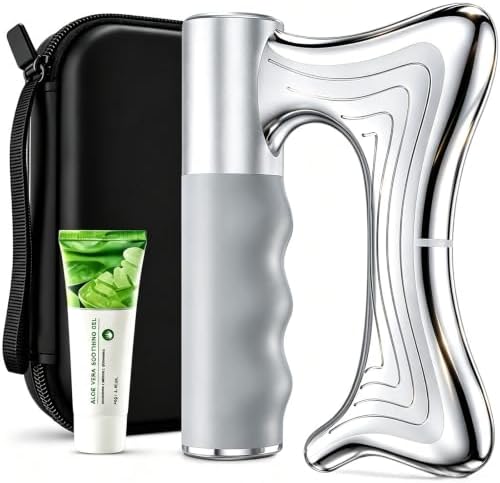
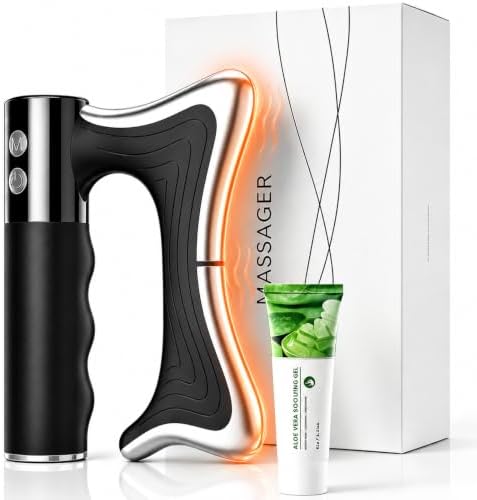
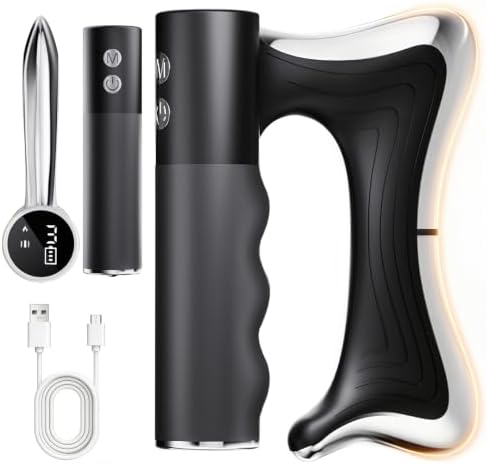
Recommended Body-Contouring Devices With Real Clearance


What Cavitation Massage Actually Is
Quick scope note: cavitation massage is a body-contouring treatment aimed at areas like the abdomen, thighs, or flanks, not a facial treatment — it’s covered here because it’s commonly offered alongside facial services at spas and med-spas, and it gets confused with legitimate facial ultrasound treatments often enough to be worth untangling. If you came here looking for a facial-specific ultrasound treatment, that’s a different technology covered in our guide to ultrasound facials.
Shopping these picks?
Amazon Prime members get fast, free shipping on eligible items, plus Prime Video, Amazon Music and member deals. New members can start with a free trial.
Start a free Prime trialAged 18 to 24? Prime for Young Adults comes with a longer free trial and a lower price after it.
Affiliate link: we may earn a commission at no extra cost to you.
Cavitation massage uses low-frequency ultrasound, typically in the 1-3 MHz range in commercial devices, to generate microbubbles in interstitial fluid that expand and collapse, creating mechanical shear stress theorized to rupture fat-cell (adipocyte) membranes. The released lipid content is supposed to clear through normal lymphatic and hepatic pathways. This mechanism has real biophysical plausibility and has been examined at the tissue level, but device power and frequency vary widely and are largely unstandardized across the commercial market, which makes comparing results across different machines genuinely difficult.
The Plain Truth
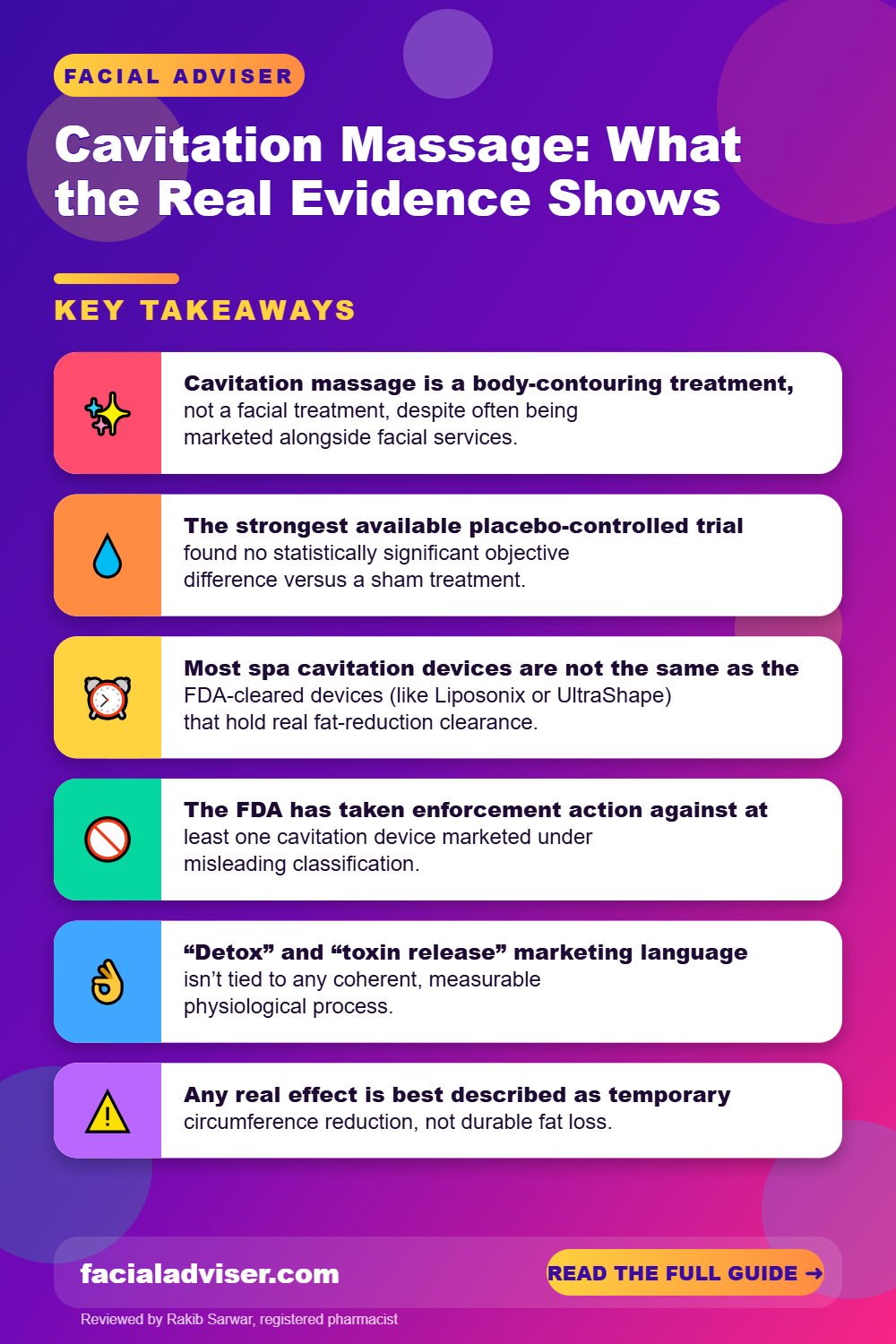
- Cavitation massage is a body-contouring treatment, not a facial treatment, despite often being marketed alongside facial services.
- The strongest available placebo-controlled trial found no statistically significant objective difference versus a sham treatment.
- Most spa cavitation devices are not the same as the FDA-cleared devices (like Liposonix or UltraShape) that hold real fat-reduction clearance.
- The FDA has taken enforcement action against at least one cavitation device marketed under misleading classification.
- “Detox” and “toxin release” marketing language isn’t tied to any coherent, measurable physiological process.
- Any real effect is best described as temporary circumference reduction, not durable fat loss.
Skip to a Topic
- What Cavitation Massage Actually Is
- The Real Mechanism Behind the Claims
- What the One Placebo-Controlled Trial Found
- FDA Clearance: What’s Real and What Isn’t
- The “Detox” Claim, Corrected
- What a Typical Cavitation Massage Session Involves
- Who This Might Reasonably Suit
- When to Skip Cavitation Massage
- When to See a Doctor Instead
- There’s No Home Test for Device Legitimacy — Here’s What to Check
- Where the Evidence Runs Out
- Frequently Asked Questions
The Real Mechanism Behind the Claims
The underlying biophysics of cavitation is real: ultrasound-generated microbubbles collapsing near a cell membrane can produce enough localized mechanical stress to disrupt it. A 2013 study in Plastic and Reconstructive Surgery Global Open specifically examined the histological and ultrastructural effects of ultrasound-induced cavitation on human skin adipose tissue, giving the mechanism genuine tissue-level support rather than being pure marketing invention. Where the claims get shakier is the jump from “this can happen to a fat cell under controlled lab conditions” to “a 20-minute spa session reliably does this at a clinically meaningful scale” — that’s a much bigger claim, and it’s the one the best available trial actually tested.
What the One Placebo-Controlled Trial Found
The most directly relevant evidence is a genuine placebo-controlled RCT: Lopes et al., “Efficacy of Ultrasound for Localized Fat Treatment on Clinical and Psychological Outcomes,” published in Aesthetic Surgery Journal Open Forum in 2020. Thirty women aged 18-30 were randomized into three groups of ten: control (no treatment), experimental (real 3 MHz, 60W ultrasound at 1.0 W/cm², 10 sessions of 20 minutes twice weekly over 8 weeks), and placebo (an identical protocol with the device output set to zero). Researchers measured waist-to-hip ratio, blood pressure, heart rate, physical performance, and blinded-assessor analysis of before/after photographs.
The headline finding: blinded assessors identified visible improvement in photographs for 60% of the experimental group, but every objective clinical and functional measurement — circumference, physical performance — showed no statistically significant difference between groups (P > 0.05). The study’s own conclusion was that ultrasound cavitation “does not constitute a superior method” compared to placebo or no treatment for measurable outcomes. That gap between photo-rated subjective improvement and objective measurement is exactly the pattern worth knowing before paying for a course of sessions.
| Measure | Result |
|---|---|
| Blinded photo-rated improvement | 60% of experimental group rated improved |
| Waist-to-hip ratio (objective) | No significant difference vs. placebo (P > 0.05) |
| Physical performance measures | No significant difference vs. placebo (P > 0.05) |
FDA Clearance: What’s Real and What Isn’t
The FDA maintains a public page on non-invasive body contouring technologies recognizing legitimate cleared categories, including cryolipolysis (fat-freezing devices like CoolSculpting), radiofrequency, laser/light-based devices, and high-intensity focused ultrasound. Two devices that genuinely hold FDA clearance specifically for fat reduction are Liposonix and UltraShape — both high-intensity focused ultrasound (HIFU) devices, a meaningfully different energy-delivery approach from the low-frequency cavitation devices typically used in repeated spa or salon “massage” sessions.
A documented enforcement case makes the regulatory gap concrete: SkinRex’s Cavi-Lipo ultrasound cavitation system received FDA action (an import detention, reported around January 2014) after being marketed as an “electric therapeutic massager” — a lower-risk device category using mechanical vibration — when it actually used ultrasound diathermy, a different and higher-risk mechanism, without the premarket approval its actual claims would require. Some marketing for the device also falsely implied FDA approval.
| Device type | Regulatory status | Typical use context |
|---|---|---|
| Liposonix, UltraShape (HIFU) | FDA-cleared specifically for fat reduction | Single or few-session in-office treatment |
| Generic low-frequency cavitation devices | Often marketed as “massagers,” not cleared for fat-destruction claims | Repeated spa/salon sessions |
More recent trials add a genuinely useful nuance here without overturning the core placebo-controlled finding above. A registered trial (ClinicalTrials.gov identifier NCT04930068) examined ultrasonic cavitation for abdominal obesity in adolescent females, and a separate 2021 study in PLOS ONE tested focused ultrasound cavitation combined with aerobic exercise for abdominal and liver fat in patients with non-alcoholic fatty liver disease. Neither reverses the Lopes 2020 finding, but together they point toward a more honest, narrower possibility: cavitation combined with exercise, or used in a specific metabolic-disease population under medical supervision, might behave differently than cavitation marketed as a standalone cosmetic treatment for healthy adults — which is the context most spa advertising actually targets. That’s a real, open research question, not a settled one either way, and it’s a meaningfully different claim from the blanket “cavitation reduces fat” framing used in most marketing.
The “Detox” Claim, Corrected
No credible peer-reviewed evidence supports the claim that cavitation “releases toxins” that the body then flushes out. The legitimate proposed mechanism — adipocyte membrane rupture followed by lipid clearance through ordinary metabolic pathways — doesn’t involve “toxins” as a coherent medical concept at all. It’s standard lipid metabolism repackaged with wellness-marketing language, and it’s worth stating plainly rather than hedging around it.
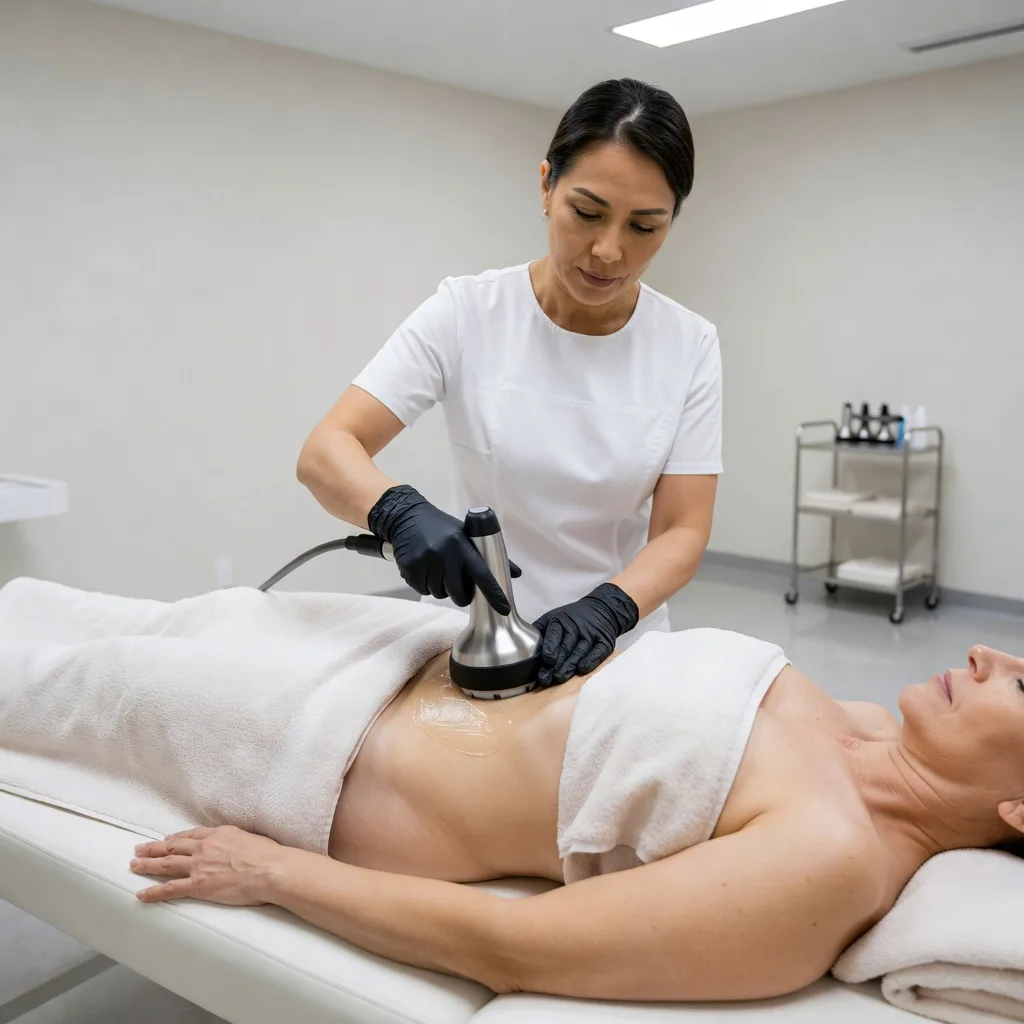
What a Typical Cavitation Massage Session Involves
Consultation and area marking
The provider identifies the treatment area and discusses realistic expectations before starting.Gel application
A conductive gel is applied to help transmit the ultrasound energy evenly.Device pass
The provider moves the ultrasound applicator over the treatment area for roughly 20-30 minutes.Post-session guidance
Hydration and light activity are typically recommended, based on the theory that this supports lymphatic clearance of released lipid content.
Who This Might Reasonably Suit
Someone specifically looking for a low-cost, non-invasive treatment mainly for the temporary circumference-reduction and skin-feel effect, with realistic expectations set by the placebo-controlled trial data above, is the most honest fit. Anyone expecting durable fat-volume reduction comparable to a genuinely FDA-cleared HIFU device, or expecting results to hold without diet and exercise changes, is setting an expectation the evidence doesn’t support.
Do
- Ask which specific device is being used and check its actual FDA clearance
- Treat any result as likely temporary rather than a lasting fat reduction
- Set expectations based on the placebo-controlled trial data, not marketing photos
Don’t
- Assume a spa offering the treatment means it’s FDA-cleared for fat reduction
- Expect “toxin release” as a real physiological mechanism
- Substitute repeated sessions for diet and exercise if durable fat loss is the actual goal
When to Skip Cavitation Massage
Skip cavitation massage if you’re pregnant, have a pacemaker or other implanted electronic device, have a bleeding disorder, or have an active infection or open wound in the treatment area. It’s also not a reasonable substitute for medically supervised weight management if you have a diagnosed metabolic condition.
When to See a Doctor Instead
See a physician rather than pursuing repeated cavitation sessions if your actual goal is significant, durable fat loss or you have an underlying metabolic condition driving your concern — a body-contouring “massage” service isn’t positioned or evidenced as a medical weight-management treatment.
There’s No Home Test for Device Legitimacy — Here’s What to Check
There’s no at-home test that tells you whether a specific cavitation device or provider is using genuinely evidenced equipment, but there is a direct question that substitutes for one: ask the provider to name the exact device and check it against the FDA’s 510(k) or De Novo clearance databases yourself before booking. That single check separates a device with real fat-reduction clearance from one marketed under a lower-risk “massager” classification it doesn’t actually match.
Where the Evidence Runs Out
Be precise about what’s established here: the microbubble mechanism has real tissue-level support, and the Lopes et al. 2020 trial is a genuine, named, placebo-controlled RCT showing no objective difference versus sham treatment. What’s missing is any large, multi-center, long-term RCT establishing durable fat-volume reduction from low-frequency cavitation specifically, as distinct from single-session HIFU devices with their own separate evidence base. Device power and protocol reporting are also inconsistent enough across the commercial market that cross-study comparison remains genuinely difficult.
Frequently Asked Questions
Is cavitation massage a facial treatment?
No — it’s a body-contouring treatment for areas like the abdomen or thighs, despite sometimes being offered alongside facial services.
Does cavitation massage actually reduce fat?
The strongest available placebo-controlled trial found no statistically significant objective difference versus sham treatment, despite subjective photo-rated improvement.
Is cavitation massage FDA-approved?
Most spa cavitation devices are not the same as the specific devices, like Liposonix or UltraShape, that hold genuine FDA clearance for fat reduction.
Does cavitation massage release toxins?
No — there’s no coherent medical mechanism behind that claim; it’s standard lipid metabolism repackaged in wellness-marketing language.
How many sessions does cavitation massage typically take?
Commercial protocols commonly involve multiple sessions over several weeks, though no dedicated trial establishes an “optimal” session count.
Is cavitation massage safe?
It’s generally low-risk for most healthy adults, but isn’t appropriate during pregnancy or for anyone with a pacemaker or bleeding disorder.
What’s the difference between cavitation and HIFU?
Cavitation uses lower-frequency ultrasound in repeated sessions; HIFU delivers focused, higher-intensity energy, often with genuine FDA clearance for fat reduction.
Has the FDA taken action against any cavitation device?
Yes — the Cavi-Lipo device was subject to FDA import detention after being marketed under a misleading device classification.
Will results from cavitation massage be permanent?
Any real effect is best treated as temporary circumference reduction rather than durable fat loss, based on current evidence.
Should I ask what device my provider uses?
Yes — checking the specific device against FDA clearance databases is the most useful thing you can verify before booking.

Written by
Registered pharmacist and founder of Facial Adviser. Rakib's pharmacy training covers how skincare actives work and interact; a later course in cosmetology turned that into a focus on facial treatments and skincare products. He plans, researches and edits every guide on the site and checks health claims against sources such as the American Academy of Dermatology, the FDA and the NIH. He is not a dermatologist; see the Editorial Policy and Medical Disclaimer.
About · Editorial policy · How we choose products · Medical disclaimer · Contact
Keep reading: Professional spa machines
- Best Professional Oxygen Facial Machine: Features, Safety and Results
- Isavera Fat Freezing System: Does At-Home Fat Freezing Work?
- 10 Best Body Wash for Spray Tan (2026): Before and After Picks
- Is 80k Cavitation Better Than 40k?
- Can Cavitation Cause Cancer? The Real Question to Ask First
- Professional Ultrasonic Cavitation Machine: Salon Buying Guide