Is 80k Cavitation Better Than 40k?
Is 80k cavitation better than 40k, the way most product listings imply?
Part of our guide to professional machines. Start with: Best Professional Oxygen Facial Machine: Features, Safety and Results
Not by the physics: a higher ultrasound frequency like 80kHz penetrates tissue less deeply than a lower one like 40kHz, and no clinical trial has ever compared the two devices head-to-head for fat-reduction results. The only FDA-cleared device that genuinely uses a cavitation mechanism doesn’t market itself by a kHz number at all.
Most consumer and spa machines sold under either label were never submitted for FDA clearance as fat-reduction devices in the first place, a pattern the agency has already taken enforcement action over.
This guide covers the real physics, the named devices that actually hold FDA clearance, and how to check a specific machine’s regulatory status before paying for a course of sessions.
Recommended Body Contouring Devices and Providers




What Matters Here
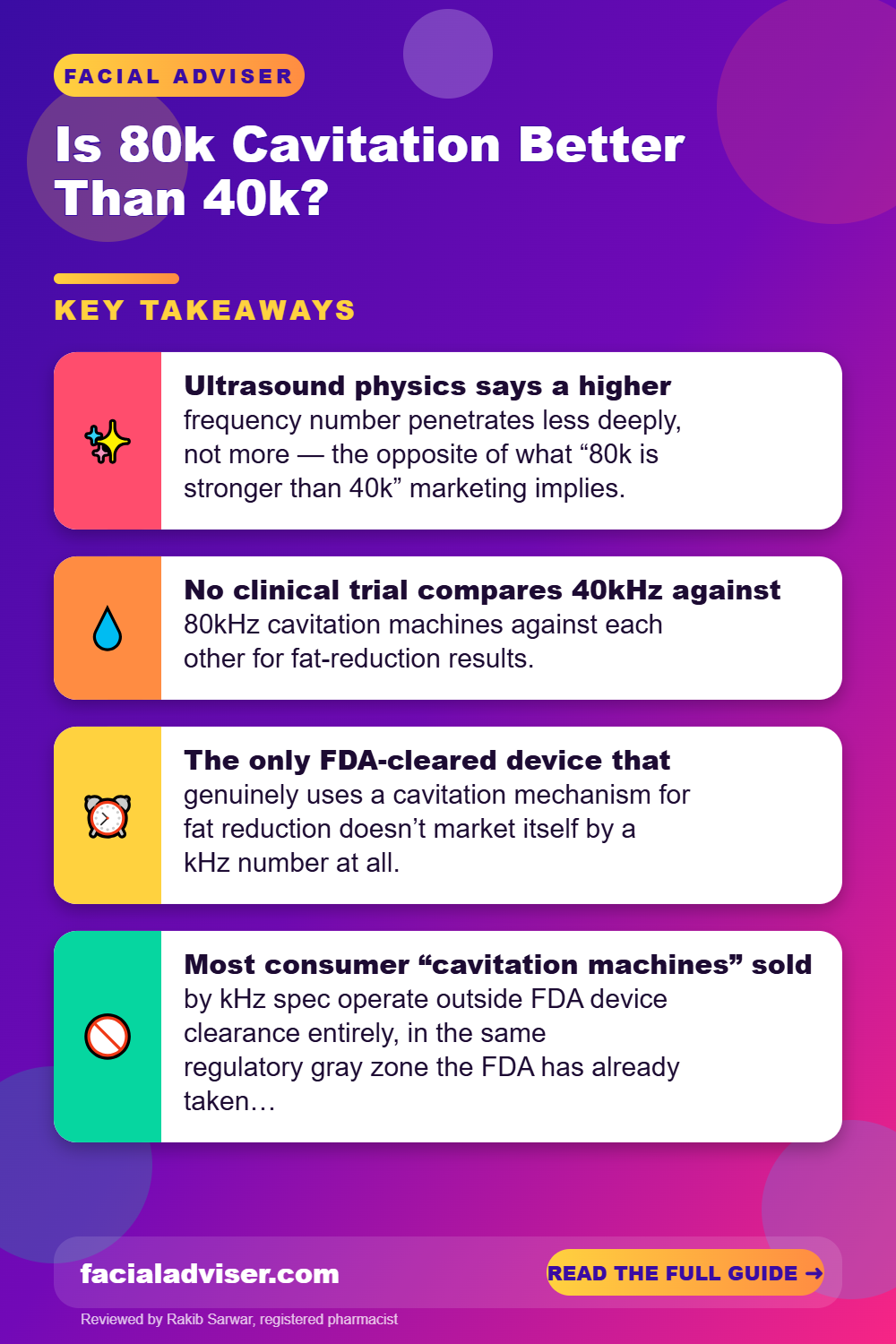
- Ultrasound physics says a higher frequency number penetrates less deeply, not more — the opposite of what “80k is stronger than 40k” marketing implies.
- No clinical trial compares 40kHz against 80kHz cavitation machines against each other for fat-reduction results.
- The only FDA-cleared device that genuinely uses a cavitation mechanism for fat reduction doesn’t market itself by a kHz number at all.
- Most consumer “cavitation machines” sold by kHz spec operate outside FDA device clearance entirely, in the same regulatory gray zone the FDA has already taken enforcement action against.
Section Guide
- What “80k vs 40k” Is Actually Claiming
- The Physics Marketing Gets Backwards
- Marketed Frequency vs. Claimed Penetration Depth
- What Frequencies Real FDA-Cleared Devices Actually Use
- The Regulatory Gray Zone Most of These Machines Sit In
- Do This, Not That
- A Documented Warning Letter, and Why It’s Not a One-Off
- How Strong Is the Fat-Reduction Evidence, Overall
- A Practical Way to Vet Any Device Before Buying
- How to Evaluate a Cavitation Machine Claim
- Is There a Way to Verify a Machine’s Real Effect at Home?
- When to Talk to a Provider Instead
- What This Evidence Doesn’t Tell Us
- Frequently Asked Questions
What “80k vs 40k” Is Actually Claiming
Shop for an ultrasonic cavitation machine and you’ll see frequency numbers — usually somewhere between 30kHz and 80kHz — presented as the key spec, with an implicit suggestion that a bigger number means a more advanced or more powerful device. An “80k” machine is often marketed at a premium over a “40k” one, positioned as the upgrade. Is that framing backed by anything in the ultrasound literature? Not really, and the direction of the actual physics is the opposite of what the marketing implies.
Shopping these picks?
Amazon Prime members get fast, free shipping on eligible items, plus Prime Video, Amazon Music and member deals. New members can start with a free trial.
Start a free Prime trialAged 18 to 24? Prime for Young Adults comes with a longer free trial and a lower price after it.
Affiliate link: we may earn a commission at no extra cost to you.
The Physics Marketing Gets Backwards
Basic ultrasound physics, taught in any introductory medical-imaging or physics course, establishes an inverse relationship between frequency and tissue penetration depth: lower frequency means a longer wavelength, which travels deeper into tissue before losing energy; higher frequency means a shorter wavelength, which is absorbed and scattered more quickly and therefore penetrates less deeply, while offering finer resolution at the surface. This relationship is why diagnostic ultrasound uses lower frequencies for deep abdominal imaging and higher frequencies for superficial structures like skin or small joints.
Applied to cosmetic cavitation machines, industry technical pages themselves describe a similar pattern: a 30kHz setting is claimed to reach roughly 1 to 6 centimeters deep, a 40kHz setting roughly 1 to 5 centimeters, and an 80kHz setting only about 1 to 2 centimeters, marketed specifically for “delicate” or shallow areas. In other words, even by the industry’s own technical claims, 80kHz is the shallower-penetrating option, not the stronger one — it’s being marketed as an upgrade while functioning, by its own stated specs, as a more superficial setting.
Marketed Frequency vs. Claimed Penetration Depth
| Marketed frequency | Manufacturer-claimed depth | Manufacturer-claimed use case |
|---|---|---|
| 30kHz | ~1–6cm | Larger, thicker fat areas (abdomen, thighs) |
| 40kHz | ~1–5cm | General-purpose, most commonly marketed setting |
| 80kHz | ~1–2cm | “Delicate” or shallow areas, face, smaller zones |
Worth noting: these depth figures come from manufacturer and industry marketing pages, not from a peer-reviewed clinical trial that measured actual tissue penetration in living patients. No study directly comparing 40kHz and 80kHz consumer cavitation devices head-to-head for fat-reduction outcomes could be located in the dermatology or plastic surgery literature. The honest state of the evidence is that this entire comparison exists almost exclusively in product marketing copy, not in controlled research.
What Frequencies Real FDA-Cleared Devices Actually Use
It helps to compare the consumer “kHz cavitation machine” category against devices that actually went through FDA clearance for body contouring. A review in the Journal of Drugs in Dermatology on ultrasound technologies in dermatology describes high-intensity focused ultrasound (HIFU) devices — the category that includes cleared products like Ulthera (cleared in 2009 for eyebrow lift, 2012 for neck and décolletage skin tightening) and Liposonix (cleared in 2011 for waist circumference reduction) — as operating at 250 to 2,000 kHz, or 0.25 to 2 megahertz. That’s roughly 3 to 25 times higher than the 20–80kHz range consumer cavitation machines advertise, and it’s a completely different underlying technology (focused, targeted energy deposition rather than broad low-frequency cavitation).
The one device in that review explicitly described as using a true cavitation mechanism for fat-cell destruction is UltraShape, cleared by the FDA in 2014 for abdominal fat reduction, which uses pulsed focused ultrasound described as inducing “a mechanical effect to destroy fat cells… through cavitation,” without thermal damage. Notably, UltraShape doesn’t market itself by a specific kHz number at all — it’s sold as a proprietary, calibrated clinical system. A separate hybrid device mentioned in the same review combines a high-frequency 3MHz component with a low-frequency 36 to 39kHz handpiece, reaching roughly 5 centimeters — a frequency close to the “40k” figure marketed in consumer machines, giving that number at least some grounding in a real cleared technology, while “80k” doesn’t appear anywhere in the cleared-device literature reviewed here.
| Named device | FDA clearance year | Real mechanism | Markets itself by kHz? |
|---|---|---|---|
| Ulthera | 2009 (brow), 2012 (neck/décolletage) | Focused ultrasound, skin tightening (not cavitation) | No |
| Liposonix | 2011 | High-intensity focused ultrasound for waist circumference | No |
| UltraShape | 2014 | Pulsed focused ultrasound, genuine cavitation-based fat-cell destruction | No |
| Generic “40k/80k cavitation machine” | Typically none found | Unclear/unverified | Yes, exclusively |
The Regulatory Gray Zone Most of These Machines Sit In
Most consumer- and spa-marketed “40k” or “80k” cavitation machines were never submitted for FDA 510(k) clearance as fat-reduction medical devices at all. That’s not a new problem specific to this product category — it echoes a documented 2014 case directly on point.
Do This, Not That
Do
- Ask any provider or seller for the device’s specific FDA clearance number (a 510(k) or PMA number) rather than accepting a “Class 1” or “FDA-approved” claim at face value.
- Treat a higher kHz number as a marketing spec, not a proxy for a stronger or deeper effect.
- Look for named, cleared devices (UltraShape, Liposonix, Ulthera) if you want a technology with an actual FDA clearance record behind it.
- Set realistic expectations: even the best-evidenced devices in this category show modest, temporary circumference changes, not dramatic fat loss.
Don’t
- Don’t assume “80k” is an upgrade over “40k” — by the industry’s own technical claims, it penetrates less deeply, not more.
- Don’t take a seller’s claim of “FDA Class 1” as proof the device is cleared for fat reduction; that classification has been used to misleadingly describe devices in the past.
- Don’t expect adverse-event databases to reflect real safety data for unregistered devices — a lack of reported problems doesn’t mean a device is proven safe.
A Documented Warning Letter, and Why It’s Not a One-Off
How Strong Is the Fat-Reduction Evidence, Overall
A 2023 analysis of the FDA’s MAUDE adverse-event database, published in Lasers in Surgery and Medicine, examined 1,325 reports covering 1,590 adverse events across noninvasive body-contouring categories from 2015 to 2021 — radiofrequency devices accounted for 41.9% of reports and cryolipolysis 38.3%. Ultrasonic cavitation as its own tracked category doesn’t appear in that analysis at all, which reinforces that most cavitation machines exist largely outside the regulated, monitored device ecosystem. That absence should not be read as “cavitation is safer” — it more likely reflects that these devices simply aren’t registered or tracked as medical devices in the first place, so problems with them go unreported to the system that would normally catch them.
Separately, broader reviews of cellulite and body-contouring treatments consistently describe the evidence for ultrasonic cavitation specifically as limited, heterogeneous, and mostly short-term in its measured effects, when it’s been studied at all under controlled conditions.
A Practical Way to Vet Any Device Before Buying
How to Evaluate a Cavitation Machine Claim
Get the exact model name
Ask the seller or provider for the specific brand and model, not just “40k” or “80k cavitation machine.”Search the FDA database
Check the FDA’s 510(k) premarket notification database directly for that model name to see if it holds any actual clearance.Read what it was cleared for
A clearance for a different purpose (like general muscle massage) doesn’t mean the device is cleared for fat reduction specifically.Compare the claim to the physics
Be skeptical of any claim that a higher kHz number means deeper or stronger fat disruption; the underlying physics points the other way.Set expectations accordingly
Treat any session as a temporary, modest circumference-reduction service rather than a substitute for diet, exercise, or a cleared surgical or minimally invasive procedure.
Is There a Way to Verify a Machine’s Real Effect at Home?
No, and it’s worth being honest about that. There’s no home measurement that can confirm whether a given cavitation session is disrupting fat tissue at the depth its marketing claims, or at all. Circumference measurements before and after a session can be influenced by temporary fluid shifts and swelling, not necessarily fat-cell destruction, so a smaller tape-measure reading right after a treatment isn’t reliable proof of a lasting effect. The most useful practical substitute is checking the device’s actual regulatory status before paying for a course of sessions, rather than trying to verify its effect yourself afterward.
When to Talk to a Provider Instead
If your goal is meaningful, lasting fat reduction rather than a temporary, modest change, it’s worth discussing FDA-cleared options directly with a board-certified dermatologist or plastic surgeon — cryolipolysis, laser lipolysis, and cleared focused-ultrasound devices all have more established clinical evidence behind them than generic kHz-branded cavitation machines, and a specialist can also flag any contraindications (certain skin conditions, pregnancy, specific medical devices like pacemakers) that a spa or home-device seller may not screen for.
What This Evidence Doesn’t Tell Us
To be direct: no controlled clinical trial comparing 40kHz and 80kHz cavitation devices head-to-head exists, so this article can’t tell you which one performs better in a rigorous head-to-head sense — because that comparison hasn’t been run. What the available physics and device-clearance literature does support is that the marketing framing of “80k as an upgrade” isn’t backed by the way ultrasound frequency and tissue penetration actually relate, and that most machines sold under either label sit outside the FDA’s fat-reduction device clearance process entirely.
Frequently Asked Questions
Is 80k cavitation better than 40k cavitation?
Not by the evidence available — ultrasound physics suggests a higher frequency like 80kHz penetrates less deeply than 40kHz, and no clinical trial has compared the two head-to-head.
What does the kHz number on a cavitation machine actually mean?
It refers to the ultrasound frequency the device emits; lower frequencies are generally associated with deeper tissue penetration and higher frequencies with shallower penetration.
Are cavitation machines FDA approved?
Most consumer and spa cavitation machines marketed by a kHz spec were never submitted for FDA clearance as fat-reduction devices; only a small number of named devices using a true cavitation mechanism hold real clearance.
Which device actually has FDA clearance for cavitation-based fat reduction?
UltraShape, cleared in 2014, is the device most clearly described in the dermatology literature as using a genuine cavitation mechanism for fat-cell destruction.
Why did the FDA send a warning letter over a cavitation device?
In 2014 the FDA warned SkinRex Co. over its Cavi-Lipo device for being sold without clearance and mislabeled as a simple massager to avoid regulation.
Does a higher cavitation frequency mean stronger fat reduction?
No — industry technical claims themselves describe higher frequencies like 80kHz as reaching a shallower depth, not a stronger effect.
How can I check if a cavitation machine is actually cleared?
Search the FDA’s 510(k) database using the device’s specific model name rather than relying on a seller’s general claim of approval.
Is ultrasonic cavitation safe?
Adverse-event tracking for this specific category is limited because most devices aren’t registered as medical devices, so an absence of reported problems doesn’t confirm safety.
How long do cavitation results last?
Available reviews describe results across body-contouring ultrasound treatments as generally modest and short-term rather than dramatic or permanent.
Should I see a specialist instead of using a cavitation machine?
If lasting fat reduction is the goal, a board-certified dermatologist or plastic surgeon can discuss FDA-cleared options with a stronger evidence base.

Written by
Registered pharmacist and founder of Facial Adviser. Rakib's pharmacy training covers how skincare actives work and interact; a later course in cosmetology turned that into a focus on facial treatments and skincare products. He plans, researches and edits every guide on the site and checks health claims against sources such as the American Academy of Dermatology, the FDA and the NIH. He is not a dermatologist; see the Editorial Policy and Medical Disclaimer.
About · Editorial policy · How we choose products · Medical disclaimer · Contact
Keep reading: Professional spa machines
- Best Professional Oxygen Facial Machine: Features, Safety and Results
- Can Cavitation Cause Cancer? The Real Question to Ask First
- Professional Ultrasonic Cavitation Machine: Salon Buying Guide
- FIVONA Unisex Sitz Bath Seat for Soaking: Is It Worth Using?
- Best Oxygen Facial Machine for Home: Buyer's Guide and What the Evidence Says
- Types of Body Sculpting: Full Comparison