

Can Cavitation Cause Cancer? The Real Question to Ask First
Somewhere between a spa brochure and a worried late-night search, the question “can cavitation cause cancer” ends up in your search bar. The short answer is no. The more useful question, the one that actually protects you, is a different one entirely: is the specific device or clinic you’re considering using something the FDA has actually reviewed for fat reduction, or one of the many machines marketed on claims nobody has checked?
Part of our guide to professional machines. Start with: Best Professional Oxygen Facial Machine: Features, Safety and Results
Ultrasonic cavitation uses low-frequency sound waves to create pressure changes that rupture fat cell membranes. That’s a mechanical effect, not radiation, and there’s no accepted biological pathway connecting it to DNA damage or tumor formation. The physics simply don’t support a cancer link, regardless of which specific device is doing the treating.
Here’s what the physics question obscures: professional ultrasound systems cleared by the FDA for body contouring are a genuinely different regulatory category from the low-cost portable “40K cavitation” machines sold for spas and home use, most of which carry no fat-reduction clearance at all. That distinction, not cancer risk, is what actually separates a treatment backed by submitted clinical data from one backed mostly by marketing photos.
This guide covers a 60-second way to check a specific device’s FDA status yourself, how cavitation stacks up against cryolipolysis and radiofrequency, what a session actually involves, and the real contraindications, pregnancy, pacemakers, active cancer near the treatment site, worth knowing before you book anything.
Recommended Products for Body Contouring Support
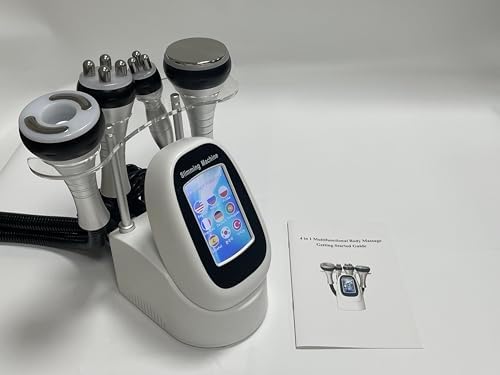


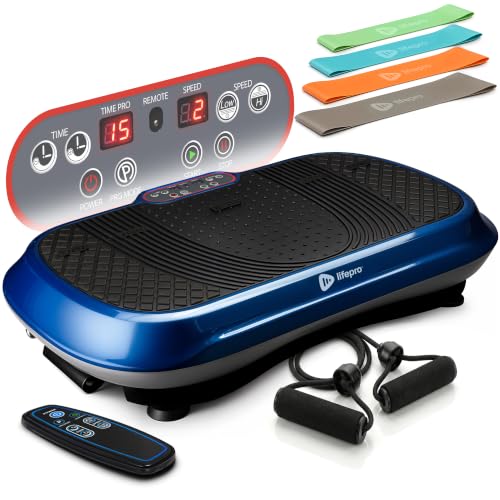


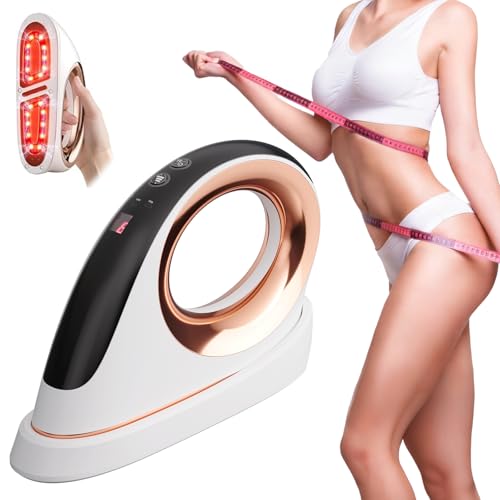
Shopping these picks?
Amazon Prime members get fast, free shipping on eligible items, plus Prime Video, Amazon Music and member deals. New members can start with a free trial.
Start a free Prime trialAged 18 to 24? Prime for Young Adults comes with a longer free trial and a lower price after it.
Affiliate link: we may earn a commission at no extra cost to you.
Key Takeaways
- No, ultrasonic cavitation does not cause cancer. It uses low-frequency sound waves, not ionizing radiation, and there’s no known mechanism by which it would damage DNA.
- The bigger question isn’t cancer risk, it’s regulatory status: professional HIFU/ultrasound systems cleared by the FDA for fat reduction are a different category from the low-cost “40K cavitation” machines sold for spas and home use.
- A one-minute FDA database lookup tells you which category a specific device falls into, before you book anything.
- Cavitation ruptures fat cell membranes mechanically. The released fatty acids still have to be processed by your liver and lymphatic system, which is why hydration and activity afterward are usually recommended.
- Results are modest and temporary compared to what people expect from marketing photos, and cavitation is not a weight-loss method or a substitute for diet and exercise.
- Active cancer at or near the treatment site, pregnancy, pacemakers, and certain clotting or kidney conditions are real contraindications, not because cavitation causes cancer, but because mechanical disruption near vulnerable tissue is avoided as a standard precaution.
- Persistent pain, numbness, or skin changes after a session are reasons to see a doctor, not to book another round.
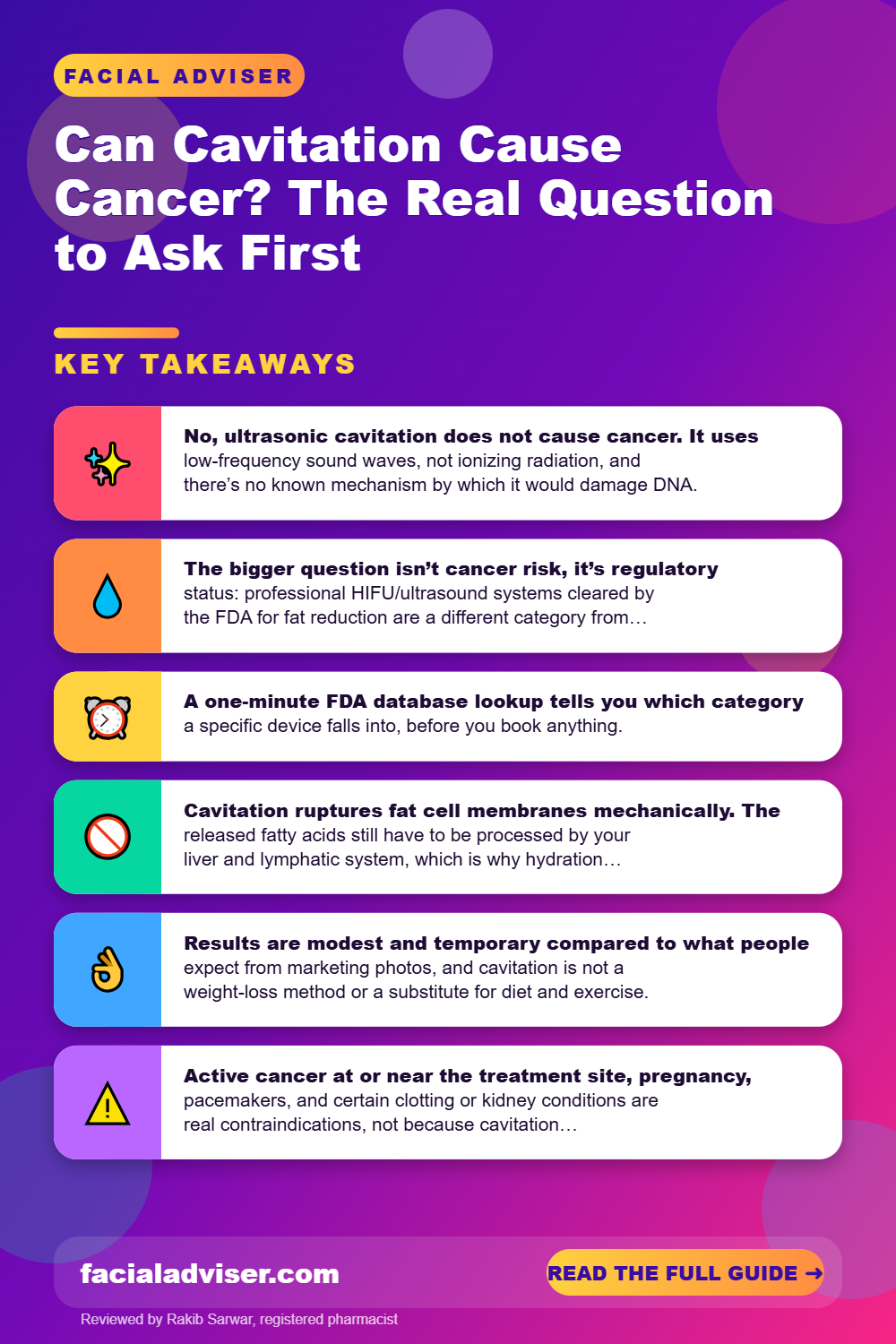
Table of Contents
- What Cavitation Actually Does to Fat Cells
- The 60-Second FDA Clearance Check
- Professional Ultrasound Devices vs. Portable Cavitation Machines
- Cavitation vs. Cryolipolysis vs. Radiofrequency
- Do This, Not That: Getting a Session Safely
- What Actually Happens During and After a Session
- What Cavitation Can’t Do
- Why Cancer Isn’t Plausible, and the Contraindications That Are Real
- Frequently Asked Questions
- The Bottom Line
What Cavitation Actually Does to Fat Cells
Ultrasonic cavitation uses low-frequency sound waves to create rapid pressure changes in tissue. Those pressure changes form microscopic gas bubbles, which expand and then collapse (implode) in a fraction of a second. The tiny shockwave from each implosion is strong enough to mechanically rupture the membrane of nearby fat cells (adipocytes), while leaving surrounding skin, blood vessels, and connective tissue largely intact at properly calibrated settings.
The fat released from ruptured cells doesn’t disappear. It’s picked up by the lymphatic system and processed by the liver like any other circulating fatty acid. This is why most protocols recommend water intake and light activity after a session, to support that clearance process, and why results take days to weeks to become visible rather than appearing instantly.
The 60-Second FDA Clearance Check
Before booking a session, or buying a device, do this:
Search the FDA’s own device database at accessdata.fda.gov (510(k) Premarket Notification database) for the exact device or manufacturer name your clinic uses, or the brand printed on a machine you’re considering buying.
- A specific fat-reduction or body-contouring clearance shows up: you’re looking at a professional system with an actual FDA clearance for that use, backed by the clinical data submitted to get it.
- Nothing comes up, or the listing is for an unrelated category like “massager”: the device has no FDA clearance for fat reduction. That doesn’t automatically make it dangerous, but it does mean any body-contouring claims attached to it haven’t been reviewed by anyone, and you should treat efficacy claims with real skepticism.
Most portable “cavitation machines” sold online fall into the second category. That’s the actual regulatory gap driving a lot of confusion about this technology, not a hidden cancer risk. If you want to see what separates a cleared clinical device from a spa gadget in more detail, our guide to professional ultrasonic cavitation machines breaks down the specific certifications to look for.
Professional Ultrasound Devices vs. Portable Cavitation Machines
| Professional HIFU/ultrasound systems | Portable “40K cavitation” machines | |
|---|---|---|
| Regulatory status | Cleared by the FDA for specific body-contouring indications, backed by submitted clinical trial data | Usually sold with no fat-reduction clearance, often marketed under general wellness or massage categories |
| Where used | Medical spas and dermatology or plastic surgery offices, operated by trained staff | Budget spas, salons, and direct home purchase |
| Evidence base | Published clinical trials measuring circumference or fat-layer reduction | Mostly manufacturer claims and anecdotal before/after photos |
| Typical cost | Higher per session, reflecting the equipment and clinical oversight | Lower cost, reflecting the absence of the same regulatory and clinical investment |
This is the comparison that actually matters for anyone asking about cavitation safety. The physics of low-frequency ultrasound is the same across both categories, which is why cancer isn’t a realistic concern either way. What differs is whether the specific device has clinical evidence behind its claims, and that comes down to which category it falls into.
Note: No FDA clearance doesn’t automatically mean a device is dangerous or fraudulent. Plenty of legitimate wellness devices are regulated under categories that don’t require a fat-reduction clearance. It does mean nobody outside the manufacturer has independently reviewed the specific claims being made, so treat before-and-after marketing photos with more skepticism than you would for a cleared professional system.
Cavitation vs. Cryolipolysis vs. Radiofrequency
| Technology | Mechanism | FDA-cleared examples exist? | Notes |
|---|---|---|---|
| Ultrasonic cavitation | Sound-wave pressure changes rupture fat cell membranes | Yes, for specific cleared systems | Effect is mechanical, not thermal; results are typically modest and temporary |
| Cryolipolysis (fat freezing) | Controlled cooling triggers fat cell death over following weeks | Yes | FDA explicitly notes that home or over-the-counter fat-freezing devices have no established safety or effectiveness; cleared systems are prescription-use only |
| Radiofrequency | Heat energy is thought to damage fat cells and stimulate skin tightening | Yes, for specific cleared systems | Often marketed more for skin tightening than pure fat reduction |
None of these three technologies is a weight-loss method. All three, at best, produce modest, localized reduction in a treated area’s circumference, and results vary considerably between individuals and between specific devices within each category.
Do This, Not That: Getting a Session Safely
Do
- Look up the specific device name in the FDA database before your first session
- Disclose pregnancy, pacemakers, active cancer, or clotting disorders during intake
- Drink water and stay lightly active in the days after a session
- Set expectations for modest, gradual, circumference-level change
- Ask how many sessions the protocol actually calls for
Don’t
- Treat cavitation as a substitute for diet or exercise
- Book treatment directly over a known tumor or unexplained mass
- Assume a lower price means the same clinical backing as a cleared professional system
- Expect visible change immediately after a single session
- Ignore new pain, numbness, or skin discoloration that doesn’t resolve within a few days
What Actually Happens During and After a Session
Intake
The provider reviews your health history, checking for pregnancy, pacemakers, active cancer, clotting disorders, and kidney or liver conditions.
Marking the treatment area
The target zone is outlined, most commonly the abdomen, flanks, or thighs.
Application
A handheld ultrasound head is moved continuously over the area for roughly 20 to 40 minutes. Most people feel a mild vibration or warmth, not pain.
Immediately after
Mild redness or warmth at the site is common and typically resolves within hours.
Following days
Water intake and light activity are usually recommended to support the lymphatic clearance of released fatty acids.
Tip: A brisk 20 to 30 minute walk on treatment days and the days after is a simple way to support circulation and lymphatic flow without over-exerting the treated area.
Weeks 2–4
Any visible change in circumference tends to appear gradually over this window, not immediately.
Repeat sessions
Most protocols call for multiple sessions spaced one to two weeks apart for a noticeable cumulative effect.
What Cavitation Can’t Do
Cavitation is not a weight-loss treatment and does not reduce fat cell number in a way comparable to surgery. It’s a localized, modest-effect treatment aimed at circumference reduction in a specific area, and results vary a great deal between individuals. Evidence for the cleared professional systems is stronger than for the low-cost portable machines, where most of what’s available is manufacturer marketing rather than independent clinical data.
It also does nothing for loose skin on its own. If skin laxity is the primary concern rather than a stubborn fat pocket, a skin-tightening device aimed specifically at collagen stimulation is a more realistic fit than cavitation.
Why Cancer Isn’t Plausible, and the Contraindications That Are Real
Cancer develops from DNA damage, most commonly from ionizing radiation, certain chemicals, or specific viral infections. Low-frequency ultrasound cavitation doesn’t carry enough energy to break chemical bonds in DNA, and there’s no accepted biological mechanism connecting it to tumor formation. This is a fundamentally different physical process from anything known to cause cancer.
Warning: Providers commonly list these as reasons to skip or delay cavitation: pregnancy, active cancer at or near the treatment site, pacemakers or other implanted electronic devices, uncontrolled clotting disorders, and significant kidney or liver disease. These precautions exist because mechanical disruption of tissue near vulnerable areas is avoided as standard practice, not because cavitation itself is known to cause or worsen cancer.
Persistent pain, numbness, or skin discoloration that doesn’t resolve within a few days after a session is a reason to see a doctor rather than book another round.
Frequently Asked Questions
Can ultrasonic cavitation cause cancer?
No. Cavitation uses low-frequency sound waves, not ionizing radiation, and there’s no known biological mechanism by which it would damage DNA or trigger cancer.
Is cavitation FDA approved?
Some professional ultrasound and HIFU systems are FDA-cleared for specific body-contouring indications. Many low-cost portable “cavitation machines” sold for spas or home use are not, and are typically marketed under general wellness categories instead.
How do I check if a cavitation device is FDA cleared?
Search the exact device or manufacturer name in the FDA’s 510(k) Premarket Notification database at accessdata.fda.gov. If a fat-reduction clearance doesn’t come up, the device doesn’t have one.
Does cavitation actually get rid of fat?
It ruptures fat cell membranes in the treated area, and the released fatty acids are processed by the body over following weeks. Results are typically modest, localized, and temporary rather than a substitute for weight loss.
Who should not get ultrasonic cavitation?
People who are pregnant, have a pacemaker or other implanted electronic device, have active cancer near the treatment site, have uncontrolled clotting disorders, or have significant kidney or liver disease are generally advised to skip it.
What’s the difference between cavitation and cryolipolysis?
Cavitation uses sound-wave pressure changes to rupture fat cells mechanically. Cryolipolysis uses controlled cooling to trigger fat cell death over following weeks. Both have FDA-cleared professional versions, though home-use fat-freezing devices specifically have no established FDA safety or effectiveness data.
How many cavitation sessions do you need to see results?
Most protocols call for multiple sessions spaced one to two weeks apart, with gradual circumference change becoming visible over several weeks rather than after one session.
Is cavitation safe for weight loss?
It’s not designed or evidenced as a weight-loss method. It targets localized fat in a specific area rather than producing meaningful overall weight change.
Can I do cavitation at home with a portable device?
You can, but most portable devices don’t carry the same FDA clearance or clinical evidence as professional systems. Treat marketing claims from these devices with more skepticism, and still follow the same contraindication checklist.
What symptoms after cavitation mean I should see a doctor?
Persistent pain, numbness, or skin discoloration that doesn’t resolve within a few days warrants medical evaluation rather than another session.
The Bottom Line
Cavitation doesn’t cause cancer. The physics simply don’t support it, low-frequency sound waves don’t carry the kind of energy that damages DNA. The question worth actually spending your sixty seconds on is whether the specific device or clinic you’re considering carries an FDA clearance for fat reduction, or whether you’re looking at one of the many portable machines marketed on claims nobody has independently reviewed.
Either way, keep expectations modest. Cavitation produces gradual, localized circumference reduction over multiple sessions, not the dramatic before-and-after transformation in most marketing photos, and it’s not a substitute for diet, exercise, or medical weight management. If you’re still weighing cavitation against other options, our overview of the types of body sculpting compares how each technology actually works. Skip it if you’re pregnant, have a pacemaker, active cancer near the treatment site, or a significant clotting or organ condition, and see a doctor rather than book another session if anything feels wrong afterward.

Written by
Registered pharmacist and founder of Facial Adviser. Rakib's pharmacy training covers how skincare actives work and interact; a later course in cosmetology turned that into a focus on facial treatments and skincare products. He plans, researches and edits every guide on the site and checks health claims against sources such as the American Academy of Dermatology, the FDA and the NIH. He is not a dermatologist; see the Editorial Policy and Medical Disclaimer.
About · Editorial policy · How we choose products · Medical disclaimer · Contact
Keep reading: Professional spa machines
- Best Professional Oxygen Facial Machine: Features, Safety and Results
- Professional Ultrasonic Cavitation Machine: Salon Buying Guide
- FIVONA Unisex Sitz Bath Seat for Soaking: Is It Worth Using?
- Best Oxygen Facial Machine for Home: Buyer's Guide and What the Evidence Says
- Types of Body Sculpting: Full Comparison
- Best Ultrasonic Cavitation Machines: What to Look For Before You Buy
One Comment