
Antioxidant Synergy in Skincare: Which Combinations Work?
Look at the ingredient list of a good antioxidant serum and you will rarely find just one antioxidant. Vitamin C often comes with vitamin E and ferulic acid, green tea with resveratrol, niacinamide with a handful of plant extracts. Brands often describe these blends as synergistic, meaning the ingredients are supposed to work better together than alone.
Part of our guide to cosmetic science. Start with: How to Read a Cosmetic Ingredient List: A Beginner Guide
Antioxidant synergy is real for some combinations, but not all. The best-studied example is vitamin C with vitamin E and ferulic acid: in laboratory research, ferulic acid helped stabilise vitamins C and E and the combination gave more protection against UV damage than the vitamins alone. For many other blends, the synergy claim is based on theory rather than testing of the finished product. An antioxidant serum can be a useful addition under sunscreen, but it does not replace sunscreen.
Antioxidants help neutralise free radicals, unstable molecules produced by UV light, pollution and normal metabolism that can damage skin cells and contribute to visible ageing. Because different antioxidants work in different parts of the skin and can regenerate one another, combining them makes sense in principle.
In practice, what matters is whether the finished formula is stable, well packaged and used consistently, alongside daily sunscreen, which the American Academy of Dermatology identifies as one of the most effective ways to prevent premature skin ageing.
This guide explains what antioxidant synergy means, which combinations have the strongest evidence, and how to use antioxidants in your routine without overcomplicating it.
Shopping these picks?
Amazon Prime members get fast, free shipping on eligible items, plus Prime Video, Amazon Music and member deals. New members can start with a free trial.
Start a free Prime trialAged 18 to 24? Prime for Young Adults comes with a longer free trial and a lower price after it.
Affiliate link: we may earn a commission at no extra cost to you.
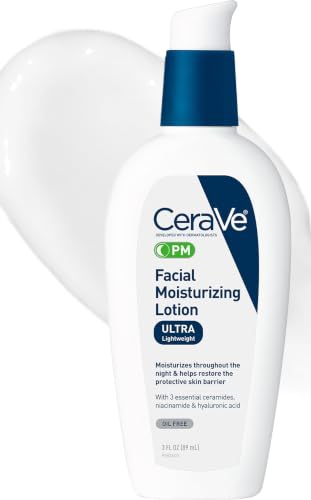
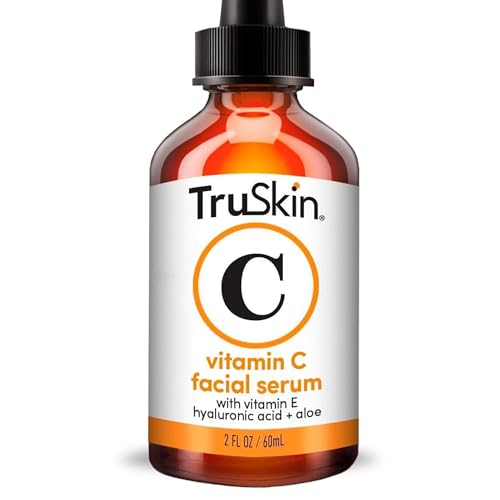
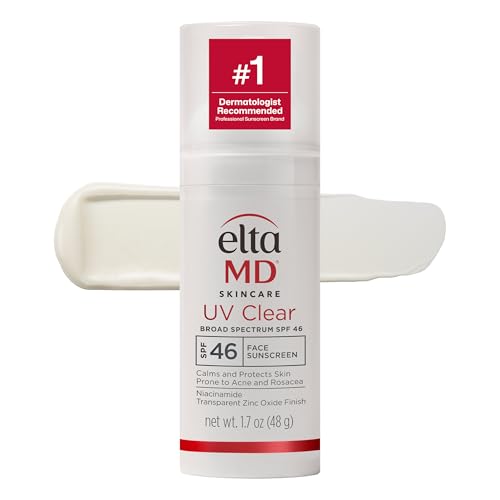
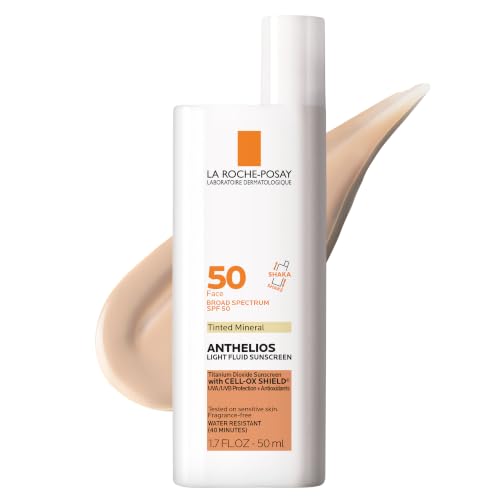
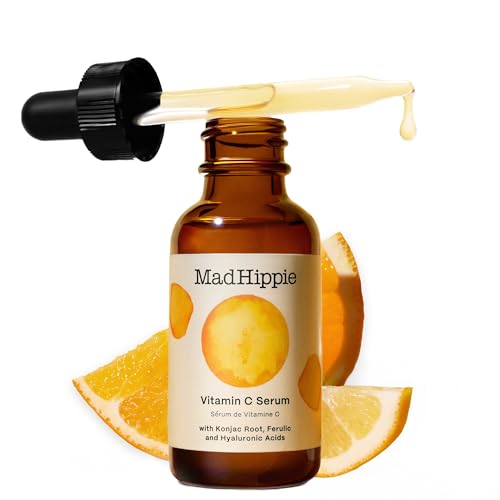
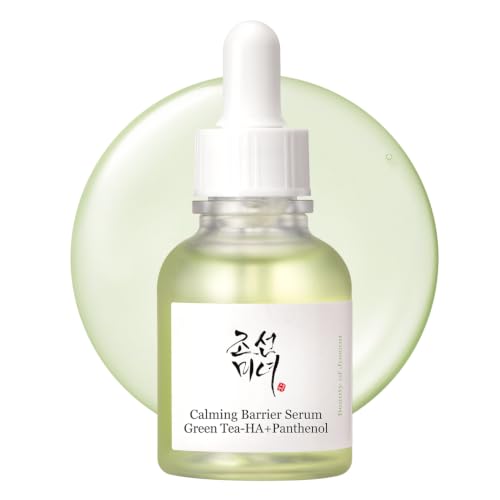
Recommended Antioxidant Serums and Sunscreens

Quick Answer
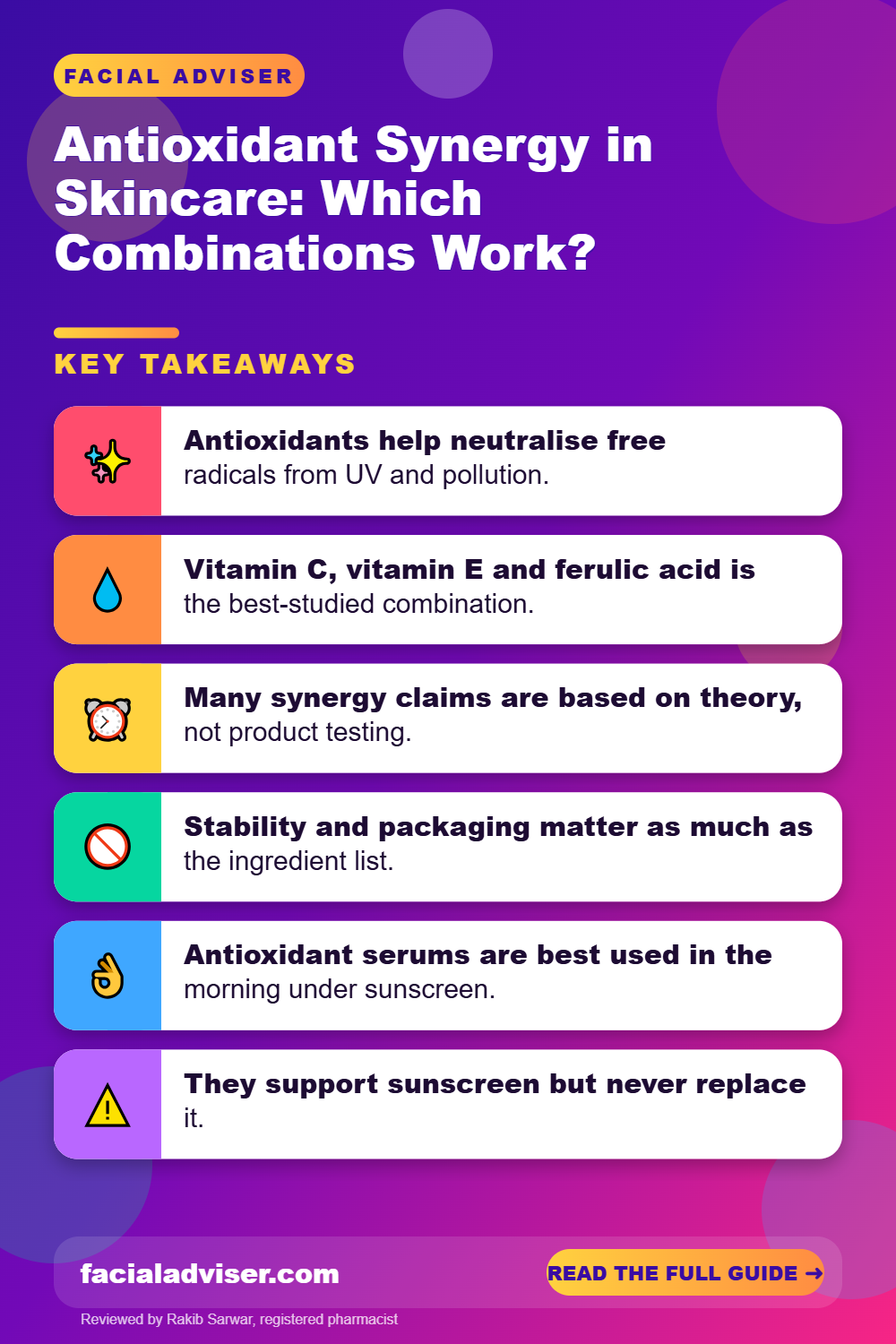
- Antioxidants help neutralise free radicals from UV and pollution.
- Vitamin C, vitamin E and ferulic acid is the best-studied combination.
- Many synergy claims are based on theory, not product testing.
- Stability and packaging matter as much as the ingredient list.
- Antioxidant serums are best used in the morning under sunscreen.
- They support sunscreen but never replace it.
- One well-made antioxidant serum is usually enough.
What This Covers
- What Antioxidant Synergy Means
- Combinations With the Strongest Evidence
- Common Skincare Antioxidants at a Glance
- Choosing by Skin Type
- Why the Formula Matters More Than the List
- How to Add Antioxidants to Your Routine
- Antioxidants and Sunscreen
- Combining Antioxidants With Other Actives
- Dos and Don’ts
- Honest Limits
- When to See a Dermatologist
- Your Questions, Answered
- The Takeaway
What Antioxidant Synergy Means
Synergy means two or more ingredients producing a greater effect together than the sum of their effects separately. With antioxidants, this can happen in a few ways.
- Regeneration: when vitamin E neutralises a free radical it becomes spent, and vitamin C can help restore it so it can work again.
- Different locations: vitamin C is water-soluble and vitamin E is fat-soluble, so together they cover more of the skin’s structures.
- Stability: some antioxidants, such as ferulic acid, help keep others from breaking down in the bottle.
- Different targets: antioxidants vary in which free radicals they neutralise most effectively.
This is why the body itself relies on a network of antioxidants rather than a single one. Skincare formulas that combine several are trying to mimic that network.
Antioxidant is a broad label. Ingredients such as vitamin C, vitamin E, ferulic acid, green tea polyphenols, resveratrol and niacinamide all have antioxidant activity, but they differ in how well they are studied in skincare.
Combinations With the Strongest Evidence
| Combination | What the evidence suggests | Strength of evidence |
|---|---|---|
| Vitamin C + vitamin E | Greater protection against UV damage together than either alone in lab studies | Moderate |
| Vitamin C + vitamin E + ferulic acid | Ferulic acid stabilised the vitamins and roughly doubled photoprotection in a lab model | Moderate |
| Antioxidants + sunscreen | May add extra protection against free radicals that sunscreen does not block | Moderate, mostly lab-based |
| Green tea polyphenols + others | Promising antioxidant and soothing effects | Limited |
| Niacinamide + other antioxidants | Well tolerated; mainly supports barrier and tone | Limited for synergy specifically |
| Multi-extract botanical blends | Often marketed as synergistic | Weak; rarely tested as finished products |
The key study behind the vitamin C, E and ferulic acid combination was published in the Journal of Investigative Dermatology. Researchers found that adding ferulic acid stabilised a solution of vitamins C and E and doubled its photoprotection in a pig skin model. That makes it one of the better-supported antioxidant pairings, although it was not a study of how skin looks over time in real people.
For most other combinations, the evidence comes from studies of individual ingredients, and the idea that they work better together is a reasonable assumption rather than a proven result.
Common Skincare Antioxidants at a Glance
Each antioxidant has its own strengths and quirks. Knowing the main ones makes it easier to read an ingredient list and choose a product that suits your skin.
- Vitamin C (L-ascorbic acid): the most researched; brightens and helps fade dark marks, but unstable and can sting at higher strengths.
- Vitamin C derivatives: gentler and more stable, such as sodium ascorbyl phosphate or tetrahexyldecyl ascorbate, though less studied than the pure form.
- Vitamin E (tocopherol): fat-soluble, moisturising and a natural partner for vitamin C.
- Ferulic acid: a plant antioxidant best known for stabilising vitamins C and E.
- Niacinamide: supports the barrier, helps with redness and uneven tone, and suits most skin types.
- Green tea polyphenols: soothing, with antioxidant activity; useful for redness-prone skin.
- Resveratrol: a grape-derived antioxidant often paired with ferulic acid in evening serums.
If your skin is sensitive, starting with niacinamide or a vitamin C derivative is often easier than jumping straight to a high-strength L-ascorbic acid serum. If your main goal is brightening and fading marks, a well-formulated L-ascorbic acid serum has the most evidence behind it.
Choosing by Skin Type
Oily or acne-prone skin: lightweight, water-based serums with vitamin C or niacinamide usually sit well under sunscreen. Avoid heavy oil-based antioxidant blends if you break out easily. Dry skin: formulas that combine antioxidants with vitamin E and hydrating ingredients such as glycerin can feel more comfortable. Sensitive skin: choose fragrance-free products and gentler antioxidants such as niacinamide, green tea or a vitamin C derivative. Patch test before using any new serum on your whole face.Why the Formula Matters More Than the List
Many antioxidants, especially L-ascorbic acid, break down when exposed to light, air and heat. A serum that has turned dark orange or brown has likely lost much of its effect, no matter how impressive its ingredient list.
| What to look for | Why it matters |
|---|---|
| Opaque or airless packaging | Protects light- and air-sensitive ingredients |
| Clear concentration of the main active | Helps you compare products |
| Stabilising partners such as ferulic acid | Can slow degradation |
| Fragrance-free formula | Reduces the risk of irritation |
| Reasonable number of actives | Long lists do not guarantee better results |
A simple, stable vitamin C serum with vitamin E and ferulic acid is likely to do more than a formula with twenty botanical extracts in tiny amounts. Near the end of the ingredient list, many extracts are present at levels too low to have much effect.
Storage makes a difference too. Keeping your serum closed, away from heat and out of direct sunlight helps it last longer.
How to Add Antioxidants to Your Routine
Choose one antioxidant serum
Pick a stable formula, such as vitamin C with vitamin E and ferulic acid, or a gentler derivative if your skin is sensitive.
Patch test
Try it on a small area for a few days before using it on your whole face.
Apply in the morning
Use a few drops on clean, dry skin after cleansing.
Let it absorb
Wait a minute before your moisturiser.
Moisturise
Use a moisturiser suited to your skin type.
Finish with sunscreen
Apply a broad-spectrum sunscreen as the final step.
Morning is usually the best time for antioxidants, because that is when your skin faces UV light and pollution. Applying them under sunscreen lets the two work together.
Antioxidants and Sunscreen
Sunscreen filters UV rays, but it does not block all of them, and it does not stop every free radical formed by UV light, visible light and pollution. Antioxidants may help mop up some of what gets through.
This is why antioxidants are often described as a supplement to sunscreen. The AAD recommends a broad-spectrum sunscreen with an SPF of 30 or higher as a key step in reducing premature skin ageing. An antioxidant serum can add to that protection but should never replace it.
Some sunscreens now include antioxidants such as vitamin E or niacinamide in the formula. These can be a convenient way to get both benefits in one step, although the amount of antioxidant is often lower than in a dedicated serum.
Do not skip or reduce sunscreen because you use an antioxidant serum. Antioxidants do not provide an SPF and cannot prevent sunburn on their own.
Combining Antioxidants With Other Actives
Most antioxidants play well with the rest of a routine. Niacinamide is gentle and can be used morning or night. Green tea and similar extracts are often soothing.
L-ascorbic acid is the one to be more careful with. It is acidic and can sting when layered with exfoliating acids or retinoids. Using vitamin C in the morning and other actives at night avoids most problems. Our guide on whether to apply acids before or after vitamin C explains how to combine them.
If you use several products that each contain a few antioxidants, you do not need to worry about getting too much. The bigger risk is irritation from stacking multiple acidic or active products, not overloading on antioxidants.
Our guide to morning versus night routine order shows where an antioxidant serum fits.
Dos and Don’ts
Try This
- Use antioxidants in the morning under sunscreen
- Choose opaque or airless packaging
- Store serums away from heat and light
- Replace vitamin C serums that turn dark
- Keep your routine simple
Avoid This
- Rely on antioxidants instead of sunscreen
- Assume a long ingredient list means better results
- Layer vitamin C with strong acids if your skin is sensitive
- Keep using a serum that stings or causes redness
- Believe every synergy claim on a label
Honest Limits
Much of the research on topical antioxidants comes from laboratory and animal studies or small human trials measuring short-term markers of UV damage. There is less evidence about how much they improve the appearance of skin over years of real-world use.
Synergy claims on labels are rarely backed by tests of the finished product. A blend can still be a good product, but the word synergy on its own does not tell you much.
Results from antioxidants are also subtle. They are best thought of as a supporting step that may help protect and brighten skin over time, not a quick fix for wrinkles or dark spots.
If budget is a concern, a daily broad-spectrum sunscreen is the better investment. An antioxidant serum is a useful extra once sunscreen is a consistent habit, not a substitute for it. Wearing sunscreen generously every day, reapplying when outdoors, and seeking shade at midday will do more for your skin than any combination of antioxidants.
When to See a Dermatologist
- You have new, changing or unusual spots on your skin.
- Dark patches are spreading or not responding to treatment.
- A serum causes burning, swelling or a rash.
- You want advice on preventing or treating sun damage.
A dermatologist can check any concerning spots and recommend a routine suited to your skin and sun exposure.
This article is for general information and does not replace professional medical advice. See a dermatologist for persistent skin concerns.
Your Questions, Answered
What is antioxidant synergy in skincare?
It is the idea that some antioxidants work better together than alone, for example by regenerating or stabilising one another.
Which antioxidant combination has the best evidence?
Vitamin C with vitamin E and ferulic acid is the best-studied combination.
Do antioxidants replace sunscreen?
No. They may add protection but provide no SPF on their own.
When should I apply an antioxidant serum?
Usually in the morning, after cleansing and before moisturiser and sunscreen.
Can I use more than one antioxidant product?
Yes, but one well-formulated serum is usually enough.
How do I know if my vitamin C serum has gone off?
If it has turned dark orange or brown, it has likely degraded.
Is niacinamide an antioxidant?
It has antioxidant properties and also supports the skin barrier.
Can antioxidants irritate skin?
Most are gentle, but L-ascorbic acid can sting, especially on sensitive skin.
Are synergy claims on labels reliable?
Not always. Many are based on theory rather than testing of the finished product.
Can I use antioxidants with retinol?
Yes, though many people use antioxidants in the morning and retinol at night.
The Takeaway
Antioxidant synergy is well supported for some combinations, especially vitamin C, vitamin E and ferulic acid, but many other synergy claims are based on theory rather than testing.
Choose one stable antioxidant serum, use it in the morning under a broad-spectrum sunscreen, and store it away from light and heat. Keep your routine simple and never let an antioxidant replace sunscreen.

Written by
Registered pharmacist and founder of Facial Adviser. Rakib's pharmacy training covers how skincare actives work and interact; a later course in cosmetology turned that into a focus on facial treatments and skincare products. He plans, researches and edits every guide on the site and checks health claims against sources such as the American Academy of Dermatology, the FDA and the NIH. He is not a dermatologist; see the Editorial Policy and Medical Disclaimer.
About · Editorial policy · How we choose products · Medical disclaimer · Contact
Keep reading: How cosmetics are made
- How to Read a Cosmetic Ingredient List: A Beginner Guide
- The Role of Emulsifiers in Cosmetic Stability: How They Keep Creams Together
- What Makes Makeup High Coverage? Pigments Explained
- Which Cosmetic Preservatives Are Mild? A Plain-English Guide
- Physical vs Chemical SPF in Cosmetics: What the Difference Means
- What Is a Chelating Agent in a Cosmetic Formula?