10 Best Makeup Organizers (2026): Drawers, Rotating Stands and Cases
A good makeup organizer does more than tidy a counter. It helps you see what you own, stops products from being crushed or contaminated, and makes it easier to notice when something has passed its best. This list covers 10 options, from acrylic drawer towers and rotating stands to drawer inserts and travel cases.
Part of our guide to makeup tools. Start with: 10 Best Makeup Brush Sets (2026): Soft, Well-Made Kits for Every Look
The best makeup organizer is one that matches the size of your collection and the space you have, holds products upright, is easy to wipe clean and keeps makeup away from heat, steam and direct sunlight. For most people that means a clear acrylic or plastic organizer with a mix of shallow drawers and open slots for daily items, plus a separate brush holder. Rotating stands suit small counters, drawer inserts suit people who prefer a clear surface, and zipped cases or train cases suit travel. Avoid fabric-lined or hard-to-clean designs for daily products, and do not buy more storage than you need, because extra space tends to fill with old makeup.
In short: choose a wipeable organizer sized for the makeup you actually use, and keep it somewhere cool and dry.
Storage cannot fix a product your skin reacts to, though. The US Food and Drug Administration advises stopping a cosmetic straight away if you suspect a reaction, and notes that sensitivity can become more severe over time, so an organizer that shows you exactly what you are using is also a safety tool.
Below you will find the ten picks, how we chose them, the main types of organizer, which materials and features matter, what to avoid, and how to set one up and keep it clean.
Shopping these picks?
Amazon Prime members get fast, free shipping on eligible items, plus Prime Video, Amazon Music and member deals. New members can start with a free trial.
Start a free Prime trialAged 18 to 24? Prime for Young Adults comes with a longer free trial and a lower price after it.
Affiliate link: we may earn a commission at no extra cost to you.
As an Amazon Associate we earn from qualifying purchases. This does not change which products we include.


Jump to a Section
- The 10 Best Makeup Organizers Right Now
- How We Chose These Products
- Types of Makeup Organizer Compared
- Materials: What Is Easiest to Keep Clean
- Features Worth Looking For
- Choosing by Space and Collection Size
- What to Avoid When Buying
- How to Arrange Products by Routine
- How to Set Up a Makeup Organizer
- How to Clean Your Organizer and Keep Makeup Hygienic
- Dos and Don’ts
- Honest Limits
- When to See a Dermatologist
- Frequently Asked Questions
- The Takeaway
Key Takeaways
- Relavel Extra Large Case is our top pick, organising a big collection at home and on the road.
- Relavel Case with LED Mirror is best for doing makeup on the go, with a separate brush compartment.
- SHANY Chic Train Case is the best lockable hard case for a compact, protected kit.
- Buy for the makeup you use, not for the collection you might own later.
- Clear, wipeable materials and upright slots make cleaning and checking products easier.
- Store organizers away from steamy bathrooms, windows and radiators.
- Clear out expired or changed products each time you clean.
The 10 Best Makeup Organizers Right Now
These ten organizers were shortlisted from widely reviewed Amazon listings and ranked by capacity, how well they keep products upright and separate, how easy they are to wipe clean and how well they suit different spaces. Each pick shows who it suits, its trade-offs and who should skip it.
| # | Product | Best For | Standout Feature | |
|---|---|---|---|---|
| 1 | Relavel Extra Large Makeup Train Case | Large collections that also travel | Two layers with two sets of dividers | View |
| 2 | Relavel Makeup Case with LED Mirror | Doing makeup on the go | Rechargeable three-tone LED mirror | View |
| 3 | SHANY Chic Makeup Train Case | Compact kits that need a lock | Aluminium and ABS shell with locks | View |
| 4 | Vtopmart Clear Stackable Storage Drawers, 4 Pack | Growing collections and skincare | Four stackable dustproof drawer units | View |
| 5 | Chomeiu Hard Makeup Case with LED Mirror | Protecting products in transit | Reinforced corners and two trays | View |
| 6 | STORi Clear 6-Compartment Vanity Organizer | Small vanities and daily essentials | Small footprint, six open compartments | View |
| 7 | Awenia 360-Degree Rotating Makeup Organizer | Small counters with lots of products | Seven adjustable layers that rotate | View |
| 8 | Readaeer 12-Drawer Makeup Organizer | Medium to large collections on a vanity | 12 drawers plus 16 top compartments | View |
| 9 | caktraie 22-Drawer Acrylic Makeup Organizer | Sorting many small products by type | 22 clear acrylic drawers in 4 units | View |
| 10 | Oubonun Expandable Shallow Drawer Organizers, 4 Pack | Keeping counters clear | Low-profile expandable trays | View |
Relavel Extra Large Makeup Train Case

Best for: Large collections that also travel
The Relavel Extra Large case earns the top spot because it organises a big collection and travels with it. It has two layers, with elastic and zipped pockets for small items and a main compartment with two sets of height-adjustable dividers, so palettes, bottles and brushes each get their own space instead of piling up.
A lockable two-way zip and a trolley sleeve make it practical for makeup artists and frequent travellers, and closed compartments keep dust and steam off products at home too. The trade-off is size: at over sixteen inches it takes up real space and is more than most small routines need. Fabric interiors also need a spot clean after spills.
- Two layers with elastic and zipped pockets
- Two sets of height-adjustable dividers
- Lockable two-way zip and trolley sleeve
- About 16.5 x 12.6 x 7.3 inches
Pros
- Holds and protects a large collection
- Closed design keeps out dust and steam
- Works at home and for travel
Cons
- Bulky for a small routine
- Fabric interior needs spot cleaning after spills
Skip it if: Skip it if your makeup never leaves the house; an acrylic unit like the Readaeer or caktraie is easier to see into.
Check Price on AmazonRelavel Makeup Case with LED Mirror

Best for: Doing makeup on the go
This Relavel case builds a rechargeable LED mirror into a large train case, with cool, natural and warm light settings. For anyone who does makeup in hotel rooms, backstage or at client homes, having consistent light in the lid is genuinely useful, and the case also includes removable dividers and a separate brush compartment.
The waterproof, tear-resistant fabric is easy to wipe, and a shoulder strap makes it simple to carry. Built-in lights can fail over time and are rarely replaceable, which is one of the risks flagged in our buying advice, so weigh how much you will use the mirror. It is slightly slimmer than the #1 case but holds a little less.
- Rechargeable LED mirror with three light tones
- Removable dividers and a separate brush compartment
- Waterproof, tear-resistant fabric
- About 16.2 x 11.5 x 5.2 inches with shoulder strap
Pros
- Consistent light for makeup on the go
- Brushes kept apart from products
- Wipeable fabric
Cons
- Built-in light may fail and is hard to replace
- Needs recharging
Skip it if: Skip it if you already have good lighting at home; the #1 case gives more space without the electronics.
Check Price on AmazonSHANY Chic Makeup Train Case

Best for: Compact kits that need a lock
SHANY’s Chic train case is a medium, hard-shell box made from aluminium and ABS plastic, with locks to keep the lid shut. It is a classic design among beauty professionals and nail techs, and the hard shell protects glass bottles and pressed powders far better than a soft bag if the case is knocked.
At around nine by six by six inches it is much smaller than the two Relavel picks, which suits a focused kit rather than a full collection. Hard surfaces are easy to wipe, and it comes in several colours. Trays and small compartments can fill quickly, so keep only the products you actually use in it.
- Medium hard train case, about 9 x 6 x 6 inches
- Aluminium and ABS plastic construction
- Lockable lid
- Popular with beauty and nail professionals
Pros
- Hard shell protects fragile products
- Lock keeps the lid secure
- Easy-wipe surfaces
Cons
- Small for a large collection
- Heavier than a fabric bag
Skip it if: Skip it if you want a large, lightweight case; the Relavel picks hold more and weigh less.
Check Price on AmazonVtopmart Clear Stackable Storage Drawers, 4 Pack

Best for: Growing collections and skincare
Vtopmart’s four-pack of clear stackable drawers is the most flexible home option here. Each unit is a tall, dustproof drawer with a pull-out handle, so you can stack them on a vanity or shelf and add more as your collection grows, keeping skincare, base and colour products in separate drawers.
The BPA-free plastic is shatter and scratch resistant, and clear fronts make products easy to see and check for expiry. These are general-purpose storage drawers rather than makeup-specific units, so there are no lipstick slots, and tall drawers can let small items pile up. Adding a small divider tray inside solves that.
- Set of 4 stackable, dustproof drawer units
- Each about 12 x 7.5 x 9.7 inches
- Pull-out handles and non-slip design
- BPA-free, shatter- and scratch-resistant plastic
Pros
- Grows with your collection
- Clear, dustproof drawers
- Sturdy plastic that wipes clean
Cons
- No built-in lipstick or brush slots
- Tall drawers can let small items get lost
Skip it if: Skip it if you want slots for lipsticks and pencils; the Readaeer or STORi organizers have them.
Check Price on AmazonChomeiu Hard Makeup Case with LED Mirror

Best for: Protecting products in transit
The Chomeiu case pairs a hard ABS and aluminium alloy shell with reinforced corners, two trays and a main compartment with adjustable dividers. That combination protects glass bottles and palettes better than soft cases, which matters if your kit is carried often, shared between rooms or stored in a busy space.
It also has a rechargeable LED mirror with three light modes, similar to the #2 Relavel, though in a hard shell rather than fabric. The seller suggests it for nail polish, jewellery and hair accessories too. Hard cases are heavier, and the built-in mirror light may not be replaceable if it fails, so treat it as a bonus rather than a reason to buy.
- Hard ABS and aluminium alloy shell with reinforced corners
- 2 trays plus adjustable dividers
- Rechargeable LED mirror with three light modes
- Also suits nail polish and accessories
Pros
- Strong protection for fragile products
- Trays keep small items visible
- Built-in lit mirror
Cons
- Heavier than fabric cases
- Mirror light may not be replaceable
Skip it if: Skip it if you only store makeup at home; an acrylic organizer is lighter and easier to see into.
Check Price on AmazonSTORi Clear 6-Compartment Vanity Organizer

Best for: Small vanities and daily essentials
The STORi organizer is a simple, US-made clear plastic unit with six open compartments and a small footprint of about eight by six inches. It holds brushes upright, stands palettes on their edges and keeps skincare bottles together, which is exactly what a daily-use organizer should do without taking over the counter.
Open compartments are quick to use and easy to wipe out, but they collect dust, so keep it away from hairspray and steam. It has no drawers, which makes it a companion to the drawer picks rather than a replacement for them. For a compact routine it is one of the most practical and easiest-to-clean options on this list.
- BPA-free clear plastic, made in the USA
- 6 divided compartments
- Holds brushes, bottles and palettes on edge
- About 8.4 x 6.3 x 4.3 inches
Pros
- Very small footprint
- Easy to wipe clean
- Keeps daily items upright
Cons
- Open top collects dust
- No drawers for backups
Skip it if: Skip it if you have a large collection; the Readaeer or caktraie drawer sets hold far more.
Check Price on AmazonAwenia 360-Degree Rotating Makeup Organizer

Best for: Small counters with lots of products
Awenia’s rotating organizer puts a large collection on a single spinning base, with seven adjustable layers for skincare, perfume and makeup. A smooth, quiet rotation means everything is within reach in one turn, which suits a corner of a counter where a deep drawer unit would not fit or would block the mirror.
It is made from acrylic and comes apart for washing, which makes deep cleaning easier than with fixed towers. As our buying advice notes, rotating stands can become top-heavy if overfilled, so put heavier bottles on the lower layers. It holds products in the open, so keep it out of direct sunlight and away from steamy showers.
- 360-degree rotating base
- 7 adjustable layers
- Large capacity for skincare, perfume and makeup
- Acrylic; comes apart for washing
Pros
- Everything within reach in one spin
- Layers adjust to product heights
- Easy to take apart and clean
Cons
- Can become top-heavy if overfilled
- Open design lets dust and light in
Skip it if: Skip it if you prefer products hidden away; a drawer insert like the Oubonun keeps the counter clear.
Check Price on AmazonReadaeer 12-Drawer Makeup Organizer
Best for: Medium to large collections on a vanity
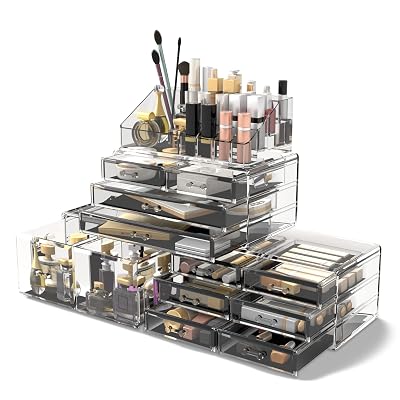
The Readaeer organizer is the classic makeup tower: twelve drawers in three sizes, from oversized to small, plus sixteen top compartments that hold lipsticks, pencils and brushes upright. It follows the mix of shallow drawers and open slots that our guide recommends for daily use, so everyday products stay visible while backups sit neatly below.
The four pieces interlock with anti-slip mats and can be restacked in different layouts, and a removable mesh liner protects small items. At around sixteen inches tall it needs vanity space, and plastic drawers should be wiped rather than soaked. For a home collection it is more organised than the #4 Vtopmart drawers.
- 12 drawers in three sizes plus 16 top compartments
- 4 interlocking pieces with anti-slip mats
- Removable mesh liner
- About 9.4 x 5.4 x 15.9 inches
Pros
- Slots keep lipsticks and brushes upright
- Mix of drawer sizes
- Pieces can be rearranged
Cons
- Needs vanity space
- Not portable
Skip it if: Skip it if you need to travel with your makeup; the Relavel cases are built for that.
Check Price on Amazoncaktraie 22-Drawer Acrylic Makeup Organizer

Best for: Sorting many small products by type
The caktraie set offers the most drawers on this list, with twenty-two clear acrylic drawers spread across four stackable units. Lots of small drawers make it easy to sort by category, such as lips, brows, eyes and cheeks, and clear fronts show what is inside without opening anything, which also makes old products easier to spot.
The acrylic is described as dustproof and water resistant, and the units also fit on shelves, dressers or under a sink. Small drawers can hold only small items, so bulky bottles and large palettes may need another home, such as the #4 Vtopmart drawers. Avoid acetone when cleaning, which can cloud acrylic.
- 4 stackable units with 22 drawers in total
- Clear, dustproof and water-resistant acrylic
- Suits lipstick, blush, mascara and eyeshadow
- Also works on shelves and counters
Pros
- Lots of small drawers for sorting
- Clear fronts show contents
- Stackable layout
Cons
- Drawers too small for big palettes
- Acrylic can cloud with harsh cleaners
Skip it if: Skip it if you own mostly large palettes; the Readaeer or Vtopmart drawers are deeper.
Check Price on AmazonOubonun Expandable Shallow Drawer Organizers, 4 Pack

Best for: Keeping counters clear
The Oubonun set is the drawer-insert option: four shallow, expandable plastic trays that sit inside an existing vanity drawer. They keep makeup out of sight and away from dust, steam and sunlight, which our guide highlights as the best choice for shared bathrooms or anyone who likes a clear counter.
We only have the listing title for this pick, so measure your drawer and check the photos for sizes before buying. Low-profile trays keep palettes and compacts in a single layer instead of stacked, and plastic wipes clean easily. It is far simpler than the towers above, but it is often all a small routine needs.
- 4 expandable drawer organizers
- Shallow, low-profile design
- Plastic trays for vanity drawers
- Keeps items in a single layer
Pros
- Keeps counters clear
- Protects products from dust and light
- Easy to wipe clean
Cons
- Needs an existing drawer
- Limited listing detail
Skip it if: Skip it if you have no suitable drawer; the STORi or Awenia organizers sit on the counter.
Check Price on AmazonHow We Chose These Products
We shortlisted makeup organizers from Amazon listings that are highly rated by a large number of shoppers, favouring established brands and fuller-featured designs with adjustable dividers, upright slots or closed drawers. We then checked each product’s listed features against the storage and safety guidance cited in this post, including the FDA’s advice on cosmetic reactions and keeping products clean.
These are research-based picks, not hands-on lab tests. Rankings reflect capacity, layout, ease of cleaning and how well each design suits a given space, rather than personal results. Near-identical sets from the same brand were left out, and one pick is described from its title because its listing gave little else.
- Strong ratings from a large number of shoppers
- Established brands and fuller-featured designs preferred
- Listed features checked against the cited storage guidance
- Products with thin or unclear listings excluded or ranked lower
- A mix of home, drawer and travel types included
Types of Makeup Organizer Compared
Makeup organizers come in a handful of basic designs. Most people end up combining two: one for the vanity or counter and one for drawers or travel.
| Type | Best for | Strengths | Drawbacks |
|---|---|---|---|
| Acrylic tower with drawers | Medium to large collections on a vanity | See-through, easy to wipe, holds palettes flat | Takes counter space; can crack if dropped |
| Rotating or spinning stand | Small counters and daily items | Everything within reach in one spin | Limited drawer space; top-heavy if overfilled |
| Drawer insert or tray | People who like a clear counter | Hides clutter, protects from dust and light | Harder to see everything at once |
| Stackable clear drawers | Growing collections | Can add units over time | Can wobble if stacked too high |
| Brush holder or cup | Brushes and pencils | Keeps bristles upright and apart | Open to dust unless it has a lid |
| Zipped bag or train case | Travel and makeup artists | Portable, closed compartments | Easy to overpack; lining can trap spills |
If you are starting from scratch, a medium acrylic organizer with two or three drawers and a separate brush cup covers most daily routines.
Materials: What Is Easiest to Keep Clean
The material matters more than most people expect, because makeup organizers collect powder, spilled foundation and oil from fingers. A surface you can wipe in seconds is one you will actually keep clean.
- Acrylic: clear, smooth and easy to wipe with a damp cloth; avoid harsh solvents, which can cloud or crack it.
- Plastic (PP or PET): light, cheap and washable; thin plastic may bend under heavy palettes.
- Glass: easy to clean and heat resistant, but heavy and breakable.
- Wood or bamboo: attractive, but unsealed wood can absorb spills and hold moisture.
- Fabric and velvet linings: soft on products, but hard to clean and prone to trapping powder.
- Leather or faux leather cases: good for travel, but check that the lining is wipeable.
Clear organizers help you see products at a glance, but they also let light in. Keep them out of direct sunlight, which can warm and degrade some formulas over time.
Features Worth Looking For
Once you know the type and material, small design details decide whether an organizer is pleasant to use every day.
- Slots sized for lipsticks, pencils and liquid bottles so they stand upright.
- Shallow drawers for palettes and compacts, so you are not stacking them.
- Removable dividers you can move as your collection changes.
- Drawer stops or handles that prevent drawers sliding out and spilling.
- Non-slip feet so the unit stays put on a glossy counter.
- A lid or cover for brushes if your space is dusty.
- Rounded edges and smooth corners that are easy to wipe out.
Measure your counter or drawer before buying, including height if the organizer will sit under a mirror or cabinet. Many returns happen because the unit does not fit the space.
Choosing by Space and Collection Size
Match the organizer to where you do your makeup and how much you actually use. The table below is a simple starting point.
| Your situation | Suggested setup | Why it works |
|---|---|---|
| Small, everyday routine | One rotating stand or small tray | Keeps a handful of items visible and handy |
| Medium collection on a vanity | Acrylic unit with drawers plus brush cup | Separates daily items from occasional ones |
| Large collection | Stackable drawers sorted by category | Grows with you and keeps palettes flat |
| Shared bathroom | Closed drawer insert or lidded box | Protects from steam, splashes and hairspray |
| Frequent travel | Zipped case with separate liquid pocket | Contains leaks and keeps tools apart |
| Professional kit | Train case or rolling case with trays | Portable and sorted by product type |
If you share space or have little room, a closed drawer is often better than a tower on the counter. For more on where makeup keeps best, our guide on makeup storage temperature tips explains how heat and humidity affect different formulas.
What to Avoid When Buying
Some organizers look good in photos but cause problems in daily use. Watch for these common issues.
- Units much bigger than your collection, which invite you to keep old products.
- Deep drawers where small items pile up and get lost.
- Fabric or velvet linings on daily-use trays that cannot be washed.
- Open designs for a steamy bathroom, where moisture and hairspray settle on products.
- Thin, flexible plastic that bends under heavy palettes.
- Mirrors or lights built in cheaply, which often fail and cannot be replaced.
- Strong chemical smell from new plastic; air it out and wash before use.
Do not store makeup in a hot car, on a sunny windowsill or next to a heater. Heat can separate formulas, melt lipsticks and speed up spoilage, and warm, damp conditions can encourage microbial growth in products.
How to Arrange Products by Routine
The way you arrange an organizer should follow the order you apply makeup, not just the type of product. When everything sits in the order you reach for it, your routine gets faster and you stop opening drawers you do not need.
- Front or top: skincare prep, primer, base, concealer and your daily powder.
- Middle: brow, eye and cheek products you use most days.
- Upright slots: lipsticks, liners, pencils and mascara, caps firmly closed.
- Lower drawers: occasional palettes, bold colours and event products.
- Separate lidded box: backups and unopened products, stored somewhere cool.
Keep unopened backups out of the main organizer so they stay sealed and you use up the open product first. If you find a drawer you never open, that is usually a sign it holds products you can pass on or throw away.
How to Set Up a Makeup Organizer
A little planning when you first fill the organizer saves time every morning and makes it obvious when something needs replacing.
Empty and sort everything
Take out all your makeup and group it by type: base, eyes, lips, cheeks, tools.
Discard what is past its best
Throw away products that smell odd, have separated or are older than their recommended period after opening.
Wash the organizer
Wipe or wash it with mild soap and water and let it dry fully before filling.
Put daily items within reach
Place the products you use every day in the top drawer or front slots.
Stand products upright
Put lipsticks, pencils, mascaras and liquids in slots so caps stay closed and nothing leaks.
Separate brushes and sponges
Keep tools in their own holder so bristles do not touch product surfaces.
Place it somewhere cool and dry
Choose a bedroom vanity or shelf away from the shower, windows and radiators.
Write the opening month on a small label on the bottom of mascaras, liquid liners and foundations. When you reorganise, you can see at a glance which ones are due to be replaced.
How to Clean Your Organizer and Keep Makeup Hygienic
An organizer is only as clean as the products and tools inside it. Powder, oil and bits of product build up in corners and can transfer back onto clean brushes and fingers.
- Wipe surfaces weekly with a damp cloth and a drop of mild soap.
- Deep clean every month or two: empty it, wash drawers in warm soapy water and dry fully.
- Avoid acetone and strong solvents on acrylic, which can cloud or crack it.
- Wipe the outside of product packaging before putting it back.
- Wash brushes and sponges regularly and let them dry before storing.
Our guide on how to sanitise makeup tools covers brushes, sponges and tweezers step by step. If a product ever makes your skin itch or sting, the FDA page on allergens in cosmetics advises stopping it and reading ingredient labels carefully, so keep the packaging in your organizer rather than throwing boxes away.
Use each clean-out to check expiry. Group products by how quickly they expire, with mascara and liquid liner first, then liquid bases, then powders, which last longest. Our guide on how to tell if makeup is expired lists the signs to look for, such as changes in smell, texture or colour.
Dos and Don’ts
Do
- Measure your space before buying
- Choose wipeable, clear materials for daily items
- Keep brushes separate from products
- Store makeup somewhere cool and dry
- Declutter every time you deep clean
Don’t
- Buy far more storage than you need
- Keep daily makeup in a steamy bathroom
- Use fabric-lined trays for liquids
- Clean acrylic with acetone
- Keep products that have changed smell or texture
Honest Limits
An organizer does not make makeup last longer than its formula allows. It can reduce heat, light and dust exposure, but once a product is opened, air and fingers still introduce microbes, and the recommended period after opening still applies.
Expensive organizers are not necessarily better. A simple, well-sized plastic drawer that you keep clean will protect your makeup as well as a designer vanity unit. What matters most is the habit of sorting, cleaning and throwing out old products.
When to See a Dermatologist
- You get itching, redness or swelling after using a product, even if it is stored well.
- You notice eye irritation or styes after using eye makeup.
- Breakouts appear in the same area where you apply a specific product.
- A rash spreads or does not settle after you stop using a product.
This article is general information about storing makeup and does not replace medical advice. Patch test new products, stop using anything that irritates your skin or eyes, and see a doctor or dermatologist if a reaction does not settle.
Frequently Asked Questions
What is the best type of makeup organizer?
For most home collections, a clear drawer unit with upright slots such as the Readaeer; for travel, a case with dividers like the Relavel Extra Large.
Are acrylic makeup organizers good?
Yes, they are clear and easy to wipe, but avoid harsh solvents.
Should I keep my makeup organizer in the bathroom?
Ideally not; steam and heat can shorten product life.
How do I clean a makeup organizer?
Wipe weekly and wash with mild soap every month or two.
Is a rotating makeup organizer worth it?
Yes for small counters; the Awenia stand keeps daily products within one spin, but do not overload the top layers.
How do I store makeup brushes?
Upright in a holder or lidded case, once fully dry.
What is the best travel makeup organizer?
A zipped case with separate pockets and a wipeable lining.
Can sunlight damage makeup in a clear organizer?
Yes, direct sun can warm and degrade some formulas.
How often should I declutter my makeup?
Check liquid eye products monthly and the rest every few months.
Is the most expensive makeup organizer worth it?
Only if you need its features, such as the travel-ready dividers of the Relavel cases; a simple STORi or Oubonun organizer protects makeup just as well at home.
The Takeaway
The best makeup organizer is one sized to the makeup you actually use, made from a material you can wipe clean and kept in a cool, dry spot; the Relavel Extra Large case is our top pick overall, with the Readaeer tower best for a home vanity.
Stand products upright, keep brushes separate, sort by expiry and clean the organizer regularly, and it will help your makeup stay fresher and your routine faster.
Our top pick: Relavel Extra Large Makeup Train Case
The Relavel Extra Large case takes the top spot because two layers, two sets of adjustable dividers and zipped pockets organise a big collection at home and carry it safely when you travel. Choose the Readaeer 12-drawer tower instead if your makeup never leaves the vanity, or the Awenia rotating stand if you have a small counter and want daily products within one spin.
Check Price on Amazon
Written by
Registered pharmacist and founder of Facial Adviser. Rakib's pharmacy training covers how skincare actives work and interact; a later course in cosmetology turned that into a focus on facial treatments and skincare products. He plans, researches and edits every guide on the site and checks health claims against sources such as the American Academy of Dermatology, the FDA and the NIH. He is not a dermatologist; see the Editorial Policy and Medical Disclaimer.
About · Editorial policy · How we choose products · Medical disclaimer · Contact
Keep reading: Makeup brushes and tools
- 10 Best Makeup Brush Sets (2026): Soft, Well-Made Kits for Every Look
- 10 Best Eyeliner Brushes (2026): Sharp Wings and Clean Gel Lines
- 10 Best Makeup Mirrors (2026): True-Colour Light and Clear Detail
- Best Airbrush Makeup Compressor: Types, Features and How to Choose
- 10 Best Bronzer Brushes (2026): Soft, Streak-Free Warmth
- 10 Best Eyeshadow Brushes (2026): Blend, Pack and Smoke Like a Pro