10 Best Makeup Mirrors (2026): True-Colour Light and Clear Detail
A good makeup mirror does two jobs: it shows your face clearly, and it shows colours accurately. This list covers 10 options, from compact desk mirrors to Hollywood, wall-mounted and travel styles. Most makeup mistakes, from a foundation shade that looks orange outdoors to heavy blush, come from poor lighting rather than poor technique.
Part of our guide to makeup tools. Start with: 10 Best Makeup Brush Sets (2026): Soft, Well-Made Kits for Every Look
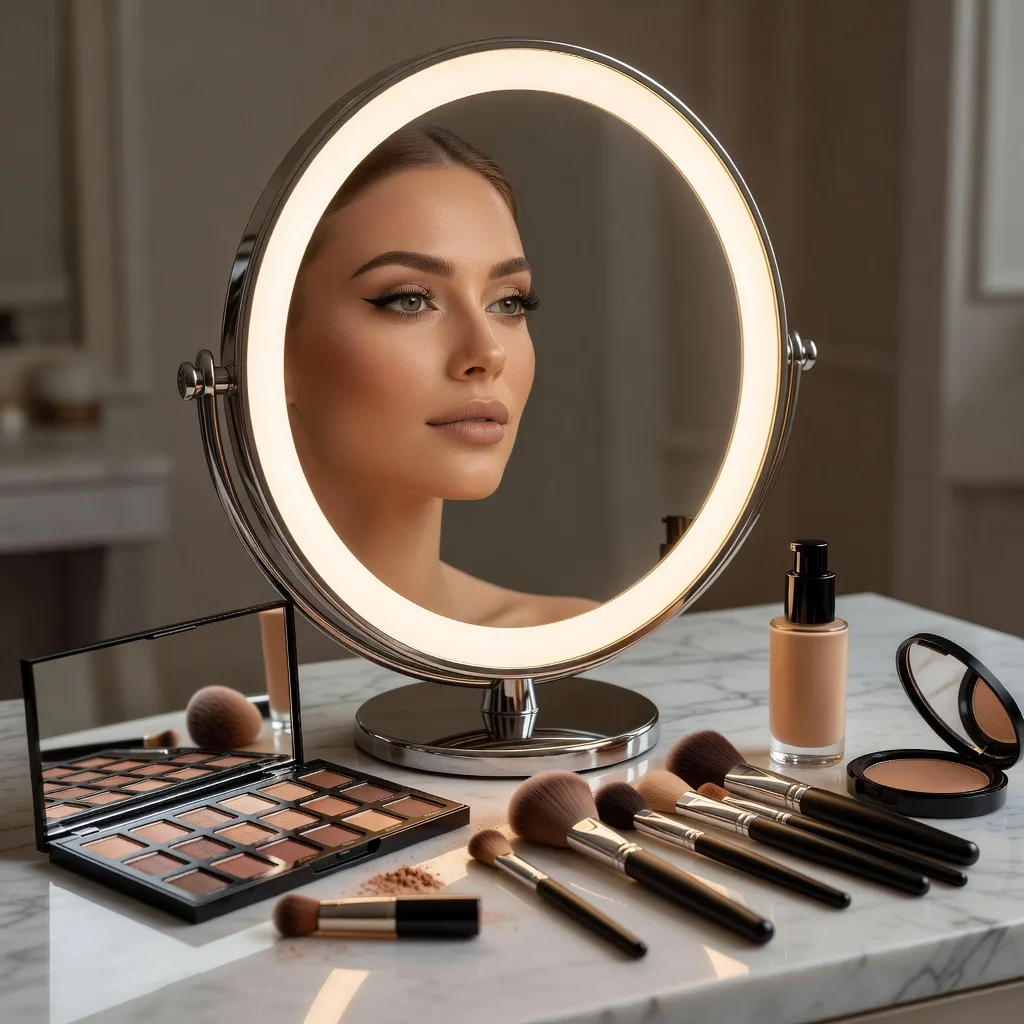
The best makeup mirror for most people is a lighted mirror with a 1x side for your whole face and a 5x or 7x side for detail, even LED lighting around the edge, adjustable brightness and a colour temperature setting close to daylight. For accurate colour, look for a high colour rendering index (CRI), ideally around 90 or above, and a neutral to daylight setting of roughly 4000 to 6500 Kelvin. Magnification above 10x distorts the face and is only useful for very close tasks such as tweezing. A stable base, glass that does not warp, and a power source that suits where you use it matter as much as the lights.
In short: choose even, high-CRI, daylight-balanced lighting with 1x and 5x to 7x magnification.
The American Academy of Dermatology advises against picking or squeezing spots because it can slow healing and increase the risk of scarring, which is worth remembering when a magnifying mirror shows every pore.
Below you will find the ten picks, how we chose them, and a guide to lighting, colour temperature, CRI, magnification and features, what to avoid, how to set a mirror up and how to keep it clean.
Shopping these picks?
Amazon Prime members get fast, free shipping on eligible items, plus Prime Video, Amazon Music and member deals. New members can start with a free trial.
Start a free Prime trialAged 18 to 24? Prime for Young Adults comes with a longer free trial and a lower price after it.
Affiliate link: we may earn a commission at no extra cost to you.
As an Amazon Associate we earn from qualifying purchases. This does not change which products we include.


Contents
- The 10 Best Makeup Mirrors Right Now
- How We Chose These Products
- Why Lighting Matters More Than the Mirror
- CRI and Colour Temperature Explained
- Which Magnification Level Do You Need?
- Features to Look For
- What to Avoid
- How to Set Up a Lighted Makeup Mirror
- Magnifying Mirrors and Your Skin
- Dos and Don’ts
- Cleaning and Caring for a Makeup Mirror
- Honest Limits
- When to Get Professional Advice
- FAQ
- Summing Up
What to Know First
- Miusco 9 inch Mirror is our top pick for high-CRI lighting, magnetic 5x and 10x lenses and cordless use.
- VESAUR 11.8 inch Three-Sided Mirror is the best large pick, with a tall 1x, 5x and 10x set-up.
- VESAUR 8.5 inch 1x/10x Mirror is the best compact detail mirror, with three colour modes and dimming.
- Even lighting from the front and sides shows your face more accurately than overhead light.
- A CRI of about 90 or above shows makeup colours more faithfully.
- 1x plus 5x or 7x magnification covers most makeup tasks; very high magnification distorts.
- Keep magnifying mirrors out of direct sunlight.
The 10 Best Makeup Mirrors Right Now
These ten mirrors were shortlisted from widely reviewed Amazon listings and ranked by lighting quality, colour modes, sensible magnification, power source and build. Each pick notes who it suits, its trade-offs and who should skip it.
| # | Product | Best For | Standout Feature | |
|---|---|---|---|---|
| 1 | Miusco 9 Inch Mirror with Magnetic 5x and 10x Lenses | Everyday makeup plus close detail | High stated CRI with magnetic magnifiers | View |
| 2 | VESAUR 11.8 Inch Three-Sided Lighted Mirror | Full-face and profile views | Tall, three-sided 1x, 5x and 10x | View |
| 3 | VESAUR 8.5 Inch 1x/10x Lighted Mirror | Brows, liner and fine detail | Bright LEDs and stepless dimming | View |
| 4 | FENCHILIN 22 x 19 Inch Hollywood Mirror | Dressing tables and content creators | Backlit plus front-lit large glass | View |
| 5 | EASEHOLD Rechargeable Tri-Panel Mirror | Small dressing tables | Three lit panels with 2x, 3x and 10x | View |
| 6 | LUXFURNI Arched Hollywood Mirror with LED Bulbs | Accurate colour matching | Angled bulbs with a stated CRI above 95 | View |
| 7 | Benbilry 9 Inch Wall-Mounted Plug-in Mirror | Bathrooms with a nearby socket | Mains powered, never needs charging | View |
| 8 | JERDON Tri-Fold Lighted Mirror with 5x | Simple, reliable everyday use | Tri-fold design with light settings | View |
| 9 | IMIKONA 9 Inch Rechargeable Wall-Mounted Mirror | Bathrooms without a socket | Large battery with an extending arm | View |
| 10 | Fancii Taylor LED Travel Mirror | Trips, handbags and small desks | Compact, rechargeable, 1x and 10x | View |
Miusco 9 Inch Mirror with Magnetic 5x and 10x Lenses

Best for: Everyday makeup plus close detail
The Miusco mirror earns the top spot because it gets the fundamentals right. The seller states a colour rendering index above 95, which is what helps foundation and blush look the same indoors as outdoors, and brightness is adjustable. The main 9 inch mirror gives a true 1x view of your whole face.
Small 5x and 10x lenses attach magnetically where you need them, so you get detail for liner or brows without a permanently distorted view. It is rechargeable and cordless, with a non-slip base and adjustable angle. Compared with the #2 VESAUR it is smaller and lacks side panels, but its lighting is better documented.
- 9 inch 1x mirror with magnetic 5x and 10x lenses
- Adjustable LED lighting with a stated CRI above 95
- Rechargeable and cordless
- Adjustable angle and non-slip base
Pros
- Colour-faithful lighting on paper
- Magnifiers only where you want them
- No cable on the desk
Cons
- No side panels for profile views
- Small magnifier lenses
Skip it if: Skip it if you want a large, tall mirror; the VESAUR 11.8 inch suits that better.
Check Price on AmazonVESAUR 11.8 Inch Three-Sided Lighted Mirror

Best for: Full-face and profile views
The VESAUR 11.8 inch mirror is the pick for people who want a big, tall view. Its three-sided design gives 1x, 5x and 10x magnification and rotates fully, so you can check your profile and contour without a hand mirror. The listing highlights a high-reflectivity surface and a sturdy alloy build.
Three colour modes and adjustable brightness let you preview makeup for daylight, office or evening light. A dual power supply and long warranty are useful extras. It takes up more space than the #1 Miusco, and the seller does not state a CRI figure, so colour accuracy is less certain than with the #1 pick.
- Three-sided 1x, 5x and 10x design
- Full rotation and a tall 11.8 inch surface
- Three colour modes with adjustable brightness
- Dual power supply and long warranty
Pros
- Large, tall face view
- Side panels for profile checks
- Long warranty
Cons
- Takes up desk space
- No stated CRI
Skip it if: Skip it if your vanity is small; the EASEHOLD or JERDON tri-fold is more compact.
Check Price on AmazonVESAUR 8.5 Inch 1x/10x Lighted Mirror

Best for: Brows, liner and fine detail
The smaller VESAUR is a double-sided 8.5 inch mirror with 1x and 10x views, lit by a ring of 90 LEDs. Three colour modes and stepless dimming let you fine-tune the light, and the mirror rotates fully so you can flip to the magnified side for brows or liner, then back to 1x to check the overall result.
The black nickel finish looks smart on a dressing table. Its 10x side is best kept for close tasks, as this guide explains. Compared with the #1 Miusco it has fixed rather than magnetic magnification and no stated CRI, but it is a tidy, bright, well-built choice for detailed work.
- Double-sided 1x and 10x mirror
- Ring of 90 LEDs
- Three colour modes and stepless dimming
- Full rotation and black nickel finish
Pros
- Bright, even ring light
- Fine brightness control
- Compact footprint
Cons
- 10x side distorts for full-face work
- No stated CRI
Skip it if: Skip it if you want side panels; the large VESAUR three-sided mirror suits you better.
Check Price on AmazonFENCHILIN 22 x 19 Inch Hollywood Mirror

Best for: Dressing tables and content creators
The FENCHILIN mirror is a large Hollywood-style vanity mirror at roughly 23 by 18 inches. It combines backlighting with front lighting, which helps light your face evenly from the front rather than only around the frame. Brightness is adjustable and a memory function keeps your last setting, so you do not have to adjust it every morning.
Tempered glass gives a clear 1x reflection, but there is no built-in magnification, so pair it with a small magnifier for detail. It needs space on a desk or wall. Compared with the #6 LUXFURNI arched mirror it is larger and brighter overall, but LUXFURNI states a CRI figure and FENCHILIN does not, which matters if you match foundation shades.
- Backlit and front-lit lighting
- Adjustable brightness with memory
- About 23 x 18 inches
- Tempered HD glass
Pros
- Large, even front light
- Remembers your setting
- Striking vanity centrepiece
Cons
- No magnification
- Needs lots of space
Skip it if: Skip it if you need magnification or have little space; the Miusco is more compact.
Check Price on AmazonEASEHOLD Rechargeable Tri-Panel Mirror

Best for: Small dressing tables
The EASEHOLD mirror folds into three lit panels with over 100 LEDs, so light comes from the front and sides, which is the most flattering and accurate direction. It offers 1x with small 2x, 3x and 10x options, and three lighting modes to check makeup for different settings, from daylight to evening.
A rechargeable battery means no cable across a small table, and the rose gold design suits compact spaces. The panels are smaller than the #2 VESAUR, so the full-face view is modest. The listing does not state a CRI, so use daylight by a window to double-check foundation shades before leaving the house.
- Three-panel lit design with over 100 LEDs
- 1x plus 2x, 3x and 10x options
- Three lighting modes
- Rechargeable battery
Pros
- Front and side light
- Compact and cordless
- Several magnification levels
Cons
- Smaller full-face view
- No stated CRI
Skip it if: Skip it if you want a large, tall view; the VESAUR 11.8 inch is bigger.
Check Price on AmazonLUXFURNI Arched Hollywood Mirror with LED Bulbs

Best for: Accurate colour matching
The LUXFURNI arched mirror brings Hollywood styling to a desk-sized 13 inch frame. The seller states a CRI above 95 for its 12 LED bulbs, with three colour temperatures and dimming, and says the bulbs are angled to reduce shadows under the eyes and chin, which matters when blending concealer.
Touch controls remember your last setting, and tempered glass is designed to resist shattering. There is no magnification, so detailed work needs a separate small mirror. Compared with the #4 FENCHILIN it is smaller but better documented on colour rendering, making it a strong choice for shade matching and blending at a desk.
- 13 inch arched mirror with 12 LED bulbs
- Stated CRI above 95 and three colour temperatures
- Bulbs angled to reduce shadows
- Touch control with memory; tempered glass
Pros
- Colour-faithful lighting on paper
- Fewer shadows under eyes
- Elegant design
Cons
- No magnification
- Smaller than the FENCHILIN
Skip it if: Skip it if you need close detail for brows; the VESAUR 8.5 inch 1x/10x suits that.
Check Price on AmazonBenbilry 9 Inch Wall-Mounted Plug-in Mirror

Best for: Bathrooms with a nearby socket
The Benbilry mirror mounts on the wall with an extending arm, freeing counter space, and runs from the mains, so it never dims as a battery drains. It is double-sided with 1x and 10x, and three colour modes with brightness adjustment let you check makeup for different light before you head out.
The seller is clear that it is not rechargeable, so you need a socket nearby and a tidy cable route. Several finishes are available. Compared with the #9 IMIKONA wall mirror it trades cordless freedom for constant power, which suits a fixed daily routine in one room where the mirror never needs to move.
- 9 inch extendable wall-mounted mirror
- Double-sided 1x and 10x
- Mains-powered plug-in
- Three colour modes and brightness control
Pros
- Frees counter space
- Constant brightness
- Clear listing on power
Cons
- Needs a socket and cable route
- Wall fixing required
Skip it if: Skip it if you have no socket near your mirror; the IMIKONA is rechargeable.
Check Price on AmazonJERDON Tri-Fold Lighted Mirror with 5x

Best for: Simple, reliable everyday use
The JERDON tri-fold is a long-established design with a rectangular centre mirror and two side mirrors, giving 1x and 5x views. Multiple light settings let you preview how makeup will look in different conditions, which is the key job of a lighted mirror and the reason to buy one at all.
Its 5x maximum is the gentlest magnification on this list, which this guide recommends for most makeup tasks because it distorts less and discourages picking. It is compact enough for any counter. It lacks the stated CRI of the #1 Miusco or #6 LUXFURNI, but it is a simple, dependable choice.
- Tri-fold design with three mirrors
- 1x and 5x magnification
- Multiple light settings
- Compact for desks and counters
Pros
- Sensible 5x magnification
- Side mirrors for profile views
- Simple to use
Cons
- No stated CRI
- Smaller than modern LED mirrors
Skip it if: Skip it if you want 10x for tweezing; the VESAUR 8.5 inch covers that.
Check Price on AmazonIMIKONA 9 Inch Rechargeable Wall-Mounted Mirror

Best for: Bathrooms without a socket
The IMIKONA mirror is the cordless counterpart to the #7 Benbilry. Its extending arm rotates fully, and a large rechargeable battery means no cable across the bathroom wall. It is double-sided with 1x and 10x, with three light colours and adjustable brightness, so you can match the light to where you are going.
The seller highlights a sturdy frame and straightforward installation, though any wall mirror still needs secure fixing. Battery-powered lights can dim as charge runs low, so top it up regularly. It suits bathrooms where a socket is not in the right place, or rented homes where extra wiring is not an option.
- Extending, fully rotating arm
- Large rechargeable battery
- Double-sided 1x and 10x
- Three light colours and brightness control
Pros
- No cable needed
- Frees counter space
- Flexible positioning
Cons
- Needs recharging
- Wall fixing required
Skip it if: Skip it if you would rather never charge a mirror; the Benbilry plugs in.
Check Price on AmazonFancii Taylor LED Travel Mirror

Best for: Trips, handbags and small desks
The Fancii Taylor is a compact lighted travel mirror with 1x and 10x magnification and a rechargeable battery, so you can do makeup in dim hotel rooms or on the move. Its small size makes it the most portable pick here and easy to slip into a wash bag or handbag.
Its listing is shorter than those higher up, and a small mirror cannot match the full-face view of the #1 Miusco or the larger desk mirrors. Use the 10x side for close tasks only. As a second mirror for trips or a tiny desk, it fills a gap the bigger picks cannot.
- Compact LED lighted travel mirror
- Rechargeable
- 1x and 10x magnification
- Small enough for a bag
Pros
- Most portable pick
- Lit for dim rooms
- No cable needed
Cons
- Small full-face view
- Brief listing detail
Skip it if: Skip it if it will be your only everyday mirror; the Miusco gives a fuller view.
Check Price on AmazonHow We Chose These Products
We shortlisted makeup mirrors from Amazon listings that are highly rated by a large number of shoppers, favouring established brands and fuller-featured models with adjustable brightness, colour modes, a 1x view and sensible magnification. We then checked each product’s listed features against the lighting and skin guidance in this post, and left out mirrors that push magnification beyond 10x, which this guide advises against for makeup.
These are research-based picks, not hands-on lab tests. We did not measure brightness or colour rendering ourselves, so CRI figures mentioned below are the sellers’ own statements, and rankings reflect listing detail, design and features rather than personal results.
- Strong ratings from a large number of shoppers
- Established brands and fuller-featured models preferred
- Lighting and magnification checked against this guide’s advice
- Products with thin or unclear listings excluded or ranked lower
- No more than two models from any one brand
Why Lighting Matters More Than the Mirror
The glass in most makeup mirrors is similar. What makes one better than another is the light around it and how evenly it falls on your face.
Overhead bathroom lights cast shadows under the eyes, nose and chin, so you tend to over-apply concealer and bronzer. Warm, yellowish bulbs hide redness and make foundation look better matched than it is. Light from one side only leaves the other half of your face in shadow, which leads to uneven blush and contour. A mirror with lights around the frame, or on both sides, lights your face from the front and cuts out most of these problems.
Natural daylight from a window in front of you is still one of the most honest lights for checking makeup. A lighted mirror is most useful early in the morning, at night, or in rooms without good natural light.
CRI and Colour Temperature Explained
Two numbers on the box tell you how true to life a mirror’s light will be. They are often missing on cheaper mirrors, which is itself a clue.
| Term | What it means | What to look for |
|---|---|---|
| CRI (colour rendering index) | How accurately a light shows colours compared with natural light, on a scale up to 100 | Around 90 or above for makeup |
| Warm light | Around 2700 to 3000 Kelvin, yellowish, like indoor evening light | Useful for checking evening makeup only |
| Neutral light | Around 4000 Kelvin, balanced white | Good everyday setting |
| Daylight | Around 5000 to 6500 Kelvin, cool and bright | Best for matching foundation to outdoor light |
| Brightness | How much light the mirror gives, often adjustable | Dimmable, so light is bright but not glaring |
Mirrors with three colour modes let you check how your makeup will look in daylight, at the office and in warm evening light. If you are matching foundation, use the daylight or neutral setting and then check the result by a window. Our guide on how to find the right shade of makeup explains how lighting affects shade matching.
Which Magnification Level Do You Need?
Magnification helps with detailed work, but more is not better. Higher levels show a smaller area and distort more at the edges.
| Magnification | Best for | Drawbacks |
|---|---|---|
| 1x | Foundation, blush, overall balance | No close detail |
| 3x | Everyday detail, eyeliner for good eyesight | Modest help for close work |
| 5x | Eyeliner, brows, lashes, blending | Need to sit a little closer |
| 7x | Precise liner, tweezing, people with reduced near vision | Small field of view |
| 10x and above | Very fine tweezing, small details | Distorts face, encourages picking, hard to judge overall look |
For most people, a double-sided mirror with 1x on one side and 5x or 7x on the other is the most useful. Always finish your makeup at 1x, because a look that seems balanced at 10x can look heavy at normal distance.
Features to Look For
Beyond lighting and magnification, practical details decide whether a mirror is pleasant to use every day.
- Even LED lighting around the frame rather than a single strip.
- Dimmable brightness and several colour modes.
- A stated CRI, ideally around 90 or higher.
- Clear glass that does not warp or ripple your reflection.
- A heavy, stable base or secure wall mount that does not wobble.
- A tilt or swivel so you can angle it without leaning.
- A power source that suits your space: plug-in, USB rechargeable or battery.
- Touch controls you can reach easily with makeup on your fingers.
If you often do makeup for photos or events, a mirror with a daylight setting and good CRI helps you check how makeup will look on camera. Our guide on keeping makeup intact for photos has more tips for camera-ready makeup.
Mirrors also come in several styles: desk mirrors with a stand, three-sided or tri-fold mirrors that show your profile, Hollywood mirrors with bulbs around the frame, wall-mounted mirrors on an extending arm and small travel mirrors. Pick the style that fits where you actually do your makeup.
What to Avoid
Some mirrors look impressive but make makeup harder. Watch out for these features and habits.
- Very warm or yellow light only, which hides redness and makes foundation look better matched than it is.
- Lights with no stated CRI or colour temperature.
- Harsh, glaring light with no dimming, which washes out colour and strains the eyes.
- Magnification of 10x or more as your only option.
- Wobbly bases or suction cups that slip and let the mirror fall.
- Glass that distorts your reflection even at 1x.
- Leaving a magnifying mirror on a sunny windowsill.
Keep magnifying mirrors out of direct sunlight. Fire services have warned that concave magnifying mirrors can focus sunlight onto nearby materials such as curtains or furniture and cause scorching or fires. Store them facing away from windows or covered when not in use.
How to Set Up a Lighted Makeup Mirror
Where and how you set up your mirror is almost as important as which one you buy. These steps help you get accurate, flattering light.
Choose the spot
Place the mirror at eye level where you can sit or stand comfortably, ideally near a window.
Face the light
Make sure the main light falls on your face from the front, not from behind or directly above.
Set the colour mode
Use the neutral or daylight setting for foundation, concealer and blush.
Adjust brightness
Turn it up enough to see detail without squinting, then down if it glares.
Use 1x for your base
Apply and blend foundation, bronzer and blush at normal magnification.
Switch for detail
Use 5x or 7x for eyeliner, brows and lashes, then switch back to check balance.
Check in daylight
Before leaving, look at your makeup by a window or outdoors.
Before buying, check how far you sit from the mirror. The higher the magnification, the closer you have to lean, so 5x often suits a vanity table better than 10x.
Magnifying Mirrors and Your Skin
A magnifying mirror shows pores, fine hairs and tiny bumps that nobody else can see from normal distance. That can make it tempting to squeeze spots or dig at blackheads.
The AAD’s acne tips warn that picking, popping or squeezing acne makes it take longer to clear and raises the risk of scarring. Use magnification for makeup and tweezing stray hairs, not for skin inspection sessions, and step back to 1x to see your skin the way other people do.
If you want to deal with blackheads or congested pores, a gentle routine with suitable cleansers and leave-on treatments works better and more safely than squeezing. Keep your hands and tools clean if you tweeze, and leave anything painful, deep or inflamed alone.
Dos and Don’ts
Try This
- Choose even, front-facing lighting
- Look for a CRI around 90 or higher
- Use daylight mode for foundation
- Finish your look at 1x
- Clean the glass and lights regularly
Avoid This
- Rely on warm light alone
- Use 10x as your only magnification
- Pick at skin under magnification
- Leave a magnifying mirror in direct sunlight
- Use harsh cleaners on the LEDs or frame
Cleaning and Caring for a Makeup Mirror
Makeup mirrors collect powder, hairspray and fingerprints quickly, which blurs your reflection and dims the light.
- Unplug or switch off the mirror before cleaning.
- Wipe glass with a soft microfibre cloth, lightly dampened with water or a mild glass cleaner sprayed onto the cloth, not the mirror.
- Avoid spraying liquid near lights, buttons or charging ports.
- Dry the edges well so moisture does not creep behind the glass.
- Charge rechargeable mirrors as the manual advises to protect the battery.
Wipe the mirror at least once a week if you use it daily. If LEDs flicker, dim unevenly or change colour, check the power supply or battery first; persistent faults usually mean the lighting is failing and colour accuracy will suffer.
Honest Limits
No mirror can show exactly how your makeup will look in every setting. Light in a restaurant, an office or on a sunny street all look different, so it is worth checking your makeup in more than one light, especially for foundation.
Specifications are not always reliable on budget mirrors, and CRI or Kelvin figures may be missing or optimistic. A mirror also cannot make up for a foundation that is the wrong shade or undertone; it only helps you see the mismatch sooner. Treat the lights as a tool for checking, and daylight as the final judge.
When to Get Professional Advice
- You struggle to see close detail even with magnification, which may mean it is time for an eye test.
- You find yourself picking at skin every time you use a magnifying mirror.
- You notice a spot, mole or patch that is new, changing or bleeding.
- Makeup regularly irritates your skin or eyes.
This article is for general information only. See an optometrist for changes in vision and a dermatologist for skin concerns you notice in the mirror.
FAQ
What is the best makeup mirror?
For most people, the Miusco 9 inch mirror, which combines a high stated CRI, adjustable brightness and magnetic 5x and 10x lenses.
What magnification is best for makeup?
5x or 7x for detail, with 1x for your overall look.
Is 10x magnification too much?
For most makeup, yes; it distorts and is best for tweezing.
What is CRI in a makeup mirror?
A measure of how accurately the light shows colours.
What colour temperature is best for makeup?
Neutral to daylight, roughly 4000 to 6500 Kelvin.
Is the most expensive makeup mirror worth it?
Only if you use its extras. The Miusco and large VESAUR add better stated lighting and size, but the JERDON tri-fold covers basic needs well.
Why does my makeup look different outside?
Indoor light is often warmer or dimmer than daylight.
Which makeup mirror is best for travel or small spaces?
The Fancii Taylor travel mirror or the compact EASEHOLD tri-panel mirror, both rechargeable.
Can magnifying mirrors cause fires?
In direct sunlight they can focus light, so keep them shaded.
How do I clean a lighted mirror?
Use a lightly damp microfibre cloth and keep liquid away from the lights.
Summing Up
The best makeup mirror is a lighted mirror with even, front-facing, high-CRI lighting, a neutral to daylight colour setting and 1x plus 5x or 7x magnification.
Set it up at eye level, finish your makeup at 1x, check it in daylight, and keep magnifying mirrors clean and out of direct sun.
Our top pick: Miusco 9 Inch Mirror with Magnetic 5x and 10x Lenses
The Miusco 9 inch mirror takes the top spot because it pairs lighting the seller rates at a high CRI with a 1x view, magnetic 5x and 10x lenses and cordless charging, which covers everyday makeup and close detail in one tidy desk mirror. Choose the VESAUR three-sided mirror instead if you want a larger, taller face view, or the LUXFURNI arched mirror if you prefer Hollywood-style bulbs with a high stated CRI.
Check Price on Amazon
Written by
Registered pharmacist and founder of Facial Adviser. Rakib's pharmacy training covers how skincare actives work and interact; a later course in cosmetology turned that into a focus on facial treatments and skincare products. He plans, researches and edits every guide on the site and checks health claims against sources such as the American Academy of Dermatology, the FDA and the NIH. He is not a dermatologist; see the Editorial Policy and Medical Disclaimer.
About · Editorial policy · How we choose products · Medical disclaimer · Contact
Keep reading: Makeup brushes and tools
- 10 Best Makeup Brush Sets (2026): Soft, Well-Made Kits for Every Look
- Best Airbrush Makeup Compressor: Types, Features and How to Choose
- 10 Best Bronzer Brushes (2026): Soft, Streak-Free Warmth
- 10 Best Eyeshadow Brushes (2026): Blend, Pack and Smoke Like a Pro
- 10 Best Body Exfoliating Brushes (2026): Smoother Skin, Gently
- 10 Best Makeup Sponges (2026): Smoother Base, Less Wasted Product