Can Teeth Change the Way You Look? The Real Answer
Can teeth change the way you look? Yes, and the real mechanism behind it is more specific than most casual advice suggests, it’s mainly about vertical dimension of occlusion, the facial height set by how your back teeth meet.
Part of our guide to lifestyle and skin. Start with: How Diet Impacts the Skin Microbiome: What the Science Actually Shows
When teeth wear down or go unreplaced, that vertical dimension can collapse, quietly changing lip support and facial proportions in a way that’s easy to mistake for ordinary skin aging. A 2025 stereophotogrammetry study of denture wearers measured this directly, and found real, if incomplete, improvement after treatment.
There are genuine, non-diagnostic self-checks you can try at home, a freeway space test, a phonetic test, and long-term photo comparison, each of which can flag whether a professional evaluation is worth pursuing.
This guide walks through the real mechanism, what the research actually measured, and the specific point at which a dentist or TMJ specialist, not more self-checking, becomes the right next step.
Recommended Products for Facial Skin Support





Key Takeaways
- Teeth genuinely can change the way you look, mainly through vertical dimension of occlusion (VDO), the facial height set by how your back teeth meet.
- Losing VDO from worn or missing teeth collapses lip support and can create a sunken, aged appearance separate from skin aging.
- Three real screening self-checks exist: the freeway space test, a phonetic test, and long-term photo comparison, none of them a diagnosis on their own.
- A 2025 study of denture wearers found dentures restore lip support and fullness but don’t fully reverse the facial shortening caused by years of bone resorption.
- Jaw surgery is the biggest genuine structural change available; braces and veneers reshape teeth but don’t meaningfully rebuild lost vertical height.
- Chronic one-sided jaw clenching is a real, documented cause of visible facial asymmetry through masseter muscle changes.
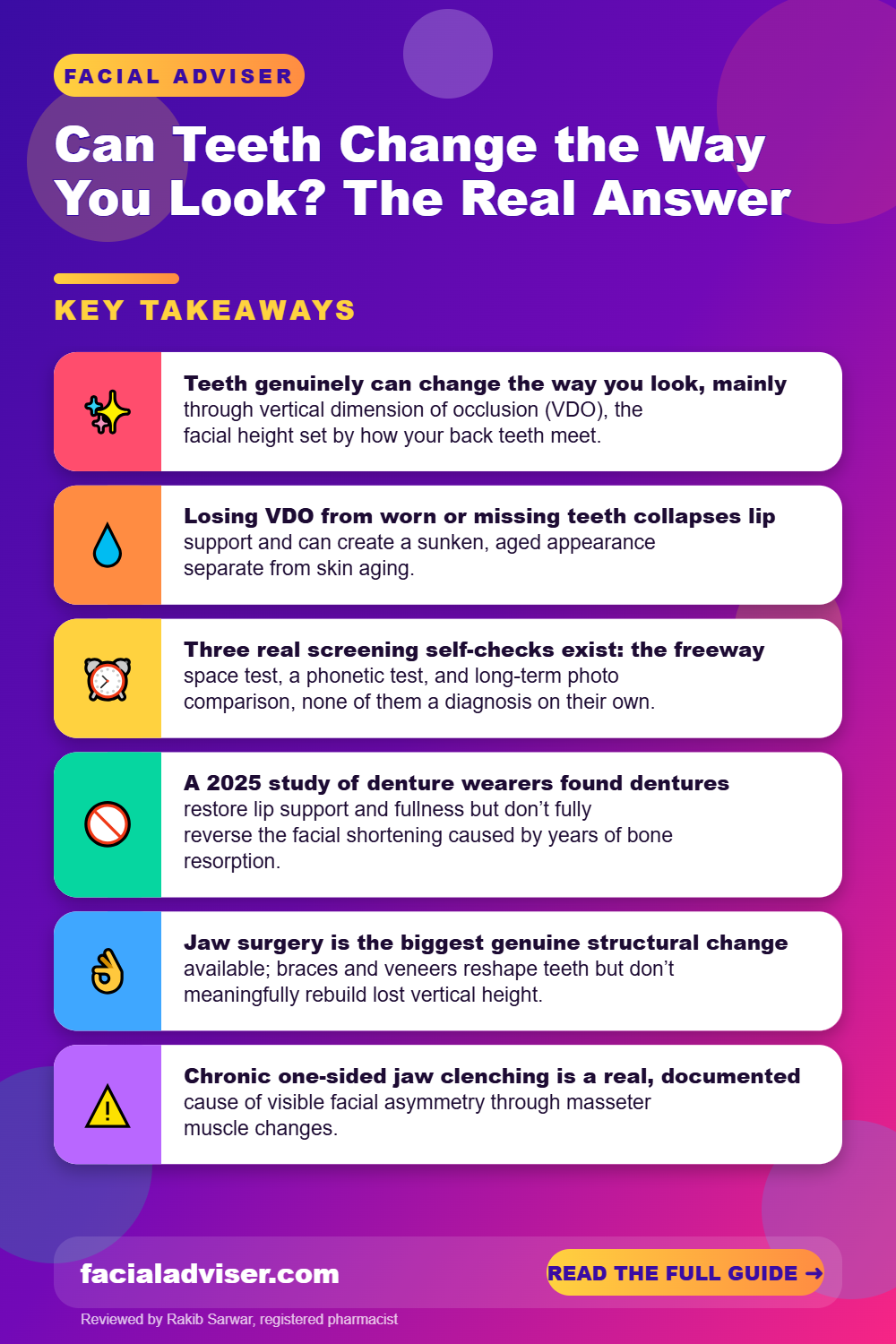
Table of Contents
- Can Teeth Change the Way You Look?
- Vertical Dimension of Occlusion: The Real Mechanism
- Three Real Self-Checks You Can Try
- Denture Wearers: A Special Case
- What a 2025 Study Actually Measured
- TMJ and Facial Asymmetry
- Comparing What Actually Changes Your Look
- Do This, Not That
- How to Check Your Own Bite and Jaw
- When to See a Dentist or TMJ Specialist
- Frequently Asked Questions
- The Bottom Line
Can Teeth Change the Way You Look?
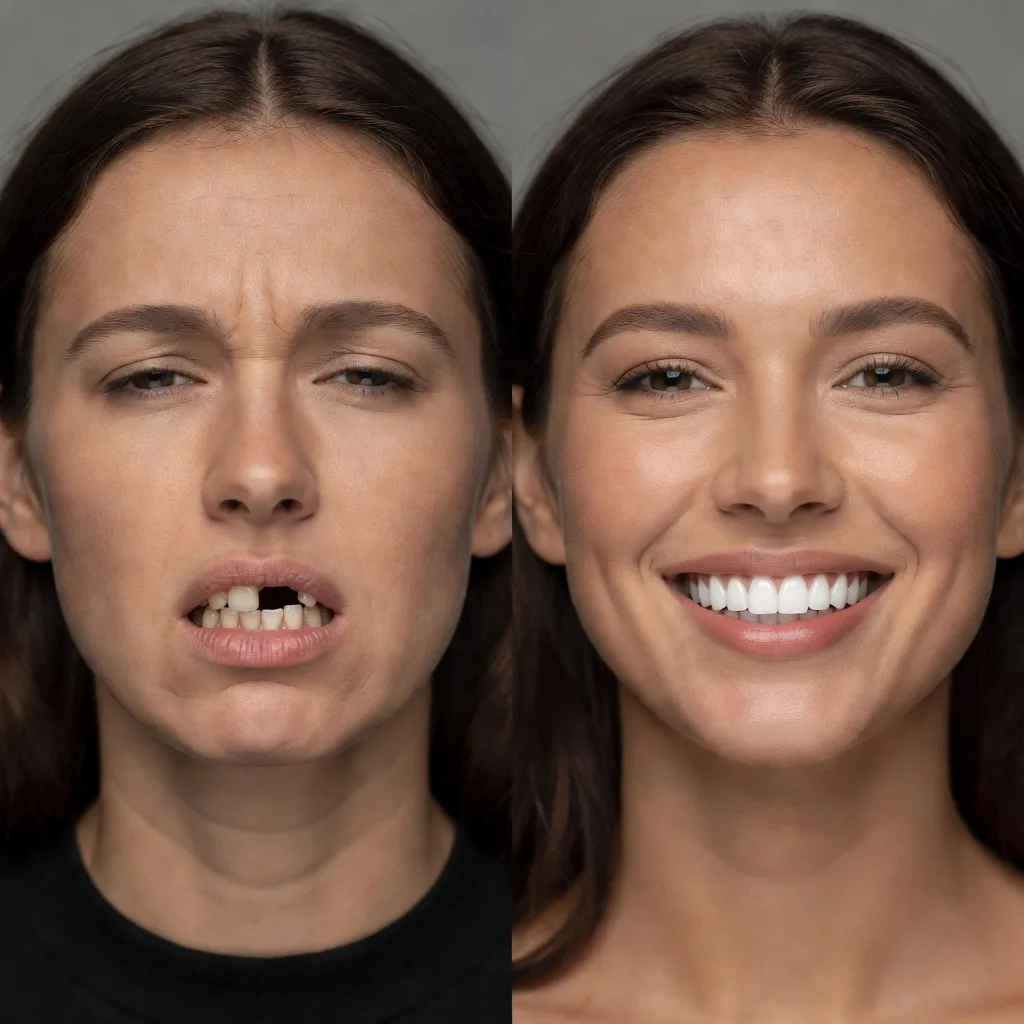
Yes, and the mechanism is more specific than most people assume: it’s mainly about vertical dimension of occlusion, the facial height determined by how your back teeth contact each other, not simply “your teeth” in some vague cosmetic sense. When teeth wear down or are lost without replacement, that vertical dimension collapses, and the lower third of the face can shorten in a way that genuinely changes appearance, independent of skin aging happening at the same time.
Shopping these picks?
Amazon Prime members get fast, free shipping on eligible items, plus Prime Video, Amazon Music and member deals. New members can start with a free trial.
Start a free Prime trialAged 18 to 24? Prime for Young Adults comes with a longer free trial and a lower price after it.
Affiliate link: we may earn a commission at no extra cost to you.
This matters because it’s frequently confused with pure skin aging. Someone can do everything right for their skin and still notice a sunken, collapsed look around the mouth and chin if the underlying bite has lost height. Understanding which one you’re looking at changes what actually helps.
Vertical Dimension of Occlusion: The Real Mechanism
A prosthodontics literature review describes how tooth wear or tooth loss, left unaddressed, collapses the vertical dimension of occlusion and produces what’s often described as a sunken or prematurely aged facial appearance. The mechanism runs through lost lip and cheek support: as the distance between your jaws at rest and at bite shortens, the soft tissue that used to be held out by that structure no longer has the same support, and it folds inward instead.
This is a genuinely different process from collagen loss or sun damage, though the two often get lumped together in casual conversation about an “aging face.” One is a skin-structure question, the other is a bite-and-bone-structure question, and they call for entirely different professionals to address.
Three Real Self-Checks You Can Try
None of these are diagnostic. They’re screening indicators that can tell you whether a professional evaluation is worth pursuing, not a substitute for one.
Freeway space test: Let your jaw relax completely and notice the gap between your upper and lower back teeth. Around 2 to 4 millimeters of space at rest is considered normal. If your back teeth are touching or nearly touching at what should be a relaxed rest position, that can suggest lost vertical dimension.
Phonetic test: Say words with b, m, p, f, and v sounds out loud. Noticeable difficulty forming these sounds cleanly can be a sign that vertical dimension has changed enough to affect how your lips and teeth meet during speech.
Long-term photo comparison: Compare photos of yourself from 10 to 20 years ago against a recent one, ideally similar angle and lighting. Look specifically for a shortened nose-to-chin distance, thinning lip vermilion, or nasolabial folds that look deeper than the rest of your facial aging would explain. That disproportionate pattern is the detail worth noticing, not aging in general.
| Self-check | What a positive result suggests |
|---|---|
| Freeway space test | Possible loss of vertical dimension of occlusion |
| Phonetic (b/m/p/f/v) test | Altered vertical dimension affecting lip-teeth contact |
| Photo comparison over 10-20 years | Disproportionate shortening or lip thinning versus general skin aging |
| Long-term denture wear without reline | Ongoing bone resorption reducing facial support |
Denture Wearers: A Special Case
Note: If you’ve worn the same dentures for five or more years without a reline or replacement, that’s a specific, well-documented risk factor for vertical dimension loss, because the jawbone underneath continues to resorb even after teeth are gone, while the denture itself doesn’t change shape to compensate.
This is one of the more overlooked groups in this whole topic. Dentures replace teeth, but they don’t stop the slow bone remodeling that happens once natural teeth are no longer stimulating the jaw. Over years, that resorption can shift how well an unadjusted denture actually supports the face, even if the denture itself still fits reasonably well in the mouth.
What a 2025 Study Actually Measured
A 2025 stereophotogrammetry study compared 102 edentulous adults before and after receiving dentures against 30 dentate control subjects, mapping 37 facial landmarks. After denture placement, mouth width increased, the upper lip lengthened by roughly 1.1 to 1.5 millimeters, the facial profile became less retruded, cheeks appeared fuller, and the lower lip shortened by about 1.6 millimeters.
The honest caveat, and the part marketing summaries tend to skip, is that even after this measurable improvement, denture-wearing faces remained approximately 10 millimeters shorter than the dentate control group. Dentures meaningfully restore lip and cheek support, but they don’t fully reverse the facial shortening that years of bone resorption already caused. That’s a real, measured limitation, not a reason to avoid getting dentures adjusted or replaced when needed.
TMJ and Facial Asymmetry
Chronic uneven jaw use, including habitual clenching or grinding concentrated more on one side, is a documented cause of visible facial asymmetry, most often through masseter muscle hypertrophy on the more-used side or, in more advanced cases, joint degeneration at the temporomandibular joint itself. This is a real structural mechanism, not a subjective impression.
A simple, non-diagnostic self-check: look at your jaw head-on with your face relaxed and check whether your chin appears centered or deviated to one side. Then slowly open your mouth in front of a mirror and watch whether your jaw travels in a straight line or visibly deviates toward one side partway through. Persistent one-sided pain, a jaw that locks, or consistent one-sided clicking alongside visible asymmetry is the specific combination worth bringing to a dentist or TMJ specialist, not something to self-manage indefinitely.
Comparing What Actually Changes Your Look
| Approach | What it actually changes | What it doesn’t fix |
|---|---|---|
| Braces or clear aligners | Tooth position and angulation, modest profile change | Doesn’t rebuild lost vertical dimension or bone |
| Veneers or crowns | Tooth shape and color, aesthetic-only | Doesn’t restore facial support or bite height |
| Dentures | Restores lip support and vertical dimension directly | Doesn’t fully reverse bone resorption already present |
| Orthognathic jaw surgery | The largest genuine structural, bone-level change available | Doesn’t address skin-level aging separately |
| Dental implants | Best long-term maintenance of vertical dimension and bone | Requires adequate bone volume and healing time |
Do This, Not That
Do
- Use the freeway space and phonetic tests as screening only, not a diagnosis
- Compare old and recent photos in similar lighting and angle
- Ask your dentist about a reline or replacement if you’ve worn the same denture 5+ years
- Bring persistent one-sided jaw clicking or locking to a dentist or TMJ specialist
- Consider a bite evaluation if you notice a bite problem from the AAO’s list, like crossbite or open bite
Don’t
- Assume a screening self-check is an actual diagnosis
- Expect veneers or braces alone to rebuild lost vertical dimension
- Ignore persistent one-sided jaw pain, locking, or clicking
- Wait years past a denture’s expected reline schedule without a check
- Assume every case of facial asymmetry is TMJ-related without an exam
How to Check Your Own Bite and Jaw
Do the freeway space test
Relax your jaw fully and notice whether there’s a small gap or your back teeth are already touching.
Try the phonetic test
Say a few words with b, m, p, f, and v sounds and notice if they feel unusually difficult to form cleanly.
Compare photos over time
Look for a shortened nose-to-chin distance or deepened folds that seem out of proportion to the rest of your facial aging.
Tip: Use photos taken from the same angle and similar lighting for a fair comparison, a straight-on, neutral-expression shot works best.
Check denture-related risk factors
If you wear dentures, note how long it’s been since your last reline or replacement.
Check jaw symmetry and movement
Look at your relaxed jaw head-on for chin deviation, then watch your jaw’s path while opening slowly in a mirror.
When to See a Dentist or TMJ Specialist
Warning: Persistent one-sided jaw pain, a jaw that locks open or closed, or jaw clicking paired with visible facial asymmetry warrants a dentist or TMJ specialist evaluation, not indefinite self-monitoring.
See a dentist or prosthodontist if your self-checks suggest possible vertical dimension loss, especially if you wear dentures that haven’t been evaluated in several years. See a TMJ specialist for persistent jaw pain, locking, or one-sided clicking combined with visible asymmetry. Only a clinical exam, sometimes paired with a cephalometric X-ray, can confirm true skeletal vertical-dimension loss or joint-level TMJ damage; none of the self-checks above can do that on their own. If your main concern is separating bite-related changes from ordinary skin aging, a dermatologist or skin specialist can help evaluate the skin side while a dentist evaluates the structural side.
Frequently Asked Questions
Can teeth really change the way your face looks?
Yes, mainly through vertical dimension of occlusion, the facial height set by how your back teeth meet.
What is vertical dimension of occlusion?
It’s the facial height determined by tooth contact when your jaws close, and losing it can collapse lip and cheek support.
How can I check my own vertical dimension at home?
The freeway space test, a phonetic test, and long-term photo comparison are real screening checks, though none is a diagnosis on their own.
Do dentures fully restore a younger facial appearance?
They meaningfully restore lip support and fullness, but a 2025 study found denture-wearing faces remain shorter than dentate controls even after fitting.
Can jaw clenching cause visible facial asymmetry?
Yes, chronic uneven clenching is a documented cause through masseter muscle changes or joint-level effects over time.
Do braces or veneers fix lost vertical dimension?
No, they reshape tooth position or appearance but don’t rebuild the vertical height lost from wear or missing teeth.
What actually reverses vertical dimension loss?
Dentures, implants, and orthognathic jaw surgery address it directly; jaw surgery is the largest structural change available.
When should I see a dentist about this?
If self-checks suggest possible vertical dimension loss, or if you wear dentures that haven’t been evaluated in several years.
When should I see a TMJ specialist?
For persistent one-sided jaw pain, locking, or clicking combined with visible facial asymmetry.
Is a screening self-check the same as a diagnosis?
No, only a clinical exam, sometimes with a cephalometric X-ray, can confirm true vertical-dimension or joint damage.
The Bottom Line
Teeth genuinely can change the way you look, and the real mechanism is vertical dimension of occlusion, not a vague notion of “your smile.” Worn or missing teeth left unaddressed collapse that vertical height and the lip and cheek support that goes with it, producing a look that’s easy to mistake for ordinary skin aging.
Three real self-checks, the freeway space test, the phonetic test, and long-term photo comparison, can flag whether it’s worth seeing a professional. Dentures, implants, and jaw surgery are the interventions that actually address vertical dimension directly, with jaw surgery representing the largest genuine structural change available. Persistent jaw pain, locking, or one-sided clicking paired with asymmetry deserves a TMJ specialist’s attention rather than continued self-monitoring.

Written by
Registered pharmacist and founder of Facial Adviser. Rakib's pharmacy training covers how skincare actives work and interact; a later course in cosmetology turned that into a focus on facial treatments and skincare products. He plans, researches and edits every guide on the site and checks health claims against sources such as the American Academy of Dermatology, the FDA and the NIH. He is not a dermatologist; see the Editorial Policy and Medical Disclaimer.
About · Editorial policy · How we choose products · Medical disclaimer · Contact
Keep reading: Diet, sleep, stress and skin