Best Microcurrent Facial Devices (2026): What to Look For Before You Buy
Shopping for a microcurrent facial device is confusing. Every listing promises a lifted jawline, sharper cheekbones and a non-surgical facelift, yet the devices range from simple two-prong wands to multi-function tools with heat, light and vibration bolted on. The right choice depends less on the number of features and more on whether the device delivers a controlled current comfortably, safely and often enough for you to keep using it.
Part of our guide to at-home facial devices. Start with: How to Incorporate Microcurrent Into Your Routine: Gel, Timing and Safety
The best microcurrent facial device for most people is a handheld model with adjustable intensity, two well-spaced conductive contacts, a rechargeable battery that lasts several sessions and some form of guidance, whether an app, a timer or a built-in routine. Microcurrent works by sending a very low electrical current into the facial muscles, which contract slightly and look temporarily firmer; the effect is modest, builds a little with regular use and fades within days once you stop. Every device needs a water-based conductive gel to work, so budget for that too. Avoid microcurrent entirely if you have a pacemaker or other implanted electronic device, epilepsy, are pregnant or have had injectables in the past two weeks.
In short: pick a device with adjustable intensity, decent battery life and a routine you can actually follow, buy conductive gel with it, and expect a subtle, temporary lift rather than a dramatic change.
Powered muscle stimulators, which include microcurrent devices, are regulated as medical devices by the US Food and Drug Administration, and the American Academy of Dermatology encourages anyone with acne-prone or sensitive skin to avoid treatments that rub or irritate inflamed areas. Both points matter when choosing a tool you will glide across your face several times a week.
This guide explains what microcurrent genuinely does, compares the three main device types, lists the features worth paying attention to, sets out the safety rules, gives a realistic results timeline and shows you how to use whatever device you choose.
Shopping these picks?
Amazon Prime members get fast, free shipping on eligible items, plus Prime Video, Amazon Music and member deals. New members can start with a free trial.
Start a free Prime trialAged 18 to 24? Prime for Young Adults comes with a longer free trial and a lower price after it.
Affiliate link: we may earn a commission at no extra cost to you.
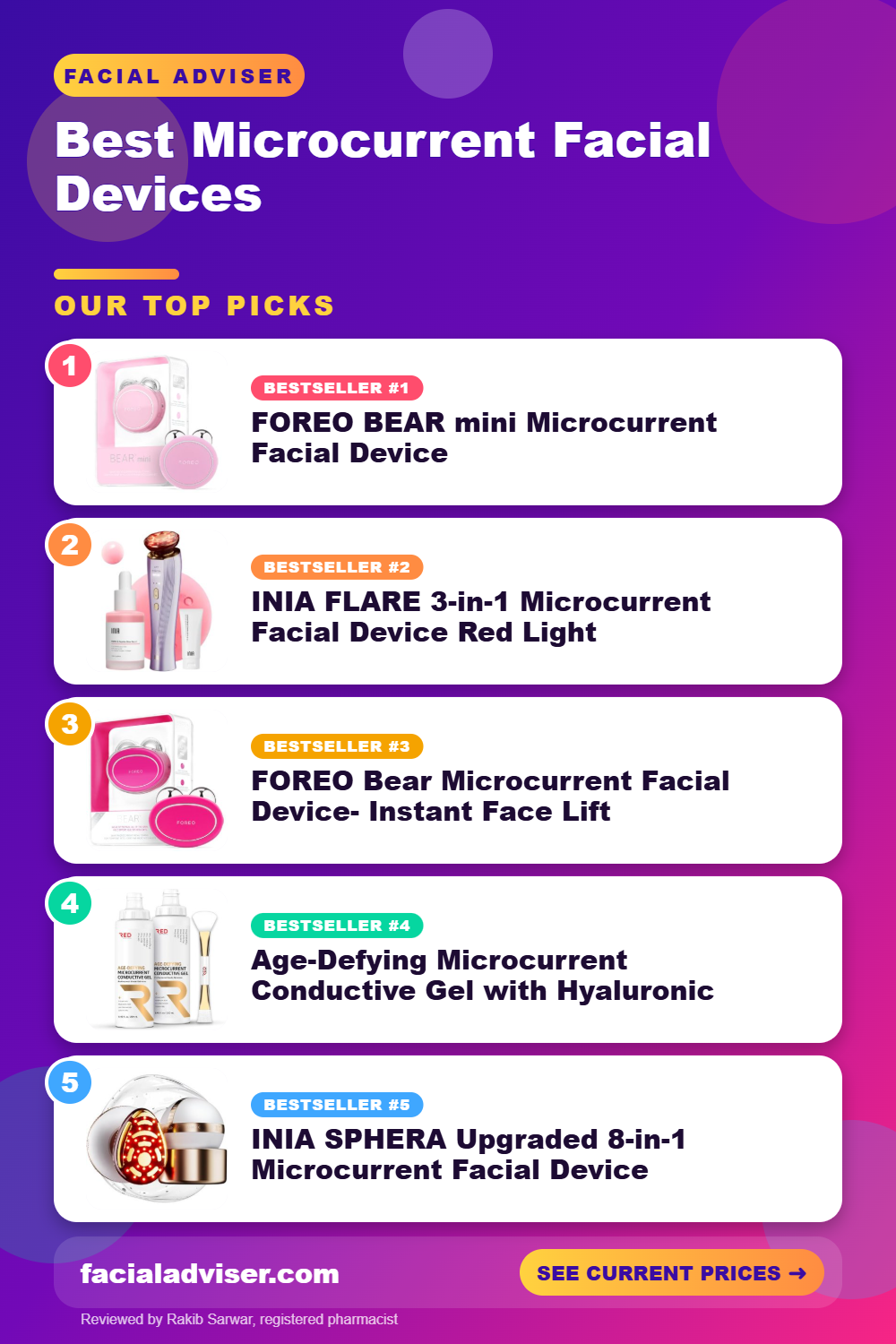
Recommended Microcurrent Facial Devices and Gels


On This Page
- What Microcurrent Actually Does
- Device Types Compared
- Features That Actually Matter
- What Paying More Actually Buys
- Contraindications and Safety
- A Realistic Results Timeline
- How to Choose and Use a Microcurrent Facial Device
- Dos and Don’ts When Buying and Using
- Common Buying Mistakes
- Honest Limits
- When to See a Dermatologist
- FAQ
- Final Word
In Brief
- Microcurrent gives a mild, temporary toning effect; it does not replace fillers, surgery or professional treatments.
- Handheld two-prong wands offer the most control; masks offer convenience; multi-function tools add features that may or may not matter.
- Adjustable intensity is the single most important feature, followed by battery life and guidance.
- Every device needs water-based conductive gel; without it the current stings and barely works.
- Skip microcurrent if you have a pacemaker, implanted electronics, epilepsy, are pregnant or have had recent injectables.
- Expect to see a subtle lift after a session and a slightly more consistent effect after six to eight weeks of regular use.
- Results fade within days without upkeep, so the best device is the one you will use three to five times a week.
What Microcurrent Actually Does
Microcurrent devices deliver a current measured in microamps, far below what you feel from a muscle-stimulation machine at the gym. The idea is to stimulate the facial muscles so they contract gently and sit a little more taut, which gives the face a lifted look straight after a session.
- Produces a short-term tightening of the jawline, cheeks and brow that is visible in a mirror for a few hours to a couple of days.
- May reduce morning puffiness slightly by encouraging fluid movement.
- Can leave the skin looking brighter for a short time, probably from increased blood flow.
- Has only modest, short-term evidence behind it; the studies are small and many are manufacturer funded.
- Does not fill wrinkles, rebuild lost volume or permanently change the structure of the face.
Think of it as exercise for the face rather than a treatment. Just as a gym routine fades when you stop, the lift from microcurrent disappears within days if you put the device in a drawer. Our guide to microcurrent facial steps and benefits explains what a professional session involves and how much of that a home device can reproduce.
Device Types Compared
Three formats dominate the market, and each suits a different kind of user.
| Type | How it works | Best for | Drawbacks |
|---|---|---|---|
| Handheld two-prong wand | Two metal spheres or pads you glide over gelled skin | Beginners, sensitive skin, anyone who wants precise control over placement and intensity | Needs attention and gel for the whole session; easy to skip areas |
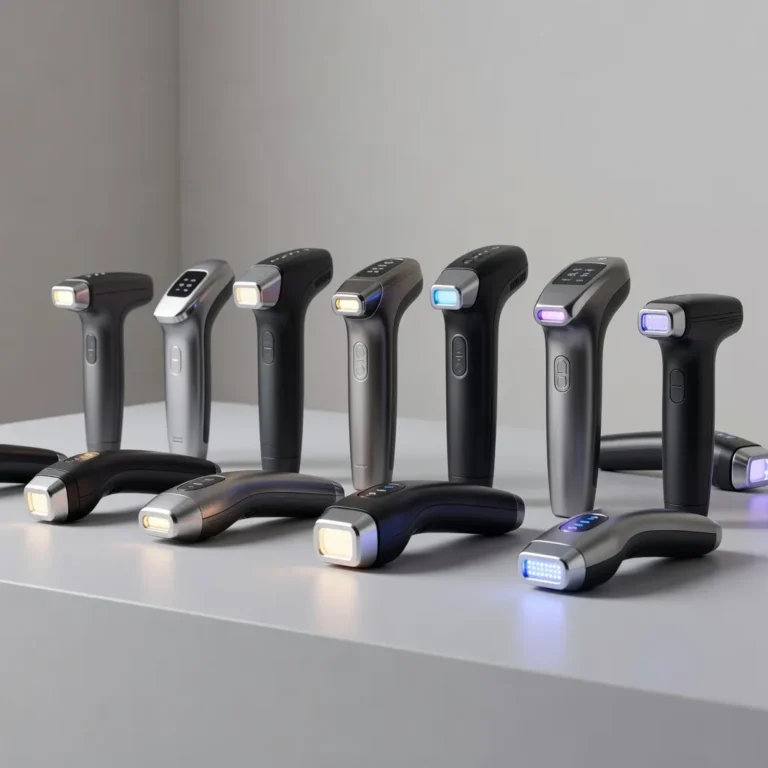
| Multi-function handheld | Microcurrent plus extras such as heat, LED light, vibration or sonic cleansing | People who want one tool for several routines | Extras can dilute the microcurrent function; more modes mean more to learn and more to go wrong |
| Microcurrent mask or strap | Fixed electrodes held against the face by a mask or band | Hands-free convenience for people who already tolerate microcurrent well | Cannot adapt to face shape, often misses the jawline and neck, harder to clean, less control near the eyes |
For a first device the handheld wand is the sensible default. You can feel and adjust the current in real time, keep it away from the eyes and thyroid, and work the jawline and neck properly.
Features That Actually Matter
Marketing pages list dozens of features. Only a handful change how well the device works day to day.
- Adjustable intensity: at least three levels, ideally more, so you can start low and find the setting that gives a faint tingle without twitching.
- Conductive gel compatibility: all microcurrent devices need a water-based gel. Some brands sell their own, but any oil-free, silicone-free conductive gel works.
- Battery life: look for a rechargeable device that manages a week or more of sessions on a single charge. Small devices with tiny batteries can die mid-routine.
- App or built-in guidance: an app that shows where to place the probes and times each zone makes sessions consistent. A simple timer or audible cue does most of the same job without a phone.
- Contact design: smooth, rounded contacts glide better than flat pads and are easier to keep in full contact with the skin.
- Water resistance: a splash-proof body is easier to rinse free of gel; full waterproofing is rarely necessary.
- Auto shut-off and skin-contact sensing: both stop the device delivering current into thin air or running for too long.
If you are undecided between two devices, choose the one with finer intensity control and the longer battery. A device you can set comfortably and that is always charged gets used; one that stings on its lowest level or needs charging every other day does not.
What Paying More Actually Buys
Microcurrent devices span a wide price range, and the difference is not always in the current itself. Higher-end models usually offer finer intensity control, a wider range of current waveforms, better build quality, longer warranties and a polished app with guided routines. Entry-level models often deliver a similar basic current but with fewer settings, a shorter battery life and less guidance.
What you rarely get for more money is a stronger effect. Home devices are deliberately limited to a safe output, so a premium device will not lift the face further than a basic one; it will simply make the routine more comfortable, more consistent and easier to keep up. Multi-function tools bundle several technologies at a lower cost per feature, but the microcurrent element in those tools is sometimes weaker or less adjustable than in a dedicated wand.
Any device that promises results equal to a professional treatment, a surgical facelift or permanent muscle remodelling is overstating what microcurrent can do. Treat such claims as a reason to look elsewhere.
Contraindications and Safety
Because microcurrent is an electrical treatment, the list of people who should avoid it is longer than for a roller or gua sha tool. These appear on most device labels and should be taken seriously.
| Condition | Guidance |
|---|---|
| Pacemaker, defibrillator or other implanted electronic device | Do not use; current can interfere with the implant |
| Epilepsy or seizure disorder | Do not use without medical clearance |
| Pregnancy | Manufacturers advise against use; safety has not been established |
| Metal implants, plates or pins in the face or head | Avoid; metal concentrates current unpredictably |
| Recent Botox, fillers or other injectables | Wait about two weeks or as your injector advises |
| Active acne, rosacea flare, eczema or sunburn | Wait until the skin has settled; probes irritate and can spread bacteria |
| Heart conditions or history of stroke | Ask your doctor before using any electrical device near the head and neck |
| Cancer or cancer treatment | Seek medical clearance first |
Never run a microcurrent device over the eyeball, the eyelids or the front of the neck where the thyroid sits. Stay on the brow bone and cheekbone around the eyes, and work only under the jaw and along the sides of the neck.
A full safety walkthrough, including intensity, areas to avoid and the signs that mean stop, is in our simple guide to using microcurrent safely.
A Realistic Results Timeline
The biggest mistake buyers make is expecting a permanent change after a few sessions. Here is what regular use typically looks like.
| Stage | What you may notice |
|---|---|
| Immediately after a session | A slight lift of the brow, cheek and jawline that lasts a few hours to a couple of days |
| Weeks 1 to 2 | Short-lived lift after each session; learning the right intensity and placement |
| Weeks 3 to 6 | The post-session effect appears more readily and may last a little longer |
| Weeks 6 to 12 | A more consistent, still subtle, toned appearance between sessions with three to five sessions a week |
| Maintenance | Two to three sessions a week to hold the effect |
| After stopping | Lift fades over days to a couple of weeks |
Even at its best, the change is subtle. People who photograph their face in the same light before and after a month of use often see a small difference in the jawline or brow; those hoping for the effect of fillers or a thread lift will be disappointed. If your concern is early jowling, our article on sagging jowls in your 30s sets out the full range of options.
How to Choose and Use a Microcurrent Facial Device
Follow this sequence both when buying and when using the device for the first time.
Rule out contraindications
Check the safety list above. If you have an implant, a seizure disorder, a heart condition or are pregnant, stop here or ask your doctor first.
Decide on the format
Choose a handheld wand for control, a multi-function tool if you want several technologies in one, or a mask only if you already tolerate microcurrent well and want hands-free sessions.
Check the essential features
Confirm adjustable intensity, a rechargeable battery with several sessions per charge, skin-contact sensing and some form of timing or guidance.
Buy conductive gel at the same time
A water-based, oil-free gel is essential. Order enough for several weeks so you do not run out and skip sessions.
Prepare the skin
Cleanse thoroughly and remove all makeup, sunscreen, oil and moisturiser, which block the current.
Apply gel generously and start low
Cover one section of the face at a time. Begin on the lowest intensity and raise it one step at a time until you feel a faint tingle.
Work upward and outward
Glide from the jawline towards the ear, the cheek towards the temple and the brow upward. Hold each position for a few seconds and avoid the eyes, lips and front of the neck.
Finish and clean
Keep the session to five to fifteen minutes, rinse off the gel, apply moisturiser and sunscreen, then wipe the contacts and let them dry.
Dos and Don’ts When Buying and Using
Do
- Choose a device with fine intensity control
- Budget for water-based conductive gel from day one
- Start on the lowest setting and work up to a faint tingle
- Use it three to five times a week for at least six weeks before judging
- Clean the contacts after every session
Don’t
- Buy on the strength of facelift claims or before-and-after photos
- Use oils, balms or moisturiser instead of gel
- Use any device with a pacemaker, implant or seizure disorder
- Glide over the eyes, the thyroid or active breakouts
- Share a device with anyone else
Common Buying Mistakes
Most disappointment with microcurrent comes from the purchase rather than the device.
- Choosing a multi-function tool for the extras and then finding its microcurrent setting is weak or barely adjustable.
- Buying a mask first; without the ability to feel and adjust the current, beginners often overdo it or find it uncomfortable.
- Skipping the gel, or using a rich serum instead, then concluding the device does nothing.
- Expecting results in a week and giving up before the routine has had a chance to work.
- Buying a device with a tiny battery that needs charging after every session, which quietly kills the habit.
- Ignoring the contraindications on the box because the current seems too low to matter.
Powered devices are only one way to support a firmer-looking face. Our overview of whether a face massager is good for skin covers what each type of tool can and cannot do.
Honest Limits
Home microcurrent delivers a small, temporary toning effect that depends entirely on repetition. It cannot lift sagging skin the way surgery or a thread lift can, it does not fill lines or restore lost volume, and there is no solid evidence that it builds collagen or produces lasting change. The studies that exist are short, small and often industry funded, so long-term claims rest more on marketing than on data.
That does not make it worthless. If you enjoy the routine, like the short-term lift and are realistic about the ceiling, a well-chosen device is a reasonable addition to a skincare regime built on sunscreen, retinoids and sensible habits. If you are hoping it will replace a professional treatment, it will not, and no amount of extra features or spending changes that.
When to See a Dermatologist
A home device suits mild, early concerns in otherwise healthy skin. See a board-certified dermatologist if:
- You have a health condition, implant or medication and are unsure whether microcurrent is safe for you.
- You have had injectables or a procedure and want to know when it is safe to resume.
- Redness, swelling, hives, numbness or persistent twitching follows a session.
- Your real concern is pronounced sagging, jowls or deep lines, which may call for treatments a home device cannot provide.
- You want an honest assessment of what will and will not work for your face before spending on a device.
This article is for general information only and does not replace professional medical advice. Consult a board-certified dermatologist or your doctor before using a microcurrent device if you have any medical condition, implant or recent cosmetic treatment, and stop immediately if you experience pain, dizziness or any unusual symptom.
FAQ
What is the best type of microcurrent facial device for beginners?
A handheld two-prong wand with adjustable intensity, because you can feel and control the current and keep it away from sensitive areas.
Do microcurrent devices really work?
They give a mild, temporary toning effect with regular use; the evidence is modest and the lift fades when you stop.
Do I need conductive gel?
Yes. Without a water-based gel the current barely penetrates and can sting.
How long before I see results?
A subtle lift straight after a session; a more consistent effect after six to twelve weeks of three to five sessions a week.
How often should I use a microcurrent device?
Three to five times a week to start, then two to three times a week to maintain.
Is a microcurrent mask better than a wand?
It is more convenient but offers less control, often misses the jawline and neck, and is harder to clean.
Who should not use microcurrent?
Anyone with a pacemaker or implanted electronics, epilepsy, a metal implant in the face, pregnancy or recent injectables.
Does a more expensive device give better results?
Usually not. It buys finer control, better build and guidance, not a stronger lift.
Can microcurrent replace Botox or fillers?
No. It tones muscles temporarily; it does not relax them or add volume.
Can I use microcurrent with retinol?
Yes, but not in the same session; cleanse the skin fully before microcurrent and apply retinol afterwards at night.
Final Word
The best microcurrent facial device is not the one with the most modes or the boldest claims. It is a comfortable, adjustable, well-charged tool that you will actually pick up three to five times a week, paired with a water-based conductive gel and realistic expectations of a subtle, temporary lift.
Rule out the contraindications first, choose a handheld wand unless you have a specific reason not to, give the routine six to eight weeks before judging, and talk to a dermatologist if your concern is more than mild early sagging.

Written by
Registered pharmacist and founder of Facial Adviser. Rakib's pharmacy training covers how skincare actives work and interact; a later course in cosmetology turned that into a focus on facial treatments and skincare products. He plans, researches and edits every guide on the site and checks health claims against sources such as the American Academy of Dermatology, the FDA and the NIH. He is not a dermatologist; see the Editorial Policy and Medical Disclaimer.
About · Editorial policy · How we choose products · Medical disclaimer · Contact
Keep reading: Microcurrent and RF devices
- How to Incorporate Microcurrent Into Your Routine: Gel, Timing and Safety
- Is RF Microneedling Better Than Laser?
- Facial Treatment Devices Explained: Microcurrent, Galvanic, LED and More
- Microcurrent Facial vs Radiofrequency: Which Works Better for Firmer Skin?
- NuFACE Mini vs Trinity: Differences, Specs and Which to Choose
- Radio Frequency vs High Frequency Facial: What Is the Difference?
- 10 Best LED Light Therapy Masks (2026): Clearer Skin, Softer Lines
- 10 Best Products for Women's Facial Hair Removal (2026): Gentle Picks