How to Avoid Makeup Creasing Under Your Eyes
Concealer that looks flawless at 8 a.m. and sits in every fine line by noon is one of the most common makeup complaints there is, so how do you actually avoid makeup creasing under your eyes instead of just fighting it all day?
Part of our guide to makeup how-to. Start with: How to Choose the Right Eye Makeup Color for Your Eyes and Skin
Eyelid skin runs roughly 0.5mm thick versus about 2mm on the cheeks or forehead, with almost no cushioning fat layer and less collagen to bounce back — a real, measurable anatomical difference, not just a perception. Add roughly 15,000 blinks a day of mechanical movement and naturally lower oil-gland density in that zone, and product has both a thinner, more textured surface to sit on and constant motion working it into every line.
The genuinely useful reframe most creasing advice skips: product doesn’t cause the crease, it makes an existing line visible by pooling pigment into it as the wet film dries — which is why the real fix starts with the skin underneath, not just the formula on top.
This guide walks through the real mechanism, product-type differences that matter, a step-by-step application technique built around why each step works, and the honest limit of what technique alone can and can’t fix.
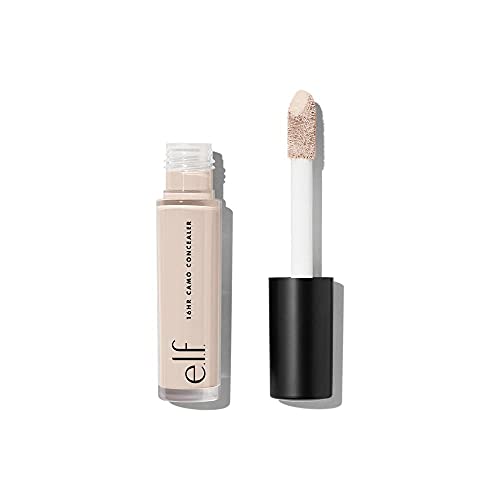
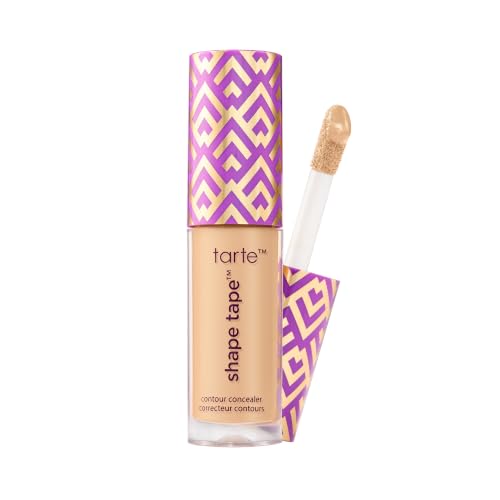
Recommended Long-Wear Under-Eye Products



Quick Take
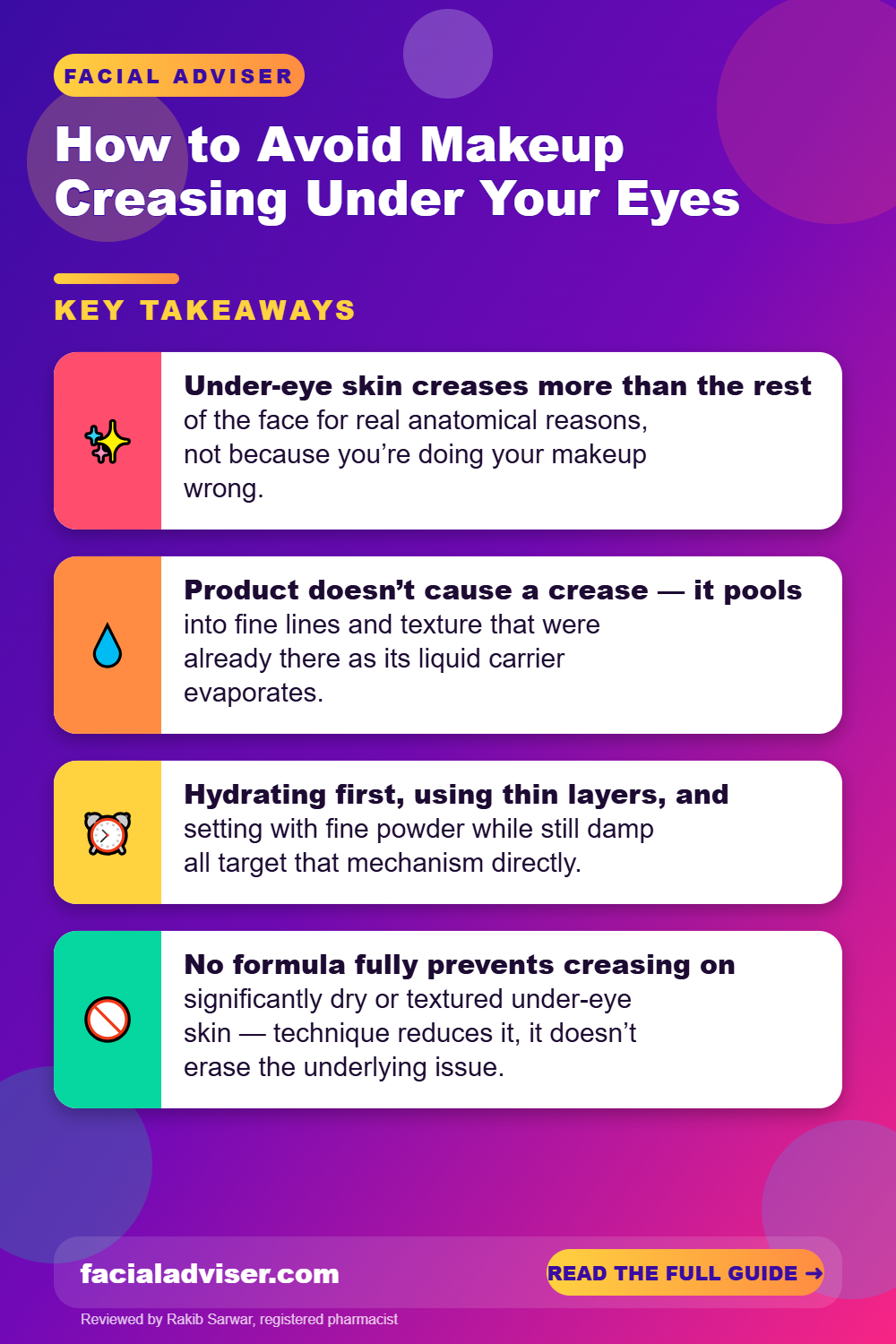
- Under-eye skin creases more than the rest of the face for real anatomical reasons, not because you’re doing your makeup wrong.
- Product doesn’t cause a crease — it pools into fine lines and texture that were already there as its liquid carrier evaporates.
- Hydrating first, using thin layers, and setting with fine powder while still damp all target that mechanism directly.
- No formula fully prevents creasing on significantly dry or textured under-eye skin — technique reduces it, it doesn’t erase the underlying issue.
Where to Start
- Why Under-Eye Skin Creases More Than Anywhere Else
- The Blink Problem: 15,000 Reasons a Day
- Why This Area Runs Drier by Default
- What’s Actually Happening When Concealer Creases
- Fix One: Hydrate Before You Apply Anything
- Fix Two: Less Product, Thinner Layers
- Fix Three: Set While Still Damp, Not After It Dries
- Choosing a Formula Built for the Area
- Addressing the Skin, Not Just the Makeup
- The Honest Limits of Technique
- A Routine That Targets Each Mechanism
- Technique-to-Mechanism Reference
- Questions People Ask
- The Bottom Line
Why Under-Eye Skin Creases More Than Anywhere Else
This isn’t marketing language about “delicate” skin — the eyelid area is a genuinely different tissue from the rest of the face. Dr. Chris Thiagarajah, a fellowship-trained oculoplastic surgeon at Denver Eyelid Specialists, explains that eyelid epidermis measures roughly 0.5 mm thick, compared to about 2 mm on the cheeks or forehead. That’s a four-fold difference in the layer meant to hold everything, including makeup, in place. The area also has almost no subcutaneous fat layer, so skin sits nearly directly on muscle and the tarsal plate, with minimal cushioning underneath it.
Shopping these picks?
Amazon Prime members get fast, free shipping on eligible items, plus Prime Video, Amazon Music and member deals. New members can start with a free trial.
Start a free Prime trialAged 18 to 24? Prime for Young Adults comes with a longer free trial and a lower price after it.
Affiliate link: we may earn a commission at no extra cost to you.
The Blink Problem: 15,000 Reasons a Day
Under-eye skin also has fewer collagen bundles and less elastin than thicker facial skin, meaning less structural bounce-back and earlier, more visible fine lines. On top of that, the area sits directly over the orbicularis oculi, one of the most repetitively active muscles on the face, contracting with every one of an estimated 15,000-plus daily blinks. Any product applied there gets mechanically flexed and folded thousands of times a day, far more than skin on the cheek or forehead ever experiences, which gives a thin film of product constant opportunity to migrate into whatever crease is already forming.
Why This Area Runs Drier by Default
Sebaceous gland density under the eye is lower than in the T-zone, so this skin runs drier by default, independent of anyone’s actual skincare routine. A dry, slightly rough surface has more microtexture for product to catch on than smooth, well-hydrated skin does, and a heavier or creamier product applied over dry, flaky skin simply has more surface irregularity to sink into. This is part of why the same concealer can behave differently under the eyes than it does when dabbed on a smoother, oilier part of the face.
What’s Actually Happening When Concealer Creases
Any liquid or cream product sits in a thin surface film on skin right after application. On thin, low-elasticity, texture-prone under-eye skin, that film collects into whatever fine lines or texture already exist as the product’s water or volatile carrier evaporates and its binders, such as oils, glycerin, and film formers, concentrate and get tacky. The product doesn’t cause the line — it makes an existing line visually obvious by pooling pigment into the crevice, functionally identical to how a thin coat of any semi-liquid material settles into a groove rather than bridging over it.
Fix One: Hydrate Before You Apply Anything
Because low sebum plus thin skin adds up to a naturally dry substrate, applying concealer directly onto dehydrated skin gives its oils and emulsifiers a rough, absorbent surface to grab onto and separate on unevenly. An eye cream or hydrating primer creates a smoother, less absorbent base so concealer sits on top instead of soaking unevenly into dry patches. This is the step most people skip because it feels like an extra product, but it addresses the root substrate problem rather than compensating for it after the fact.
Fix Two: Less Product, Thinner Layers
More product means a thicker wet film with more volume available to be pushed into creases every time you blink. Thin layers, patted rather than dragged into place with a damp sponge, redistribute pigment more evenly and leave the product less material to physically pool with. Building coverage in two thin passes, letting the first set slightly before the second, controls creasing far better than one heavy application aimed at full coverage in a single pass.
Fix Three: Set While Still Damp, Not After It Dries
A light dusting of translucent or finely milled powder, applied while the product is still slightly damp, speeds evaporation of the wet vehicle and locks the product’s position before blinking has a chance to move it into a line. The dose matters: over-application dries the surface further and can itself crack or settle into lines, which is why “as little as needed” is the actual rule, not “as much as possible.”
Choosing a Formula Built for the Area
A lower oil-content, higher pigment-load, or long-wear polymer-based formula is designed to set into a flexible film rather than remain semi-fluid, the same mechanism that lets waterproof mascara resist smudging: a flexible polymer film moves with the skin instead of sliding as a discrete liquid pool. An all-purpose concealer built for coverage everywhere on the face isn’t necessarily built for this specific mechanical environment.
| Concealer Type | Creasing Tendency | Why |
|---|---|---|
| Heavy cream concealer | High | Higher oil content stays semi-fluid longer, giving blinking more time to push it into lines |
| Standard liquid concealer | Moderate | Thinner film than cream, but still relies on full evaporation to set in place |
| Long-wear / polymer-based liquid | Lower | Film formers set into a flexible layer that moves with skin instead of pooling |
| Powder concealer / color corrector | Lowest | No wet evaporation phase at all, so there is no film to migrate into creases |
Do
- Pat product into place with a damp sponge instead of dragging it.
- Let each thin layer set before adding more where needed.
- Choose a lower-oil or polymer-based formula for the eye area specifically.
Don’t
- Pile on concealer in one heavy pass to hide everything at once.
- Apply straight onto bare, unmoisturized skin.
- Bury the area in powder hoping it will fix a formula that’s fighting the skin.
Addressing the Skin, Not Just the Makeup
Since the root issue is thin, low-oil, texture-prone skin, the most durable fix is on the skincare side rather than only compensating at the makeup layer: a barrier-supporting moisturizer used consistently, and retinoid-driven texture improvement over time under dermatologic guidance, both work on the substrate rather than the product sitting on top of it. Makeup technique manages the daily symptom; skin condition is the underlying variable that determines how much managing is needed in the first place.
The Honest Limits of Technique
No concealer formula will fully prevent creasing on skin that is significantly dehydrated, has visible static wrinkles, or has textured or enlarged pores in the tear-trough area. Application technique can reduce creasing but cannot eliminate it on structurally aged or very dry under-eye skin, and any claim that a specific product “never creases” on every skin type should be read skeptically. The realistic goal is meaningfully less creasing over the course of a day, not a guarantee of none.
A Routine That Targets Each Mechanism
Put the fixes above in order and they map onto the actual causes of creasing rather than functioning as an arbitrary checklist:
Prep with hydration
Apply an eye cream or hydrating primer and let it absorb fully before moving on, so concealer isn’t sitting on a rough, dry surface.
Apply in thin layers
Pat, don’t drag, a small amount into place with a damp sponge, building coverage gradually rather than in one heavy pass.
Let the first layer settle
Give the product a moment before adding more, so you’re not compounding a thick wet film in one spot.
Set while still damp
Press a small amount of finely milled powder onto the area before the product fully dries, locking position ahead of the first blinks.
Dust off excess
Brush away any surplus powder rather than leaving it to sit, since leftover powder on dry skin is what causes flaking later.
Technique-to-Mechanism Reference
It helps to see each fix lined up against the specific mechanism it’s actually addressing, rather than treating them as a generic list of tips.
| Technique | Mechanism It Targets | What Happens Without It |
|---|---|---|
| Hydrate before applying | Low sebum density leaves skin dry and absorbent | Product soaks in unevenly and separates on rough patches |
| Use thin layers | Thicker film has more volume to push into creases when blinking | Heavy application pools visibly within the first hour |
| Set while damp | Evaporating carrier is what causes pooling into existing texture | Product keeps moving and migrating until fully dry on its own |
| Choose a polymer-based formula | Flexible film formers move with skin instead of sliding | A semi-fluid formula stays mobile through thousands of daily blinks |
Questions People Ask
Why does my concealer only crease under my eyes and nowhere else?
Eyelid skin is about a quarter the thickness of cheek or forehead skin, has almost no fat cushioning, and flexes with every blink, giving product far more opportunity to settle into existing lines there.
Does creasing mean I used the wrong concealer?
Not necessarily. Creasing happens when a wet film pools into texture that was already present as it dries, so formula matters, but underlying skin condition matters just as much.
Will more powder always stop creasing?
No. Over-application can dry the surface further and cause its own flaking or settling on already-dry under-eye skin, so use only as much as needed.
Should I set concealer before or after it fully dries?
While it is still slightly damp. Setting a fully dried product does less to lock its position before blinking has already had time to move it.
Is cream or liquid concealer worse for creasing?
Heavier cream formulas with higher oil content tend to stay semi-fluid longer, giving blinking more time to push them into lines, compared to lighter or polymer-based liquids.
Can skincare actually reduce creasing over time?
Yes. A barrier-supporting moisturizer and retinoid-driven texture improvement address the dry, textured substrate that makeup technique can only manage on a daily basis.
Why do I blink so often that it matters for makeup?
The orbicularis oculi muscle under the eye contracts an estimated 15,000-plus times a day, mechanically flexing any product applied there far more than skin elsewhere on the face.
Is there a concealer that never creases?
No formula eliminates creasing on significantly dehydrated or textured skin. Technique and formula choice reduce it meaningfully, but a universal no-crease claim should be read skeptically.
Why is under-eye skin drier than the rest of my face?
Sebaceous gland density is lower under the eyes than in the T-zone, so this area produces less natural oil and runs drier by default.
Does baking under the eyes actually help?
It can lock product in place, but heavy powder on naturally dry under-eye skin can also increase flaking, so it is a genuine trade-off rather than a universal fix.
The Bottom Line
Under-eye creasing isn’t a sign of doing your makeup wrong — it’s the predictable result of unusually thin, fat-poor, low-oil skin that flexes thousands of times a day being asked to hold a wet film of product in place. Understanding that mechanism is what makes the standard fixes, hydrating first, applying thin layers, and setting while still damp, actually make sense instead of feeling like arbitrary rules.
None of it fully overrides significantly dry or textured skin, and no formula on the market changes that. The realistic goal is a meaningfully better result over the course of a day, achieved by working with the skin’s actual behavior rather than fighting it with more product.

Written by
Registered pharmacist and founder of Facial Adviser. Rakib's pharmacy training covers how skincare actives work and interact; a later course in cosmetology turned that into a focus on facial treatments and skincare products. He plans, researches and edits every guide on the site and checks health claims against sources such as the American Academy of Dermatology, the FDA and the NIH. He is not a dermatologist; see the Editorial Policy and Medical Disclaimer.
About · Editorial policy · How we choose products · Medical disclaimer · Contact
Keep reading: Eye makeup
- Is It Safe to Put Makeup on Your Waterline?
- Best Way to Do Makeup for Hooded Eyes: Shadow, Liner and Lash Tips
- How to Choose the Right Eye Makeup Color for Your Eyes and Skin
- Puffy Eyes After Salty Food: Why It Happens and How to De-Puff Fast
- Dark Circles vs Hyperpigmentation Under Eyes: How to Tell Them Apart
- How to Get Started as a Freelance Makeup Artist: Training, Kit and Clients
- Best Way to Use Makeup Remover: Micellar Water, Balms, Oils and Eye Removers