How Often Should You Use Red Light Therapy on Your Face? Frequency and Session Length
Red light therapy has moved from dermatology offices into bathrooms. LED masks, wands and panels promise smoother skin, fewer fine lines and calmer breakouts, and most come with a quick-start guide that says to use them for a few minutes a day.
Part of our guide to at-home facial devices. Start with: 10 Best LED Light Therapy Masks (2026): Clearer Skin, Softer Lines
That raises a practical question: how often should you actually use one? It is a fair question, and the answer is less dramatic than the marketing suggests.
The honest answer is that there is no single schedule that works for every device. Power output, wavelength, distance from the skin and mask design all change how much light your skin receives.
Black Friday is coming: shop the deals with Prime
A 10-minute session on a high-powered panel is not the same as 10 minutes on a low-powered wand, and the manufacturer’s instructions are the best starting point. Always read the manual before your first session.
What most guidance has in common is moderation and patience. Typical home routines use short sessions several days a week, and visible changes, if they come, usually take a couple of months. More is not necessarily better, and using a device far longer than directed can irritate skin or waste money without extra benefit.
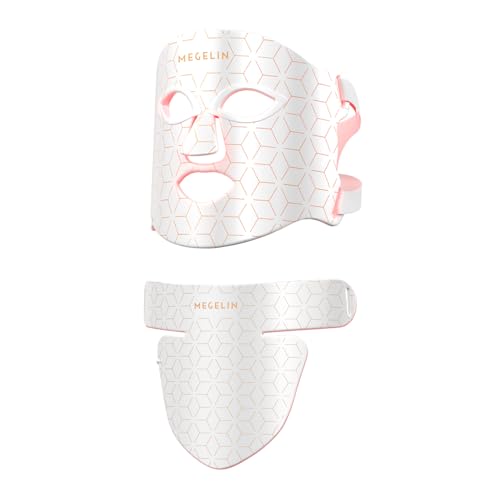
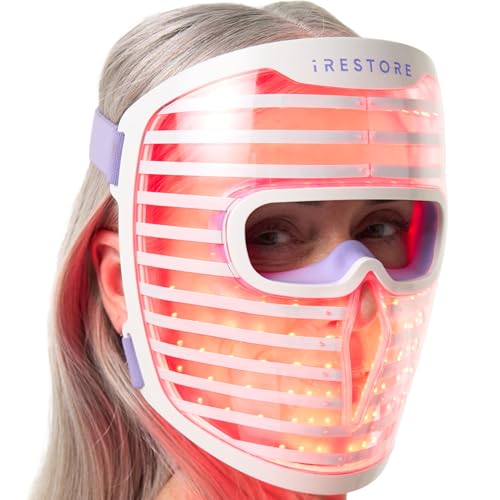
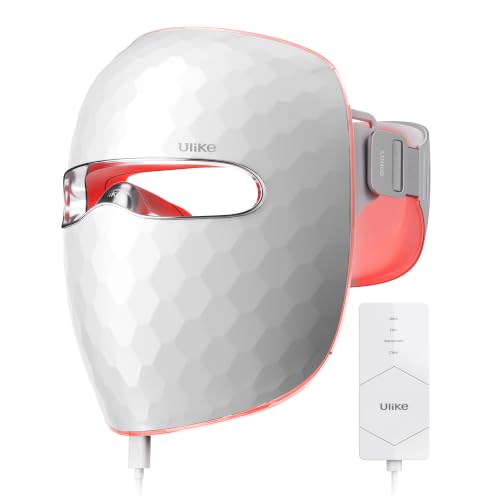
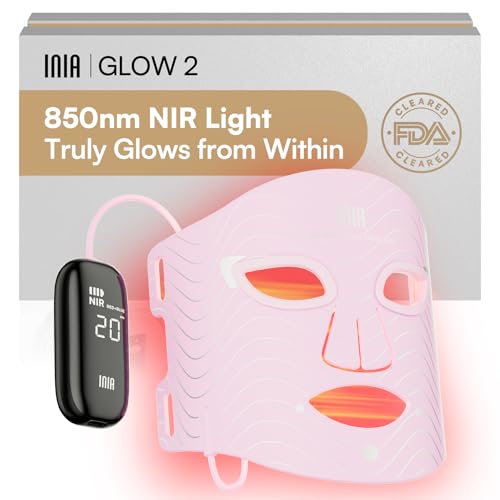
In this guide we explain the typical frequency and session lengths people use, how to adjust for your device and skin, what to expect over time, and the safety points to follow. We also list seven popular devices described from their listings, so check each manufacturer’s guidance before use.
Red Light Therapy Devices People Commonly Ask About

Contents
- What Red Light Therapy Does
- Why There Is No One-Size-Fits-All Schedule
- Typical Frequency and Session Length
- How to Start Safely
- How Long Until You See Results
- Does More Light Mean Better Results
- Eye Safety and Other Precautions
- Who May Want to Try It and Who Should Skip
- Combining Red Light With Your Skincare Routine
- Common Mistakes
- Honest Limits
- When to See a Professional
- Common Questions
- The Takeaway
In Brief
- There is no universal schedule; follow your device manual first.
- Many home routines use 3 to 20 minutes per session, about 3 to 5 days a week.
- Results, if any, usually take 8 to 12 weeks of consistent use.
- More frequent or longer sessions do not clearly give better results and may irritate skin.
- Protect your eyes with the provided goggles or by keeping them closed as directed.
- Evidence is modest, and quality varies widely between devices.
- Talk to a doctor if you are pregnant, take photosensitizing medication or have a skin condition.
What Red Light Therapy Does
Red light therapy, also called photobiomodulation, uses low-level red and near-infrared light, usually in the range of about 600 to 850 nanometers. The idea is that cells absorb the light and respond with changes such as increased energy production and reduced inflammation.
In skincare, red light is marketed for fine lines, skin tone, scars and acne-related redness. Some small studies suggest modest improvements in skin texture and the appearance of wrinkles, but results vary and the quality of the research is mixed.
Red light is not the same as ultraviolet light. It does not tan the skin or cause sunburn, but it is not risk-free, and it does not replace sunscreen or medical treatment.
Why There Is No One-Size-Fits-All Schedule
Several factors decide how long and how often you should use a device. Power output matters most, since stronger devices deliver more light in less time. Distance matters too, because light intensity falls quickly as the device moves away from the skin.
| Factor | What it changes | What to do |
|---|---|---|
| Device power | How much light reaches the skin | Follow the stated session time |
| Distance | Intensity of the light | Keep the device at the recommended distance |
| Wavelength | Depth and type of effect | Choose a device with clear specifications |
| Skin sensitivity | Tolerance to repeated sessions | Start with fewer days per week |
Because manufacturers test their own devices, the best advice is to follow the manual and avoid improvising. If a device does not provide clear instructions, that is a warning sign about its quality.
Typical Frequency and Session Length
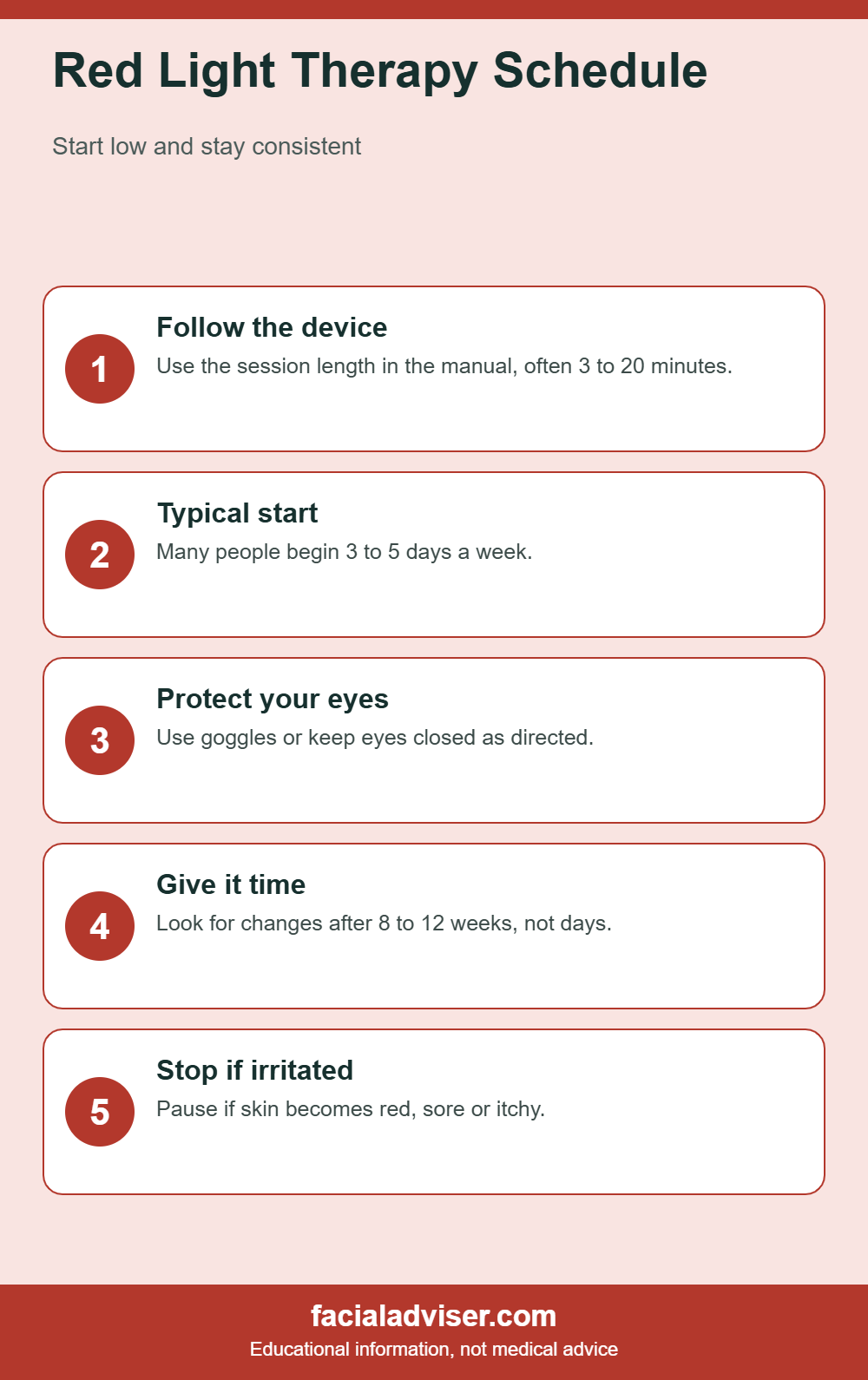
Home devices usually recommend short sessions. A common pattern is 3 to 10 minutes for a mask or 10 to 20 minutes for a panel, used three to five days a week. Some devices suggest daily use, but many people do not need that.
| Device type | Typical session | Typical frequency |
|---|---|---|
| LED face mask | 10 to 20 minutes | 3 to 5 days a week |
| Handheld wand | 3 to 10 minutes per area | 3 to 5 days a week |
| Panel or larger device | 10 to 20 minutes at set distance | 3 to 5 days a week |
| Professional treatment | Set by a clinician | Course of visits |
These ranges are only examples. Always check your own device, and start at the lower end if your skin is sensitive.
Professional red light treatments in a clinic use higher-powered equipment, which is why home devices usually require more frequent use for a smaller effect. If you want stronger results, ask a dermatologist whether other treatments might suit your goals.
How to Start Safely
Begin with fewer sessions than the maximum on the label. Two or three days a week for the first two weeks gives your skin time to adapt, and you can increase gradually if you see no irritation.
Cleanse the skin
Remove makeup, sunscreen and heavy products before each session.
Protect your eyes
Wear the supplied goggles or follow the manual about closing your eyes.
Use the device as directed
Set the timer and keep the correct distance.
Moisturize afterward
Apply a gentle moisturizer if your skin feels dry.
Track your skin
Take photos every two weeks in the same light.
Pick a consistent time, such as after evening cleansing, so you are less likely to skip sessions.
Stop using the device and speak with a doctor if you notice burning, blistering, severe redness or vision changes.
Keep a short log of dates and how your skin looks and feels. This helps you spot irritation early and judge honestly whether the routine is worth continuing after three months.
How Long Until You See Results
If red light therapy helps you, changes are usually gradual. Many studies run for eight to twelve weeks or longer, and brands often suggest judging results after about three months.
Early signs may include skin that feels smoother or a slight improvement in redness. Changes in fine lines are subtle and may be hard to separate from good skincare and sun protection.
If you see no change after twelve weeks of consistent use, it may not be the right tool for you, and your money may be better spent on sunscreen, a retinoid or a visit to a dermatologist.
It helps to set a clear goal before you start, such as calmer-looking redness or slightly smoother texture. Vague goals make it easy to feel disappointed, while specific ones let you compare photos honestly. Also remember that skin changes with seasons, sleep and stress, so judge trends over months rather than days.
Does More Light Mean Better Results
It is tempting to assume that longer or more frequent sessions work faster, but light therapy often shows a biphasic response. That means too little does nothing and too much may also reduce the effect.
There is little evidence that exceeding the manufacturer’s recommended time gives extra benefit, and it can increase the chance of irritation, dryness or discomfort.
If you want to improve results, focus on consistency, correct distance and combining the device with proven basics such as daily sunscreen and a gentle routine.
If you ever feel tempted to add extra sessions, ask yourself whether you would rather spend that time on sleep, hydration or a short walk. All of those support skin health at no cost.
Eye Safety and Other Precautions
Bright light can be uncomfortable or harmful to the eyes, even if it is red. Use the goggles supplied with the device, or keep your eyes closed and avoid looking directly at the LEDs.
People who are pregnant, have photosensitive conditions, take medications that increase light sensitivity, or have a history of skin cancer should talk to a doctor before using light devices.
If you use retinoids, exfoliating acids or other irritating products, watch for dryness and redness. You may need to reduce frequency or skip a product on session nights.
Keep devices clean according to the manual, and do not share masks, because skin contact can transfer oils and bacteria. Store devices away from heat and water, and stop using any device that overheats, flickers or has a damaged cable.
Who May Want to Try It and Who Should Skip
Try This
- People who want to try a gentle, non-invasive home device
- Those who can follow a consistent routine
- People with mild fine lines or uneven texture who already use sunscreen
- Anyone who tolerates light devices and has no medical contraindications
- People who want a relaxing evening routine
Avoid This
- Pregnant people and those with light-sensitive conditions without medical advice
- Anyone on photosensitizing medication
- People with active skin cancer or suspicious lesions
- Those with eye conditions sensitive to bright light
- Anyone expecting dramatic or fast results
If you are unsure, ask your doctor or a dermatologist before starting.
Combining Red Light With Your Skincare Routine
Red light works best as one part of a basic routine, not a replacement for it. Use sunscreen every morning, a gentle cleanser, and a moisturizer that suits your skin type. These basics do more for long-term skin health than any device.
If you use retinoids, vitamin C or exfoliating acids, there is no strong evidence that you must avoid red light on the same day. Still, if your skin becomes dry or irritated, separate them by using light on one evening and your active on another.
Apply serums and moisturizer after your session, not before. Thick creams or oils can block some of the light, and a clean face lets the device work as intended. Avoid sunscreen or makeup during sessions for the same reason.
Finally, give yourself rest days. Skin does not need a device every day, and a few days off each week help you notice whether the routine is making any difference.
Common Mistakes
The most common mistake is expecting quick results and giving up after two weeks. Another is skipping sessions and then using the device for much longer to catch up.
Some users hold a handheld device too far from the skin, which reduces the dose. Others use it over sunscreen or heavy products, which may block light.
Finally, many people buy very cheap devices with unclear specifications. If a product does not list wavelengths, power and instructions, it is hard to know what you are getting.
Another error is using a red light device while skipping sunscreen. UV exposure is the largest driver of skin aging, so no light device can undo daily sun damage without protection.
Honest Limits
Red light therapy is not a replacement for sunscreen, retinoids or professional treatments. Evidence is modest, and results vary.
We have not tested every product, and the descriptions here come from listings and general knowledge. Your results may differ.
Claims about collagen, anti-aging and acne vary widely between brands. Treat claims that sound dramatic with caution, and check whether a device has regulatory clearance for the use it advertises.
When to See a Professional
See a doctor or dermatologist if you notice new or changing spots, persistent redness, pain, blistering, or if acne, scarring or pigmentation concerns do not improve. A professional can recommend treatments with stronger evidence.
This article is for general information and is not medical advice. Rakib Sarwar is a registered pharmacist with a cosmetology course, not a dermatologist. Talk to a doctor or dermatologist before using light devices if you have a medical condition.
Common Questions
How often should I use red light therapy on my face?
Many home routines use 3 to 5 days a week. Follow your device’s manual.
How long should a red light therapy session last?
Typically 3 to 20 minutes depending on the device.
Can I use red light therapy every day?
Some devices allow it, but many people do well with fewer days. Start lower and watch your skin.
How long does red light therapy take to work?
Often 8 to 12 weeks of consistent use, if it helps at all.
Is more red light therapy better?
Not necessarily. Longer or more frequent sessions have not been shown to work better and may irritate skin.
Do I need eye protection?
Yes. Use goggles or follow the manual about closing your eyes.
Can I use red light therapy with retinol?
Many people do, but watch for dryness. Reduce frequency if skin is irritated.
Should I apply skincare before or after?
Use on clean skin, then apply serums and moisturizer after.
Does red light therapy replace sunscreen?
No. Sunscreen is still essential.
When should I see a doctor?
See a doctor for burning, blistering, vision changes or new skin changes.
The Takeaway
A sensible red light routine is short, consistent and based on your device’s instructions. Start with a few sessions a week, protect your eyes, and judge results after about three months.
If you have a medical condition or skin concerns, talk to a doctor before starting.

Written by
Registered pharmacist and founder of Facial Adviser. Rakib's pharmacy training covers how skincare actives work and interact; a later course in cosmetology turned that into a focus on facial treatments and skincare products. He plans, researches and edits every guide on the site and checks health claims against sources such as the American Academy of Dermatology, the FDA and the NIH. He is not a dermatologist; see the Editorial Policy and Medical Disclaimer.
About · Editorial policy · How we choose products · Medical disclaimer · Contact
Keep reading: LED light therapy
- 10 Best Acne Light Therapy Devices (2026): Masks vs Spot Tools
- What Is an LED Anti-Aging Facial? Red Light, Results and Safety
- 10 Best LED Light Therapy Masks (2026): Clearer Skin, Softer Lines
- 7 Best Anti-Breakout Skin Therapy Wands for Hormonal Acne (2026): Blue Light Guide
- 7 Best Mask-Friendly LED Therapy Caps for Combined Treatments (2026): Buyer's Guide
- 10 Best Facial Tools (2026): LED, Cleansing, Gua Sha and More
- How to Incorporate Microcurrent Into Your Routine: Gel, Timing and Safety
Prime for Young Adults: a longer free trial and a lower price after it