Does Makeup Help Protect You From the Sun?
Does makeup help protect you from the sun the way the SPF number on the label suggests, or is that number measuring something you never actually get?
Part of our guide to makeup how-to. Start with: How to Properly Put On Face Makeup: The Right Order, Step by Step
The SPF chemistry in tinted makeup is real, but SPF ratings are tested at a much thicker application than anyone applies with foundation or BB cream, so real-world protection often lands at a fraction of the labeled number. Layering multiple SPF products doesn’t add their numbers together either — protection caps at the higher single value, not the sum.
Reapplication is the other gap: dermatologists recommend reapplying sunscreen roughly every two hours outdoors, and almost no one reapplies foundation midday the way they would a standalone sunscreen.
This guide walks through the real math behind makeup SPF, the UVA coverage gap the number doesn’t show, and what dermatologists actually recommend instead.
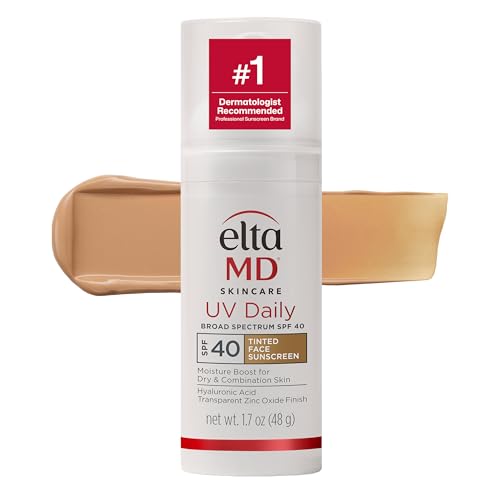
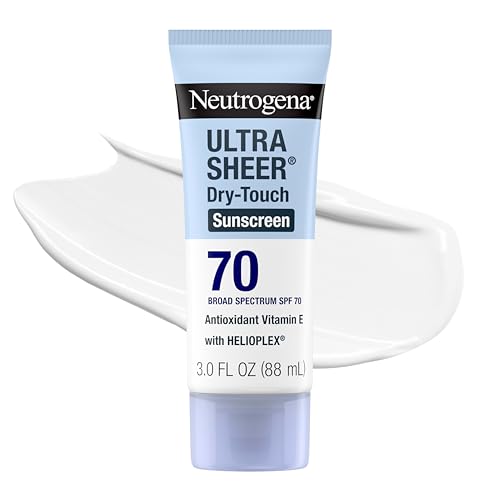
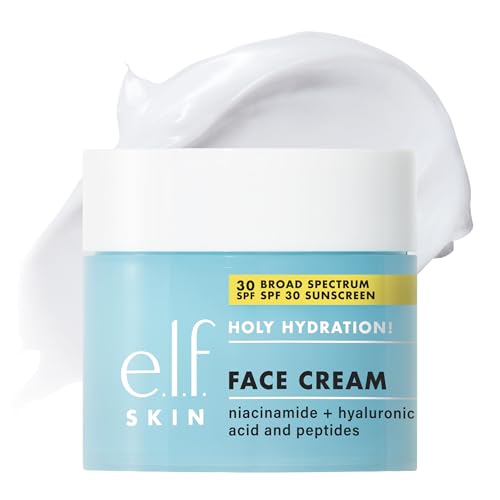
Recommended Broad-Spectrum Sunscreens for Under Makeup


Bottom Line
- Foundation, BB cream, and tinted moisturizer with SPF do filter real UV rays — the chemistry is genuine.
- SPF is lab-tested at a much thicker application (2 mg/cm²) than most people actually put on their face with makeup.
- Real-world application is often only a quarter to a half of the tested amount, which meaningfully lowers the effective SPF you’re actually getting.
- SPF numbers measure UVB protection only — they don’t guarantee balanced UVA coverage, and stacking SPF products doesn’t add their numbers together.
- The AAD recommends reapplying sunscreen every two hours outdoors — a standard almost nobody meets with makeup-based SPF.
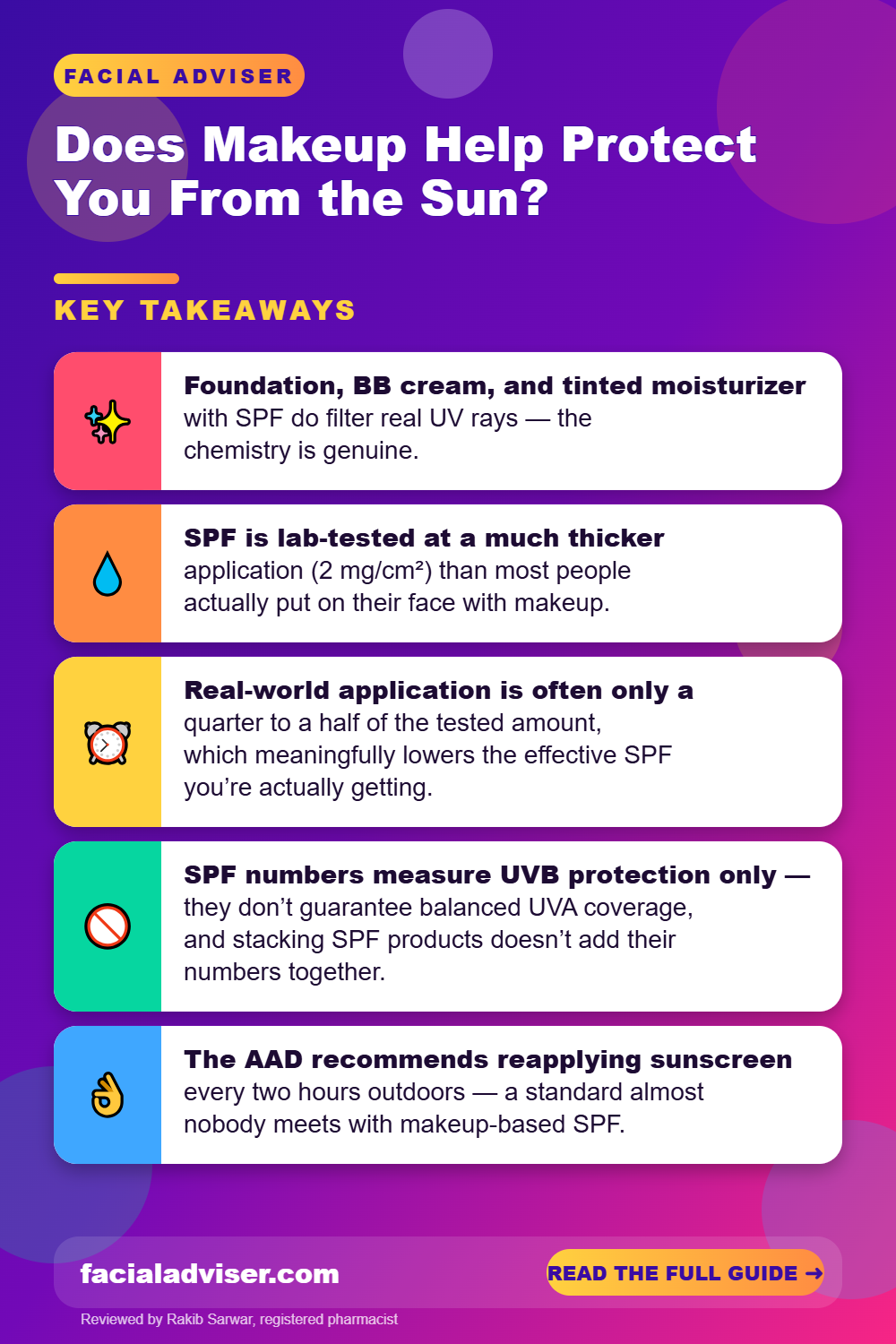
Table of Contents
- The Chemistry Is Real
- The Application-Amount Problem
- How Much Protection You’re Actually Getting
- The UVA Gap SPF Numbers Don’t Show
- Why Stacking SPF Products Doesn’t Add Up
- The Reapplication Problem
- Makeup SPF vs. Dedicated Sunscreen
- What the AAD Actually Recommends
- How Sun Protection Is Labeled, Region by Region
- Do This, Not That
- How to Actually Get Protected
- What This Doesn’t Cover
- Frequently Asked Questions
The Chemistry Is Real
Foundations, BB creams, and tinted moisturizers labeled with an SPF number contain the same categories of UV filters — chemical filters like avobenzone and octinoxate, or physical/mineral filters like zinc oxide and titanium dioxide — found in dedicated sunscreens. When properly applied at the tested thickness, these products genuinely filter UV radiation. The problem isn’t that the chemistry is fake — it’s that almost nobody applies makeup the way SPF is tested.
Shopping these picks?
Amazon Prime members get fast, free shipping on eligible items, plus Prime Video, Amazon Music and member deals. New members can start with a free trial.
Start a free Prime trialAged 18 to 24? Prime for Young Adults comes with a longer free trial and a lower price after it.
Affiliate link: we may earn a commission at no extra cost to you.
The Application-Amount Problem
Sunscreen SPF ratings are determined in a lab using a standardized application density of 2 milligrams per square centimeter of skin — a specific, fairly thick layer. A 2014 review in Photodermatology, Photoimmunology & Photomedicine by Petersen and Wulf synthesized observational research on how thickly people actually apply sunscreen in real life, and the consistent finding across that literature is that real-world application falls well short of the tested amount.
Cosmetic chemist Michelle Wong, who holds a PhD and writes as Lab Muffin Beauty Science, summarizes the typical real-world range at roughly 0.5 to 1.0 mg/cm² — a quarter to a half of what SPF testing assumes. A dermatologist-reviewed piece from the Prevent Cancer Foundation, quoting Dr. Patricia Lucey, states people commonly apply “one-half to one-quarter” of the tested amount when the SPF is coming from makeup specifically, rather than a dedicated sunscreen applied with sun protection as the explicit goal.
How Much Protection You’re Actually Getting
The relationship between how much you apply and the SPF you actually get isn’t a simple linear drop, but it isn’t forgiving either. Wong’s analysis of the underlying sunscreen physics clarifies that halving the applied amount roughly cuts the effective SPF to somewhere between a third and a half of the labeled number, not proportionally further down toward zero. Even with that more moderate relationship, a labeled SPF 30 foundation applied at a typical thin makeup layer realistically delivers something in the single digits to low double digits of actual protection — a real gap between what’s printed on the packaging and what’s reaching your skin.
The UVA Gap SPF Numbers Don’t Show
SPF as a number measures UVB protection specifically — the rays most directly responsible for sunburn, and the ones lab SPF testing is built around. UVA rays penetrate more deeply into skin and are more strongly linked to photoaging and to skin cancer risk, but they aren’t captured by the SPF number itself. “Broad-spectrum” labeling is meant to address this gap, but not every SPF-containing makeup product carries strong or balanced UVA filtering, and a consumer generally can’t tell how well-balanced the UVA protection is just from the SPF number — unlike some international systems (the PA rating used across parts of Asia, or the UVA-in-a-circle seal used in the EU) that disclose UVA protection more explicitly.
Makeup SPF vs. Dedicated Sunscreen
| Factor | Makeup with SPF | Dedicated sunscreen |
|---|---|---|
| Typical application thickness | Thin, cosmetic-layer amount | Closer to the tested 2 mg/cm² when applied properly |
| Effective real-world SPF | Often single digits to low double digits | Closer to the labeled number with correct application |
| UVA coverage clarity | Often unclear or unbalanced | Broad-spectrum products are formulated and tested for this specifically |
| Realistic reapplication | Almost never done midday | More commonly reapplied, though still often skipped |
Why Stacking SPF Products Doesn’t Add Up
A common assumption is that layering an SPF 15 moisturizer under an SPF 20 foundation gives you something like SPF 35 of combined protection. It doesn’t work that way. Protection from stacked SPF products is generally capped at the higher of the two individual numbers, not their sum — the Prevent Cancer Foundation’s consumer guidance is explicit on this point. Two thin, under-applied layers of SPF product don’t combine into one thick, properly protective layer; they’re still two thin layers.
The Reapplication Problem
The American Academy of Dermatology’s public guidance states that sunscreen needs to be reapplied approximately every two hours when you’re outdoors — and makes no exception for sunscreen delivered through makeup. In practice, almost nobody touches up a full face of foundation every two hours the way they might reapply a standalone sunscreen stick or spray. That means even a reasonably well-applied morning application of SPF foundation has typically lost meaningful protection by early afternoon on a day with real sun exposure, simply because the reapplication step that sunscreen depends on almost never happens with makeup.
What the AAD Actually Recommends
The American Academy of Dermatology treats SPF from makeup as a supplement to sun protection, not a substitute for it. Their public sunscreen guidance is built around a dedicated, adequately applied broad-spectrum sunscreen as the primary line of defense, with reapplication built into the recommendation regardless of what else is on your skin. Nothing in the AAD’s guidance suggests that makeup-based SPF changes that baseline recommendation.
How Sun Protection Is Labeled, Region by Region
Part of the UVA confusion above comes from how differently regions disclose it. A US SPF label tells you almost nothing about UVA strength beyond a pass/fail “Broad Spectrum” claim, while other regulatory systems require a graded number.
| Region | UVB indicator | UVA indicator | What’s actually disclosed |
|---|---|---|---|
| United States | SPF number | “Broad Spectrum” claim (pass/fail only) | No UVA magnitude shown — you either qualify for the claim or you don’t |
| European Union | SPF number | UVA circle logo | Confirms UVA protection is at least one-third of the labeled SPF, a ratio requirement rather than an absolute value |
| Japan and much of Asia | SPF number | PA+ to PA++++ rating | A graded UVA protection level shown directly alongside SPF |
Because most makeup sold in the US only carries the binary “Broad Spectrum” claim, you can’t tell from the label alone whether a foundation’s UVA filtering is barely adequate or genuinely strong — one more reason to treat it as a bonus layer rather than your primary defense.
Do This, Not That
Do
- Apply a dedicated broad-spectrum SPF 30+ sunscreen underneath your makeup as your real protection.
- Treat any SPF number in your foundation or BB cream as a small bonus on top of that base layer.
- Carry a setting spray or powder SPF for realistic midday touch-ups over makeup.
Don’t
- Don’t rely on SPF foundation alone as your only sun protection for a day with real outdoor exposure.
- Don’t assume layering two SPF products adds their numbers together.
- Don’t assume a high SPF number on a makeup product means balanced UVA protection.
How to Actually Get Protected
Start with a dedicated sunscreen
Apply a broad-spectrum SPF 30 or higher sunscreen as your base layer before any makeup, at a proper thickness rather than a thin cosmetic layer.
Let it fully absorb
Give sunscreen several minutes to set before applying makeup on top, which helps it perform as intended and reduces pilling.
Apply makeup normally
Any SPF in your foundation or BB cream adds a small amount of extra protection on top of your real base layer — don’t count on it to carry the job alone.
Carry a realistic touch-up option
A powder or setting-spray sunscreen is far more realistic to reapply over makeup midday than trying to redo your entire foundation.
Reapply on a real schedule outdoors
Set a reminder for roughly every two hours during actual sun exposure, per AAD guidance, rather than assuming your morning routine covers the whole day.
What This Doesn’t Cover
The application-amount research (Petersen & Wulf, and the broader sunscreen-physics literature Michelle Wong draws on) is about typical real-world sunscreen application generally, extrapolated to makeup specifically by dermatologists and cosmetic chemists rather than a study that measured makeup-SPF application thickness in isolation. The core conclusion — that thin application meaningfully reduces effective SPF — is well supported; the precise numbers for makeup specifically are a reasonable, expert-backed estimate rather than a single definitive study result.
A Note From a Dermatology Perspective
If you have a personal or family history of skin cancer, or spend significant time outdoors, talk to a board-certified dermatologist about a sun-protection plan tailored to your risk rather than relying on general guidance like this article alone.
Frequently Asked Questions
Is SPF in makeup enough sun protection on its own?
Generally no, for real-world use. The thin application typical of makeup, uncertain UVA coverage, and lack of reapplication all reduce the actual protection well below the labeled SPF number.
Why doesn’t an SPF 30 foundation give me SPF 30 protection?
SPF numbers are tested using a much thicker application than most people use when applying foundation. Real-world application is often only a quarter to a half of the tested amount, which lowers the effective protection you actually get.
Can I skip sunscreen if my foundation has SPF?
Dermatologists generally advise against it. The American Academy of Dermatology treats makeup SPF as a supplement to a dedicated, properly applied sunscreen, not a replacement for one.
Does layering two SPF products add up to a higher SPF?
No. Stacking an SPF moisturizer under an SPF foundation doesn’t add the two numbers together — protection is generally capped at the higher of the two individual SPF values.
Does makeup SPF protect against UVA rays too?
Not necessarily to the same degree as UVB. The SPF number measures UVB protection specifically, and not every SPF-containing makeup product has strong, balanced UVA filtering.
How often should I reapply sunscreen if I’m wearing makeup?
The AAD recommends reapplying roughly every two hours when outdoors, with no exception for makeup-based SPF. A powder or spray SPF product is a more realistic way to do this over a full face of makeup.
Why do dermatologists say makeup SPF isn’t reliable alone?
Because real-world application is much thinner than the amount SPF is tested at, UVA coverage isn’t guaranteed by the SPF number, and almost nobody reapplies makeup-based SPF on the schedule sunscreen actually requires.
Is a tinted moisturizer with SPF better than plain sunscreen under makeup?
Not automatically. A dedicated sunscreen applied at a proper thickness before makeup is the more reliable approach; a tinted moisturizer’s SPF is subject to the same thin-application and reapplication problems as any other makeup SPF product.
How much sunscreen should I actually be applying to my face?
The AAD’s guidance suggests about one teaspoon of sunscreen for the face alone — a noticeably thicker layer than most people use, whether from a dedicated sunscreen or a makeup product.
Is it worth buying makeup with SPF at all?
It can still provide a small, genuine bonus layer of protection on top of a proper sunscreen routine. The issue isn’t that it’s fake protection — it’s that it shouldn’t be your only or primary sun protection strategy.

Written by
Registered pharmacist and founder of Facial Adviser. Rakib's pharmacy training covers how skincare actives work and interact; a later course in cosmetology turned that into a focus on facial treatments and skincare products. He plans, researches and edits every guide on the site and checks health claims against sources such as the American Academy of Dermatology, the FDA and the NIH. He is not a dermatologist; see the Editorial Policy and Medical Disclaimer.
About · Editorial policy · How we choose products · Medical disclaimer · Contact
Keep reading: Makeup basics and skin
- How to Properly Put On Face Makeup: The Right Order, Step by Step
- How Do You Know If Makeup Is Water Based or Oil Based?
- 10 Best Makeup for Acne-Prone Skin (2026): Coverage That Won't Clog
- Is It Safe to Buy Makeup From AliExpress?
- When Can You Wear Makeup After Pink Eye? A Safe Timeline
- When Can You Wear Makeup After Cataract Surgery?
- How to Get Started as a Freelance Makeup Artist: Training, Kit and Clients
- Best Way to Use Makeup Remover: Micellar Water, Balms, Oils and Eye Removers