Best Retinol Serums in the UK: 7 Picks for Beginners and Beyond
Retinol is one of the most studied skincare ingredients, and it is also one of the easiest to get wrong. Start too strong or too fast and you can end up red, flaky and tempted to give up. Chosen well and introduced slowly, a retinol serum can become the most useful step in an evening routine.
Part of our guide to skincare products. Start with: 10 Best Facial Serums for Aging Skin (2026): Picks by Concern
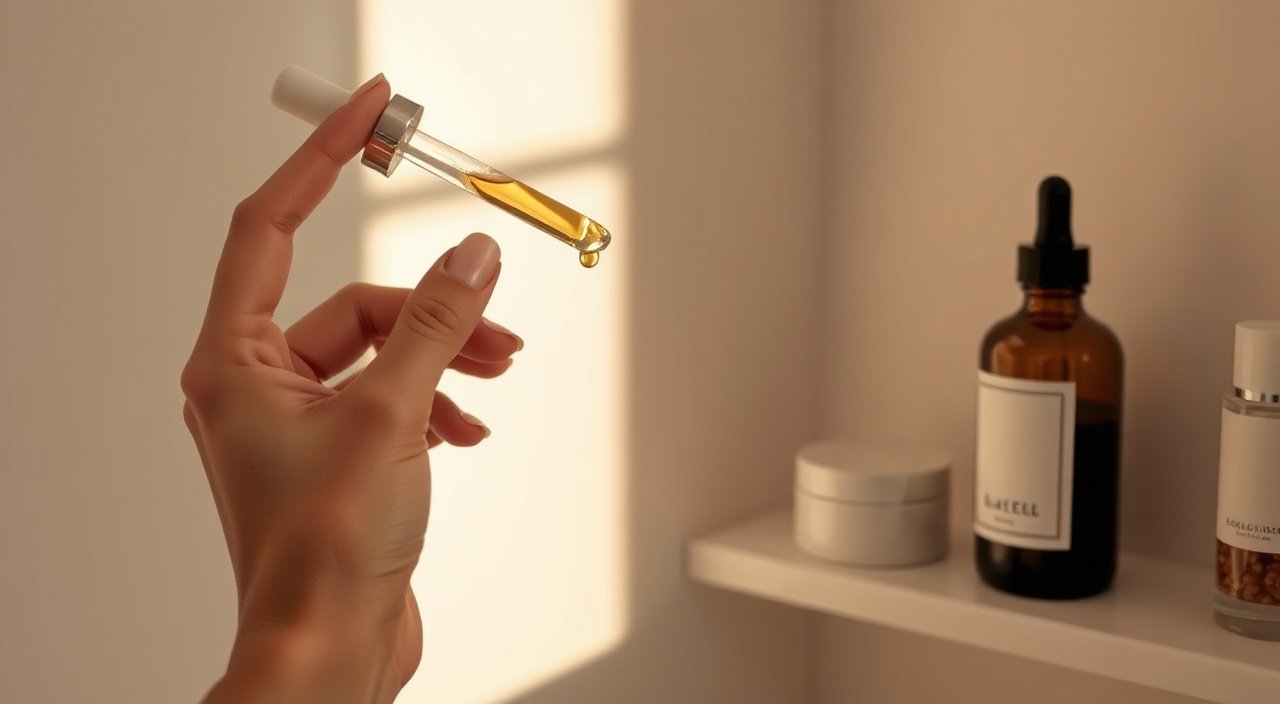
The best retinol serums in the UK are gentle, well-formulated products that you can use consistently without irritation. CeraVe Resurfacing Retinol Serum is a good first retinol because it combines encapsulated retinol with ceramides and niacinamide. L’Oreal Paris Revitalift Retinol Night Serum and Olay Retinol 24 MAX are easy-to-find high street options, PURITO suits sensitive skin, and Minimalist 0.3% Retinol is a clearly labelled beginner strength. Start two nights a week with a pea-sized amount, follow with moisturiser, and wear SPF 30 or higher every morning. Retinol is generally not recommended during pregnancy unless a doctor advises otherwise.
The 7 Best Retinol Serums on Amazon UK


Links go to Amazon.co.uk. As an Amazon Associate I earn from qualifying purchases.
Black Friday is coming: shop the deals with Prime
In short: pick a gentle retinol, start slowly at night, moisturise, and never skip sunscreen.
The British Association of Dermatologists notes that retinoids can irritate the skin and increase sensitivity to sunlight, and the NHS advises that retinoid treatments should not be used in pregnancy. Cosmetic retinol is milder than prescription retinoids, but the same caution applies.
I am Rakib Sarwar, a registered pharmacist with a cosmetology course. I chose these serums for trusted brands, sensible formulas and good customer ratings on Amazon UK. This is general information, not medical advice. As an Amazon Associate I earn from qualifying purchases.
Contents
- How We Chose These Serums
- Quick Comparison
- CeraVe Resurfacing Retinol Serum: Best First Retinol
- L’Oreal Paris Revitalift Retinol Night Serum: Best High Street Night Serum
- PURITO Retinol + Retinal Serum: Best for Sensitive Skin
- Minimalist 0.3% Retinol Serum: Best Clearly Labelled Beginner Strength
- Olay Retinol 24 MAX Night Serum: Best for Regular Users
- RoC Derm Correxion Retinol Serum Stick: Best for Targeted Use
- Nature Spell 1% Bakuchiol Serum: Best Retinol-Free Alternative
- Retinol Strengths and Types Explained
- How to Start Using Retinol
- Dos and Don’ts
- Frequently Asked Questions
- The Takeaway
Quick Answer
- Retinol is a form of vitamin A used at night to improve the look of fine lines, texture and uneven tone.
- Beginners should choose a low strength or an encapsulated, buffered formula.
- Start two nights a week and build up slowly over several weeks.
- A pea-sized amount is enough for the whole face.
- Moisturise afterwards and wear SPF 30 or higher every morning.
- Retinol is generally not recommended during pregnancy unless a doctor advises otherwise.
How We Chose These Serums
We looked for retinol serums sold on Amazon UK from brands that are established in British shops or have a strong record of reviews. Each had a customer rating of at least 4.2 out of 5 at the time of writing, most from over a thousand buyers. Retinol products tend to score a little lower than moisturisers because some buyers experience irritation.
We favoured formulas that state their retinol type or strength, or that pair retinol with soothing ingredients such as ceramides, niacinamide or hyaluronic acid. We included options for beginners, sensitive skin and more experienced users, plus one retinol-free alternative.
Formulas, strengths and packaging change. Always check the current listing and the pack for the full ingredient list and directions before you buy.
We do not quote prices because they change often. Check the current price on the listing.
Quick Comparison
This table shows who each serum suits. More detail on each one follows below.
| Serum | Best for | Notes |
|---|---|---|
| CeraVe Resurfacing Retinol Serum | First-time users | With ceramides and niacinamide |
| L’Oreal Paris Revitalift Retinol Night Serum | A high street night serum | Pure retinol, night use |
| PURITO Retinol + Retinal Serum | Sensitive skin | Described as for sensitive skin |
| Minimalist 0.3% Retinol | A clearly labelled low strength | 0.3% retinol |
| Olay Retinol 24 MAX Night Serum | Regular users | Fragrance-free per brand |
| RoC Derm Correxion Retinol Serum Stick | Targeted use, travel | Solid stick format |
| Nature Spell 1% Bakuchiol Serum | A retinol-free alternative | Plant-derived bakuchiol |
CeraVe Resurfacing Retinol Serum: Best First Retinol

CeraVe’s Resurfacing Retinol Serum is a popular starting point in the UK. The listing describes it as a retinol serum for the face with niacinamide, and the brand’s formulas include ceramides.
The retinol is encapsulated, which means it is released gradually. Together with the barrier-supporting ingredients, that makes it gentler than many traditional retinol serums, and the brand positions it for blemish-prone skin and post-blemish marks.
It is a light, fragrance-free serum that layers easily under moisturiser. Introduce it slowly even though it is mild.
It works well as a long-term serum too, so there is no need to move to something stronger if your skin is happy with it.
L’Oreal Paris Revitalift Retinol Night Serum: Best High Street Night Serum

L’Oreal Paris sells this as a night serum for the face in its Revitalift range, and the listing describes it as containing pure retinol.
It is aimed at fine lines and wrinkles and comes in a dropper bottle that makes it easy to measure a small amount. The texture is light and absorbs quickly before moisturiser.
Because it is a pure retinol serum, beginners should start with one or two nights a week and increase gradually. It is fragranced on some versions, so check the listing if your skin reacts to perfume.
PURITO Retinol + Retinal Serum: Best for Sensitive Skin

PURITO is a Korean skincare brand with a reputation for gentle formulas. The listing describes this as a retinol and retinal serum for sensitive skin.
Retinal, also called retinaldehyde, is another form of vitamin A that sits one step closer to the active form than retinol. Here the two are combined in a formula designed to be well tolerated.
Sensitive skin can still react to any vitamin A product. Patch test first, begin with one night a week, and buy from a listing with a solid review history.
Minimalist 0.3% Retinol Serum: Best Clearly Labelled Beginner Strength

Minimalist is known for stating its concentrations on the bottle. This serum is labelled as 0.3% retinol, which is a sensible strength for people who are new to the ingredient.
Knowing the percentage makes it easier to step up later if you want to, instead of guessing how strong a product is. The serum is intended for night use.
Its rating is slightly lower than some others here, which is common for retinol. Read recent reviews and introduce it gradually.
Olay Retinol 24 MAX Night Serum: Best for Regular Users

Olay’s Retinol 24 range is widely sold in UK chemists and supermarkets. The listing describes this as the MAX night face serum, and the brand describes the range as fragrance-free.
It combines Olay’s retinoid complex with niacinamide, also known as vitamin B3, in a silky serum that many people find comfortable under a night cream.
As the stronger version in the range, it suits people who have already used a gentler retinol without problems. Beginners may prefer to start with the CeraVe or Minimalist options.
RoC Derm Correxion Retinol Serum Stick: Best for Targeted Use

RoC has been making retinol products for decades. This one is unusual because it is a solid serum stick, described on the listing as a firming retinol serum stick.
A stick lets you glide product onto specific areas such as the forehead, around the mouth or the neck without using your fingers. It is also tidy for travel.
Keep it away from the eyelids and the corners of the nose and mouth, where skin is thinner and more easily irritated, and follow with moisturiser.
Nature Spell 1% Bakuchiol Serum: Best Retinol-Free Alternative

Bakuchiol is a plant-derived ingredient that is often described as a gentler alternative to retinol. This Nature Spell serum is listed as a 1% bakuchiol face serum.
Early studies suggest bakuchiol may improve the look of fine lines and uneven tone with less irritation than retinol, although the evidence is much more limited. It can be an option for people whose skin does not tolerate retinol.
Bakuchiol is not vitamin A, but research on its use in pregnancy is sparse. If you are pregnant or breastfeeding, check with your midwife, GP or pharmacist before using any new active product.
Retinol Strengths and Types Explained
Vitamin A products come in several forms. They all have to be converted by the skin into retinoic acid, and the fewer steps needed, the stronger and more irritating they tend to be.
| Type | Where you find it | Strength |
|---|---|---|
| Retinyl esters (such as retinyl palmitate) | Cosmetics | Mildest |
| Retinol | Cosmetics | Moderate |
| Retinal (retinaldehyde) | Cosmetics | Stronger than retinol |
| Adapalene, tretinoin | Pharmacy or prescription medicines | Strongest, medical use |
Percentages are only part of the picture. The rest of the formula, the delivery system and how often you apply it all affect how a product feels, which is why a well-buffered 0.3% serum can be more comfortable than a basic 0.2% one.
For cosmetic retinol, low strengths are roughly 0.1% to 0.3%, and higher strengths go up to about 1%. Cosmetic regulations in the UK and EU are introducing limits on retinol concentration in face products, so very high strengths are becoming less common.
Encapsulated retinol releases slowly and is often gentler at the same percentage. If you have used prescription retinoids, see our guide to the tretinoin purge for what to expect in the early weeks.
How to Start Using Retinol
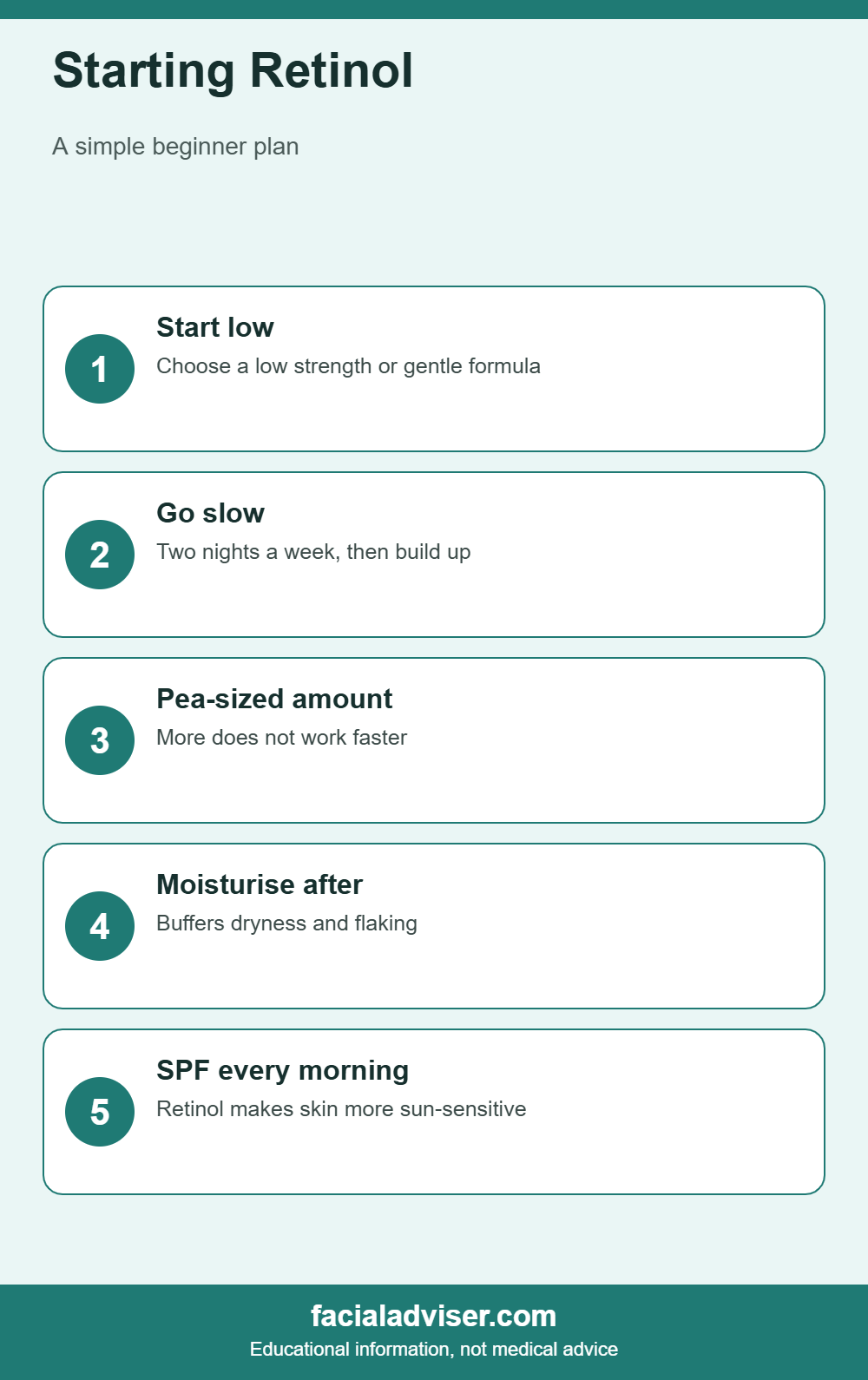
Patience is the secret. Results take around twelve weeks, and rushing only causes irritation.
Patch test
Apply a little behind the ear or on the jawline for a few nights.
Cleanse and dry your face
Apply retinol in the evening to clean, fully dry skin.
Use a pea-sized amount
Dot it on and spread thinly, avoiding eyelids, nostrils and lip corners.
Follow with moisturiser
This reduces dryness. Sensitive skin can moisturise first as well.
Start two nights a week
After two to three weeks, move to alternate nights if your skin is comfortable.
Wear SPF every morning
Use SPF 30 or higher, as retinol makes skin more sensitive to the sun.
A popular method for sensitive skin is the sandwich technique: a thin layer of moisturiser, then retinol, then moisturiser again. It slightly reduces how much retinol reaches the skin, which makes the early weeks easier, and you can drop the first layer once your skin has adjusted.
Do not use retinol on the same night as exfoliating acids or benzoyl peroxide when you are starting out. Alternate them instead.
You will need a good moisturiser and sunscreen alongside it. See our picks of the best moisturisers for dry skin and the best face sunscreens in the UK.
Dos and Don’ts
Good Habits
- Start with a low strength or gentle formula
- Use it at night only
- Moisturise generously
- Wear SPF 30 or higher daily
- Give it at least twelve weeks
Common Mistakes
- Use it during pregnancy unless a doctor advises otherwise
- Apply more to speed things up
- Combine with strong acids on the same night at first
- Use on broken, sunburned or eczema-affected skin
- Wax areas where you apply retinol
Store retinol away from heat and light and close the lid firmly, because vitamin A breaks down when exposed to air and sunlight. Most serums are best used within a few months of opening. If the colour or smell changes noticeably, replace it.
Mild dryness, flaking and tingling are common in the first few weeks and usually settle. If they do not, cut back to fewer nights or stop.
Stop using retinol and speak to a pharmacist or GP if you develop marked redness, swelling, burning or a rash. Retinol is generally not recommended during pregnancy or when trying to conceive unless a doctor advises otherwise. If you use prescription skin treatments, ask your prescriber before adding retinol.
This article is general educational information and is not a substitute for advice from your own GP, pharmacist or dermatologist. Product details were checked on Amazon UK at the time of writing and can change. Always read the label and follow the directions for use.
Frequently Asked Questions
What is the best retinol serum in the UK for beginners?
A gentle, buffered formula such as CeraVe Resurfacing Retinol Serum or a clearly labelled low strength such as Minimalist 0.3% is a sensible start.
What strength of retinol should I start with?
Around 0.1% to 0.3%, or an encapsulated formula, used two nights a week at first.
How long does retinol take to work?
Most people need about twelve weeks of regular use to see a difference in texture and fine lines.
Can I use retinol every night?
Eventually, if your skin tolerates it. Build up slowly from two nights a week over several weeks.
Can I use retinol when pregnant?
Retinol is generally not recommended during pregnancy unless a doctor advises otherwise. Speak to your midwife, GP or pharmacist.
Do I need sunscreen if I only use retinol at night?
Yes. Retinol makes skin more sensitive to sunlight, so daily SPF 30 or higher is important.
Can I use retinol with vitamin C?
Yes, but separate them. Many people use vitamin C in the morning and retinol at night.
Is bakuchiol as good as retinol?
Early research is promising and it tends to be gentler, but the evidence is far more limited than for retinol.
Why is my skin peeling on retinol?
Dryness and flaking are common early side effects. Use less, apply it less often and moisturise more.
At what age should I start retinol?
There is no set age. Many people start in their mid to late twenties or thirties, and it is not needed for teenage skin unless advised by a clinician.
The Takeaway
The best retinol serum in the UK is one gentle enough that you will keep using it. CeraVe is a reliable first choice, L’Oreal Paris and Olay are easy to find on the high street, PURITO and Minimalist suit cautious beginners, and bakuchiol is there if retinol does not agree with you.
Start slowly, moisturise well and wear sunscreen every morning. If you are pregnant, planning a pregnancy or using prescription skin treatments, check with a doctor or pharmacist first.

Written by
Registered pharmacist and founder of Facial Adviser. Rakib's pharmacy training covers how skincare actives work and interact; a later course in cosmetology turned that into a focus on facial treatments and skincare products. He plans, researches and edits every guide on the site and checks health claims against sources such as the American Academy of Dermatology, the FDA and the NIH. He is not a dermatologist; see the Editorial Policy and Medical Disclaimer.
About · Editorial policy · How we choose products · Medical disclaimer · Contact
Keep reading: Serums and actives
- 10 Best Facial Serums for Aging Skin (2026): Picks by Concern
- Best Vitamin C Serums in the UK: 7 Picks for Brighter Skin
- Best Hyaluronic Acid Serums in the UK: 7 Hydrating Picks
- Niacinamide or Hyaluronic Acid: Pick Both?
- Antioxidant Facial Treatment: What Holds Up
- Vitamin C Facial: What the Real Data Shows
- 10 Best Face Masks for Every Skin Type (2026): Clay, Gel and Sheet
- What Does a Facial Toner Do? The Real Answer
Turn skincare time into me-time with a free audiobook