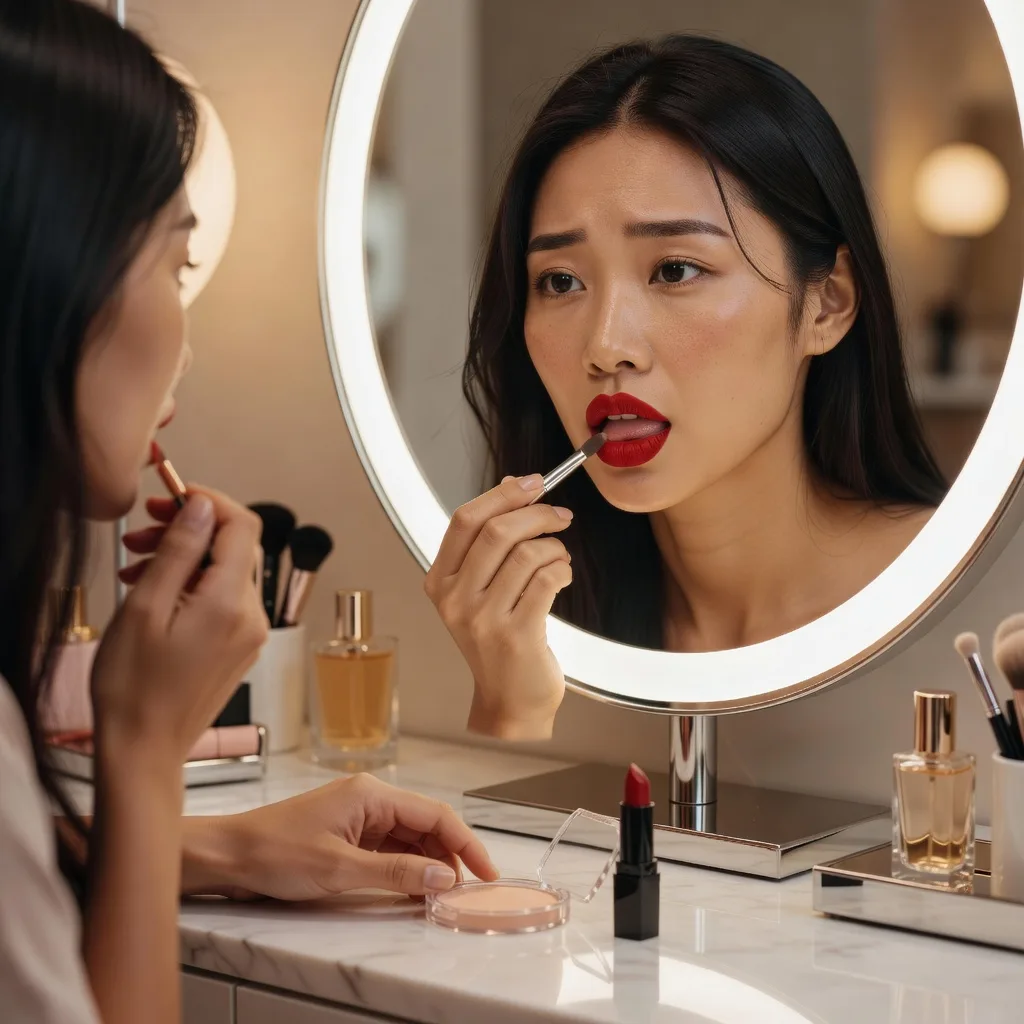
Why Does Red Lipstick Look Pink on Me? Undertones, Lip Colour and Lighting
You buy a lipstick that looks like a perfect fire-engine red in the tube, then it goes on your mouth and suddenly reads as bright pink or raspberry. It is a common complaint, and it is rarely because the lipstick is faulty. Red is one of the most sensitive shades to undertone, formula and lighting.
Part of our guide to makeup how-to. Start with: How to Choose Lipstick Shade: Undertone, Skin Tone and Testing Tips
Red lipstick often looks pink on you because it has a cool, blue base, because the formula is sheer and mixes with your naturally pink lips, or because the light you are in shifts it. Blue-reds lean towards raspberry and berry, especially on fair or cool-toned skin, while orange-reds and brick reds stay closer to a warm, true red. Sheer, glossy and creamy formulas let your own lip colour show through, which adds pink. Cool daylight and many cameras also push red towards pink. To get a truer red, choose an opaque formula with a neutral or slightly warm base, line and fill with a red liner, and check it in several kinds of light.
In short: blue undertones, sheer formulas, pink natural lips and cool lighting are the usual reasons red turns pink.
While you work on the perfect red, remember that the American Academy of Dermatology advises protecting your lips with a lip balm of SPF 30 or higher, because most lipsticks offer little or no sun protection.
This guide explains the difference between blue-reds and orange-reds, why a red lipstick can look bad on you, how lip colour and lighting change it, and how to make a red read as red.
Shopping these picks?
Amazon Prime members get fast, free shipping on eligible items, plus Prime Video, Amazon Music and member deals. New members can start with a free trial.
Start a free Prime trialAged 18 to 24? Prime for Young Adults comes with a longer free trial and a lower price after it.
Affiliate link: we may earn a commission at no extra cost to you.
Recommended Red Lipsticks, Liners and Primers


On This Page
- The Main Reasons Red Lipstick Looks Pink
- Blue-Red vs Orange-Red: Understanding Undertones
- Why Red Lipstick Looks Bad on Me
- How Your Natural Lip Colour Affects Red
- Lighting and Cameras Change How Red Looks
- How to Make Red Lipstick Look Truly Red
- Choosing the Right Red for Your Skin
- Dos and Don’ts for Wearing Red
- Lip Irritation and Red Pigments
- Honest Limits
- When to See a Doctor
- Your Questions, Answered
- Final Word
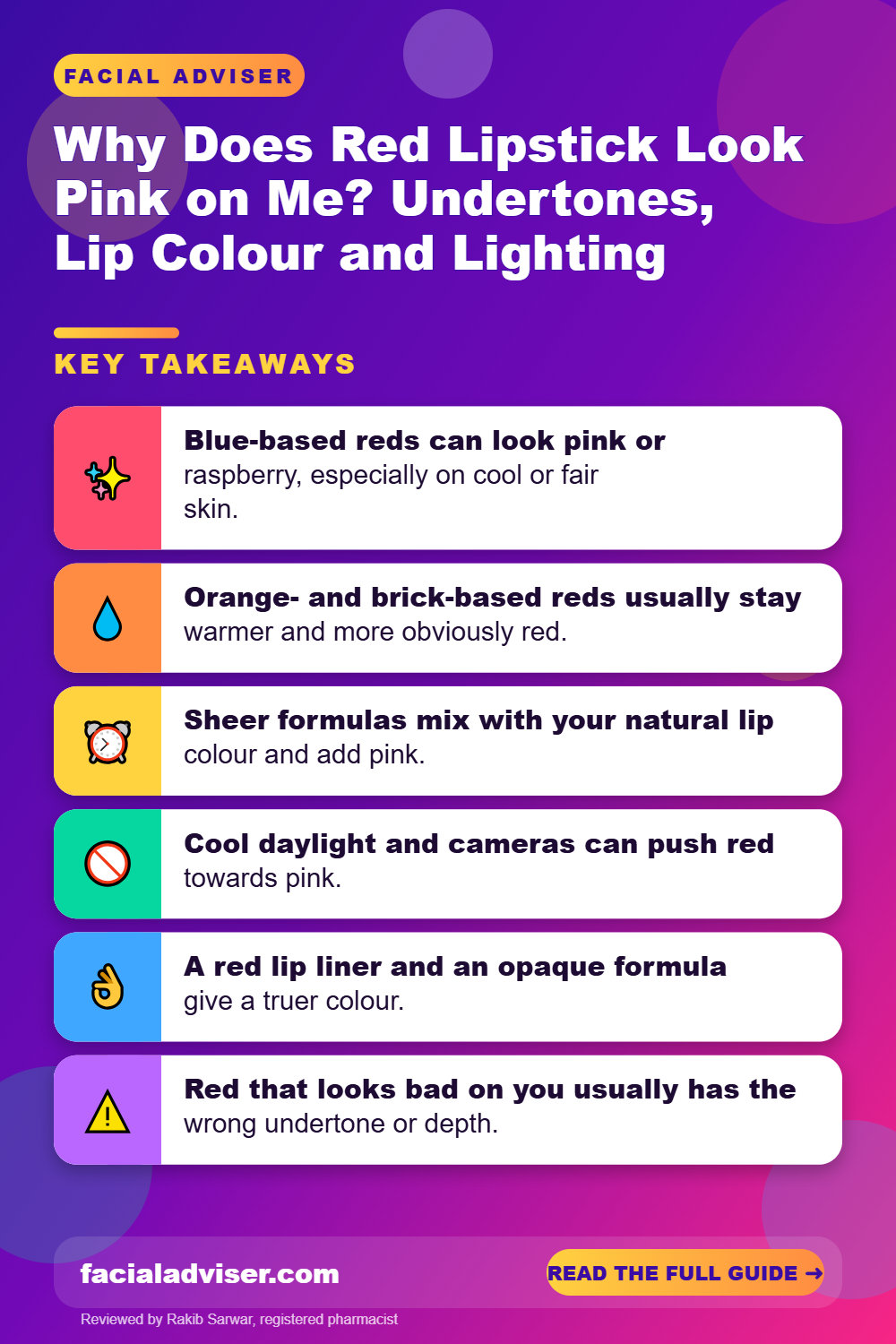
At a Glance
- Blue-based reds can look pink or raspberry, especially on cool or fair skin.
- Orange- and brick-based reds usually stay warmer and more obviously red.
- Sheer formulas mix with your natural lip colour and add pink.
- Cool daylight and cameras can push red towards pink.
- A red lip liner and an opaque formula give a truer colour.
- Red that looks bad on you usually has the wrong undertone or depth.
- Almost everyone can wear red once the undertone is right.
The Main Reasons Red Lipstick Looks Pink
There is rarely one single cause. Most of the time, two or three small factors add up, and fixing just one of them makes a visible difference.
| Cause | What you see | Quick fix |
|---|---|---|
| Blue or cool base | Red reads as raspberry, cherry or pink | Try a neutral or warm true red |
| Sheer or glossy formula | Colour looks lighter and pinker than the tube | Choose an opaque cream or matte |
| Naturally pink lips | Lipstick picks up your lip colour | Use a red liner all over first |
| Thin application | Patchy, pinkish colour | Apply two thin layers and blot between |
| Cool daylight or flash | Red looks brighter and pinker in photos | Check in several kinds of light |
| Contrast with cool skin | Blue-red looks more pink beside rosy skin | Balance redness, or use a warmer red |
Work through the list one step at a time. If a red still looks pink after switching to an opaque formula and a liner, the undertone is almost always the reason.
Blue-Red vs Orange-Red: Understanding Undertones
Every red lipstick leans slightly one way or the other. Blue-reds contain cooler pigments that pull them towards berry and pink, while orange-reds contain warmer pigments that pull them towards coral and tomato. True reds sit in the middle.
| Type of red | How it looks | Often suits | May look pink or off on |
|---|---|---|---|
| Blue-red | Cherry, crimson, raspberry | Cool and neutral undertones, fair to deep skin | Warm skin, where it can look harsh or purple-pink |
| True or neutral red | Classic, balanced red | Most undertones | Very cool or very warm skin in extreme light |
| Orange-red | Tomato, poppy, flame | Warm and olive undertones | Cool skin, where it can look orange or clash with redness |
| Brick or brown-red | Muted, earthy red | Warm, olive and deep skin | Very fair cool skin, where it can look muddy |
| Wine or deep blue-red | Rich, dark red | Deep skin, evening looks | Very fair skin in daylight |
If your blue-red looks pink, it may simply be that a blue-red is doing what it is designed to do on you. Try a true red or one with a hint of orange before deciding red does not suit you. Our guide on matching makeup to your undertone explains how to tell whether you are cool, warm or neutral.
Why Red Lipstick Looks Bad on Me
Pink is not the only complaint. Some people find red makes them look tired, sallow or too made-up. These are the most common reasons, and most are easy to fix.
- The undertone clashes: an orange-red on cool skin can make teeth look yellow, while a blue-red on warm skin can look stark.
- The depth is wrong: a very bright red on deep skin can look chalky, while a deep wine on very fair skin can look heavy in daylight.
- Uneven application: red shows every wobble and gap, so edges look messy.
- Dry lips: flakes and lines stand out under a bold shade, especially matte ones.
- The rest of the face is bare: red with no brows or base can look unbalanced, so a little concealer and brow product help.
- Redness around the nose or mouth: red lipstick draws attention to it unless you even out the skin first.
Red lipstick can make teeth look whiter or more yellow depending on the undertone. Blue-reds usually make teeth look brighter, while orange-reds can emphasise yellow tones, which is worth considering if that bothers you.
How Your Natural Lip Colour Affects Red
Your lips are not white paper. Their natural colour sits underneath the lipstick, and any formula that is less than fully opaque will blend with it.
- Pink or rosy lips: add pink to sheer reds, so a cherry balm or gloss can look pink.
- Darker or more pigmented lips: can make bright reds look deeper or more muted, so a slightly brighter red may read as true.
- Uneven lips: a darker outer edge or lighter centre can make red look patchy.
- Very pale lips: show the lipstick’s own undertone clearly, so blue-reds look very cool.
A lip liner in a true red, applied over the whole lip, creates a neutral base so the lipstick shows closer to its tube colour. A thin layer of concealer patted on first does a similar job but can make some formulas slide, so use it sparingly.
Lighting and Cameras Change How Red Looks
Red is especially sensitive to light. The same lipstick can look warm brick red under a table lamp and bright pink-red by a window.
- Cool daylight and many office lights emphasise blue and pink tones.
- Warm indoor bulbs and candlelight warm reds up and can make them look orange or brown.
- Camera flash and phone cameras often boost saturation and push reds towards pink.
- Ring lights and beauty filters can wash reds out or change their hue entirely.
If you wear red mainly in one setting, test it there. For events with photos, take a quick test shot in the actual lighting and adjust with a slightly warmer or deeper red if needed. Our guide on how to choose a lipstick shade covers testing shades in daylight before you buy.
How to Make Red Lipstick Look Truly Red
These steps help most reds show closer to the colour you expected, whatever your skin tone.
Prep your lips
Smooth any flakes with a gentle balm and a soft cloth, then blot away excess balm.
Apply a lip primer
A thin layer of primer helps colour grip evenly and stops it sinking into lines.
Line and fill with red liner
Outline your lips in a true red liner, then fill in the whole lip to neutralise your natural lip colour.
Apply an opaque red
Use a cream or matte formula rather than a sheer balm or gloss.
Blot and apply a second layer
Blot with a tissue, then apply a second thin layer for deeper, truer colour.
Clean the edges
Use a little concealer on a small brush to sharpen the outline.
Check in two kinds of light
Look in daylight and indoor light before you leave.
If you only own a blue-red that looks pink on you, try layering a thin coat of a warmer orange-red or brick shade over it. Mixing the two often lands on a balanced true red.
Choosing the Right Red for Your Skin
Skin depth matters as well as undertone. These are general starting points rather than strict rules.
- Fair and cool: a clear blue-red or cherry; add a red liner if it goes too pink.
- Fair and warm: a light true red or a soft poppy red.
- Medium and neutral: a classic true red usually looks balanced.
- Olive: brick, terracotta red or a warm true red; very blue-reds can look purple.
- Deep and cool: rich blue-red, wine and deep cherry.
- Deep and warm: brick, rust red and warm, saturated reds.
Finish matters too. Matte reds usually look truer and more opaque, while satin and glossy reds look brighter and lighter. Our guide on how to apply red lipstick walks through application for a clean, even finish.
Dos and Don’ts for Wearing Red
Do
- Identify whether your red is blue- or orange-based
- Use a red liner to neutralise pink lips
- Choose opaque formulas for true colour
- Check the shade in daylight and indoors
- Keep edges clean with a little concealer
Don’t
- Assume red cannot suit you after one try
- Rely on sheer balms for a true red
- Test only under warm shop lights
- Apply thick layers that bleed
- Share lipsticks or testers
A red that looks pink is not wasted. Sheer it out with balm for a flushed, everyday tint, use it as a cream blush, or keep it for evenings when warmer indoor light pulls it back towards red. Many people find that the red they disliked in daylight becomes their favourite evening shade once they stop expecting it to match the tube.
Lip Irritation and Red Pigments
Red lipsticks are generally safe for most people, but some pigments, fragrances and flavourings can irritate sensitive lips. Long-wear red formulas can also be drying.
Stop using a lipstick if your lips become itchy, swollen, scaly or develop small blisters. These can be signs of irritant or allergic contact dermatitis. Switch to a plain balm and see a doctor if the reaction does not settle within a few days.
Lips have very thin skin and burn easily, so the AAD guide on how to apply sunscreen recommends a lip balm with SPF 30 or higher. Apply it first and let it settle before your liner and lipstick.
Honest Limits
No lipstick looks identical on everyone. Even with the right undertone, liner and formula, a red will always blend a little with your own lip colour and change with light, so a perfect match to the tube is not always possible.
Undertone guidance is also a starting point rather than a rule. Many people with cool skin love orange-reds and many with warm skin wear blue-reds well. If a red makes you feel good, that matters more than any chart. The simplest fix, trying a different red, is often faster than trying to change how one lipstick looks on you.
When to See a Doctor
- Your lips react to several different lipsticks.
- You have persistent dryness, cracking or peeling that balm does not help.
- A sore, crust or patch on the lip does not heal within a few weeks.
- You notice a new dark or discoloured area on your lip.
This article is for general information only. Patch test new lip products if you have sensitive skin or allergies, and see a doctor or board-certified dermatologist about lip reactions or any lip change that does not heal.
Your Questions, Answered
Why does red lipstick look pink on me?
It is usually a blue base, a sheer formula, pink lips or cool lighting.
Is a blue-red or orange-red better for me?
Blue-reds often suit cool undertones; orange-reds often suit warm ones.
Why does red lipstick look bad on me?
The undertone or depth is usually wrong for your skin.
How do I stop red lipstick looking pink?
Use a red liner all over and an opaque formula.
Does lip primer help red lipstick?
Yes, it helps colour apply evenly and last longer.
Why does red lipstick look different in photos?
Cameras and flash often shift reds towards pink.
Can anyone wear red lipstick?
Yes, with the right undertone and depth.
Do blue-red lipsticks make teeth look whiter?
They often make teeth look brighter than orange-reds.
Should I mix two red lipsticks?
Mixing a cool and a warm red can create a true red.
Is matte red truer than glossy red?
Usually yes, because it is more opaque.
Final Word
Red lipstick looks pink mostly because of a blue base, a sheer formula, naturally pink lips or cool lighting, and several of these often combine.
Choose a red with the right undertone for your skin, line and fill with a red liner, use an opaque formula, and check it in more than one kind of light.

Written by
Registered pharmacist and founder of Facial Adviser. Rakib's pharmacy training covers how skincare actives work and interact; a later course in cosmetology turned that into a focus on facial treatments and skincare products. He plans, researches and edits every guide on the site and checks health claims against sources such as the American Academy of Dermatology, the FDA and the NIH. He is not a dermatologist; see the Editorial Policy and Medical Disclaimer.
About · Editorial policy · How we choose products · Medical disclaimer · Contact
Keep reading: Lipstick
- How to Choose Lipstick Shade: Undertone, Skin Tone and Testing Tips
- What Is Matte Lipstick? Finish, Formulas, Dryness and How to Wear It
- How to Keep Lipstick From Bleeding Into Lines Around Your Lips
- What Color Lipstick With a Red Dress? Red, Nude and Berry Options
- What Is Lipstick Made Of? Waxes, Oils, Pigments, Scent and Allergens
- What Color Lipstick With a Royal Blue Dress? Red, Nude, Pink and Berry
- How to Properly Put On Face Makeup: The Right Order, Step by Step
- How to Find the Right Shade of Makeup: Undertone, Depth and Testing