What Products Are Used in a Facial?
What products are used in a facial, and which of them actually have clinical-trial evidence behind their marketing claims?
Part of our guide to facials: what to expect. Start with: How Often Should You Get a Professional Facial? A Guide by Skin Type and Goal
AHAs and BHA have genuine trial-level support for texture and acne, while topical collagen creams are a well-documented myth — collagen molecules are simply too large to penetrate skin intact and rebuild anything. The FDA’s own 2019 proposed rule found only zinc oxide and titanium dioxide confirmed safe and effective among 16 sunscreen filters, leaving 12 others in an unresolved “insufficient data” status.
Niacinamide and vitamin C both carry real randomized-trial evidence, though L-ascorbic acid is chemically unstable and loses potency once it visibly oxidizes.
This guide sorts the trial-backed ingredients from the marketing language across cleansers, exfoliants, masks, and sunscreen.
Recommended Evidence-Backed Facial Products



The Short Version
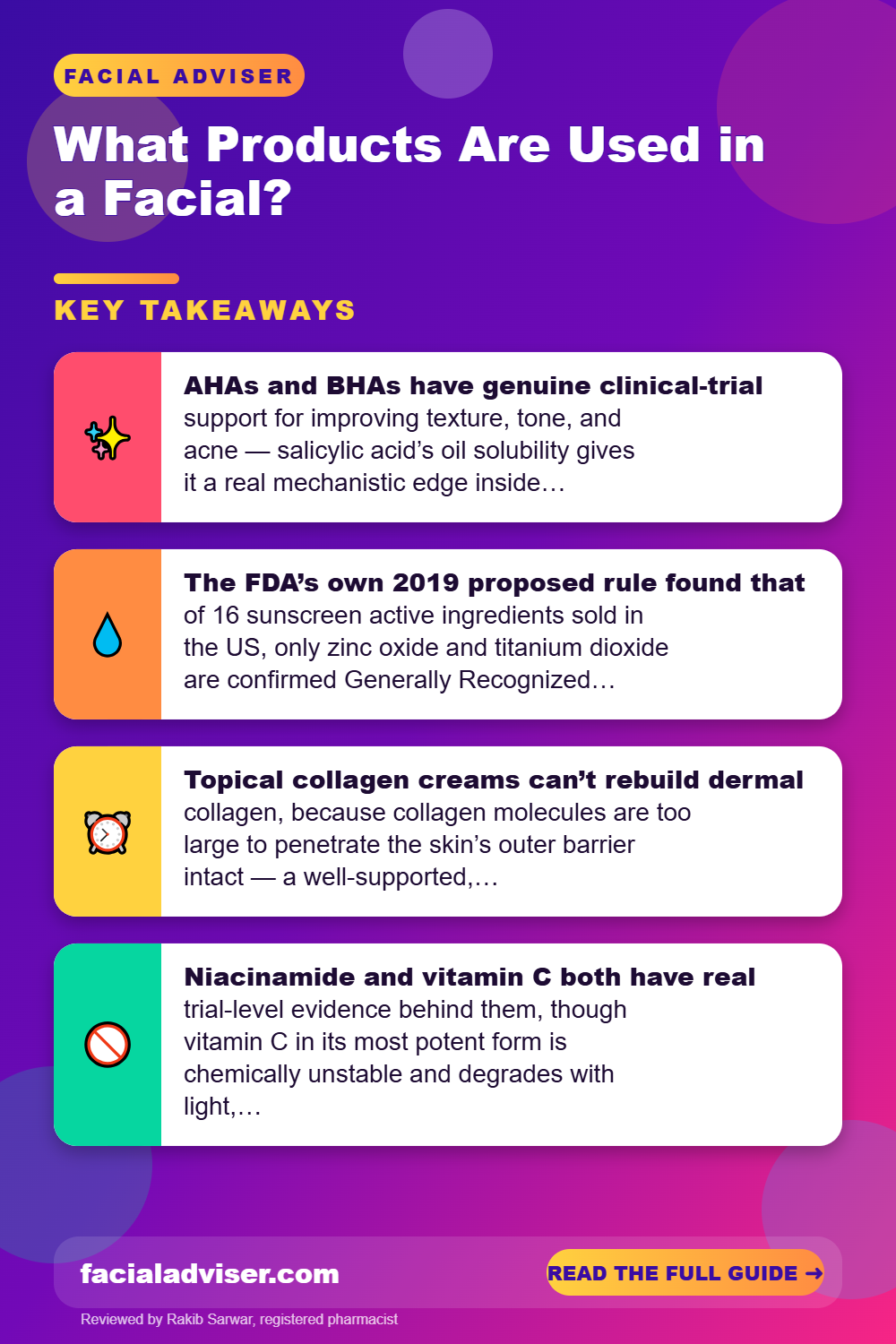
- AHAs and BHAs have genuine clinical-trial support for improving texture, tone, and acne — salicylic acid’s oil solubility gives it a real mechanistic edge inside sebum-filled pores that water-soluble AHAs don’t have.
- The FDA’s own 2019 proposed rule found that of 16 sunscreen active ingredients sold in the US, only zinc oxide and titanium dioxide are confirmed Generally Recognized As Safe and Effective — the other 12 organic filters sit in “insufficient data” status, which is not the same as unsafe.
- Topical collagen creams can’t rebuild dermal collagen, because collagen molecules are too large to penetrate the skin’s outer barrier intact — a well-supported, easily debunked claim, distinct from oral collagen supplements.
- Niacinamide and vitamin C both have real trial-level evidence behind them, though vitamin C in its most potent form is chemically unstable and degrades with light, heat, and air exposure.
Jump To
- Sorting Marketing Claims From Trial-Backed Ingredients
- Cleansers: Matching pH to Skin Type
- AHAs: Glycolic, Lactic, and Citric Acid
- BHA: Why Salicylic Acid Works Differently
- AHA vs. BHA: How They Actually Differ
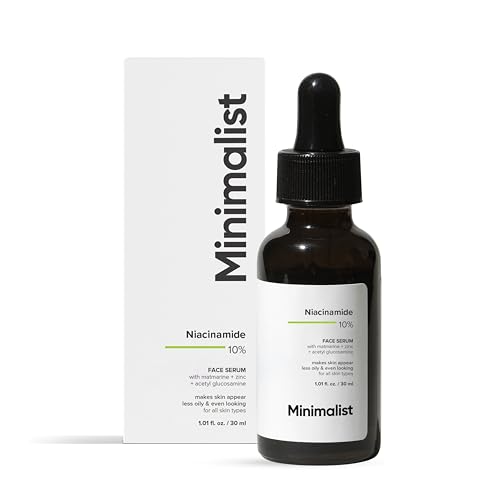
- Niacinamide: A Genuinely Evidence-Backed Ingredient
- Vitamin C: Real Evidence, Real Instability
- The Sunscreen Ingredient the FDA Hasn’t Fully Confirmed
- FDA GRASE Status of Common Sunscreen Filters
- Masks: What Clay and Sheet Masks Actually Do
- The Collagen Cream Myth, and Botanical Extracts
- Do This, Not That
- Reading a Facial’s Product Lineup, Step by Step
- What This Article Can’t Tell You
- Frequently Asked Questions
Sorting Marketing Claims From Trial-Backed Ingredients
Ask what products get used in a facial and most answers list categories — cleanser, exfoliant, mask, serum, moisturizer, sunscreen — without saying which ingredients inside those categories actually have clinical evidence behind them and which are riding on marketing language. Some of what shows up on a facial menu, like AHAs and niacinamide, has real trial-level support. Some, like topical collagen creams, is a well-documented myth. The categories matter less than what’s actually inside them.
Shopping these picks?
Amazon Prime members get fast, free shipping on eligible items, plus Prime Video, Amazon Music and member deals. New members can start with a free trial.
Start a free Prime trialAged 18 to 24? Prime for Young Adults comes with a longer free trial and a lower price after it.
Affiliate link: we may earn a commission at no extra cost to you.
Cleansers: Matching pH to Skin Type
The first product in nearly any facial is a cleanser, and the meaningful distinction isn’t brand or price — it’s whether the formulation is pH-appropriate and non-stripping versus a harsh, alkaline soap-based cleanser. Established dermatology consensus holds that matching a cleanser to skin type and barrier status reduces irritation more reliably than chasing a single “best” active ingredient. A gel cleanser suited to oily skin can be the wrong choice for dry or sensitized skin, regardless of how well it’s marketed.
AHAs: Glycolic, Lactic, and Citric Acid
Alpha-hydroxy acids, including glycolic, lactic, and citric acid, work by stimulating enzymes that break down corneodesmosomes, the structures holding dead skin cells together, which increases desquamation and reveals fresher skin underneath. A 2023 review in the journal Cosmetics cited trials showing increased dermal collagen and improved fine lines from glycolic acid, improved skin roughness from lactic acid, and lightened post-inflammatory hyperpigmentation from citric acid. This is a genuinely evidence-backed category, not just a trend ingredient.
BHA: Why Salicylic Acid Works Differently
Salicylic acid, the main beta-hydroxy acid used in skincare, is lipophilic — it dissolves in oil rather than water. That gives it a real mechanistic advantage: it penetrates sebum-filled pores more effectively than water-soluble AHAs, which is why it shows up so often in formulations targeting acne and congestion specifically. The same review that covered AHA evidence found combined AHA and BHA formulations produced synergistic improvement in acne and texture within as little as 28 days in cited trials.
AHA vs. BHA: How They Actually Differ
| Feature | AHA (glycolic, lactic, citric) | BHA (salicylic acid) |
|---|---|---|
| Solubility | Water-soluble | Oil-soluble (lipophilic) |
| Best suited for | Surface texture, tone, fine lines | Oily, congested, acne-prone pores |
| Mechanism | Degrades corneodesmosomes, increases desquamation | Penetrates sebum to reach inside the pore |
| Combined use | Synergistic improvement reported within 28 days in cited trials | Same combined finding applies |
Niacinamide: A Genuinely Evidence-Backed Ingredient
Niacinamide has moved from trend ingredient to genuinely supported one. A study by Draelos and colleagues found that a niacinamide-containing moisturizer improved skin barrier function and benefited patients with rosacea at a randomized-trial level of evidence. That’s a meaningfully different evidentiary standing than an ingredient that shows up on ingredient lists mostly because it’s popular in marketing copy rather than because trials back its claimed benefit.
Vitamin C: Real Evidence, Real Instability
L-ascorbic acid, the most active form of topical vitamin C, has a dedicated clinical-trial review confirming real evidence for antioxidant benefits and support for collagen synthesis. The honest caveat is stability: L-ascorbic acid is chemically unstable and oxidizes with exposure to light, heat, and air, and a serum that has visibly turned yellow or brown has reduced activity. More stable derivative forms exist, like magnesium ascorbyl phosphate and ascorbyl glucoside, but they generally carry a thinner clinical evidence base than pure L-ascorbic acid — a real stability-versus-potency tradeoff, not a simple upgrade.
The Sunscreen Ingredient the FDA Hasn’t Fully Confirmed
Sunscreen deserves more regulatory precision than it usually gets in facial-product roundups. The FDA’s 2019 proposed sunscreen rule examined 16 UV-filter active ingredients marketed in the United States and determined that only zinc oxide and titanium dioxide are Generally Recognized As Safe and Effective, the FDA’s formal safety-and-efficacy designation. PABA and trolamine salicylate were found not to meet that standard. The remaining 12 organic filters — avobenzone, oxybenzone, octocrylene, homosalate, octisalate, and octinoxate among them — sit in an “insufficient data” status.
FDA GRASE Status of Common Sunscreen Filters
| Filter category | FDA status (2019 proposed rule) | What that means |
|---|---|---|
| Zinc oxide, titanium dioxide | Confirmed GRASE | Formally recognized as safe and effective |
| PABA, trolamine salicylate | Not GRASE | Determined not to meet the safety-and-efficacy standard |
| Avobenzone, oxybenzone, octocrylene, and 9 others | Insufficient data | Not confirmed safe or unsafe — status unresolved |
Masks: What Clay and Sheet Masks Actually Do
Clay masks, made from kaolin or bentonite, have published efficacy and safety data supporting their oil-absorbing and mattifying effect on oily or acne-prone skin — a real, if modest, mechanism. Sheet masks are largely occlusive hydration-delivery vehicles: the plumping and hydration they provide is real but short-lived, coming from the occlusion itself plus whatever humectant serum saturates the sheet, not from a lasting structural change to the skin.
The Collagen Cream Myth, and Botanical Extracts
Topical “collagen” creams are one of the cleanest, most well-supported myths to debunk in skincare. Collagen molecules are simply too large to penetrate the stratum corneum and be absorbed intact in a way that could “rebuild” dermal collagen from the outside. This is distinct from oral hydrolyzed collagen supplementation, a separate modality with its own evidence base — a 2024 randomized trial in Dermatology Research and Practice reported improvements in skin collagen, hydration, elasticity, and wrinkles after 12 weeks of oral supplementation, a genuinely different mechanism from a topical cream.
Chamomile, green tea, and aloe extracts show up constantly on ingredient lists with confident marketing language attached, but the clinical support at the low concentrations typically used in finished multi-ingredient products is generally limited and inconsistent. The same goes for vague “detox” or “lifting and tightening” mask claims, which usually overstate what is really a temporary occlusion or hydration effect rather than a genuine structural change. Both of these deserve a healthy dose of skepticism relative to how confidently they’re marketed on a facial’s product menu.
Do This, Not That
Do
- Ask which active ingredients are in a product before it’s applied, especially exfoliating acids and vitamin C.
- Treat “insufficient data” on a sunscreen filter as unresolved, not automatically unsafe.
- Consider oral collagen supplementation separately from topical collagen creams if that’s the benefit you’re after.
Don’t
- Don’t expect a topical collagen cream to rebuild dermal collagen — the molecules can’t penetrate intact.
- Don’t assume a vitamin C serum that’s turned yellow or brown is still at full potency.
- Don’t take a “detox” or “lifting” mask claim at face value without asking what mechanism is actually behind it.
Reading a Facial’s Product Lineup, Step by Step
Start with the cleanser
Check whether it’s matched to your skin type rather than a one-size-fits-all formula.
Identify any exfoliating acid
Note whether it’s an AHA, a BHA, or both, and whether that suits your skin’s current condition.
Ask about vitamin C freshness
A visibly discolored serum has reduced activity regardless of its original formulation.
Check the sunscreen’s active ingredients
Zinc oxide and titanium dioxide are the only two with confirmed FDA GRASE status.
Weigh mask claims against mechanism
Clay masks have real oil-absorbing evidence; vague “detox” claims usually don’t.
What This Article Can’t Tell You
This guide can’t tell you which specific product line or brand to choose, or how your individual skin will react to a given formulation — that depends on your skin type, sensitivities, and how a product is formulated as a whole, not just its headline ingredient. What it can tell you honestly is which ingredient categories have real trial-level evidence behind them and which claims are overstating what a temporary or cosmetic effect actually delivers.
Frequently Asked Questions
What products are typically used in a facial?
A pH-matched cleanser, possibly an AHA or BHA exfoliant, a mask suited to skin type, and a moisturizer with sunscreen, adjusted to the client’s skin condition that day.
What’s the difference between AHA and BHA?
AHAs are water-soluble and work on surface texture and tone; BHA (salicylic acid) is oil-soluble and penetrates sebum-filled pores more effectively.
Is niacinamide actually backed by evidence?
Yes. A randomized trial found a niacinamide moisturizer improved skin barrier function and benefited rosacea patients, a genuine evidence-supported standing.
Does vitamin C serum expire or lose potency?
Yes. L-ascorbic acid oxidizes with light, heat, and air exposure, and a visibly yellow or brown serum has reduced activity.
Are all sunscreen ingredients FDA-approved as safe?
Only zinc oxide and titanium dioxide have confirmed GRASE status; 12 other common filters sit in an unresolved “insufficient data” category, which isn’t the same as unsafe.
Do topical collagen creams actually work?
No, not by rebuilding dermal collagen — collagen molecules are too large to penetrate the skin’s outer barrier intact.
Does oral collagen supplementation work differently?
Yes. A 2024 randomized trial reported improvements in skin collagen, hydration, elasticity, and wrinkles after 12 weeks of oral supplementation, a separate mechanism from topical creams.
Are clay masks actually effective?
For oil absorption and mattifying oily or acne-prone skin, yes — that specific effect has published supporting data.
Are botanical extracts like green tea or chamomile effective?
Generally limited and inconsistent clinical support at the low concentrations typically used in finished products, despite prominent marketing.
Should I trust a “detox” or “lifting” mask claim?
Be skeptical. Those claims usually overstate what’s really a temporary occlusion or hydration effect rather than a lasting structural change.

Written by
Registered pharmacist and founder of Facial Adviser. Rakib's pharmacy training covers how skincare actives work and interact; a later course in cosmetology turned that into a focus on facial treatments and skincare products. He plans, researches and edits every guide on the site and checks health claims against sources such as the American Academy of Dermatology, the FDA and the NIH. He is not a dermatologist; see the Editorial Policy and Medical Disclaimer.
About · Editorial policy · How we choose products · Medical disclaimer · Contact
Keep reading: Facials: what to expect
- How Often Should You Get a Professional Facial? A Guide by Skin Type and Goal
- Is a Facial Harmful? Real Risks, Who Should Avoid Them and How to Stay Safe
- What Should You Not Do After a Facial? Mistakes That Undo the Results
- How Long Does It Take for Facial Extractions to Heal?
- How Much Does an Extraction Facial Cost?
- How Does an Esthetician Do Extractions?