How to Use Microcurrent Safely at Home: Settings, Gel and Who Should Skip It
Microcurrent devices promise a lifted, more sculpted face from a few minutes of gliding two metal probes over the skin. They are safe for most people, but the current is real, and using one without gel, over the wrong areas or with the wrong health history can leave you with irritation, twitching or worse. A little care turns a gimmick into a sensible habit.
Part of our guide to at-home facial devices. Start with: How to Incorporate Microcurrent Into Your Routine: Gel, Timing and Safety
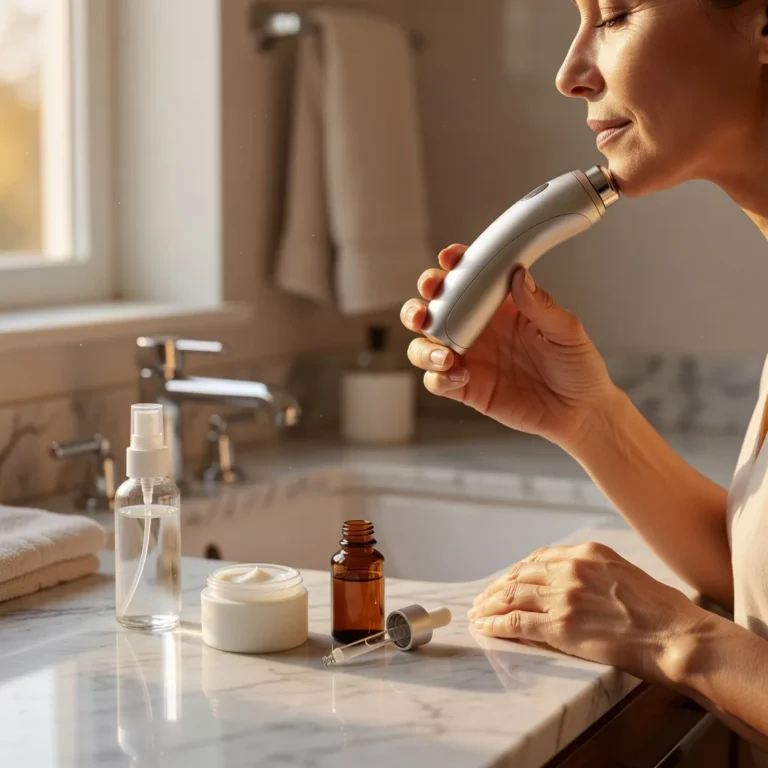
To use microcurrent safely at home, first confirm that you have no contraindication such as a pacemaker or other implanted electronic device, epilepsy, pregnancy or metal implants in the face. Always apply a thick layer of water-based conductive gel so the current spreads evenly instead of concentrating on dry skin, start at the lowest intensity and raise it only until you feel a faint tingle or see a slight muscle response, and keep sessions to about five to fifteen minutes three to five times a week. Glide the probes upward and outward over the cheeks, jaw and brow, avoid the eyes, the thyroid at the front of the neck and any active breakouts, and stop immediately if you feel pain, burning or dizziness.
In short: screen yourself for contraindications, use plenty of gel, keep the intensity low and the sessions short, stay away from the eyes and thyroid, and expect a temporary lift rather than a transformation.
Powered muscle stimulators are regulated as medical devices by the US Food and Drug Administration, which is why reputable microcurrent devices carry warnings about pacemakers, pregnancy and placement; the American Academy of Dermatology also advises treating acne-prone skin gently and avoiding anything that rubs or irritates active spots, which rules out gliding probes over a flare.
This guide covers what microcurrent actually does, who should skip it, the settings and schedule that work, how to clean the device, the signs that mean stop, and how handheld wands compare with microcurrent masks.
Shopping these picks?
Amazon Prime members get fast, free shipping on eligible items, plus Prime Video, Amazon Music and member deals. New members can start with a free trial.
Start a free Prime trialAged 18 to 24? Prime for Young Adults comes with a longer free trial and a lower price after it.
Affiliate link: we may earn a commission at no extra cost to you.
Recommended Microcurrent Devices and Conductive Gels


Quick Answer
- Microcurrent gives a modest, temporary lift by stimulating facial muscles; the evidence is limited.
- Skip it with a pacemaker or implanted electronics, epilepsy, pregnancy or metal implants in the face.
- Conductive gel is essential, not optional, and water-based gels work best.
- Start at the lowest intensity; a faint tingle is enough.
- Five to fifteen minutes, three to five times a week, is a sensible schedule.
- Avoid the eyes, the thyroid, active acne or rosacea flares and fresh injectables.
- Clean the probes after every session and never share a device.
In This Guide
- What Microcurrent Does and Does Not Do
- Who Should Skip Microcurrent and Why
- Why Conductive Gel Is Not Optional
- Intensity, Session Length and Frequency
- Areas to Avoid
- How to Do a Safe At-Home Microcurrent Session
- Handheld Device vs Microcurrent Mask
- Signs That Mean Stop
- Dos and Don’ts
- Honest Limits
- When to See a Dermatologist
- Questions People Ask
- The Takeaway
What Microcurrent Does and Does Not Do
Microcurrent sends a very low-level electrical current through the skin to the muscles underneath. The muscles contract gently, which is why the face can look a little more lifted straight after a session.
- Stimulates facial muscles, giving a short-lived tightening of the jawline, cheeks and brow.
- May reduce puffiness slightly by encouraging fluid movement.
- Can make the skin look brighter for a few hours, likely from increased blood flow.
- Does not remove wrinkles, replace fillers, build collagen in any proven way or change the underlying structure of the face.
- Results fade within a day or two and depend on regular use.
Studies on at-home devices are small, short and often funded by manufacturers, so claims of long-term remodelling should be treated with caution. Our guide to microcurrent facial steps and benefits covers what a professional session involves and how much of that an at-home device can replicate.
Who Should Skip Microcurrent and Why
Because microcurrent is an electrical treatment, the list of people who should avoid it is longer than for a jade roller. These contraindications appear on most device labels.
| Contraindication | Why it matters |
|---|---|
| Pacemaker, defibrillator or any implanted electronic device | Current can interfere with the device’s function |
| Epilepsy or seizure disorder | Electrical stimulation can lower the seizure threshold |
| Pregnancy | Safety has not been established; manufacturers advise against use |
| Metal implants, plates or pins in the face or head | Metal conducts current and can concentrate it unpredictably |
| Active acne or rosacea flare | Gliding probes over inflamed skin spreads bacteria and worsens irritation |
| Recent fillers, Botox or other injectables | Stimulation may move product or affect results; wait about two weeks or as your injector advises |
| Open wounds, sunburn, eczema or dermatitis | Broken or inflamed skin conducts unevenly and stings |
| Heart conditions or a history of stroke | Any electrical treatment near the head and neck should be cleared by a doctor first |
| Cancer treatment or a history of head and neck cancer | Medical clearance needed before stimulating tissue |
If you have any implanted electronic device, epilepsy or a heart condition, do not use a microcurrent device at all without written clearance from your doctor. The current is low, but it is still an electrical signal travelling through the head and neck.
Why Conductive Gel Is Not Optional
Microcurrent cannot pass through dry skin efficiently. Without a conductive medium the current concentrates in small spots and stings. Gel spreads it evenly and lets the probes glide.
- Use a water-based conductive gel, applied thickly enough that the probes slide without drag.
- Aloe-based gels and plain hyaluronic acid gels work if they are water-based and free of oil and silicone.
- Oils, balms, rich moisturisers and silicone primers block the current and should be removed before a session.
- Reapply gel as soon as it starts to dry or the probes begin to tug.
If you feel a sharp prick or see the muscle jump suddenly, the gel has dried or you have hit a patch of bare skin. Stop, reapply and continue at a lower setting.
Intensity, Session Length and Frequency
More is not better with microcurrent. Pushing the intensity up does not deepen the result; it just makes the session unpleasant.
- Intensity: begin on the lowest level. Increase one step at a time until you feel a faint tingle or notice a slight tightening, then stay there.
- Session length: five minutes is enough for beginners; experienced users rarely need more than fifteen.
- Frequency: three to five sessions a week during the first month or two, then two to three to maintain.
- Direction: always lift upward and outward along the muscle, from the centre of the face towards the ears and from the jaw towards the temples.
| Week | Sessions per week | Length | Intensity |
|---|---|---|---|
| 1 | 3 | 5 minutes | Lowest setting |
| 2 | 3 to 4 | 7 to 10 minutes | Low, until a faint tingle |
| 3 to 4 | 4 to 5 | 10 minutes | Low to medium |
| 5 to 8 | 4 to 5 | 10 to 15 minutes | Comfortable medium |
| Maintenance | 2 to 3 | 10 minutes | Comfortable medium |
If the skin looks red for more than a few minutes afterwards, or the muscles feel tired or achy the next day, drop back a level and shorten the session.
Areas to Avoid
Most of the face is safe for microcurrent, but a few zones are not.
- Eyes and eyelids: never run the probes over the eyeball or the thin lid skin; stay on the brow bone and the cheekbone.
- Front of the neck: the thyroid sits here and should not be stimulated. Work on the sides and under the jaw only.
- Lips: the muscle is small and the skin thin; most devices advise skipping the lip itself.
- Active breakouts, cold sores or any broken skin.
- Fresh injectable sites for the period your injector recommends.
Our comparison of facial fillers versus Botox explains how each injectable behaves, which is useful for understanding why stimulation too soon after treatment is a bad idea.
How to Do a Safe At-Home Microcurrent Session
Follow this sequence every time; it prevents nearly every common problem.
Check your contraindications
Confirm that none of the conditions above apply. If anything is uncertain, ask your doctor before the first session.
Cleanse and dry the skin
Remove all makeup, sunscreen, oil and moisturiser. Residue blocks the current and causes uneven stimulation.
Apply a thick layer of conductive gel
Cover the section you are about to treat generously. The probes should glide without any drag.
Start on the lowest intensity
Place both probes on the cheek and raise the level one step at a time until you feel a faint tingle. Stop there.
Glide upward and outward
Work one side at a time: jawline towards the ear, cheek towards the temple, brow upward. Hold each position for a few seconds.
Avoid the no-go zones
Keep clear of the eyes, the front of the neck, lips, active spots and any recent injection sites.
Keep to time
Five to fifteen minutes in total. Set a timer so the session does not drift longer.
Rinse, moisturise and clean the device
Wash the gel off, apply moisturiser and sunscreen, then wipe the probes with a damp cloth or alcohol wipe and let them dry.
Do your session in front of a mirror with your face relaxed. If you can see the muscle lift slightly under the probes, the intensity is right. If your whole cheek twitches, it is too high.
Handheld Device vs Microcurrent Mask
Two formats dominate the at-home market, and they suit different people.
- Handheld wands use two probes you move yourself. They give precise control over where and how long you stimulate, and they are easier to keep away from the eyes and thyroid, but they need attention and gel for the whole session.
- Microcurrent masks hold fixed electrodes against the face, so you can sit back while the device runs. They are convenient but cannot adapt to your face shape, often skip the jawline and neck, and are harder to clean.
- Wands are usually the safer choice for beginners and for anyone with sensitive skin, because you feel and adjust the intensity in real time.
- Masks suit people who already tolerate microcurrent well and want a hands-free routine.
Whichever you choose, cleaning matters. Gel residue and skin oil build up on probes and electrodes and can transfer bacteria to the face. Wipe metal contacts after every use and let them dry fully. Our guide on whether a face massager is good for skin covers hygiene and realistic expectations for powered tools more broadly.
Signs That Mean Stop
Normal microcurrent feels like a faint tingle or nothing at all. Anything beyond that is the device telling you something is wrong.
- Pain, burning or a sharp pricking sensation.
- Strong or uncontrolled muscle twitching.
- Dizziness, light-headedness, headache or nausea.
- A metallic taste or flashes of light, which indicate the current is reaching nerves it should not.
- Redness that lasts more than a few minutes, hives or swelling.
- Any new numbness or tingling that persists after the session.
Stop immediately, rinse off the gel and do not resume that day. If symptoms persist for more than an hour, seek medical advice.
Dos and Don’ts
Helps
- Screen yourself for contraindications first
- Use plenty of water-based conductive gel
- Start low and raise intensity only to a faint tingle
- Keep sessions short and regular
- Clean the probes after every use
Backfires
- Use the device over the eyes, thyroid or active spots
- Apply current over oils, balms or makeup
- Use it within two weeks of fillers or Botox without advice
- Share your device with anyone
- Push through pain, twitching or dizziness
Honest Limits
At-home microcurrent gives a mild, temporary lift that most people can see in a mirror for a few hours after a session. It does not lift sagging skin the way surgery or professional treatments can, it does not fill lines, and there is no strong evidence that it builds collagen or changes the face permanently. Results depend entirely on repeating the sessions, and they fade when you stop.
Home devices are deliberately weaker than clinical machines, which makes them safe to use unsupervised but caps what they can achieve. If you enjoy the routine and like the short-term effect, it is a reasonable addition to skincare; if you are hoping to avoid a procedure, it will not do that.
When to See a Dermatologist
- You are unsure whether a health condition or implant rules microcurrent out.
- You have had fillers, Botox or a procedure recently and want to know when it is safe to resume.
- Redness, swelling, hives or a rash follows a session.
- You have persistent numbness, twitching or headaches after using the device.
- Your real concern is sagging, jowls or deep lines, which may need treatments a home device cannot provide.
This article is for general information and does not replace professional medical advice. Check with a board-certified dermatologist or your doctor before using microcurrent if you have any medical condition, implant or recent cosmetic treatment, and stop at once if you experience pain or unusual symptoms.
Questions People Ask
Is microcurrent safe to use at home?
Yes for most healthy adults, provided you follow the contraindications, use gel and keep the intensity low.
Who should not use microcurrent?
Anyone with a pacemaker or implanted electronics, epilepsy, pregnancy, metal facial implants or an active skin flare.
Do I really need conductive gel?
Yes. Without it the current concentrates on dry skin and stings.
Can I use moisturiser or oil instead of gel?
No. Oils and most creams block the current; use a water-based gel.
How long should a microcurrent session last?
Five to fifteen minutes.
How often should I use microcurrent?
Three to five times a week at first, then two to three to maintain.
Which areas should I avoid?
Eyes, eyelids, the front of the neck over the thyroid, lips, active spots and recent injection sites.
Can I use microcurrent after Botox or fillers?
Wait about two weeks or as long as your injector advises.
What does microcurrent feel like?
A faint tingle or nothing at all; pain or twitching means the setting is too high.
Does at-home microcurrent really work?
It gives a modest, temporary lift with regular use; it does not replace professional treatments.
The Takeaway
Using microcurrent safely comes down to screening yourself for contraindications, using a generous layer of water-based conductive gel, keeping the intensity at a faint tingle and the sessions short, and staying away from the eyes, thyroid and any inflamed or recently injected skin.
Treat it as a routine that gives a mild, temporary lift rather than a cure for sagging, clean the device every time and talk to a dermatologist if you have a medical condition, an implant or any reaction.

Written by
Registered pharmacist and founder of Facial Adviser. Rakib's pharmacy training covers how skincare actives work and interact; a later course in cosmetology turned that into a focus on facial treatments and skincare products. He plans, researches and edits every guide on the site and checks health claims against sources such as the American Academy of Dermatology, the FDA and the NIH. He is not a dermatologist; see the Editorial Policy and Medical Disclaimer.
About · Editorial policy · How we choose products · Medical disclaimer · Contact
Keep reading: Microcurrent and RF devices
- How to Incorporate Microcurrent Into Your Routine: Gel, Timing and Safety
- Best Body Microcurrent Device: Evidence, Safety and How to Choose
- Thermage Treatment: What Actually Happens
- Electric Current Facial: Galvanic vs. Microcurrent
- Radiofrequency Facial: What FDA Clearance Really Means
- 10 Best LED Light Therapy Masks (2026): Clearer Skin, Softer Lines
- 10 Best Products for Women's Facial Hair Removal (2026): Gentle Picks