
Do Collagen Pills Really Work?
Do collagen pills really work, or is the answer more complicated than either side of the debate lets on?
Part of our guide to skincare products. Start with: 10 Best Facial Serums for Aging Skin (2026): Picks by Concern
Two recent meta-analyses looked at overlapping trial pools and reached different conclusions: one found significant benefit, the other found no clinical evidence once industry funding and study quality were factored in. Neither side of that split is wrong exactly — the disagreement itself is the real finding.
A 2024 pilot study did find that a meaningful share of ingested collagen survives digestion as intact peptides, a more nuanced mechanism than the old “it’s just amino acids” dismissal, though that still doesn’t prove those peptides reach skin tissue.
This guide covers both meta-analyses honestly, what the absorption research actually shows, and the supplement-regulation caveat worth knowing before you buy.
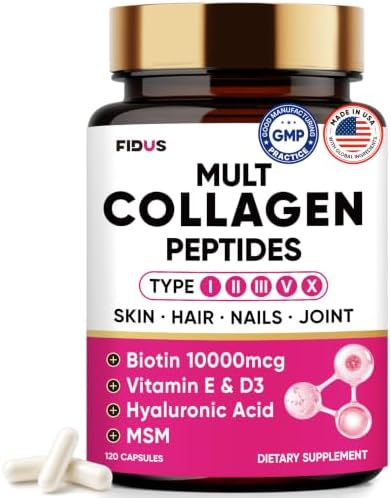
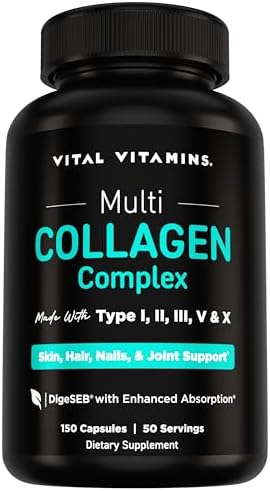
Recommended Hydrolyzed Collagen Supplements




The Short Version
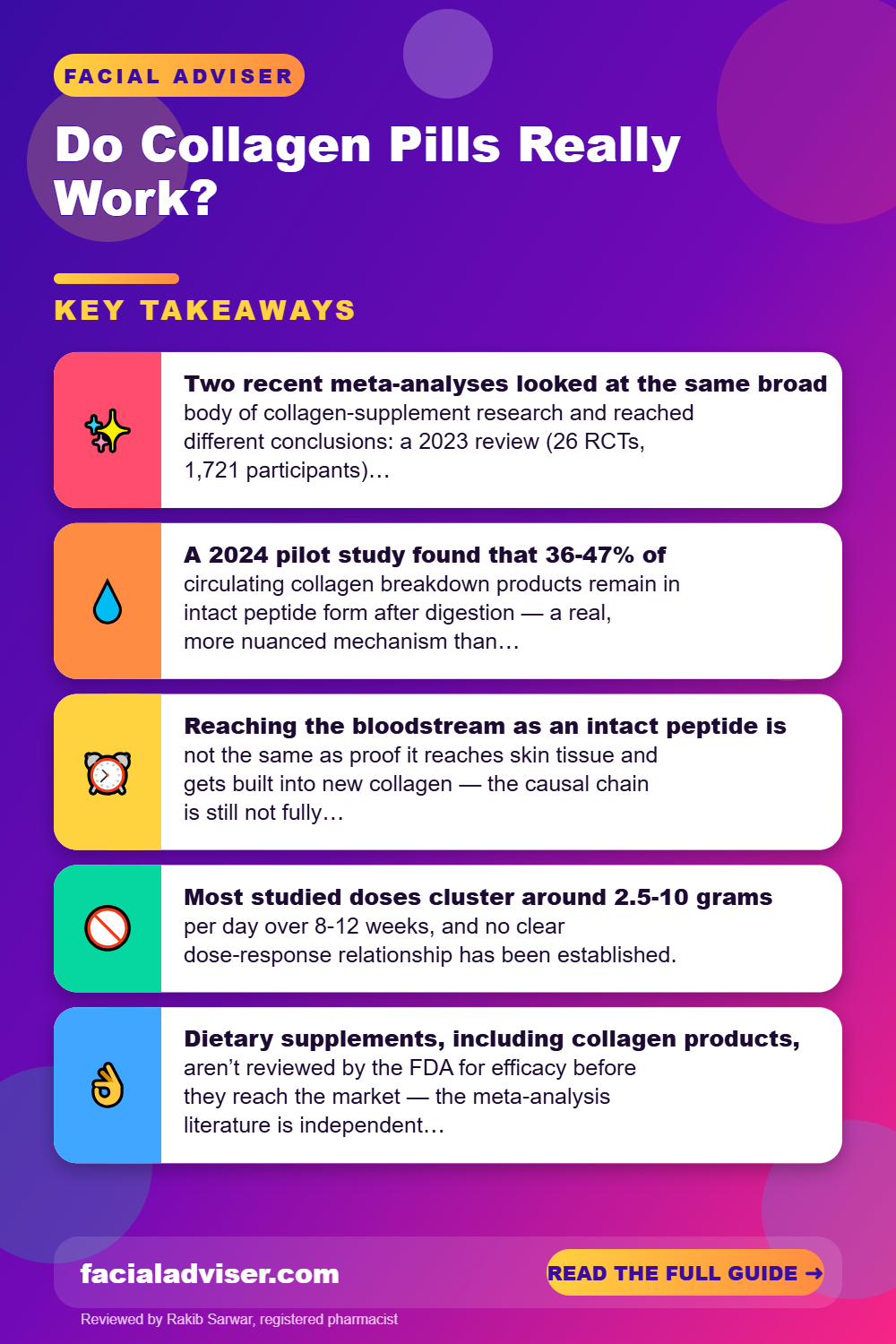
- Two recent meta-analyses looked at the same broad body of collagen-supplement research and reached different conclusions: a 2023 review (26 RCTs, 1,721 participants) found significant benefit for hydration and elasticity, while a 2025 review (23 RCTs, 1,474 participants) found no significant benefit once industry-funded and lower-quality studies were separated out.
- A 2024 pilot study found that 36-47% of circulating collagen breakdown products remain in intact peptide form after digestion — a real, more nuanced mechanism than “it just gets broken into generic amino acids.”
- Reaching the bloodstream as an intact peptide is not the same as proof it reaches skin tissue and gets built into new collagen — the causal chain is still not fully established.
- Most studied doses cluster around 2.5-10 grams per day over 8-12 weeks, and no clear dose-response relationship has been established.
- Dietary supplements, including collagen products, aren’t reviewed by the FDA for efficacy before they reach the market — the meta-analysis literature is independent academic scrutiny happening after these products are already for sale.
Contents at a Glance
- Two Meta-Analyses, Two Different Answers
- What the More Skeptical 2025 Review Found
- A Third Data Point That Doesn’t Resolve It
- What Actually Happens After You Swallow It
- The Gap Between Bloodstream and Skin
- Gelatin vs. Hydrolyzed Collagen vs. Peptides
- Dosage Ranges Actually Studied
- The Supplement-Regulation Caveat
- Comparing the Two Meta-Analyses Side by Side
- If You Want to Try It Anyway
- Do’s and Don’ts
- A Practical Way to Track Whether It’s Working
- What This Research Can’t Prove Either Way
- Frequently Asked Questions
Two Meta-Analyses, Two Different Answers
This site has already covered topical collagen’s molecular-weight problem elsewhere — native collagen is far too large a molecule to cross the skin barrier — and cited a 2023 meta-analysis in Nutrients covering 26 randomized controlled trials and 1,721 participants that found statistically significant benefit from oral collagen peptides for skin hydration and elasticity. That finding is real and worth taking seriously. But it isn’t the whole picture, and a genuinely different, more recent piece of evidence complicates it directly.
Shopping these picks?
Amazon Prime members get fast, free shipping on eligible items, plus Prime Video, Amazon Music and member deals. New members can start with a free trial.
Start a free Prime trialAged 18 to 24? Prime for Young Adults comes with a longer free trial and a lower price after it.
Affiliate link: we may earn a commission at no extra cost to you.
A 2025 systematic review and meta-analysis published in The American Journal of Medicine examined 23 randomized controlled trials covering 1,474 participants on collagen supplements and skin-aging outcomes — a substantially overlapping body of literature with the 2023 review. The pooled result across all 23 trials did show statistically significant improvement. But the more revealing finding came from subgroup analysis: when the researchers separated trials by funding source and methodological quality, the picture flipped. Independently-funded studies showed no significant improvement across any measured outcome, while industry-funded studies showed benefit. High-methodological-quality studies showed no significant benefit, while lower-quality studies drove the positive elasticity findings that dominated the pooled result.
What the More Skeptical 2025 Review Found
This is a genuinely important, underused finding for anyone researching this topic, and the honest way to handle it isn’t to declare one meta-analysis “right” and the other “wrong.” Both drew from a substantially overlapping pool of trials. The difference in conclusion comes down almost entirely to how each review weighted trial quality and funding source — and that difference is itself the real lesson here: collagen supplement research is disproportionately industry-funded, and quality-weighting changes the answer dramatically. A reader deserves to know that distinction exists, rather than being handed one number as settled fact.
A Third Data Point That Doesn’t Resolve It
A third meta-analysis, published in Cureus in 2024 and covering 14 randomized controlled trials with 967 participants, reported positive findings for hydration and elasticity specifically after a 12-week regimen. This doesn’t resolve the disagreement between the 2023 and 2025 reviews above — it adds a third data point to a genuinely split literature rather than breaking the tie in either direction. Three reviews drawing from overlapping trial pools and reaching different emphases is itself informative: this is not settled science, whatever a single supplement bottle’s marketing claims imply.
What Actually Happens After You Swallow It
A common dismissive claim about oral collagen is that it “just gets digested into generic amino acids like any other protein, so it can’t possibly help skin specifically.” A 2024 randomized, double-blind crossover pilot study in Frontiers in Nutrition complicates that dismissal directly. Researchers tracked plasma levels after a single 10-gram oral dose of collagen hydrolysate from four different sources and molecular weights, and found that 36-47% of circulating hydroxyproline — a marker specific to collagen breakdown — remained in peptide-bound form, not broken down into free amino acids. Specific bioactive di- and tripeptide sequences (including Pro-Hyp and Gly-Pro-Hyp) were detected intact in the bloodstream.
This is a real, mechanistically meaningful finding: a substantial fraction of ingested collagen does appear to survive digestion and enter circulation as intact, potentially bioactive peptides, rather than being reduced entirely to generic amino acids the body can’t distinguish from any other protein source.
The Gap Between Bloodstream and Skin
Here’s the necessary honest caveat, though: reaching the bloodstream as an intact peptide is not the same as proof that peptide then reaches skin tissue specifically and gets incorporated into new dermal collagen synthesis. The mechanistic plausibility here is genuinely stronger than the old “it’s just amino acids” dismissal — but it still falls short of proving a complete causal chain from swallowed supplement to visible skin outcome. This is exactly where the 2025 American Journal of Medicine meta-analysis’s null result among high-quality trials becomes relevant: a plausible mechanism existing in the bloodstream doesn’t automatically guarantee a measurable clinical outcome once you control for study quality.
Gelatin vs. Hydrolyzed Collagen vs. Peptides
Marketing terms in this category get blurred more than most people realize. Gelatin is collagen that’s been partially denatured by heat or hydrolysis but still retains large protein chains — it’s what gels when cooled, which is why it’s used in food applications. Hydrolyzed collagen and collagen peptides undergo more extensive enzymatic hydrolysis, breaking the protein down into much smaller peptide chains, often in the 2,000-5,000 dalton range used in the absorption study described above. These smaller peptides dissolve in cold liquid without gelling and are the form used in essentially all modern collagen supplement products, since smaller peptide size is generally associated with better absorption. Gelatin and hydrolyzed collagen come from the same source protein but are processed differently, and supplement labeling sometimes uses the terms loosely enough that a consumer can’t tell which form they’re actually buying without checking closely.
| Form | Processing | Dissolves without gelling? |
|---|---|---|
| Gelatin | Partial denaturation, large protein chains retained | No — gels when cooled |
| Hydrolyzed collagen | Extensive enzymatic hydrolysis | Yes |
| Collagen peptides | Further broken into small peptide chains (2,000-5,000 Da) | Yes |
Comparing the Two Meta-Analyses Side by Side
| Factor | 2023 Nutrients review | 2025 American Journal of Medicine review |
|---|---|---|
| Trials/participants | 26 RCTs, 1,721 participants | 23 RCTs, 1,474 participants |
| Pooled headline result | Significant benefit | Significant benefit (before subgroup weighting) |
| After quality/funding subgroup analysis | Not separately reported this way | No significant benefit in high-quality or independently-funded studies |
| Stated conclusion | Oral collagen supports skin hydration/elasticity | “No clinical evidence to support” use for skin aging |
Dosage Ranges Actually Studied
Across the meta-analyses discussed here, tested doses ranged from as low as 0.6 grams per day (in one chicken-sourced collagen study) up to 12 grams per day, with most studies clustering around 2.5-10 grams per day taken over 8-12 week durations. No clear dose-response relationship has been conclusively established across this literature — higher doses in the reviewed studies didn’t reliably outperform lower ones, which undercuts a common “more is better” marketing framing around higher-dose products.
The Supplement-Regulation Caveat
In the United States, dietary supplements, including oral collagen products, are regulated under the Dietary Supplement Health and Education Act framework. That means they are not reviewed by the FDA for efficacy before reaching market, unlike a prescription drug. A manufacturer can sell a collagen supplement making structure/function claims — “supports skin hydration,” for instance — without submitting clinical trial data to FDA for pre-approval. FDA’s role here is primarily post-market enforcement against false or misleading claims, not a pre-market efficacy review.
This regulatory reality means the entire meta-analysis literature discussed above represents independent academic scrutiny happening after these products are already on shelves, not a pre-market efficacy bar these products had to clear before being sold to you.
If You Want to Try It Anyway
Set a realistic timeline
Studies showing any benefit typically ran 8-12 weeks minimum — expecting visible change sooner isn’t supported by the trial timelines used in this research.Pick a dose within the actually-studied range
2.5-10 grams per day matches most of the trial data; there’s no clear evidence that exceeding this range does more.Choose hydrolyzed collagen or collagen peptides, not plain gelatin
The smaller peptide size used in most supplement research is the form that’s actually been studied for oral use.Track objective measures, not just how your skin “feels”
Photos under consistent lighting, or noting specific changes rather than a general impression, reduces the placebo-expectation effect that’s common with any supplement.Reassess honestly after 12 weeks
If you see no change and the product isn’t causing harm, it’s reasonable to stop rather than assume a longer trial period will eventually show results the studied timelines didn’t.
Do’s and Don’ts
Do
- Understand that both a positive and a null meta-analysis exist on overlapping evidence, not just one settled answer.
- Pick a dose and duration that matches what’s actually been studied (2.5-10g/day, 8-12 weeks).
- Remember that collagen supplements aren’t FDA-reviewed for efficacy before sale.
Don’t
- Assume “26 studies show benefit” settles the question when a more recent, quality-weighted review found no clinical evidence.
- Assume a higher dose than what’s been studied will produce better results — no dose-response relationship has been established.
- Confuse “detected in the bloodstream as a peptide” with “proven to rebuild collagen in your skin.”
A Practical Way to Track Whether It’s Working
There’s no reliable at-home test that proves whether a collagen supplement is measurably improving your skin’s collagen content — that’s a genuine limit of self-monitoring, not something a checklist can substitute for. A reasonable practical approach: take consistent, well-lit photos of the same area before starting and at the 12-week mark, and separately track a specific, measurable factor like how quickly your skin feels dry after washing, rather than relying on a vague overall impression, which is more subject to expectation bias with any supplement.
What This Research Can’t Prove Either Way
This guide can lay out the real, split state of the evidence honestly, but it can’t tell you definitively whether collagen supplements will work for you specifically, because the research itself hasn’t settled that question — reasonable researchers looking at overlapping data have reached different conclusions. It also can’t verify the specific quality or dose accuracy of any individual product you might buy, since supplement manufacturing isn’t held to the same pre-market verification standard as pharmaceuticals.
Frequently Asked Questions
Do collagen pills really work?
The evidence is genuinely split: a 2023 meta-analysis of 26 RCTs found significant benefit for skin hydration and elasticity, while a 2025 meta-analysis of 23 RCTs found no significant benefit once industry-funded and lower-quality studies were separated from independently-funded, higher-quality ones.
Why do two major reviews disagree about collagen supplements?
Both drew from a substantially overlapping pool of trials, but reached different conclusions largely based on how each weighted study quality and funding source — independently-funded and higher-quality studies showed less benefit than industry-funded, lower-quality ones.
Does oral collagen actually get absorbed into the bloodstream?
Yes, at least partially as intact peptides. A 2024 pilot study found 36-47% of circulating collagen breakdown markers remained in peptide-bound form after a single dose, rather than being fully broken down into generic amino acids.
Does reaching the bloodstream as a peptide prove it helps skin?
No. Detecting intact peptides in the bloodstream is a real, mechanistically interesting finding, but it doesn’t prove those peptides reach skin tissue and get incorporated into new collagen — that causal chain isn’t fully established.
What’s the difference between gelatin and hydrolyzed collagen?
Gelatin is partially denatured collagen that still gels when cooled, while hydrolyzed collagen and collagen peptides undergo more extensive enzymatic breakdown into smaller peptide chains that dissolve without gelling — the form used in nearly all modern supplements.
What dose of collagen supplement has actually been studied?
Most research clusters around 2.5-10 grams per day over 8-12 weeks, with no clear evidence that higher doses within or beyond that range produce better results.
Are collagen supplements reviewed by the FDA before they’re sold?
No. Dietary supplements, including collagen products, aren’t reviewed by the FDA for efficacy before reaching market under current US regulation — manufacturers can make structure/function claims without submitting trial data for pre-approval.
How long does it take to see results from collagen supplements, if they work at all?
Studies showing any measurable benefit typically used 8-12 week regimens; there’s no good evidence supporting faster results, and the honest answer is that clinical evidence for whether it works at all remains genuinely split.
Is there a difference between how this post and other posts on this site cover collagen?
Yes — this post focuses specifically on oral collagen supplement evidence and the funding/quality split in the research, distinct from this site’s other posts covering topical collagen’s molecular-weight barrier problem and collagen versus hyaluronic acid’s different mechanisms.
Should I stop taking a collagen supplement if I don’t see results?
If you’ve given it a realistic 12-week trial at a studied dose and see no change, and it isn’t causing harm, it’s reasonable to stop rather than assume a longer period will eventually show the results the studied timelines didn’t.

Written by
Registered pharmacist and founder of Facial Adviser. Rakib's pharmacy training covers how skincare actives work and interact; a later course in cosmetology turned that into a focus on facial treatments and skincare products. He plans, researches and edits every guide on the site and checks health claims against sources such as the American Academy of Dermatology, the FDA and the NIH. He is not a dermatologist; see the Editorial Policy and Medical Disclaimer.
About · Editorial policy · How we choose products · Medical disclaimer · Contact
Keep reading: Serums and actives
- Does Drinking Collagen Help Your Skin?
- At What Age Should You Start Using Anti-Aging Serum? A Decade-by-Decade Guide
- 10 Best Serums for Mature Skin to Reduce Wrinkles (2026): Top Picks
- 10 Best Facial Serums for Aging Skin (2026): Picks by Concern
- Skinimalism Guide: How to Build a Simple Minimal Skincare Routine
- 10 Best Face Masks for Every Skin Type (2026): Clay, Gel and Sheet
- What Does a Facial Toner Do? The Real Answer