10 Best Safety Razors (2026): Closer, Calmer Shaves for Every Level
Safety razors use a single, double-edged blade clamped in a metal head. They have become popular again with people who want less plastic waste and a shave that some find kinder to bump-prone skin than multi-blade cartridges. This list covers 10 options, from mild closed comb razors for beginners to adjustable and open comb designs for thick stubble.
For most people, and especially beginners, the best safety razor is a mild to medium closed comb razor with a solid, well-finished stainless steel or plated brass head, a textured handle of around ten centimetres and a secure three-piece or twist-to-open design. A closed comb, or safety bar, guides shaving cream and skin smoothly and reduces nicks. Open comb and adjustable razors cut more efficiently on thick, long stubble but are less forgiving. Pair the razor with good blades, change them often, and shave with light pressure at a shallow angle. Avoid rough, poorly finished heads, loose blade alignment and very aggressive razors when you are starting out.
In short: start mild with a closed comb, let the weight of the razor do the work, and replace blades regularly.
The American Academy of Dermatology advises shaving in the direction of hair growth, rinsing the blade after each swipe and changing blades after about five to seven shaves to reduce irritation, all of which apply fully to safety razors.
Below you will find the ten picks, how we chose them, how the designs differ, what to avoid and how to shave, clean and store a safety razor.
Shopping these picks?
Amazon Prime members get fast, free shipping on eligible items, plus Prime Video, Amazon Music and member deals. New members can start with a free trial.
Start a free Prime trialAged 18 to 24? Prime for Young Adults comes with a longer free trial and a lower price after it.
Affiliate link: we may earn a commission at no extra cost to you.
As an Amazon Associate we earn from qualifying purchases. This does not change which products we include.


What This Covers
- The 10 Best Safety Razors Right Now
- How We Chose These Products
- Safety Razor Designs Compared
- Three-Piece, Two-Piece or Twist-to-Open?
- Features to Look For
- What to Avoid
- Choosing Blades and Lather for a Safety Razor
- How to Shave With a Safety Razor
- Cleaning, Storage and Blade Disposal
- Safety Razors, Razor Burn and Bumps
- Dos and Don’ts
- Honest Limits
- When to See a Dermatologist
- FAQ
- The Takeaway
What to Know First
- Feather AS-D2 is our top pick for its all-stainless build, weighted handle and simple fixed head.
- Rockwell 6S is the best adjustable pick, letting beginners start mild and step up later.
- Merkur Futur 702 suits experienced shavers who want to change the blade gap with a dial.
- Closed comb razors are the gentlest and best for beginners; open comb suits thick stubble.
- Use almost no pressure and a shallow angle, and shave with the grain on sensitive skin.
- Change blades every few shaves and dispose of them safely in a closed container.
- Dry and store the razor away from steam to prevent rust and bacteria.
The 10 Best Safety Razors Right Now
These ten razors were shortlisted from widely reviewed Amazon listings and ranked by build quality, how forgiving the head is, adjustability and how clearly each listing describes the design. Each pick explains who it suits, its trade-offs and who should skip it.
| # | Product | Best For | Standout Feature | |
|---|---|---|---|---|
| 1 | Feather AS-D2 Stainless Steel Safety Razor | Shavers who want one razor for life | All stainless steel with a weighted handle | View |
| 2 | Rockwell 6S Adjustable Safety Razor (Black) | Beginners who want room to progress | Six settings via swappable base plates | View |
| 3 | Merkur Futur 702 Adjustable Safety Razor | Experienced shavers who like quick tweaks | Dial adjusts blade gap in seconds | View |
| 4 | Merkur Progress 510 Long Handle Adjustable | Large hands and coarse hair | Twist handle to change blade gap | View |
| 5 | Parker Variant Adjustable Safety Razor | Gift buyers and style-conscious shavers | Solid brass with black PVD coating | View |
| 6 | Edwin Jagger Long Handle Safety Razor | First-time safety razor users | Less aggressive closed comb head | View |
| 7 | Muhle R41 Open Comb Safety Razor | Experienced shavers with coarse beards | Open comb head for efficient cutting | View |
| 8 | Muhle R89 Closed Comb Safety Razor | Daily shavers wanting a mild, smooth shave | Classic closed comb with smooth glide | View |
| 9 | Vikings Blade Adjustable Safety Razor | Trying adjustable shaving on a budget | Adjustable head with a carry case | View |
| 10 | Parker 24C Open Comb Safety Razor | Coarse beards on a tighter budget | Chrome open comb head | View |
Feather AS-D2 Stainless Steel Safety Razor

Best for: Shavers who want one razor for life
The Feather AS-D2 earns the top spot because it combines a fully stainless steel build with a weighted handle, so it resists corrosion and lets its own mass do most of the work. That matters more than any other feature with a safety razor, because pressing down is the main cause of nicks and razor burn for people switching from cartridges.
It has a fixed head rather than a dial, which keeps things simple: you learn one angle and one feel. The listing positions it as a closer alternative to multi-blade cartridges and a reusable option that cuts plastic waste. Compared with the adjustable #2 and #3 picks it offers less flexibility, but there are no moving parts to loosen or misalign over time.
- Made entirely from stainless steel
- Weighted handle of about 3.2 ounces for control
- Designed as a closer-shaving alternative to cartridges
- Reusable design aimed at reducing plastic waste
Pros
- Stainless build resists rust and pitting
- Heft reduces the urge to press
- Simple fixed head with nothing to adjust
Cons
- No adjustable settings for very thick stubble
- Heavier than some travellers will want
Skip it if: Skip it if you want to fine-tune aggressiveness; the Rockwell 6S or Merkur Futur suit you better.
Check Price on AmazonRockwell 6S Adjustable Safety Razor (Black)

Best for: Beginners who want room to progress
The Rockwell 6S is the pick for anyone who wants to start gently and gradually move to a more efficient shave without buying a second razor. Its listing describes six shave settings, so you can begin at a mild setting while your angle and pressure improve, then step up for longer stubble or a coarser beard.
It is made from 316L stainless steel and is described as much heavier than cartridge or aluminium razors, which again helps you keep a light touch. Unlike the dial-based #3 and #4 Merkur picks, it changes settings through its plates rather than a mechanism, which suits people who like a solid, simple head but means a few seconds of fiddling to switch.
- 316L stainless steel construction
- Six shave settings for different hair types
- Heavy build so you need little pressure
- Aimed at traditional wet shaving
Pros
- One razor from beginner to experienced
- Corrosion-resistant stainless steel
- Weight encourages good technique
Cons
- Changing settings takes a little longer than turning a dial
- Higher settings are too aggressive for most beginners
Skip it if: Skip it if you never plan to change settings; the Edwin Jagger or Muhle R89 are simpler.
Check Price on AmazonMerkur Futur 702 Adjustable Safety Razor

Best for: Experienced shavers who like quick tweaks
The Merkur Futur 702 suits shavers who want to change how aggressive their razor feels on the fly. Its listing describes an adjustable blade gap that you set with a dial, so you can use a gentler setting on the neck and a more efficient one on the cheeks, or adapt to how many days of growth you have.
Blade changes are straightforward: the snap-on cap lifts away to drop a new blade in. It has a bold, angular look that not everyone likes, and a short handle compared with the #4 Merkur Progress. Because it is adjustable, it is less forgiving than a mild fixed head if you forget to check the setting, so it rewards some existing experience.
- Dial-adjusted blade gap for a custom shave
- Snap-on cap for quick blade changes
- German design built for durability
- Gap can be set to suit hair length
Pros
- Fast, tool-free adjustment
- Easy blade loading
- Suits varied stubble lengths
Cons
- Distinctive, bulky head shape
- Short handle may feel small in large hands
Skip it if: Skip it if you are brand new to safety razors and prefer a mild fixed head like the #6 or #8 picks.
Check Price on AmazonMerkur Progress 510 Long Handle Adjustable

Best for: Large hands and coarse hair
The Merkur Progress 510 pairs an adjustable blade gap with a long handle, which gives more control for people with bigger hands or those who find standard handles cramped. You twist the base of the handle to open or close the gap, so you can keep the razor mild for sensitive areas and open it up for coarse growth.
Its listing pitches it at both sensitive skin and coarse hair, which reflects the flexibility of an adjustable head rather than any special formula. Compared with the Futur, it has a more traditional look and a longer reach, but it is a little more fiddly to fine-tune mid-shave. It is a sound choice for someone who already knows their angle.
- Adjustable blade gap with a long handle
- Twist the handle to control aggressiveness
- Long-running German design
- Designed for sensitive skin or coarse hair
Pros
- Long handle gives extra control
- Adjust without tools
- Traditional, understated look
Cons
- Adjusting mid-shave takes practice
- Longer handle may feel unbalanced to some
Skip it if: Skip it if you have small hands or want a compact travel razor.
Check Price on AmazonParker Variant Adjustable Safety Razor

Best for: Gift buyers and style-conscious shavers
The Parker Variant is an adjustable closed comb razor with a five-level dial, running from mild to more efficient, so beginners and experienced shavers can share the same tool. This edition has a solid brass body with a matte black PVD coating and gold accents, which makes it the most eye-catching razor on the list.
Its listing highlights a two-piece mechanism designed to keep the blade aligned evenly, which is important for a comfortable shave. Functionally it sits close to the #2 Rockwell as a razor you can grow into, but it adjusts with a dial rather than plates. The limited edition finish is mostly cosmetic, so choose it for the adjustability first.
- Five adjustable levels from mild to more efficient
- Solid brass body with matte black PVD coating
- Limited edition black and gold finish
- Two-piece mechanism for even blade alignment
Pros
- Easy dial adjustment
- Closed comb head is forgiving at low settings
- Striking finish makes a good gift
Cons
- Limited edition may be hard to replace
- Coating can show wear over time with heavy use
Skip it if: Skip it if you want a plain, workmanlike razor and do not care about the finish.
Check Price on AmazonEdwin Jagger Long Handle Safety Razor

Best for: First-time safety razor users
The Edwin Jagger is our pick for beginners because its closed comb, chrome plated head is known for a less aggressive feel, which leaves more margin for error while you learn the angle. A fixed, mild head removes the temptation to experiment with settings before your technique is steady and consistent.
This version has a long handle with a textured, barley-pattern finish in blue, and the listing notes that handles come in a range of colours and materials. Compared with the adjustable picks above it offers less flexibility, and it is milder than the #7 Muhle R41. That makes it better for daily shaving and sensitive skin than for clearing several days of thick stubble.
- Closed comb, chrome plated head
- Less aggressive, beginner-friendly design
- Long textured handle in several colours
- Uses standard double edge blades
Pros
- Forgiving for learners
- Comfortable long handle
- Good for daily shaving
Cons
- May need extra passes on long stubble
- Plated head needs drying to keep its finish
Skip it if: Skip it if you have a very coarse beard and shave only every few days; an open comb suits you better.
Check Price on AmazonMuhle R41 Open Comb Safety Razor

Best for: Experienced shavers with coarse beards
The Muhle R41 is the most efficient razor on the list and the one to choose if you have a dense, fast-growing beard or shave only every few days. Its open comb head channels lather and hair to the blade, cutting more in a single pass than a closed comb design.
That efficiency comes at a price in forgiveness. It is not a sensible first razor, and even experienced shavers need a light touch and a shallow angle. The listing itself recommends pulling the skin taut and drawing the blade across at an angle. Compared with the #8 R89 from the same maker, it feels noticeably more aggressive.
- Open tooth comb head for a close shave
- Long-lasting handle in several finishes
- Guidance on stretching skin and holding the blade angle
- Made by an established German maker
Pros
- Clears long, coarse stubble efficiently
- Solid build quality
- Fewer passes needed
Cons
- Unforgiving for beginners
- Higher risk of nicks on the neck and jawline
Skip it if: Skip it if you are new to safety razors or have sensitive, bump-prone skin.
Check Price on AmazonMuhle R89 Closed Comb Safety Razor
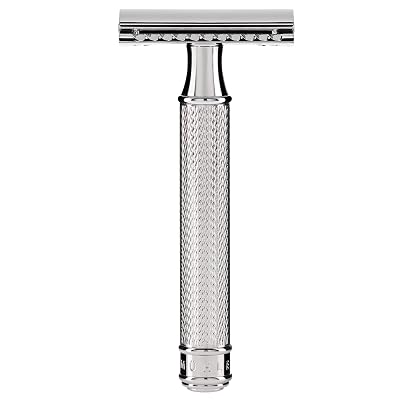
Best for: Daily shavers wanting a mild, smooth shave
The Muhle R89 is a classic closed comb razor that many shavers use as their everyday tool. It sits between the gentle Edwin Jagger and the efficient R41 from the same maker, giving a smooth, predictable shave that works for most beards when done daily or every other day with fresh blades.
The listing notes a range of handle finishes and repeats the same technique advice as the R41: stretch the skin and keep a consistent, shallow angle. It has no adjustment, which keeps it simple and durable. Compared with the #1 Feather it has a lighter, plated build rather than stainless steel, so dry it well after each use.
- Closed tooth comb head
- Handle available in several finishes
- Guidance on skin stretching and blade angle
- Made by an established German maker
Pros
- Mild and predictable
- Suits daily shaving
- Simple three-piece style with no mechanism
Cons
- Less efficient on several days of growth
- Plated finish needs care to avoid wear
Skip it if: Skip it if you want adjustable settings; the Parker Variant or Rockwell 6S are better fits.
Check Price on AmazonVikings Blade Adjustable Safety Razor

Best for: Trying adjustable shaving on a budget
The Vikings Blade adjustable razor is a lower-cost way to try an adjustable safety razor before committing to one of the premium picks. Its title describes an adjustable double edge design supplied with a luxury case, which is handy for travel or storing the razor away from damp bathroom steam between shaves.
Because this listing gives little detail beyond its title, we can say less about its materials and adjustment range than for the Parker or Merkur picks. Treat it as an entry point: if you find you enjoy adjusting your shave, you can upgrade later. As with any adjustable razor, start on the lowest setting and work up slowly.
- Adjustable double edge safety razor
- Comes with a protective case
- Reusable, lower-waste alternative to cartridges
- Uses standard double edge blades
Pros
- Affordable route to an adjustable razor
- Case helps with storage and travel
- Reusable design
Cons
- Listing gives limited build details
- Less proven than the Merkur or Parker adjustables
Skip it if: Skip it if build detail matters to you; the #3 or #5 picks describe their construction more fully.
Check Price on AmazonParker 24C Open Comb Safety Razor

Best for: Coarse beards on a tighter budget
The Parker 24C is a chrome open comb razor that offers a similar style of shave to the #7 Muhle R41 at a gentler cost. Its title describes an open comb head, which moves lather and hair efficiently to the blade, so it suits coarse beards and people who shave less often.
The listing is brief, so we have kept our description to its stated design. Like any open comb, it is less forgiving than closed comb razors, so it is best for shavers who already have a steady angle. If you are unsure whether you want an open comb at all, this is a lower-risk way to find out.
- Open comb head for efficient cutting
- Chrome finish
- Double edge blade design
- Suited to longer or coarser stubble
Pros
- Efficient on thick hair
- Lower-cost entry to open comb shaving
- Classic chrome look
Cons
- Not ideal for beginners
- Listing gives few construction details
Skip it if: Skip it if you are new to wet shaving or prone to razor bumps.
Check Price on AmazonHow We Chose These Products
We shortlisted safety razors from Amazon listings that are highly rated by a large number of shoppers, favouring established brands and fuller-featured models with solid metal builds, clear head designs and, where offered, adjustable settings. We then checked each razor’s listed features against the shaving guidance cited in this post, including the AAD’s advice on shaving direction, blade changes and storage.
These are research-based picks, not hands-on lab tests. We did not shave with each razor ourselves, so the ranking reflects build, design, adjustability and listing detail rather than personal results. Where a listing gave little detail, we say so and describe the razor only from what the seller states.
- Strong ratings from a large number of shoppers
- Established brands and fuller-featured models preferred
- Listed features checked against the cited shaving guidance
- Near-duplicate colour versions removed
- Products with thin or unclear listings excluded or ranked lower
Safety Razor Designs Compared
Safety razors differ mainly in how the head guides the skin and how the blade is loaded. These two factors decide how smooth, efficient and forgiving the shave feels.
| Design | What it means | Feel | Best for |
|---|---|---|---|
| Closed comb (safety bar) | A solid or scalloped bar sits below the blade edge | Mild to medium, smooth and forgiving | Beginners, sensitive skin, daily shavers |
| Open comb | Teeth instead of a bar channel lather and hair to the blade | More efficient, less forgiving | Thick or several days of stubble |
| Adjustable | A dial changes the blade gap | Mild to aggressive in one razor | Experienced shavers who want flexibility |
| Slant bar | The blade is twisted across the head | Slicing, efficient cut | Coarse beards, experienced users |
If you have never used a safety razor, a closed comb head with a mild to medium blade exposure is the safest place to begin. Once your technique is consistent, you can decide whether you want something more efficient. Many experienced shavers still prefer a mild closed comb for daily use, because a gentle razor used every day tends to be more comfortable than an aggressive one used on long stubble, and it is easier on the neck, where skin is thinner and hair often grows in several directions.
Three-Piece, Two-Piece or Twist-to-Open?
How a razor holds the blade affects convenience and durability more than shave quality.
| Loading style | How it works | Pros | Cons |
|---|---|---|---|
| Three-piece | Handle, base plate and top cap screw together | Simple, sturdy, easy to clean thoroughly | Takes a moment longer to change blades |
| Two-piece | Top cap with a threaded post screws into the handle | Fewer loose parts | Slightly more fiddly to clean |
| Twist-to-open (butterfly) | A knob opens doors on the head to drop the blade in | Quick, convenient blade changes | More moving parts that can loosen or misalign over time |
A well-made three-piece razor is often the most durable choice, because there is no mechanism to wear out. Twist-to-open designs are convenient, but check that the doors close evenly so the blade sits straight. Whatever the style, the threads should turn smoothly and the parts should fit together without wobbling, because a loose head changes the blade angle during the shave.
Features to Look For
Beyond the head design, these practical details help a razor feel safe and comfortable.
- Material: stainless steel resists corrosion and lasts; chrome-plated brass is heavy and durable; cheap plated zinc alloy can pit or flake if the plating wears.
- Finish: smooth edges and even plating on the head and cap, with no sharp burrs.
- Blade alignment: the blade edges should sit evenly on both sides once tightened.
- Handle length and grip: around ten centimetres suits most hands; knurling or texture helps when wet.
- Weight: a moderately heavy razor lets the weight do the work so you do not press.
- Balance: a head-heavy or neutral balance feels controlled on the jaw and neck.
Blades vary widely in sharpness and smoothness, and the same blade can feel very different in two razors. Many shavers buy a small sampler pack of blades to find one that suits their skin and razor before buying in bulk.
What to Avoid
Some razors and habits make safety razor shaving more painful than it needs to be.
- Very aggressive open comb, slant or high-setting adjustable razors as a first razor.
- Rough casting marks, sharp edges or uneven plating on the head.
- Razors where the blade sits crooked or loose after tightening.
- Pressing down as you would with a cartridge razor, which causes nicks and burn.
- Using the same blade for weeks, which pulls hair and irritates skin.
- Multiple passes against the grain on sensitive or bump-prone skin.
Safety razors are not ideal for everyone. If you have very curly hair and frequent bumps, even a careful single-blade shave may be too close. Our comparison of facial razors vs normal razors explains the differences between blade types and when a gentler tool makes more sense.
Choosing Blades and Lather for a Safety Razor
Double-edge blades fit almost every standard safety razor, so you are not locked into one maker. That freedom is useful, because blades differ in sharpness, coating and smoothness, and the right one depends on your beard and skin.
- Very sharp blades cut coarse hair easily but can feel harsh on thin or sensitive skin.
- Smoother, slightly less sharp blades are often more comfortable for fine hair and daily shaving.
- Coated blades glide more easily for the first few shaves, then behave like uncoated ones.
- A good lather matters as much as the blade: it should be slick and cushioning, not thin or airy.
- Glycerin-rich shaving soaps and creams tend to give more glide than canned foam.
- Fragrance-free shaving creams are a sensible choice if your skin reacts easily.
Change only one thing at a time, whether it is the blade, the razor or the shaving cream. That way, if your skin reacts or the shave improves, you know what made the difference. Many shavers settle on one blade and one lather they trust and stop experimenting once their skin is consistently calm.
How to Shave With a Safety Razor
The technique is different from a cartridge razor. Go slowly and focus on angle and pressure rather than speed.
Prepare the skin and hair
Shave after a warm shower or wash your face with warm water to soften the hair.
Apply lather
Use a shaving cream, soap or gel and work it into the beard for a minute.
Find the angle
Place the handle flat against your cheek, then lower it until the blade just touches, about 30 degrees.
Use short, light strokes
Let the weight of the razor cut; do not press down.
Shave with the grain first
Follow the direction of hair growth and rinse the razor after each few strokes.
Re-lather for a second pass
If needed, re-lather and shave across the grain, not against it, on sensitive skin.
Rinse and soothe
Rinse with cool water, pat dry and apply a fragrance-free moisturiser or balm.
Stretch the skin gently with your free hand on tricky areas such as the jawline and under the chin. A flat surface helps the blade glide and cuts down on nicks.
Cleaning, Storage and Blade Disposal
A safety razor is easy to keep clean because it comes apart completely. Good care keeps it hygienic and stops the finish from corroding.
- Rinse the head under hot water after each shave to clear soap and hair.
- Once a week, take the razor apart and clean the parts with warm soapy water and an old toothbrush.
- Dry every part with a towel and leave it to air-dry fully.
- Store the razor out of the shower, in a dry, ventilated spot.
- Change the blade every few shaves, or sooner if it tugs.
- Put used blades in a closed metal blade bank or sturdy tin, not loose in the bin.
The American Academy of Dermatology guide on how to shave recommends storing your razor in a dry area and letting it dry completely between shaves to prevent bacteria from growing.
Safety Razors, Razor Burn and Bumps
Many people switch to a single blade hoping for fewer razor bumps. Some find it helps, because a single blade cuts hair at skin level rather than lifting and cutting below it. Others find no difference, because technique and hair type matter more than the number of blades.
If you get small, itchy spots along the jaw after shaving, they may be ingrown hairs, irritated follicles or breakouts. Our guide on tiny pimples on the jawline helps you tell them apart. Leaving a little stubble, shaving with the grain only and shaving less often all reduce the risk.
Do not shave over raised moles, open spots, cold sores or infected bumps. Keep blades away from children, never share a razor, and see a doctor if a cut keeps bleeding or a bump becomes painful, hot or filled with pus.
Dos and Don’ts
Good Habits
- Start with a mild closed comb razor
- Use a rich lather
- Keep the angle shallow and the pressure light
- Change blades every few shaves
- Dry and store the razor away from steam
Common Mistakes
- Press the razor into your skin
- Shave against the grain on sensitive skin
- Use a dull or rusty blade
- Throw loose blades in the bin
- Share your razor with anyone
Most people find the first two or three weeks the hardest, and nicks become rare once the angle and pressure feel natural. If you are also weighing up other hair removal methods, our guide on waxing vs shaving facial hair compares the options.
Honest Limits
A safety razor will not magically eliminate razor burn or bumps. It can give a close, comfortable shave for many people, but only with careful technique, and there is a learning curve with a real chance of nicks at first.
Claims that one razor is universally the best ignore how different faces, beards and skin are. Aggressiveness, weight and blade choice are personal, and the best combination is usually found by trying a mild razor and a few blades. The long-term savings on replacement blades are real, but the environmental benefit depends on recycling or safely disposing of the used blades.
When to See a Dermatologist
- Razor bumps or ingrown hairs keep returning despite good technique.
- Bumps leave dark marks, scars or hard lumps.
- Shaving causes a rash that lasts for days.
- A spot or mole in the shaving area changes, bleeds or does not heal.
This article is for general information and does not replace professional medical advice. See a board-certified dermatologist for persistent razor bumps, infections or any changing spot on your skin.
FAQ
What is the best safety razor for beginners?
A mild closed comb razor such as the Edwin Jagger or Muhle R89, or the Rockwell 6S on a low setting.
Is a safety razor better for razor bumps?
Some people find it helps, but technique matters more.
What angle should I hold a safety razor?
Roughly 30 degrees, with the blade just touching the skin.
How often should I change a safety razor blade?
Every few shaves, or when it starts tugging.
Open comb or closed comb?
Closed comb is gentler; open comb suits thick stubble.
Can women use safety razors?
Yes, for legs, underarms and other areas.
Why am I getting nicks with a safety razor?
Usually too much pressure or too steep an angle.
Is the most expensive safety razor worth it?
Only if you value a stainless build or adjustability, as with the Feather AS-D2 or Rockwell 6S. Technique matters more than price.
How do I dispose of used blades?
Store them in a closed blade bank or tin before disposal.
Which safety razor is best for a thick beard?
An open comb razor like the Muhle R41 or Parker 24C, or an adjustable one opened up, such as the Merkur Futur.
The Takeaway
The best safety razor for most people is a well-made razor with good blade alignment and a comfortable handle, such as the Feather AS-D2, or a mild closed comb like the Edwin Jagger if you are just starting.
Shave slowly with light pressure, change blades often, dry the razor after use and give your technique a few weeks to settle.
Our top pick: Feather AS-D2 Stainless Steel Safety Razor
The Feather AS-D2 takes the top spot because its all-stainless build, weighted handle and fixed, well-regarded head give a smooth, consistent shave that suits both careful beginners and experienced shavers for years. Choose the Rockwell 6S instead if you want to grow into a more efficient shave with swappable settings, or the Edwin Jagger if you want a gentle, classic closed comb razor with less outlay.
Check Price on Amazon
Written by
Registered pharmacist and founder of Facial Adviser. Rakib's pharmacy training covers how skincare actives work and interact; a later course in cosmetology turned that into a focus on facial treatments and skincare products. He plans, researches and edits every guide on the site and checks health claims against sources such as the American Academy of Dermatology, the FDA and the NIH. He is not a dermatologist; see the Editorial Policy and Medical Disclaimer.
About · Editorial policy · How we choose products · Medical disclaimer · Contact
Keep reading: Shaving and razors
- 10 Best Rotary Shavers (2026): Closer Shaves on Curves and Neck
- 10 Best Pre-Shave Oils (2026): Smoother Glide, Less Razor Irritation
- 10 Best Aftershave Balms (2026): Alcohol-Free Relief for Razor Burn
- BaBylissPRO Barberology GoldFX Double Foil Shaver (FXFS2G): Pros and Cons
- The Art of Shaving After-Shave Balm for Men: Soothing and Moisturising?
- 10 Best Hair Dryers (2026): Faster Drying With Less Heat Damage
- 10 Best Beard Trimmers (2026): Even Lengths, Clean Edges